
Weight Gain Meal Plan UK: 7 Days With the Calories Counted
Written by James, founder of Flaming Phoenix and the maker of Phoenix Bars. Updated October 2026.
This is a 7-day weight gain meal plan built from ordinary UK supermarket food, with the calories counted for every meal. Each day comes to about 2,500 kcal from three meals and two snacks, about 2,800 with the evening extra, and about 3,300 with one booster. The NHS suggests adults gain weight gradually by adding around 300 to 500 extra calories a day, so pick the level that sits that far above what you eat now.
Pick your level
Level 1 is the three meals and two snacks as written, about 2,500 kcal a day. Level 2 adds the evening extra, about 2,800. Level 3 adds one booster of 500 to 600 kcal, about 3,300.
If you do not know what you eat now, the weight gain calculator gives you a starting figure in metric. As a rule of thumb, 300 to 500 extra calories a day adds roughly a quarter to half a kilo a week. Weigh yourself once a week, on the same day and at the same time. If nothing has moved after two weeks, go up one level.
The calorie figures are approximate. They use standard UK food composition values and typical pack labels, so your brands will differ a little.
The 7 days
Monday. Breakfast: porridge made with 50g oats and 300ml whole milk, a tablespoon of peanut butter and a banana (580). Mid-morning: 250ml whole milk and 30g mixed nuts (350). Lunch: cheddar sandwich on two thick slices of wholemeal with butter and 40g cheese, an apple and a small bag of crisps (640). Afternoon: 150g full-fat Greek yoghurt with a tablespoon of honey (210). Dinner: 75g dry pasta with two tablespoons of pesto, a tablespoon of olive oil, 100g cooked chicken and parmesan (740). Day total: about 2,520. Evening extra: two buttered crumpets (270).
Tuesday. Breakfast: three eggs scrambled in butter on two slices of buttered toast (560). Mid-morning: a banana with two tablespoons of peanut butter (285). Lunch: large jacket potato with butter, half a tin of baked beans and 30g cheddar (590). Afternoon: a 65g flapjack (290). Dinner: 150g cooked chicken thigh in half a jar of korma sauce with 75g dry rice (830). Day total: about 2,560. Evening extra: hot chocolate made with 250ml whole milk (235).
Wednesday. Breakfast: 50g granola, 150g Greek yoghurt, a banana and honey (545). Mid-morning: two slices of toast with two tablespoons of peanut butter (365). Lunch: a wrap with 50g hummus, half an avocado and 100g cooked chicken (620). Afternoon: 250ml whole milk and three Medjool dates (365). Dinner: a 120g salmon fillet, 200g new potatoes with butter, and green veg with a tablespoon of olive oil (635). Day total: about 2,530. Evening extra: half a tin of rice pudding with honey (250).
Thursday, the out-all-day version. Breakfast: porridge with 50g oats, 300ml whole milk, 30g nuts and honey (635). Mid-morning: a banana and a 250ml carton of whole milk (265). Lunch: a Phoenix Bar and an apple, no fridge or prep needed (about 590, as bars run from 527 to 557). Afternoon: an apple with two tablespoons of peanut butter (235). Dinner: three sausages, 250g buttery mash, peas and gravy (770). Day total: about 2,490. Evening extra: a pot of custard and a banana (250).
Friday. Breakfast: two thick slices of toast with two tablespoons of peanut butter and a banana (505). Mid-morning: a blended shake of 300ml whole milk, a banana and 50g oats (485). Lunch: a pitta with 50g hummus, a tin of tuna and a tablespoon of mayonnaise (525). Afternoon: 30g nuts and 20g dark chocolate (300). Dinner: five fish fingers, 150g oven chips, peas and a tablespoon of mayonnaise (700). Day total: about 2,515. Evening extra: two oatcakes with 30g cheddar (215).
Saturday. Breakfast: two fried eggs, two thick slices of buttered toast and half a tin of beans (685). Mid-morning: hot chocolate made with 250ml whole milk (235). Lunch: 75g dry pasta with pesto and 30g cheddar (530). Afternoon: a 65g flapjack (290). Dinner: spaghetti bolognese with 100g dry pasta, a portion of mince and tomato sauce, parmesan and a tablespoon of olive oil (795). Day total: about 2,540. Evening extra: Greek yoghurt with honey (210).
Sunday. Breakfast: porridge with 50g oats, 300ml whole milk, a tablespoon of peanut butter and honey (540). Mid-morning: two crumpets with plenty of butter (340). Lunch: 150g roast chicken thigh, 200g potatoes cooked in a tablespoon of oil, buttered veg and gravy (670). Afternoon: 250ml whole milk and 30g nuts (350). Dinner: a two-egg cheese omelette cooked in butter with two thick slices of buttered toast (650). Day total: about 2,550. Evening extra: half a tin of rice pudding and a banana (285).
Boosters for level 3
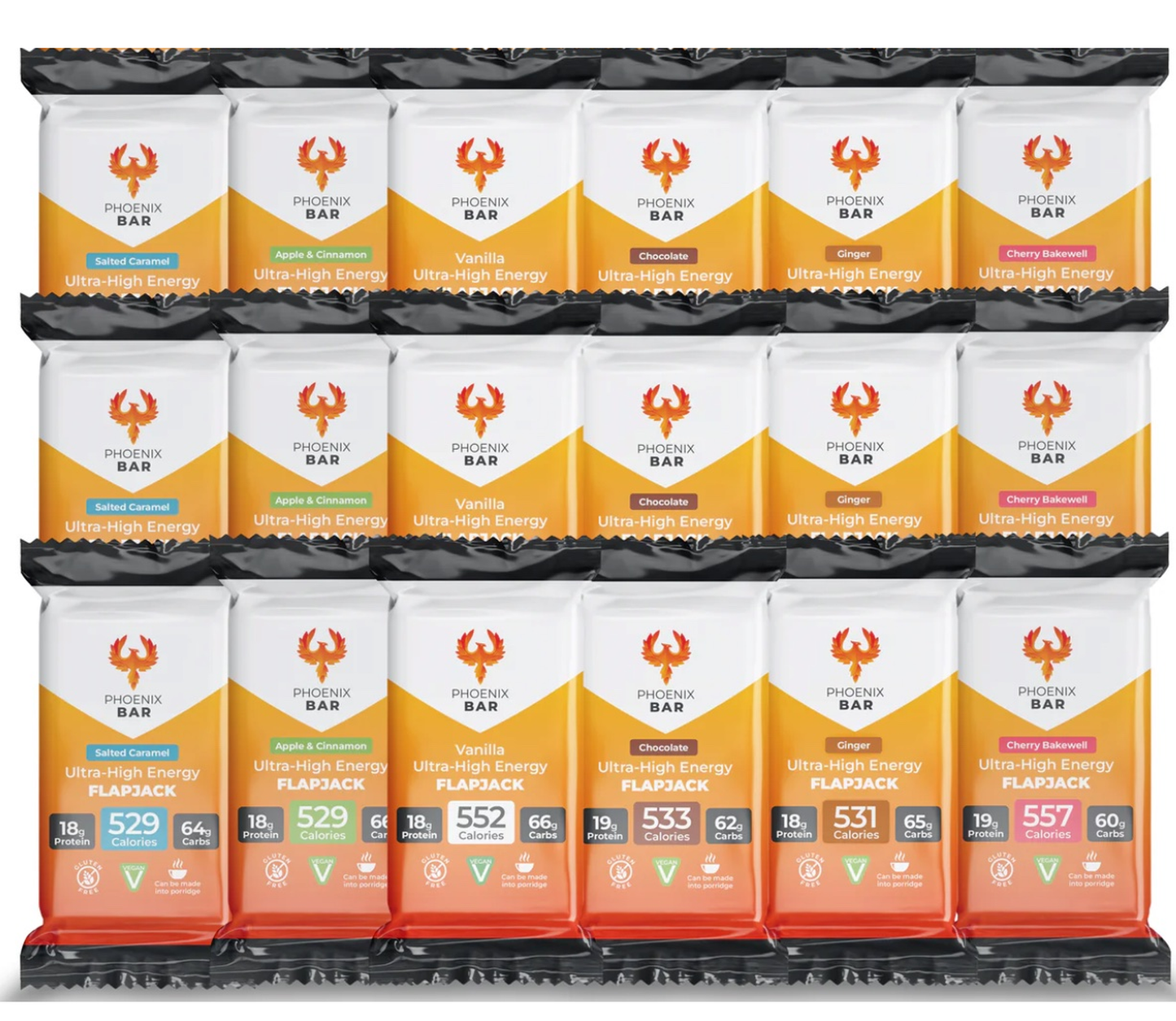
Add one of these a day. A shake of 300ml whole milk, a banana, two tablespoons of peanut butter and 30g oats is about 595 kcal. A Phoenix Bar is 527 to 557 kcal with no preparation. A cheese and peanut butter toastie made with thick bread comes in at around 550. For more ideas, see high calorie drinks and smoothies and high calorie snacks ranked by calories per gram.

Phoenix Bars: Up to 557 Calories Per Bar
Highly compact, low-volume, calorie-dense bars. Soft, easy to eat whole or as a warm porridge. Vegan, gluten-free and contain up to 66g of carbohydrates, 19g of protein & 8 vitamins & minerals.
If your appetite is small
Do not try to eat bigger plates. Make the same plates carry more.
- A tablespoon of olive oil stirred into pasta, soup or mash adds about 120 kcal.
- A tablespoon of peanut butter adds about 90.
- 30g of grated cheddar adds about 125.
- Swapping semi-skimmed for whole milk adds about 50 per 300ml.
Split the day into six small sittings, and have drinks between meals instead of just before them, as the NHS advises. There is no need to finish everything. Something small and dense counts.
Customers who struggle with volume say the same thing about our bars. “The bars were a good way to get the calories in even when I was not hungry,” wrote Tom R. in May 2026. “They were easy to eat without making me feel too full,” wrote Loretta in August 2026. For more on this, see high calorie low volume foods and what to eat when your appetite is low.
When you cannot face a meal
Swap the meal for one of these and move on. There is no need to make it up later.
- The 595 kcal shake above, sipped over an hour.
- Half a Phoenix Bar now and half later, about 265 to 280 kcal each.
- A Phoenix Bar stirred into hot milk as porridge.
- 250ml whole milk and a handful of nuts, about 350 kcal.
“I also enjoy the bars post run with a cup of tea, when you can’t quite face/access a meal,” wrote Sabrina A. in January 2026. If you are on the road, Simon A., a lorry driver, put it this way in May 2026: “They also help me stop buying service station food.” You can see the full range of high calorie bars for weight gain on the homepage.
Vegan and gluten-free swaps
For a vegan week, use fortified soya milk and soya yoghurt, swap cheese for hummus or extra nut butter, and swap meat and fish for tofu, beans or lentils. Soya milk has about 40 kcal per 100ml against 66 for whole milk, so add a tablespoon of oil or nut butter to keep the totals. Check pesto, crumpets and custard labels. The high calorie vegan foods ranking and the best vegan mass gainer comparison go further.
For a gluten-free week, use gluten-free oats, bread, pasta and crumpets, and check sausages, fish fingers and gravy. See high calorie gluten free foods.
Shopping list for the week
Oats, granola, wholemeal bread, crumpets, pittas, wraps, oatcakes, pasta, rice, potatoes, oven chips. Whole milk (about three litres), full-fat Greek yoghurt, cheddar, parmesan, butter, a dozen eggs. Chicken breast and thighs, sausages, mince, salmon, fish fingers, tinned tuna. Peanut butter, mixed nuts, hummus, pesto, olive oil, mayonnaise, korma sauce, honey. Bananas, apples, an avocado, Medjool dates, green veg, peas, baked beans. Flapjacks, dark chocolate, crisps, rice pudding, custard, hot chocolate. For the cheapest way to fill the list, see cheap high calorie foods ranked by pence per calorie.
When to get advice first
The NHS says to speak to a GP if you have lost weight suddenly, if you have lost weight without changing how you eat or exercise, or if controlling food is a way of coping with how you feel. A meal plan is not the right first step in any of those situations.
Common questions
How many calories should I eat to gain weight? Around 300 to 500 more than you eat now, according to the NHS. The page on how many calories to gain weight shows how to work out your own figure.
What if I need more than this plan? If your target is fixed at a higher number, the 3,000 calorie meal plan and the 5,000 calorie meal plan are built around those totals.
Do I have to follow the days in order? No. Each day stands alone at about the same total, so repeat the days you like and skip the ones you do not.
Sources: NHS, healthy ways to gain weight. British Dietetic Association, malnutrition food fact sheet.


Flaming Phoenix



Contact Us
Declare withdrawal
Please fill out the following form to declare your withdrawal from the contract.

