
Meal Replacement Bars UK: Which Type Is Best?
By James Frost, founder of Flaming Phoenix and the maker of Phoenix Bars. I've shipped more than 20,000 high-calorie bars to customers in 19 countries and hand-pack every order from home in Surrey. Updated August 2026.
Two completely different products share the name "meal replacement bar" in the UK, and picking the wrong one wastes your money. UK law defines only one version: bars sold for weight control must contain 200 to 250 calories. Everything else, including the 500-plus calorie bars built for mountains and big appetites, uses the name informally. Same phrase, opposite job. This guide names real bars in every category, with honest numbers, including three types I don't sell and one situation where you shouldn't buy mine.
Which type do you actually need?
Trying to manage your weight: stay in the regulated 200 to 250 calorie section below, and involve your GP or a dietitian before replacing meals regularly. Busy days when cooking won't happen: the balanced complete-nutrition options, and if your busy days are actually busy nights, my night shift eating guide covers that schedule properly. Hiking, camping, ultras or expeditions: calorie density wins, because every gram in your pack must earn its place; my highest calorie foods guide explains the principle, the wild camping food guide applies it to a night on the hill, and the full ultra endurance and expedition nutrition guide goes deep on multi-day efforts. Smaller appetite, or eating enough feels like a chore: a dense bar eaten slowly, or made into warm porridge, can be a gentler way to get energy in than facing a full plate; my soft, easy-to-eat foods guide collects more low-effort options, and if your appetite has dipped lately, what to eat when your appetite is low is the kinder place to start.
The five types at a glance
Weight-control bars are 200 to 250 calories by law and built to restrict. Complete-nutrition bars run 200 to 400 calories and suit busy desk days. Protein bars are snacks wearing meal costumes. High-calorie fuel bars run 550 calories and up and replace a meal's actual energy. Supermarket flapjacks are the £1 benchmark that keeps everyone honest.
Regulated weight-control bars (200 to 250 kcal)
The only legally defined type, carrying the sales name "meal replacement for weight control": capped calories, protein at 25 to 50 percent of energy, and a third of your reference vitamins and minerals per bar. The recognisable examples are SlimFast meal replacement bars, around 210 to 220 calories with 23 vitamins and minerals, and Nupo One Meal bars at roughly 200 calories, both built for structured weight-loss plans. They do their regulated job well. What they cannot do is fuel a mountain day, and eating four of them to try costs more than a proper meal. If weight management is the goal, pair them with advice from a GP or registered dietitian rather than a search results page.
Complete-nutrition bars (roughly 200 to 400 kcal)
The desk-lunch category: balanced macros and a wide micronutrient spread, built for convenience in ordinary daily life rather than weight loss or endurance. The best-known example is the Huel Complete Nutrition Bar at around 200 calories, plant-based with added vitamins and minerals. Good products, honestly useful, and the closest thing to a general-purpose small meal in bar form. The same brands usually sell shakes that solve the same problem in liquid form; my guide to high calorie drinks, smoothies and milkshakes covers the higher-energy end of that world. The limitation is arithmetic: replacing the energy of one real meal takes two or three of these bars, at which point the per-meal price stops being convenient.
Protein bars and mass-gainer bars (roughly 150 to 400 kcal)
Protein bars are not meal replacements at all, though they dominate these search results. They optimise one nutrient at snack-sized calories and skip the micronutrients and energy a meal provides. Protein matters enormously if you're trying to gain weight, but grams of protein alone don't make a meal. Excellent between meals, misleading instead of them. If a wrapper leads with protein content rather than the word meal, this is what you're holding. One cousin worth knowing: mass-gainer bars from bodybuilding brands push 300 to 400 calories with big sugar numbers, closer to a meal in energy, built for the gym rather than the hill.
High-calorie fuel bars (550 kcal and up): the type I make
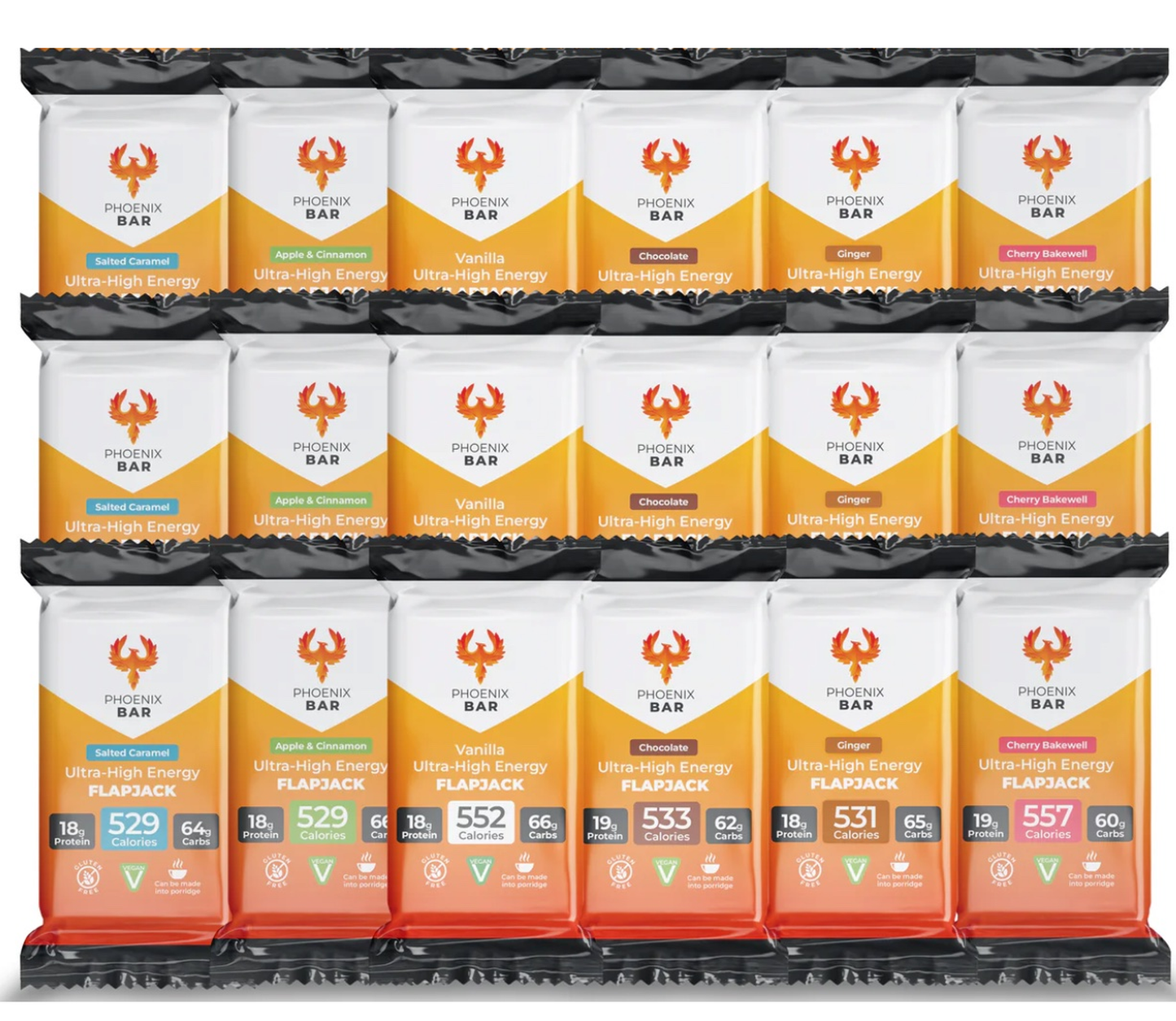
The unregulated, opposite end of the category: bars carrying the full energy of a cooked meal, for people whose problem is getting enough in rather than keeping it out. A Phoenix Bar is 120g and up to 557 calories, vegan, gluten free, six flavours, with a shelf life of up to two years that also makes it a sensible emergency cupboard food. And it does something no other format on this page does: crumbled into hot water or milk it becomes a proper bowl of high-calorie porridge, so one bar covers a hill breakfast and pocket fuel. At £5.25 a bar that's roughly 106 calories per pound spent, better value in bundles, and it's rated 5.0 from more than 370 verified reviews by hillwalkers, ultrarunners and people who simply find eating enough hard work.
The other UK name in this lane is Real Meal, whose bar carries 600-plus calories. How every UK bar actually stacks up is its own page: I've ranked the highest calorie bars in the UK, per gram and per bar.
Don't buy mine for a diet plan. High-calorie bars exist for the days when the calories are the point.

Phoenix Bars: Up to 557 Calories Per Bar
Highly compact, low-volume, calorie-dense bars. Soft, easy to eat whole or as a warm porridge. Vegan, gluten-free and contain up to 66g of carbohydrates, 19g of protein & 8 vitamins & minerals.
Meal replacement bars for weight gain
If the goal is gaining weight rather than losing it, the regulated 200 to 250 calorie bars are the wrong tool by design: they exist to cap energy, not deliver it. What works is the opposite spec, meal-level calories in a volume a smaller appetite can actually manage. That's a 550-plus calorie fuel bar eaten slowly through the morning, or made into porridge as a quick high-calorie breakfast, with a mass-gainer bar as the gym-focused alternative if the sugar suits you. One dense bar in place of a meal you'd otherwise skip beats a perfect meal that never gets eaten.
The budget benchmark: a supermarket flapjack
Around 480 calories per 100g for about a pound, and every premium bar on this page, mine included, has to justify itself against it. The flapjack's weaknesses are the justification: sugar-heavy, almost no protein, melts in a warm pack, lasts days not years, and sits badly on a moving stomach, the same reason many runners go hunting for gentler alternatives to energy gels. What you pay a purpose-built bar for is the nutrition profile, the shelf life and the digestibility over long efforts.
What legally counts as a meal replacement bar in the UK?
Under retained EU law, Commission Regulation 2016/1413, any bar claiming to help weight loss or maintenance by substituting meals must contain 200 to 250 calories per portion, with less than 30 percent of energy from fat, 25 to 50 percent from protein, and at least 30 percent of your reference intake of listed vitamins and minerals. Those products carry the legal name "meal replacement for weight control". Everything above that calorie line, however meal-like, sits outside the regulation and uses the phrase informally.
FAQs
How many calories should a meal replacement bar have? If it's sold for weight control, UK rules require 200 to 250 calories per bar. If it's replacing a meal's actual energy, aim for what a meal contains: 500 to 700 calories. The right number depends entirely on whether you're restricting energy or getting enough of it.
Are meal replacement bars good for losing weight? Bars meeting the regulated composition can legally claim that substituting one or two daily meals contributes to weight loss or maintenance. High-calorie bars like mine are designed for the opposite situation. For a weight-loss plan, speak to a GP or dietitian first.
What are the best meal replacement bars for weight gain? The ones that carry a meal's real energy in a small volume: 550-plus calorie fuel bars, with mass-gainer bars as the gym alternative. Regulated diet bars are the wrong tool, because their calorie cap is the point of them.
What's the difference between a protein bar and a meal replacement bar? Protein bars optimise one nutrient at snack-sized calories. Meal replacement bars aim to cover a meal, either its regulated 200 to 250 calorie weight-control form or its full 500-plus calorie energy form.
What's the highest calorie meal replacement bar in the UK? The densest UK bars are the outdoor fuel type, running from around 550 calories upward. Phoenix Bars reach 557 calories per 120g bar across six flavours, and can be eaten whole or made into porridge, which puts them among the most calorie-dense bars sold in the UK.
Can you eat meal replacement bars every day? Regulated weight-control bars are designed for daily meal substitution within their instructions. Dense fuel bars are best treated as real food for demanding days or a reliable extra meal when time or appetite is short, alongside a varied diet.
SlimFast, Nupo, Huel and Real Meal are trademarks of their respective owners. Figures for their products come from public product information at the time of writing. Flaming Phoenix has no affiliation with any of them.


Flaming Phoenix



Contact Us
Declare withdrawal
Please fill out the following form to declare your withdrawal from the contract.

