

Everest Base Camp Nutrition: Fuelling 12 Days at Altitude
In this guide

The Everest Base Camp trek is not a climb, and its nutritional challenges are not the ones most people prepare for. You will have three hot meals a day in tea houses. You will not be carrying food for meals, only snacks for the trail. The problems that catch trekkers out are smaller: tea house menus that blur into sameness by day five, the 3-4 hour walking gaps where nothing is available, the appetite drop that starts above Dingboche and catches most trekkers off guard, and the cold 4am summit push to Kala Patthar before any breakfast is served.
Most trekkers finish EBC in a modest calorie deficit, feeling more drained than they expected. This is almost always a nutrition problem, not a fitness problem.
About this guide
This guide is written for trekkers, not climbers. It covers what to eat across the 12-14 day trek from Lukla to Everest Base Camp and Kala Patthar, where the tea house food is actually good, where the gaps are, and what to bring from home to close them. It is not a guide for mountaineering expeditions on the 8,000m peaks that sit above base camp. For that, see the High Altitude Mountaineering Nutrition guide.
Phoenix Bars are bars with up to 557 calories in only 120g, and they began as an idea for a compact, high-calorie hunger-relief ration rather than a sports product. They are mentioned throughout this guide because trekkers use them on EBC to close the trail-snack gap, supplement tea house breakfasts on cold mornings, and carry compact calories on summit day.
Written by James Frost, Founder of Flaming Phoenix. Last updated: April 2026.
Key points
The EBC trek burns roughly 3,500 to 4,500 calories a day for most trekkers. Tea houses reliably deliver 2,000 to 2,800 calories across three meals if you eat actively, which leaves a 700 to 1,500 calorie gap that needs to come from daypack snacks. Appetite typically drops from Dingboche (4,410m) onwards, not at Base Camp. Trail snacks need to survive being sat on, freezing on the upper section, and being eaten one-handed with gloves. Calorie-dense snacks packed from home that stay edible in the cold, such as nuts and high calorie bars, are the simplest way to close that 700 to 1,500 calorie gap.
Contents
- Why EBC nutrition is different from mountaineering nutrition
- How many calories the EBC trek actually burns
- Where tea house food works well, and where it falls short
- Why appetite drops at Dingboche
- Where most trekkers get fuelling wrong
- A practical daily nutrition approach
- What to pack from home
- How Phoenix Bars fit into the trek
- Summit day: Kala Patthar at 4am
- Frequently asked questions
- Related guides
Why EBC nutrition is different from mountaineering nutrition
Nutrition for expeditions above 6,000m is dominated by one problem: hypoxic appetite suppression so severe that climbers consume 50 to 70 percent of what they burn. The EBC trek is a different animal. You top out at 5,364m at Base Camp itself, 5,643m at Kala Patthar. Both are brief visits, not sustained exposure. Your body is under altitude stress, but not at the level where hormonal appetite collapse takes over.
Instead, EBC nutrition is about consistency across a long trip. Twelve to fourteen days of walking, sleeping cold, and eating similar food in communal dining rooms wears on the appetite in a different way. By Pheriche or Lobuche, most trekkers are picking at meals they would have eaten enthusiastically in Namche. The right snacks in your daypack become the difference between keeping your legs under you and hitting the wall on the second week.
How many calories the EBC trek actually burns
A typical trekking day on EBC involves five to seven hours of walking with a daypack, steady elevation gain, and cold conditions above Dingboche. For most adults, that burns 3,500 to 4,500 calories across the full day, including your baseline metabolic need.
Tea house meals are generous but do not reliably close this gap. A standard tea house breakfast of porridge and Tibetan bread sits around 600 to 800 calories. A dal bhat lunch, with free refills taken advantage of, runs 700 to 1,000. Dinner is similar. If you eat actively at every meal, you can realistically hit 2,000 to 2,800 calories from tea houses.
That leaves a consistent gap of 700 to 1,500 calories that needs to come from snacks, and almost all of it needs to be eaten on the trail between meals, because lunch stops are two to four hours after breakfast and you will not want to eat at 9pm when you are shivering in a sleeping bag.
Where tea house food works well, and where it falls short
Tea house food is better than most first-time trekkers expect. Dal bhat (lentils, rice, and vegetable curry) is nutritionally solid and usually unlimited. Garlic soup is a local favourite that most trekkers enjoy. Porridge in the morning is reliable. Pizzas and pasta exist, though quality drops sharply above Namche.
Where it falls short: variety collapses as you climb. By day five or six, you will have seen every item on the menu multiple times. Fresh vegetables and fruit thin out above 4,000m because everything is carried in by yak or porter. Meat is typically avoided from Namche onwards for food safety reasons, which removes a significant protein option. And nothing is available between tea houses, which is often three to four hours of walking apart.
Why appetite drops at Dingboche, and why most trekkers are not ready for it
The altitude threshold where trekkers start noticing meaningful appetite suppression tends to be around Dingboche (4,410m), not at Base Camp. This catches people off guard because they feel fine at Namche (3,440m) and assume the pattern will hold. It does not. Above 4,000m, sleep worsens, mild headaches become common, and the hormonal signals that normally drive hunger weaken. Food that looked appealing in Namche starts to feel like effort.
At the same time, this is when calorie demands are highest. Dingboche, Lobuche, and Gorak Shep are cold, high, and involve some of the hardest walking of the trek. The mismatch is the core EBC nutrition problem.
Where most trekkers get fuelling wrong
The pattern is consistent across trekkers who report struggling on EBC. They assume tea house meals will cover them. They pack a handful of Snickers and a few cereal bars for the trail, expecting to graze. By day four, the chocolate bars have become unappealing in the cold, they have stopped eating mid-walk, and they are arriving at each tea house with nothing in the tank. The calorie deficit builds day by day until it shows up as heavy legs on the walk to Lobuche or a brutal summit day at Kala Patthar.
The second common error is relying on snacks bought in Namche or Dingboche. Prices are high, quality is variable, and selection is narrow. Anything you care about eating, you should bring from Kathmandu or, ideally, from home.
A practical daily nutrition approach
A workable pattern looks like this. Eat actively at breakfast, targeting 600 to 800 calories. Porridge with honey and peanut butter if they have it, plus a boiled egg or Tibetan bread. Start the walking day with 400 to 500 calories of snacks already broken into pieces in your hip pocket, not buried in your daypack. Eat something every 60 to 90 minutes while moving, regardless of whether you feel hungry. Aim for a proper sit-down lunch of dal bhat or similar. Carry another snack portion for the afternoon walk. At dinner, eat more than you feel like eating.
This pattern delivers 3,500 to 4,200 calories across the day with minimal extra effort. The cost is almost entirely what you choose to pack from home.
What to pack from home
For trail snacks that actually work on EBC, prioritise four characteristics: high calorie density, cold-resistant, will not crush or melt, and not too sweet. Sweetness becomes cloying above 4,000m, which is why chocolate bars stop working for many trekkers on the second week. See the calorie-dense foods guide for a full breakdown. Our ranking of the best energy bars for expeditions scores bars on calorie density and cold performance.
Good options to pack: salted nuts (macadamias and pecans are the most calorie-dense), nut butter sachets, dried fruit, hard cheese (keeps well in cold weather), high-calorie flapjacks, jerky, and Parmesan crackers. Avoid: chocolate bars (melt on lower days, harden above Dingboche), fresh fruit (weight, perishability), gels (too sweet, too little calorie per gram), anything that needs water to reconstitute.
Budget roughly 600 to 900 calories per day of packed snacks across 12 to 14 days. That is around 8,000 to 11,000 calories total, which is significant but manageable if calorie density is high.
How Phoenix Bars fit into the trek
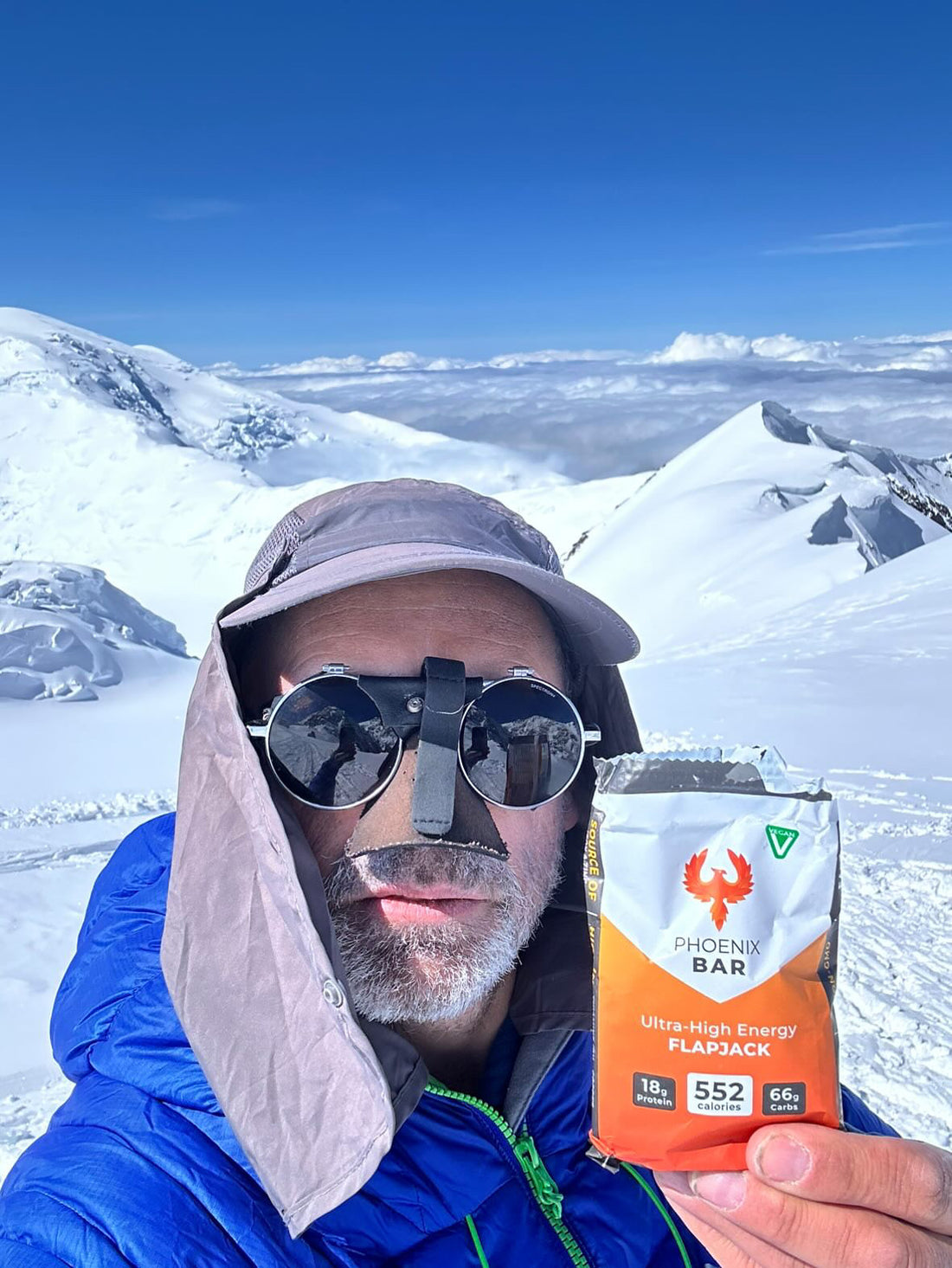
Phoenix Bars were built for exactly the constraints EBC creates: maximum calories per gram of pack weight, soft enough to eat with cold hands, mild enough in flavour to stay appetising after a week of the same foods, and stable in both warm lower sections and freezing upper altitudes. Each bar has up to 557 calories in only 120g, about 4.6 calories per gram. For comparison, a standard cereal bar is 3.5 to 4.0 calories per gram.
On trek, a typical use pattern is one bar broken into pieces for the morning walk, half a bar mixed into tea house porridge on days when you want a 900-calorie breakfast rather than a 500-calorie one, and one bar held in reserve for summit day. For guidance on the porridge method, see How to Use Phoenix Bars. Many EBC trekkers carry ten to fourteen bars for the full trip, which adds roughly 5,300 to 7,800 calories of shelf-stable, cold-resistant trail food for 1.2 to 1.7kg of pack weight.
Phoenix Bars are also useful when appetite drops above Dingboche. The low appetite guide explains why calorie-dense, soft-textured food is easier to tolerate than dense meals when hunger signals weaken.
Summit day: Kala Patthar at 4am
Most teahouses in Gorak Shep start serving breakfast at 5am or later. The Kala Patthar summit push typically leaves at 4am to reach the viewpoint at sunrise. This means most trekkers climb their hardest hour of the trip, in the coldest conditions of the trip, having eaten nothing.
The fix is simple but often ignored. Eat 400 to 600 calories in your sleeping bag before you leave. A Phoenix Bar works here because it does not need preparation, it is soft enough to eat without water at freezing temperatures, and it gives you up to 557 calories before you have touched your tea house breakfast. Carry a second bar in an inside jacket pocket for the descent, when your body temperature drops and another 300 to 500 calories matters.
Related guides
- High Altitude Mountaineering Nutrition: for 6,000m+ expeditions and technical climbing
- Hiking and Trekking Nutrition: principles for multi-day treks generally
- Ultra-Endurance and Expedition Nutrition Guide: the full framework
- Calorie-Dense Foods: what to pack and why
- How to Use Phoenix Bars: including the porridge method
Frequently asked questions
How many calories do I burn per day on the EBC trek? Most adults burn 3,500 to 4,500 calories a day across a typical EBC trekking day, depending on body weight, pace, and how cold it is.
Is the food on EBC actually good? Dal bhat, garlic soup, and porridge are reliably good across the trail. Pizza, pasta, and Western food quality drops sharply above Namche. Variety narrows with altitude, which is the more significant problem.
How much should I budget for food on the trek? Meals at tea houses run roughly £6 to £10 each, rising with altitude. Total food budget for 12 to 14 days is typically £250 to £400, excluding drinks. Bringing your own snacks from home is significantly cheaper than buying them in Namche or Dingboche.
Should I bring energy gels? Gels are engineered for racing, not trekking. They deliver 2.5 to 3.0 calories per gram and very little satiety. For a 12-day trek, calorie-dense flapjacks, nuts, and dried fruit are more practical.
Do I need to worry about freezing food? From Dingboche upwards, yes. Chocolate bars can become dental hazards, and standard energy bars stiffen. Phoenix Bars and soft flapjack-style foods remain edible in sub-zero conditions. Keep anything you plan to eat close to your body on summit day.
Can Phoenix Bars replace a meal at a tea house? A single Phoenix Bar has up to 557 calories, up to 66g of carbohydrate and up to 19g of protein. Made into porridge with water, it can serve as a breakfast on cold mornings when you want more calories than the tea house menu provides. It is not a full nutritional substitute for dal bhat across multiple days, but it is a strong supplement.
Questions about fuelling for EBC
If you are preparing for the trek and have specific questions, feel free to contact me directly. I am always happy to talk it through.
James Frost Founder, Flaming Phoenix jfrost@flaming-phoenix.co.uk 07990 519422
Big calories. Small bar.
Up to 557 calories in a compact, lightweight bar of only 120g, with up to 66g of carbs and 19g of protein. Eat it whole, break it into pieces over a few hours, or mix it with water or milk for porridge.
Easy to eat, easy to digest and not sickly sweet. Customers have eaten them at -45°C and through the heat of the Marathon des Sables, and they keep for up to 2 years, so they work on a mountain, on a night shift, or at home on days when eating enough feels hard.
- 557 calories in only 120g (529 to 557 by flavour)
- 4.6 calories per gram
- 66g carbs per bar (up to)
- 19g protein per bar (up to)
