
High calorie vegan foods: what to eat and how to get enough
Dans ce guide

 Written by James Frost, founder of Flaming Phoenix and the maker of Phoenix Bars. Updated November 2026.
Quick answer: The highest calorie vegan foods are oils (about 120 calories a tablespoon), nuts and nut butters (roughly 600 to 750 calories per 100g), seeds, avocado, coconut milk, dried fruit and dark chocolate. Build meals on denser staples like oats, bread, pasta, tofu and beans, then add fat to them, and a normal appetite goes much further.
The reason many vegans struggle to eat enough is that most plant foods are high in fibre and water, which fills you up before you have taken in the calories. The fix is to lean on the dense foods and add fat, rather than eating more volume. For the full picture across all foods, see calorie-dense foods.
This is the part that trips people up on a plant-based diet. A big plate of vegetables, salad and fruit feels like a lot of food and barely registers on the calorie count, because it is mostly fibre and water. Eating more of it does not help. Eating denser does.
Why is it harder to get enough calories on a vegan diet?
Because plant foods are, on the whole, lower in calorie density than animal foods. Vegetables, fruit, salad and even a lot of whole grains carry a lot of fibre and water for their calories, so they fill your stomach long before they fill your calorie target.
That is why so many people assume a vegan diet automatically means eating less. It does not have to. It just means being deliberate about choosing the plant foods that are concentrated rather than bulky, and not letting low-calorie veg crowd out the dense stuff. Get that right and eating enough gets much easier.
The most calorie-dense vegan foods
Ranked roughly from most concentrated down, here is where the calories actually are.
| Food | Typical portion | Calories per portion | Calories per 100g |
|---|---|---|---|
| Olive or rapeseed oil | 1 tbsp (15ml) | 120 | 899 |
| Macadamia nuts | 30g handful | 225 | 750 |
| Walnuts | 30g handful | 205 | 690 |
| Almonds | 30g handful | 185 | 620 |
| Tahini | 1 tbsp (about 15g) | 95 | 620 |
| Peanut butter | 2 tbsp (about 32g) | 190 | 600 |
| Dark chocolate (70%) | 25g | 145 | 580 |
| Pumpkin seeds | 30g | 170 | 570 |
| Oats | 50g | 190 | 375 |
| Hummus | 50g | 150 | 300 |
| Dates or raisins | 30g | 85 | 290 |
| Avocado | Half, about 80g flesh | 150 | 190 |
| Full-fat coconut milk (tinned) | 100ml | 180 | 180 |
| Firm tofu | 100g | 125 | 125 |
| Cooked lentils | 150g | 165 | 110 |
| Broccoli, for comparison | 80g | 30 | 35 |
Figures are approximate, worked out from typical UK label values, and brands vary a little. The last column is the one to watch: anything above about 400 calories per 100g carries a lot for its size, while most vegetables sit well under 50.
Oils are the densest food there is. A tablespoon of olive, rapeseed or coconut oil is about 120 calories and pure fat, so a drizzle over a finished meal adds a lot without any bulk.
Nuts, seeds and their butters are next. A 30g handful of almonds or cashews is around 180 calories, two tablespoons of peanut butter about 190, and a tablespoon of tahini roughly 95. Seeds like chia, flax and hemp add 50 to 60 calories a tablespoon.
Avocado and coconut are rich in fat. Half an avocado is about 150 calories, and 100ml of full-fat coconut milk around 180. Coconut milk goes straight into curries and smoothies.
Dried fruit packs sugar into a small space. Around 30g of dates or raisins is 85 to 90 calories, while dried apricots are lighter at about 55, and all of them stir easily into oats or trail mix.
Dense staples give you a solid base. A 50g serving of oats is about 190 calories, a plain bagel around 230, and pasta, bread, rice, potatoes, tofu and beans all deliver real calories for their size. Beans and lentils are more calorie-dense than most people expect.
Dark chocolate is worth a mention at about 145 calories per 25g. Many dark chocolates are vegan, but some contain milk, so check the label.
How to add calories to vegan meals
You do not need new meals, just denser versions of the ones you already eat. The move is always the same: add fat.
Drizzle oil over cooked dishes, or fry in more of it. Stir a spoon of peanut butter or tahini into sauces, oats or smoothies. Use full-fat coconut milk instead of water in curries and stews. Add half an avocado to a bowl or wrap. Scatter nuts, seeds or dried fruit over breakfast and salads. Each of these adds 100 to 200 calories and takes up almost no room on the plate. Eating the dense part of a meal first, before the vegetables, also helps if you fill up quickly.
Drinks are the vegan's best friend here, because a smoothie bypasses the fullness that solid plant food causes. A blend of oat or soya milk, oats, peanut butter, banana and a few dates can carry 600 calories in a glass. See high calorie drinks and smoothies for recipes.
Vegan foods for gaining weight
If your goal is to gain weight, the foods above are the tools, but the thing that actually does it is a calorie surplus, eating a bit more than you burn, consistently. Plant foods make that harder only because they are filling, which the density approach solves. On days with no time to cook, a calorie-dense vegan weight gain bar or a smoothie fills the gap with no preparation.
Work out the number you are aiming for with how many calories to gain weight, and if you are eating plenty but still not gaining, see why can't I gain weight, which is almost always about appetite and density rather than effort.
What vegan food has the most calories?
Oil is the most calorie-dense vegan food, at about 900 calories per 100g, because it is pure fat. Among whole foods, nuts come next: macadamias are around 750 calories per 100g and walnuts about 690, with nut butters, seeds and dark chocolate close behind. A 30g handful of nuts, at roughly 185 to 225 calories, is the easiest single addition to a vegan day.
Which vegan foods are high in calories and protein?
Peanuts and peanut butter give about 25g of protein and 600 calories per 100g, and pumpkin seeds are similar. Tempeh has about 20g of protein per 100g, firm tofu around 12 to 15g, and cooked lentils about 9g. Soya milk carries more protein than most other plant milks, so using it in smoothies and porridge adds protein and calories together. All figures are approximate and vary by brand.
A ready-made high calorie vegan option
Everything above takes a bit of preparation, and some days you want calories with none.
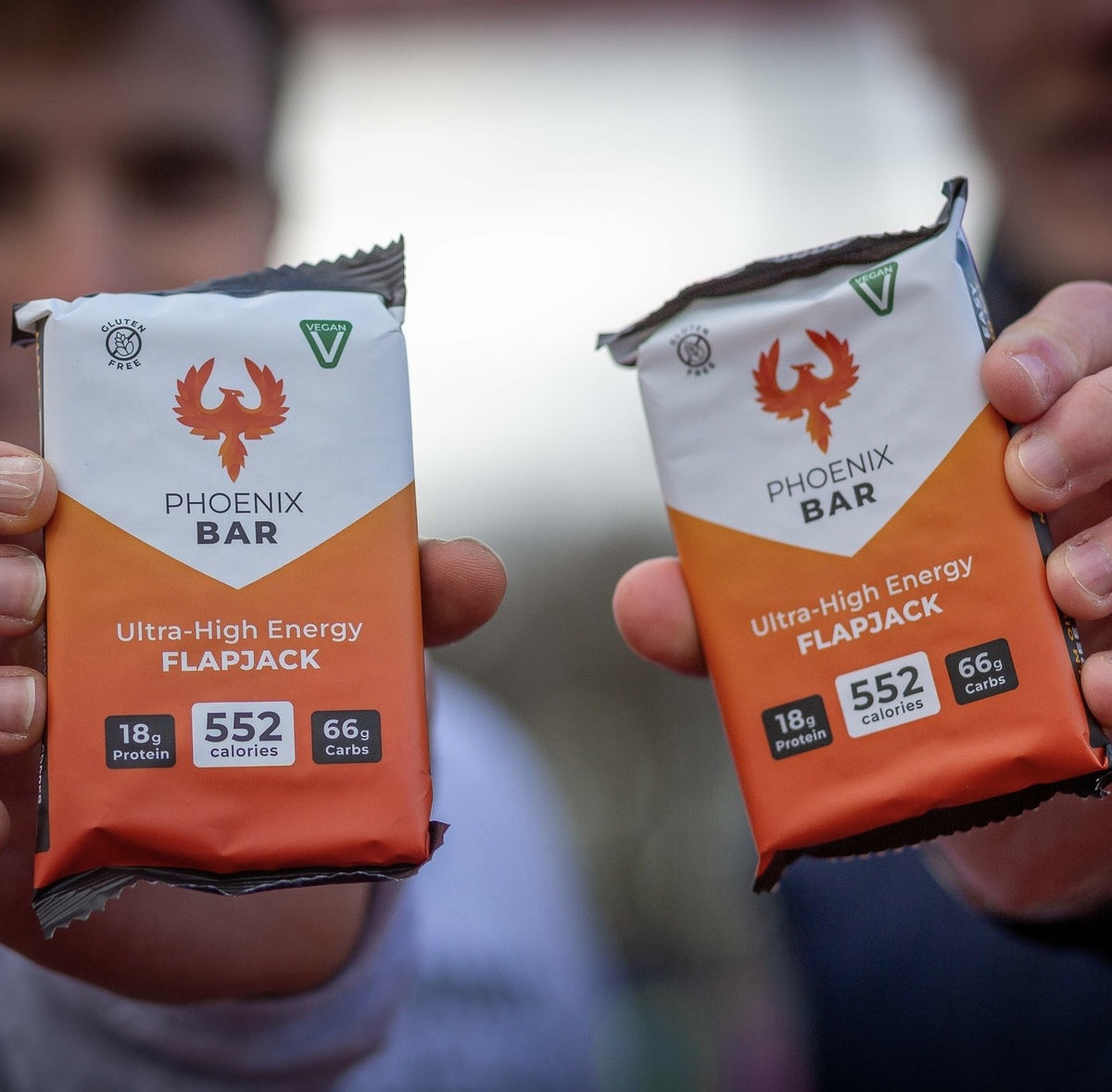
I make Phoenix Bars for days like that: up to 557 calories in a compact, 120g bar made mainly from gluten-free oats, and every flavour is vegan and gluten-free, so it fits a plant-based diet. It needs no preparation, comes in six flavours, and can be mixed with water or plant milk to make porridge if you would rather eat it soft. It is a simple way to add a known amount of calories in a compact, plant-based form. You can see the full range of high calorie bars on the homepage.
Frequently asked questions
What are the best high calorie vegan foods?
The most calorie-dense are oils, nuts, nut butters, seeds, avocado, coconut and dried fruit, because they are high in fat or low in water. Denser staples like oats, bread, pasta, beans and tofu give you a solid base. Building meals around these makes eating enough on a vegan diet much easier.
Why is it hard to gain weight on a vegan diet?
Because plant foods tend to be high in fibre and water, so they fill you up before you reach your calorie target. The bulky, filling foods crowd out the concentrated ones, even though plenty of vegan food is calorie-dense. Focusing on dense foods and adding fat solves it.
How do I get more calories in a vegan diet?
Add fat to meals you already eat: drizzle oil, stir in nut butter or tahini, use coconut milk, add avocado, nuts, seeds or dried fruit. Drink calorie-dense smoothies between meals, and eat the dense part of a meal before the vegetables if you fill up fast.
What are high calorie vegan snacks?
Nuts, nut butter on oatcakes or toast, trail mix with dried fruit and dark chocolate, a smoothie, hummus with bread, or a ready-made high calorie vegan bar. The best options are high in fat or dried, so they carry a lot of calories in a small, portable amount. My round-up of the best vegan energy bars compares the bar options.
Can you gain weight on a vegan diet?
Yes. Weight gain comes down to a steady calorie surplus, which is achievable on any diet. On a vegan diet it takes a little more intention, because plant foods are filling, so you lean on calorie-dense foods and drinks rather than trying to eat a larger volume. For the rest of the method, see how to gain weight.
Related guides
For all calorie-dense foods, not just vegan, see calorie-dense foods. For drinks, see high calorie drinks and smoothies. For gaining weight, see how many calories to gain weight and why can't I gain weight. For the porridge method, see how to use Phoenix Bars.
Written by James Frost, founder of Flaming Phoenix and the maker of Phoenix Bars. James started Flaming Phoenix in 2024 and has spent the years since working out how to get the most calories into the least food, building and testing compact, calorie-dense recipes. He can be reached at jfrost@flaming-phoenix.co.uk. Last reviewed: November 2026.
Sources: NHS, healthy ways to gain weight; typical UK pack labels for the foods in the table.

Plein de calories. Petit format.
Jusqu’à 557 calories dans une barre compacte et légère de seulement 120 g, avec jusqu’à 66 g de glucides et 19 g de protéines. Mangez-la entière, en morceaux sur quelques heures, ou mélangez-la à de l’eau ou du lait pour en faire un porridge.
Facile à manger, facile à digérer et pas trop sucrée. Des clients les ont mangées à -45 °C et dans la chaleur du Marathon des Sables, et elles se conservent jusqu’à deux ans : elles conviennent en montagne, pendant un travail de nuit ou à la maison, les jours où manger suffisamment est difficile.
- 557 calories dans seulement 120 g (529 à 557 selon la saveur)
- 4,6 calories par gramme
- 66g glucides par barre (jusqu’à)
- 19g protéines par barre (jusqu’à)
Soumettre une demande de rétractation
Veuillez remplir le formulaire suivant pour soumettre votre demande de rétractation.

