
Best Energy Bars for Hiking (2026): UK Calorie-Dense Picks
Updated July 2026. Written by James, founder of Flaming Phoenix and the maker of Phoenix Bars.
The best energy bar for hiking is the one that delivers the most usable energy for the least pack weight, survives both heat and freezing cold, and does not turn your stomach after several hours on the trail. Judged on that, the most calorie-dense bar in this guide is the Phoenix Bar at 557 calories in a 120g bar, which works out at 4.6 calories per gram, higher than a typical flapjack (around 4.3), cereal bar (3.5 to 4.0) or protein bar (around 3.8). For a short walk or a quick sugar hit on a climb, lighter and cheaper bars do the job well, and below I explain exactly which bar suits which kind of hike.
Quick picks
- Best overall for long and multi-day hikes: Phoenix Bar. Most calories per gram, freeze-proof and heat-proof, and it can be crumbled into hot porridge for a trail meal.
- Best budget all-rounder: Clif Bar. Cheap, everywhere, reliable.
- Best fast-release boost on steep climbs: Kendal Mint Co.
- Best whole-food, natural option: Nakd or Veloforte.
- Best plant-based protein flapjack: Trek Protein Flapjack.
- Best for a short day walk: a light cereal or fruit bar.
How to choose an energy bar for hiking
Most guides rank bars on taste. Taste matters, but on a real hike four things matter more.
1. Calorie density is the number that decides everything else. On a long walk your limiting factor is the weight on your back, so the figure that counts is not calories per bar but calories per gram. A common rule of thumb among backpackers is that "calorie-dense" trail food clears roughly 4 calories per gram, or about 113 calories per ounce. Most energy bars fall short of that, sitting between 3.5 and 4.3 calories per gram. The denser the bar, the fewer grams you carry for the same energy, which is why calorie density is the single most useful spec on the label and the one almost no product page shows you.
2. Carbohydrate content and how fast it releases. Carbohydrate is your primary fuel when hiking, and the harder and longer you go, the more of it you need. A good hiking bar carries a large carbohydrate load with a mix of fast-release sugars for an immediate lift and slower-release carbohydrate from sources like oats to keep you going between stops.
3. It has to work in the weather. A bar that melts into sticky mush on a sun-baked summit is useless, and so is one that freezes into a brick on a winter ridge. Chocolate-coated and nut-butter bars are the usual offenders in heat. Date and fruit bars are the usual offenders in the cold. Check how a bar behaves at the temperatures you actually hike in.
4. It cannot be sickly sweet, and it has to be easy to eat. Palate fatigue is real. After a few hours of effort, intensely sweet bars and gels start to turn the stomach, and you stop eating them, which is how people end the day in a calorie deficit. A bar with a balanced, less-sweet flavour is one you can eat repeatedly. It also needs to open with cold hands or gloves on and chew easily when you are breathing hard, without cementing itself to the roof of your mouth.
How many calories do you actually need on a hike?
Hiking burns roughly 350 to 550 calories an hour depending on your pace, your pack weight and the terrain, and a full day on the hills can put you 3,000 to 5,000 calories or more in the red. You cannot realistically replace all of that on the move, but the closer you get, the better your energy, grip, decision-making and recovery, especially across consecutive days. This is the whole argument for calorie density: the more energy you can carry and stomach per gram, the smaller your deficit. It is far easier to eat one dense 557-calorie bar than to force down four sweet cereal bars.
The best energy bars for hiking, ranked
For each bar: what it is, the stats that matter, who it suits, and the honest trade-off.
1. Phoenix Bar. Best overall for long and multi-day hikes.
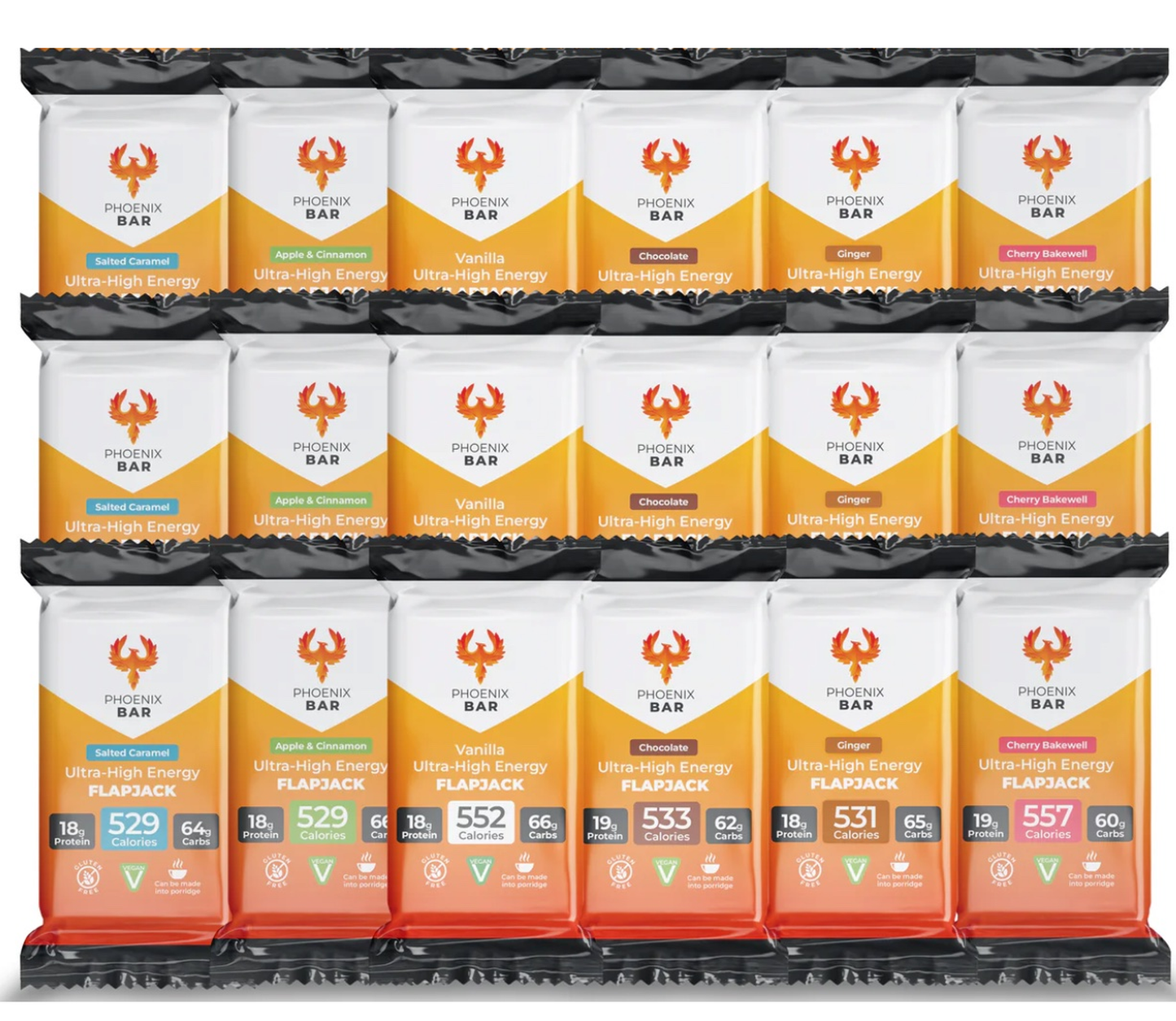
Each Phoenix Bar delivers up to 557 calories and 66g of carbohydrate in a 120g bar, which is 4.6 calories per gram, placing it in the top tier of portable foods for energy per gram. It is vegan, made with gluten-free oats, and, unlike chocolate or nut-butter bars, it will neither melt in heat nor freeze solid in alpine cold. It is deliberately not sickly sweet, so you can eat it hour after hour, and it can be broken into a mug and made into porridge with hot water for a proper trail meal. Best for ultra-distance days, multi-day treks, expeditions and anyone counting grams. The honest trade-off: at a premium price per bar it is overkill for a gentle two-hour stroll, and per calorie it costs a little more than a supermarket bar. What you buy is the weight saving and the fact that it works when conditions are harsh. Phoenix Bars are rated 5.0 out of 5 from more than 370 reviews and are used on multi-day treks and endurance events including the Marathon des Sables. If you want the full spec, see our high-calorie energy bars range.
2. Clif Bar. Best budget all-rounder.
The default for good reason: around 250 calories per bar, a solid carbohydrate hit, wide availability and a low cost per calorie. Softer and sweeter than a dense flapjack, and it can get sticky in real heat, but for everyday hikes on a budget it is hard to argue with. Best when you want cheap, familiar fuel and are not worried about shaving pack weight.
3. Kendal Mint Co. Best fast-release energy on steep climbs.
Kendal Mint Cake is a piece of British hillwalking heritage, carried on the 1953 Everest expedition, and it is built for one thing: a rapid sugar hit. The modern pocket bars break into blocks and some add electrolytes, which makes them useful for a quick boost on a hard climb or to settle the stomach. The limitation is that it is mostly fast sugar with little protein or fat, so it is a lift rather than sustained fuel, and it can tire the palate on a long day.
4. Nakd or Veloforte. Best whole-food, natural option.
If you want short ingredient lists, dates, nuts and fruit are the classics. Nakd bars are cheap and widely stocked; Veloforte is the premium, sport-focused end with real fruit and botanicals. Both are soft and easy to chew. The trade-offs for hiking: lower calorie density than a dedicated high-calorie bar, so you carry more grams per calorie, and date-based bars can set hard in the cold.
5. Trek Protein Flapjack. Best plant-based protein flapjack.
A popular UK option at around 250 calories with a useful hit of plant protein, filling and satisfying on a walk. It is denser and heavier per calorie than a bar built specifically for maximum energy density, and it leans sweet, but as an all-day plant-based flapjack it is a strong pick.
6. Styrkr BAR50. Best high-carb quick fuel.
A UK-made, puffed-rice bar carrying over 50g of carbohydrate in an easy-to-digest format, designed to be eaten on the move without sitting heavy. Total calories are lower than a meal-style bar, so treat it as fuel between stops rather than a stand-in for lunch. Excellent for fast, carb-focused days.
7. A light cereal or fruit bar. Best for a short day walk.
For a couple of hours on easy ground, you do not need specialist fuel. A cheap cereal or fruit bar is light, palatable and perfectly adequate. Save the dense, expensive bars for the days that earn them.

Phoenix Bars: Up to 557 Calories Per Bar
Highly compact, low-volume, calorie-dense bars. Soft, easy to eat whole or as a warm porridge. Vegan, gluten-free and contain up to 66g of carbohydrates, 19g of protein & 8 vitamins & minerals.
Why calorie density wins on a long hike: the pack-weight maths
Here is the comparison in numbers, which is the part most guides skip. Two Phoenix Bars weigh 240g and give you 1,114 calories. To match that with typical supermarket cereal bars at roughly 130 to 180 calories each, you would carry six to eight bars weighing 300g or more, and you would have to eat every one of them. Over a single day that difference is a nuisance. Over a five-day trek, carrying a third more weight in food for the same energy, and battling palate fatigue from a pile of sweet bars, is exactly how hikers end up under-fuelled. The denser your fuel, the lighter your load and the easier it is to actually eat enough. That is why serious long-distance and expedition users gravitate to compact, high-calorie bars rather than a stack of ordinary snacks.
Can you use an energy bar as a meal on a multi-day trip?
For long treks where you want to cut cooking, a dense bar doubles as a compact meal. The Phoenix Bar can be crumbled into a mug and turned into porridge with hot water, or broken up and mixed with dried fruit and nuts as trail mix, which is a common way our customers use it on multi-day routes. It will not replace every hot dinner, but it takes the pressure off breakfasts and lunches when weight and time are tight. If you are planning bar-based fuelling for a specific event, our guide to hiking and trekking nutrition covers how to build a full day of eating around it.
Frequently asked questions
Is an energy bar good for hiking?
Yes. Hiking, especially long or uphill, burns a lot of carbohydrate, and a good energy bar is a compact, convenient way to replace it on the move. The key is choosing a bar that is calorie-dense enough to fuel your day without weighing your pack down, and one you can keep eating for hours without it becoming sickly.
What is the best energy bar for hiking?
For long and multi-day hikes where pack weight matters, the most calorie-dense option in this guide is the Phoenix Barat 557 calories per 120g bar (4.6 calories per gram), which also resists melting and freezing. For short walks or a quick boost, a lighter, cheaper bar such as Clif or Kendal Mint Cake is a sensible choice.
What is the best energy source for hiking?
Carbohydrate is your main fuel for hiking, so bars and snacks built around a high carbohydrate load, ideally a mix of fast and slow release, keep your energy steadiest. Fat adds calorie density for long efforts, and a little protein helps on multi-day trips and with recovery.
How many energy bars should I take hiking?
Plan for roughly 350 to 550 calories per hour of hiking, then work out how much of that you want to replace on the trail. A denser bar means fewer bars to carry for the same energy: two 557-calorie bars, for instance, cover over 1,100 calories in 240g.
Do energy bars freeze or melt?
Many do. Chocolate-coated and nut-butter bars soften or melt in heat, and date and fruit bars can set rock-hard in the cold. If you hike in extremes, choose a bar tested to stay edible across temperature swings, such as the Phoenix Bar, which is designed to neither melt nor freeze.
Ready to fuel your next big day? Explore the full range of high-calorie Phoenix Bars, hand-made in the UK and built for endurance.


Flaming Phoenix



Contact Us
Declare withdrawal
Please fill out the following form to declare your withdrawal from the contract.

