
What to Eat on the Dragon's Back Race
A fuelling guide from the team at Phoenix Bars. Last reviewed July 2026.
Quick answer: On the Dragon's Back Race, eat little and often across each stage, aiming for roughly 60 to 90 grams of carbohydrate an hour and around 2,000 to 2,500 calories during the day on the course, then refuel hard at camp each evening. Prioritise compact, calorie-dense, easy-to-digest food, and carry a variety of soft options you can still get down late in a stage when your appetite fades. Use the hot evening meal and breakfast to top up carbohydrate and take on protein for overnight recovery.
The Dragon's Back Race is one of the hardest things you can do on two feet: six days across the mountainous spine of Wales, roughly 380 kilometres and around 17,400 metres of climbing, from the north of the country to the south, over ground that rarely lets you settle into a rhythm. The early stages take in the ridgelines and scrambles of Snowdonia before the route works its way south through wild, trackless mountain terrain. Most runners who come unstuck here are not undertrained. They are underfed. Two things quietly end more races than the climbs do: the calorie deficit that builds day after day, and the moment, usually late in each stage, when your appetite disappears and chewing anything feels like hard work. This guide covers how much to eat, why carbohydrate matters most, how to keep eating when you no longer want to, and how to fuel at the overnight camps. If you want the shorter version for other UK ultras too, see our guide to UK ultra and multi-day mountain race nutrition.
How much do you need to eat each day?
More than you can fully replace, which is the first thing to accept. A day in the Welsh mountains at race effort can burn several thousand calories, well beyond what anyone can take in on the move. The goal is not to break even. It is to keep the daily deficit small enough that you can get up and do it again tomorrow, five more times. As a working target, take in somewhere around 2,000 to 2,500 calories during each day on the course, on top of the evening meal and breakfast at camp. That figure lines up with what finishers consistently report from the race itself. For carbohydrate specifically, the range widely used for long endurance efforts is about 60 to 90 grams per hour, and some well-trained runners push towards 100 grams an hour at points when they can eat well. If you are new to the top of that range, build up to it on your long back-to-back training runs, because race day is the wrong place to discover your stomach cannot cope.
Why carbohydrate is the priority
Your body only stores enough glycogen for somewhere around 90 minutes to two hours of hard effort, and once it is gone your pace and your decision-making fall off a cliff. On a race measured in days rather than hours, that means you cannot rely on stored fuel. You have to keep feeding carbohydrate in to spare glycogen and hold your blood glucose steady. Carbohydrate is broken down to glucose, which is the fuel your working muscles and your brain reach for first, so it does double duty on terrain where a lapse in concentration on a scramble is genuinely dangerous. Two practical points follow. Food that blends fast and slower-release carbohydrate gives you a quick lift plus a steadier burn, which suits the stop-start nature of mountain running. And training your gut in advance, by practising your race-day intake on long runs, raises how much you can absorb per hour and cuts the risk of stomach trouble deep into a stage.
Eat little and often, before you feel like it
On a race this long, hunger is a poor guide. By the time you feel empty you are already behind, and appetite tends to switch off under stress, cold and fatigue. Eat to a schedule instead. Aim for something every 30 to 45 minutes and set a timer on your watch so you do not forget when your head goes foggy. As one runner who used our bars on a 130-mile race put it, "Whenever I do ultras, I find it hard to focus on things like eating as my brain tends to stop working properly." That is completely normal, and it is exactly why a schedule beats willpower. The runners who finish are usually the ones who made eating a habit rather than a decision.
The late-day problem: when your appetite disappears
This is the part people underestimate, and it is where most guides go quiet. Early in a stage you will happily eat almost anything. Late in a stage, and especially on days four, five and six, your mouth is dry, you may feel a little sick, and dense, dry food becomes a genuine obstacle. Runners describe food that went down fine one day going "down like razorblades" the next. At that point, food that goes down easily is worth more than food that is theoretically optimal. A runner on the Winter Spine Challenger South found the same in the cold: our bars, he said, were "tasty and palatable especially towards the end of the race where you find it hard to eat," and "remained soft enough to eat unlike some other food that I had that was too hard to eat." Whatever you carry, make sure at least some of it is soft and easy to swallow for the back half of each day.
Beating flavour fatigue over six days
Six days of the same three snacks will defeat you. Flavour fatigue is real, and the food you loved on day one can turn your stomach by day five. Carry variety, and lean towards neutral, not-too-sweet flavours that stay tolerable when everything sugary starts to feel sickly. One runner heading into serious multi-day efforts told us, "The different flavours really help on multi day efforts when appetite can drop." Rotating between a few options, and alternating sweeter choices with plainer ones, keeps you eating when a single flavour would have you gagging. It is also why relying only on gels and sweet drinks tends to fail on multi-day races: the sameness becomes unbearable and the sugar load overwhelms your gut.

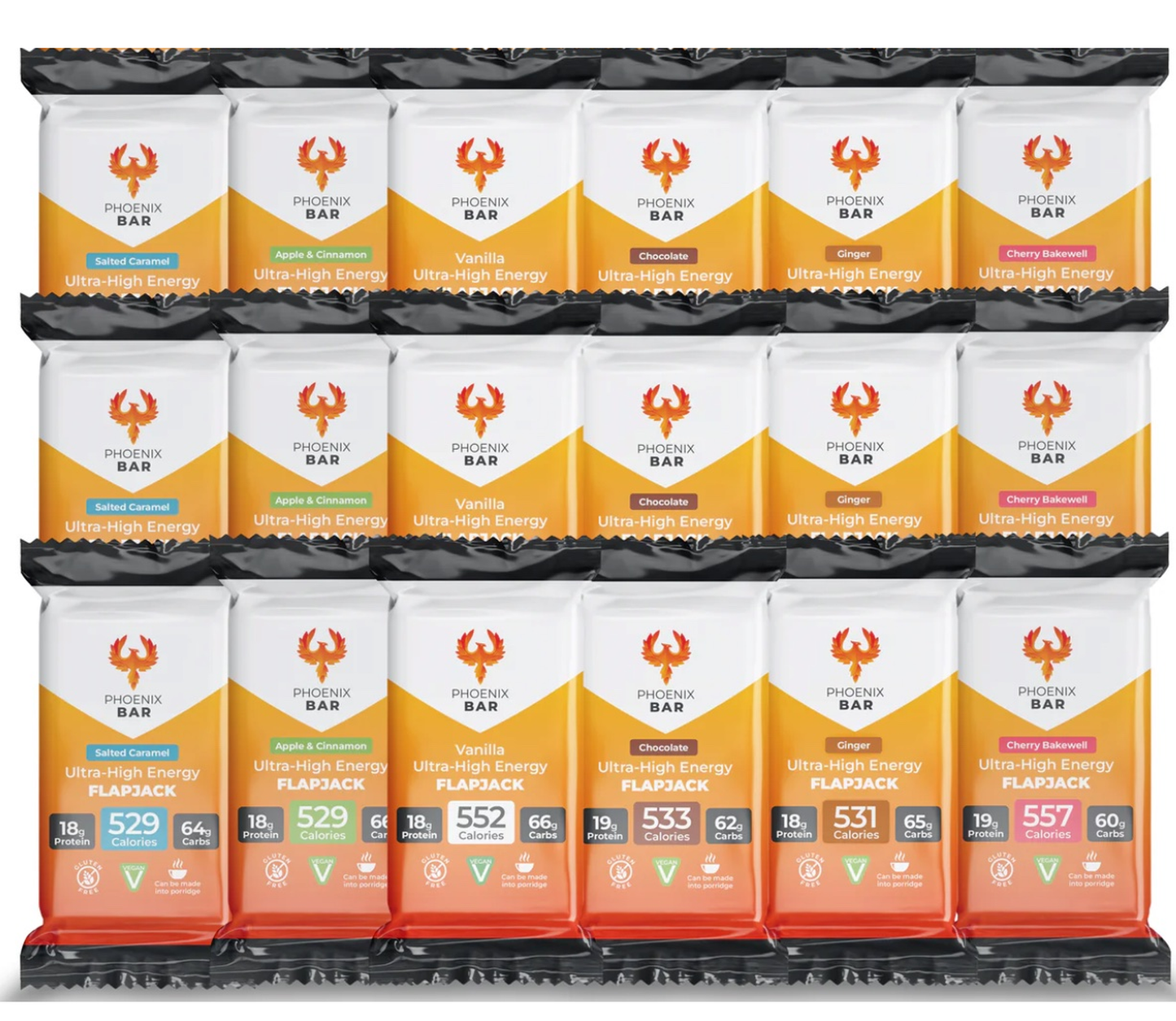
Phoenix Bars: Up to 557 Calories Per Bar
Highly compact, low-volume, calorie-dense bars. Soft, easy to eat whole or as a warm porridge. Vegan, gluten-free and contain up to 66g of carbohydrates, 19g of protein & 8 vitamins & minerals.
Hydration and electrolytes
Fluid does more than quench thirst. It maintains your blood volume and helps regulate body temperature, both of which matter across the range of weather a Welsh mountain range can throw at you in a single stage. Sweat losses climb with heat and hard climbing, and you lose sodium as well as water, so on warm days and long ascents you need electrolytes alongside your fluid, not just plain water. Drink to thirst, add sodium through electrolyte drinks or tablets, and avoid the opposite mistake of drinking far more than you sweat, which can dilute your blood sodium and cause its own problems. A simple approach that works for many is to keep hydration and solid fuel slightly separate, using drinks mainly for fluid and electrolytes and food mainly for carbohydrate, so you are not forced to overload one to get enough of the other.
Fuelling at the overnight camps
The Dragon's Back Race is semi-supported: you carry your daytime food and mandatory kit between camps, and each night you get a hot evening meal and breakfast. Use those camp meals deliberately, because they are where recovery happens. The evening is your best chance to top up carbohydrate, take on protein to support overnight repair, and get something warm inside you when you are cold and depleted. Eat as soon as you can face it rather than waiting, and top up again before you sleep. If your appetite is low at camp, something soft and warm is far easier than a big plate of solids. A number of runners stir our bars into hot water to make a dense porridge for exactly this reason. As one put it, pouring on hot water to eat it as porridge is "a good way to get something hot and nutritious inside on long or multiday events." For more on that, see how to use Phoenix Bars.
Carrying a day of food: weight, calories and temperature
Because you carry your own daytime food plus a heavy mandatory kit list, every gram counts. That pushes you towards food with a high calorie-to-weight ratio, so you are not lugging bulk for the energy you get back. Welsh mountain weather also does as it pleases, and you can meet heat, cold, wind and rain in one stage. Food that freezes solid, melts into a greasy mess, or crumbles to dust in your pack becomes useless at the worst possible moment, so texture that stays stable across conditions matters more than most people expect.
Where Phoenix Bars fit
Phoenix Bars were built for this exact problem: getting a lot of energy into you in a small, easy-to-eat package when conditions and fatigue are working against you. Each 120g bar carries up to 557 calories and around 66 grams of carbohydrate, with a mix of fast and slower-release energy and some protein for a steadier feed, so a single bar covers a meaningful chunk of your hourly carbohydrate target without much bulk. They are vegan and gluten-free, and the packaging is waterproof.
Three things make them suited to a race like this. First, the texture is soft and melts in the mouth, which is why runners reach for them late in a stage when chewing is hard. As one runner deep in an ultra noted, other calorie-dense bars "take a lot of chewing, which really doesn't work too well deep into an ultra," whereas the melt-in-the-mouth quality kept her eating. Second, they hold their texture across conditions, staying soft in the cold and not melting in the heat, which a performance nutritionist who tested them singled out as genuinely useful for events with big temperature swings. Third, there is the porridge option: stir a bar into hot water at camp for a warm, dense feed when a full meal feels like too much.
Runners preparing for the Dragon's Back have already put them to work in Welsh ultras. One, ordering more ahead of the race, said: "I bought Phoenix Bars after Run Walk Crawl's Brecon to Cardiff Ultra and I used them during the Haworth Hobble. They were bang on. I particularly liked that they are so easy to digest and I'm going to be ordering more in preparation for the Dragons Back." Another, also stocking up for it, valued the calorie density and the porridge option: "The calorie-density of Phoenix Bars suits my nutritional needs very well and I think they would be particularly helpful for early morning races. I really like how they can be made into a nutritionally dense porridge."
One honest, practical note. Because the bar is dense and only lightly sweet, it goes down best with a few sips of fluid alongside it, and it turns into porridge if you would rather take your calories warm at camp. You can shop Phoenix Bars here, or read more accounts from runners and expedition teams on our reviews page.
A sample day's fuelling plan to adapt in training
Treat this as a starting point, not a prescription, and rehearse it before race week. Eat a solid breakfast at camp, then take on something every 30 to 45 minutes from the moment you leave, aiming for roughly 60 to 90 grams of carbohydrate an hour early on while you can still eat well. Front-load the day while your appetite is good, and deliberately keep your softest, easiest food in reach for the final hours when everything gets harder. Drink to thirst with electrolytes, more on warm days and big climbs. At camp, eat your evening meal as soon as you can face it, take on some protein, and top up again before you sleep so you start the next stage less depleted. Whatever plan you settle on, test it on back-to-back long days first, so nothing on your race-day menu is a surprise to your stomach.
Common mistakes to avoid
The most common fuelling errors on this race are predictable, which makes them avoidable. Trying a new food or product on race day is the classic one, because your gut has not adapted to it and a stage in the mountains is a bad place to find that out. Coasting through the easy early hours without eating enough, then trying to claw back the deficit once your appetite has gone, rarely works. Relying only on sweet gels and drinks tends to end in flavour fatigue and an overloaded gut by the middle of the week. Neglecting sodium on warm days leaves you flat even when your carbohydrate is on point. And skimping at camp because you are too tired to eat quietly sets up tomorrow's bad day. Almost all of these come back to the same fix: eat early, eat often, and carry food you can still stomach when you are wrecked.
Frequently asked questions
How many calories do you need per day on the Dragon's Back Race?
More than you can fully replace. A day at race effort in the mountains can burn several thousand calories. Many finishers take in around 2,000 to 2,500 during the day on course, plus the camp meals, to keep the deficit manageable across six days.
How many carbs per hour should you eat?
Aim for roughly 60 to 90 grams of carbohydrate per hour, and build up to it in training. Some well-trained runners push towards 100 grams an hour when they can eat well, but only if their gut is used to it.
How often should you eat during a stage?
Little and often. Aim for something every 30 to 45 minutes and use a timer, because appetite drops under fatigue and you cannot rely on hunger to remind you.
What should you eat when you feel too sick to chew?
Soft, easy-to-swallow, not-too-sweet food, plus warm options like porridge at camp. Keep your easiest food for the late hours of each stage, when dry, dense food becomes hard to get down.
Do energy bars freeze or melt in the mountains?
Some do, which is a real problem in variable Welsh weather. Phoenix Bars are designed to stay soft in the cold and not melt in the heat, so the texture stays reliable across a stage.
Can you make Phoenix Bars into porridge?
Yes. Stir a bar into hot water for a warm, dense feed, which is especially useful at camp when your appetite is low.
Related guides
You might also find these useful: UK ultra and multi-day mountain race nutrition, how to use Phoenix Bars, fuelling for Marathon des Sables, and our runner reviews.
About this guide: Phoenix Bars are made by founder James in Cobham, Surrey, and were developed from more than 150 conversations with ultra-runners, expedition leaders and dietitians about the practical problem of eating enough when it is hard to eat at all. They have been carried on Marathon des Sables, the Spine, and expeditions to Everest, Denali and Manaslu, as well as a South Pole crossing, and are rated an average of 4.97 out of 5 across more than 370 verified reviews. This guide reflects that field experience alongside established sports-nutrition principles.
Phoenix Bars are made by Flaming Phoenix Enterprises Ltd, which is independent and not affiliated with, endorsed by or sponsored by the Dragon's Back Race, Ultra X or the event organisers. The name "Dragon's Back Race" is used here only to describe and refer to the event for the benefit of runners.


Flaming Phoenix



Contact Us
Declare withdrawal
Please fill out the following form to declare your withdrawal from the contract.

