
Emergency food calculator: how much food and water for 3 days
In this guide

 Written by James Frost, founder of Flaming Phoenix and the maker of Phoenix Bars. Updated November 2026.
Quick answer: For three days without power, water or shops, plan on about 7,500 calories of food for an adult man and 6,000 for an adult woman, all of it food that needs no cooking and no fridge. Add 9 litres of drinking water per person, which is the government's Be Ready advice of 3 litres per person per day. Two adults and two children aged 4 to 10 need about 23,100 calories and 36 litres of water for three days.
Enter your household below to get your own numbers in calories, litres, tins and bars, for three days, a week or two weeks. The formula and every source are written out underneath, so you can check the maths yourself.
Emergency food calculator
Food for your household
Drinking water
With Phoenix Bars only
With tins of beans only
A sensible mix
Email me my plan
Get your numbers in your inbox so you have them when the power is off, plus my free 3-day emergency food checklist.
Free. You'll also get the occasional email from me, James. Unsubscribe anytime. Privacy policy
Plan your own supply
Tap the foods you would store until the bar is full. It works out the calories and the weight as you go.
Calories are typical UK values for the pack sizes shown and weights are food only, before packaging. Brands vary, so check your own labels. Phoenix Bars average 538 calories across the six flavours, up to 557.
How the emergency food calculator works
The calculator adds up a normal day's calories for everyone in your household, multiplies by the number of days, and turns the answer into water, tins and bars. Each step uses a published UK or international figure:
- Adults: 2,500 calories a day for men and 2,000 for women, the figures the NHS uses.
- Children and teenagers: the Scientific Advisory Committee on Nutrition's 2011 estimated average requirements, with boys and girls averaged and rounded: 950 a day for ages 1 to 3, 1,600 for 4 to 10, 2,250 for 11 to 14 and 2,700 for 15 to 18.
- Babies under 1: not counted, because the Be Ready advice is ready-to-feed formula rather than stored food.
- A cold home: plus 100 calories per person a day at around 15°C and plus 200 at 10°C or below. This follows the convention used by the World Food Programme and UNHCR, which add 100 calories for every 5°C below 20°C.
- Water: 3 litres per person per day for drinking, from the government's Be Ready checklist.
- Phoenix Bars: 538 calories each, the average across the six flavours (529 to 557 by flavour), at 120g a bar.
- Tins: a standard 415g tin of baked beans at about 320 calories, and about 460g including the tin.
How much food do you need for 3 days?
Plan on a normal day's calories, not a survival ration. For three days, that works out at:
- Adult man: 7,500 calories
- Adult woman: 6,000 calories
- Teenager aged 15 to 18: 8,100 calories
- Child aged 11 to 14: 6,750 calories
- Child aged 4 to 10: 4,800 calories
- Toddler aged 1 to 3: 2,850 calories
- Baby under 1: ready-to-feed formula, nappies and wipes
For a week, multiply by seven and divide by three: an adult man needs about 17,500 calories and an adult woman about 14,000.
Why not plan lower? Lifeboat-style ration packs sold as 72 hours of food usually give 800 to 1,200 calories a day. That is enough to keep going until rescue, but well below what an adult normally eats, and a home kit is meant to make three days at home bearable, not just survivable. My guide to emergency rations compares the main packs.
How much water do you need?
Store 3 litres of drinking water per person per day, which is 9 litres each for three days. A family of four needs 36 litres, or eighteen 2-litre bottles. That covers drinking only. The Be Ready checklist notes that you need more for cooking and washing, so store extra if you have the space, and add water for pets.
Bottled water is the simplest option. If you fill your own containers, my guide to emergency water storage covers containers, how long tap water keeps and where to store it.
What food should you store?
The Be Ready advice is non-perishable food with a long shelf life that needs no fridge or cooking, and food you would usually eat. In practice that means:
- Tins you can eat cold: baked beans, fish, meat, fruit in juice and rice pudding.
- Cupboard food: oatcakes, crackers, breakfast cereal, peanut butter, nuts and dried fruit.
- Long-life drinks: UHT milk and fruit juice, which also add calories.
- Something you enjoy: chocolate, biscuits or whatever keeps spirits up.
- Compact, high-calorie food for the grab bag and the car: bars or rations you can carry and eat anywhere.
Remember a tin opener. For full lists, see my non-perishable food list, the best food to stockpile in the UK and the 3-day emergency food supply list.
Free download
Free: your 3-day emergency food checklist
Two printable pages built around the government's Be Ready advice: how much water, how much food, and the three things to do first. Free, sent straight to your inbox.
Free. Unsubscribe anytime. Privacy policy
Why weight matters for a grab bag
Tins are ideal at home and heavy everywhere else. Three days of food for an adult man, at 7,500 calories, works out at:
- Baked beans only: 24 tins, weighing about 11kg.
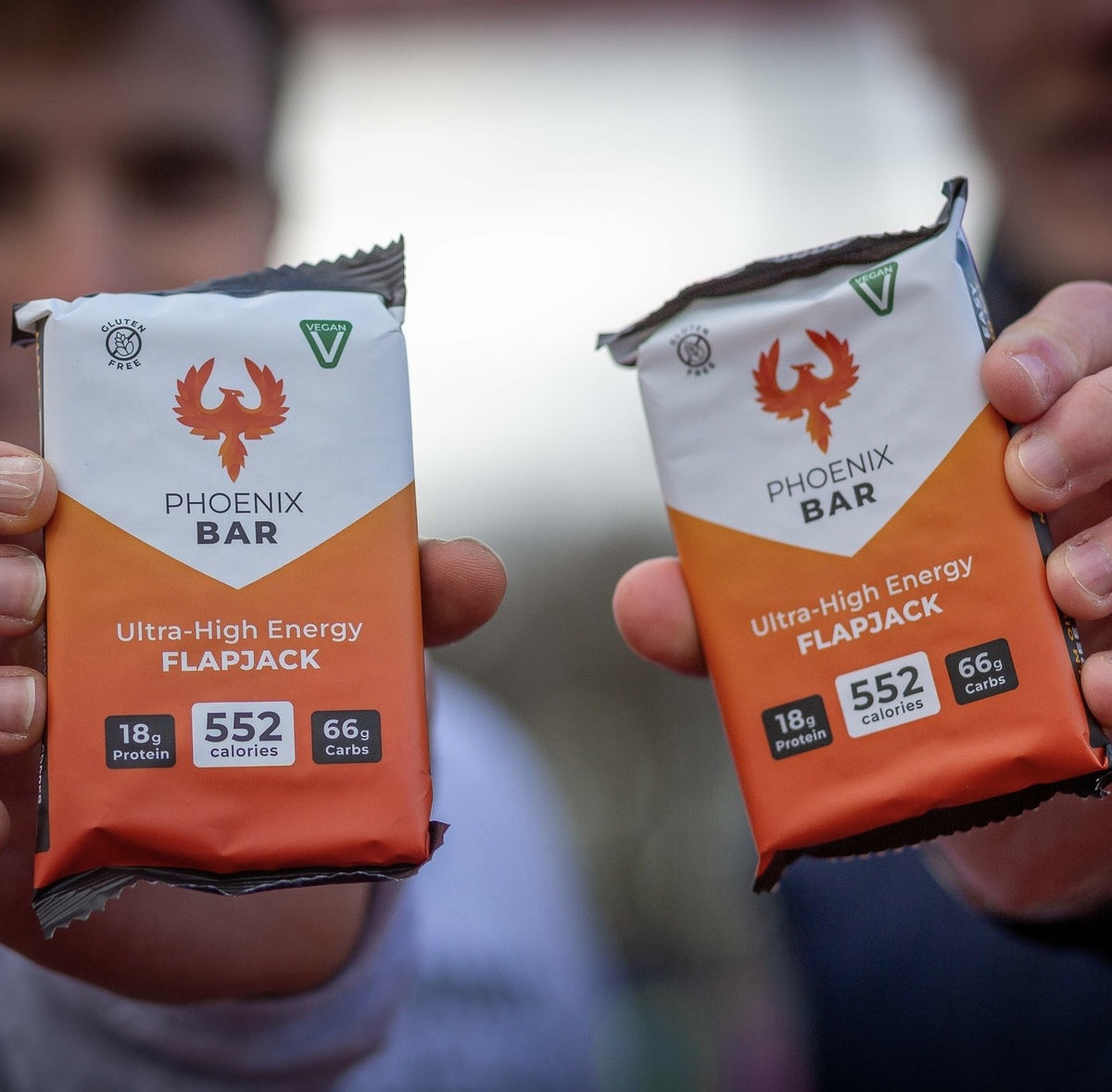
- Phoenix Bars only: 14 bars, weighing about 1.7kg.
That is the difference between a bag you can carry to a rest centre and one you leave behind. It is why I keep tins in the cupboard and bars in the grab bag and the car. My emergency grab bag list and winter car kit checklist cover the rest of what goes in each.
Planning for a winter power cut
Power cuts often come with winter storms, and a home without heating gets cold quickly. Your body burns a little more to stay warm: a UK Health Security Agency evidence review found that most studies of cooler air showed people burning around 50 to 200 extra calories a day. That is why the calculator adds 100 to 200 calories per person for a cool or cold home. Warm layers, blankets and sleeping bags make a far bigger difference than extra food, so sort those first. The Be Ready checklist also recommends a torch rather than candles, because it is safer.
Children, older relatives and anyone with a small appetite
Children cope best with foods they already know, so stock their usual cereal, crackers and snacks rather than anything new. For toddlers, store foods they already eat and soften or cut them as you normally would. For babies, Be Ready recommends ready-to-feed formula, because you may not be able to boil water safely.
Older relatives, and anyone whose appetite drops under stress, often find big portions hard. Foods that pack a lot of calories into a small portion help: nut butter, whole UHT milk, oatcakes with a spread, rice pudding and Phoenix Bars, which carry up to 557 calories in only 120g and mix with water or milk into a soft porridge. My guides to high-calorie foods for older adults and what to eat when your appetite is low have more ideas. If anyone in your household eats a diet set by a doctor or dietitian, or needs special feeds or medication, plan their supply with that professional first.
How to store and rotate your supply
- Keep food somewhere cool, dry and dark, away from big swings in temperature.
- Write the best before dates on the outside of the box.
- Set a reminder every six months, as Be Ready suggests, to check the dates and swap anything close to them.
- Eat the shortest-dated food on walks, commutes or long days, and replace it. A supply you rotate stays fresh.
- Phoenix Bars keep for up to two years (12 months for Cherry Bakewell, so eat those first), and they won't freeze or melt, which suits a car boot.
For what keeps longest, see my guide to long shelf life food, and use the home emergency kit checklist for everything beyond food and water. If you want to buy rations, kits or water containers, my guide to UK prepper shops lists where to look.
Why I built this calculator
Phoenix Bars began as my university project to design a nourishing, very high-calorie bar that could replace inefficient food rations. Today I make high calorie bars for people who need a lot of calories in very little space, from desert ultramarathons to older people with small appetites. When the government asked every household to be ready for three days, the obvious next question was how much food and water that actually means for a real family. This calculator answers it, with the working shown.
Frequently asked questions
How many calories does a person need per day in an emergency?
Plan on a normal day: about 2,500 for an adult man and 2,000 for an adult woman. Humanitarian agencies use 2,100 calories per person per day as the starting average when they plan emergency food for a whole population, children included.
How much food do I need for a family of 4 for 3 days?
Two adults and two children aged 4 to 10 need about 23,100 calories over three days, plus 36 litres of drinking water. With two teenagers aged 15 to 18 instead, the food figure rises to about 29,700 calories.
How much water should I store per person in the UK?
3 litres per person per day for drinking, according to the government's Be Ready advice. That is 9 litres per person for three days, plus extra for cooking, washing and pets.
How many Phoenix Bars would cover 3 days?
About 14 bars for an adult man and 12 for an adult woman if bars were the only food. Most households use fewer: one or two bars a day per person for the grab bag and the car, with tins and cupboard food at home. The 12-bar Starter Bundle carries 6,462 calories, roughly three days for one adult.
Should I plan for 3 days or longer?
Start with three days, which is the UK government's advice and matches the 72 hours recommended across the EU. Once that is in place, stretching to a week is mostly a matter of buying more of what you already store.
Do I need to count calories exactly?
No. The figures are averages, and the point is to have enough, not the perfect amount. If in doubt, round up, and choose food your household will actually eat.
Sources
- GOV.UK, Be Ready for emergencies checklist, October 2026. beready.campaign.gov.uk
- NHS, Understanding calories. nhs.uk
- Scientific Advisory Committee on Nutrition, Dietary Reference Values for Energy, 2011. gov.uk
- WFP and UNHCR, Guidelines for Estimating Food and Nutritional Needs in Emergencies. unhcr.org
- UK Health Security Agency, Additional calorie requirements in extreme cold weather: a rapid evidence summary, 2023. gov.uk
This calculator gives general estimates for planning a household food supply, not medical or dietary advice. Questions about your result? Email me at jfrost@flaming-phoenix.co.uk.

Big calories. Small bar.
Up to 557 calories in a compact, lightweight bar of only 120g, with up to 66g of carbs and 19g of protein. Eat it whole, break it into pieces over a few hours, or mix it with water or milk for porridge.
Easy to eat, easy to digest and not sickly sweet. Customers have eaten them at -45°C and through the heat of the Marathon des Sables, and they keep for up to 2 years, so they work on a mountain, on a night shift, or at home on days when eating enough feels hard.
- 557 calories in only 120g (529 to 557 by flavour)
- 4.6 calories per gram
- 66g carbs per bar (up to)
- 19g protein per bar (up to)
