

Marathon des Sables Training Guide: How to Prepare for MDS
In this guide

 By James Frost, founder of Flaming Phoenix. Updated August 2026.
This is an independent guide for runners and walkers preparing for the Marathon des Sables. Flaming Phoenix is not affiliated with, endorsed by or connected to the race or its organisers. Race facts are drawn from the organiser's published information, and you should always verify current details on the official race website before making decisions.
The Marathon des Sables is a roughly 250 km, six stage footrace across the Moroccan Sahara in which every competitor carries their own food and kit for the week. Preparing well takes six to nine months of structured training, a deliberate heat acclimatisation block, a ruthless approach to pack weight and a proper foot care plan. This guide covers all of it: what the race actually involves, entry and cost, a phase-by-phase training plan, kit strategy, feet, and race week tactics. Food gets only a short section here, because fuelling has its own page: our Marathon des Sables nutrition guide.
What is the Marathon des Sables?
The Marathon des Sables, often shortened to MDS and now officially called the MDS Legendary, is a self-sufficient stage race held in the Sahara since 1986. It covers approximately 250 km in six stages, completed by running or walking, within an eleven day programme in Morocco that includes nine days in the desert. The 2027 race is the 41st edition. It is frequently nicknamed the toughest footrace on Earth, run in early April in conditions that can reach around 45°C by day before dropping towards 10°C at night.
Self-sufficiency is what defines it. You carry everything you need for the week on your back: food, sleeping kit, clothing and survival equipment. The organisation provides only water and the tent. That single rule shapes every part of your preparation, because every decision about training, kit and food eventually becomes a decision about weight.
It is also far more achievable than its reputation suggests. According to the organiser's published figures, more than 30,000 people have completed the adventure. A typical edition features around 60 nationalities, over 30% of the field are walkers, 27% are women, the average age is 47, around 90% of starters finish, and the average pace is 5.2 km/h, with time cut-offs set at a walkable 3.5 km/h. The MDS is a race for well-prepared, stubborn people.
How the race week actually works
The event runs as an eleven day trip, not just six days of racing. Day one is the bus transfer into the desert bivouac. Day two is technical, administrative and medical checks. Stages one to three run on consecutive days, the long stage spans two days, then comes the marathon stage, then a final shorter stage, followed by a night in an Ouarzazate hotel, a prize-giving and gala day, and departures on day eleven.
Distances change with each year's course. The exact route is only revealed in the road book, handed to you at the bivouac two days before the start. As a guide, the 2025 edition ran stages of 32 km, 40 km, 32.5 km, a long stage of 80 to 90 km, a 42 km marathon stage and a 21.1 km final stage. The long stage is the crux of the whole event: get through it and the marathon stage becomes a victory lap with sore feet.
Camp life happens in the bivouac. You sleep in traditional eight person Berber tents, open to the outside, in what amounts to a temporary village that moves every day. Your tent mates become your team, your entertainment and occasionally your medical support.
Water is provided but managed. Checkpoints roughly every 10 km supply water on the course, and you receive a ration on arrival at the bivouac to cover the evening and the following morning. The system has modernised in recent years: you are no longer handed sealed bottles, volunteers pour water into your own bottles at checkpoints, and if you drain a bottle standing there, they refill it. Older guides describing sealed bottle rationing are out of date, which is a good reminder to check the current rules for the year you race.
Entry, cost and the 2027 waiting list
The headline numbers for the 41st edition: the Classic offer costs €3,990 per person and the Superior offer €4,390. Both include the race entry, eight nights in the bivouac, two hotel nights in Ouarzazate with half board, water during the race, medical and organisational support, deferral insurance, a finisher medal and a finisher gift. Demand is now ahead of supply: every offer for the 2027 edition is fully booked, with a waiting list in operation for anyone hoping a place opens up. If you are reading this with 2028 in mind, that sell-out is your reason to enter the moment registration opens and to start preparing before you even have a confirmed bib.
Budget beyond the entry fee. Flights, kit, travel insurance and time off work all add up, and a first-timer building a kit list from scratch should expect the equipment alone to cost a four figure sum. On logistics, most participants fly into Marrakech, with organised transfers taking five to six hours to Ouarzazate, or fly directly into Ouarzazate on fewer available routes.
There is no qualifying standard, but there is a medical file. You must present the original official medical certificate, signed and dated, plus a resting electrocardiogram with its tracing, performed within the month before the start. Digital copies and photocopies are not accepted. Book the ECG appointment early, because this is the piece of admin that catches people out in the final month.
How fit do you need to be?
You need to be an enduring walker before you need to be a fast runner. With cut-offs set at 3.5 km/h and more than 30% of the field walking, the fitness floor is the ability to move steadily for very long days in heat, back to back, under a pack. Nine months out, aim to be comfortable at half marathon distance and holding steady 40 to 60 km training weeks. If you are starting from the sofa, add three to six months to everything in this guide rather than compressing it.
Respect the race even so. The finish rate is high in normal years because the field prepares properly, and the exceptions prove the rule: the postponed 2021 edition, run in unusual October heat, produced one of the highest dropout rates in the event's history. Heat and feet end far more races here than fitness does, which is why both get their own sections below.
The training plan: nine months to the start line
The plan below assumes a runner or run-walker with a half marathon base. Adapt the volumes to your body and history, but keep the order of the phases even if your numbers differ.
Months nine to seven: build the base. Four to five sessions a week, mostly easy. Grow your long run gradually towards three hours. Add two short strength sessions a week focused on calves, glutes and core, because a loaded pack on soft ground punishes weak stabilisers. Start deliberately including long walks: the MDS rewards efficient walking more than any other race, and most competitors walk a large share of every stage.
Months six to four: build specificity. Introduce back to back long sessions every other weekend, for example 30 km on Saturday and 20 km on Sunday, teaching your body to work on tired legs. Bring in the pack at 3 to 4 kg on one long session a week. Enter a 50 km event or organised ultra as a rehearsal with the pack, and practise eating on the move with the same high-calorie energy bars you intend to race with, because race day fuelling is a skill you train, not a plan you write. If you have not picked a bar yet, our guide to the best energy bars for ultra running compares the options. Keep one weekly session hilly, and make some of your long days loaded hill walks; our hiking and trekking nutrition guide covers how to fuel those. If you live near a beach, soft sand walking is the closest free simulation of dunes you will find in the UK.
Months three to two: peak. This is where the biggest fortnights land. Push the back to backs towards 40 km plus 30 km with the pack at 6 to 6.5 kg, close to realistic race weight. If you can, do one multi-day event or a self-organised two to three day fastpack carrying full kit and sleeping out: it will teach you more about your systems in one weekend than a month of single runs. Use it to test your stage food too, starting from our guide to the best foods for ultra running. Practise power hiking with purpose, because a strong 6 km/h march up soft ground beats a shuffle-jog that wrecks you. Train time on feet, not pace.
The final six weeks: sharpen, heat, taper. Freeze your kit choices with a month to go and change nothing new after that. Run your last very long session three weeks out, then taper volume while keeping some intensity. The final ten to fourteen days belong to heat acclimatisation, covered next. Sort feet, admin and packing lists in this window, not race week.
Training with your race pack
Start light and progress slowly. Begin pack sessions at 3 to 4 kg and only reach full race weight for your key back to back weekends in the peak phase; grinding every run under 8 kg is a fast route to injury, not fitness. Spend time dialling in the fit, chest strap position and front bottle setup, because a pack that bounces for 250 km causes chafing that no training can fix. By race week, the loaded pack should feel like clothing. For reference on what full means, experienced multi-time finishers argue there is never a reason to start with a pack over 8.5 kg, and the sharpest packers start between 6.5 and 6.9 kg, while some competitors haul 10, 12 or even 15 kg and pay for every gram. Train for the pack you intend to carry, then carry the pack you trained with.
Heat acclimatisation that actually works
Heat is the variable most UK-based entrants cannot train in naturally, and it is trainable in ten to fourteen days. The established approach among endurance coaches is to add controlled heat exposure in the final fortnight: training in extra layers, sauna sessions of 15 to 30 minutes immediately after easy runs, or hot baths of around 40°C for 20 to 40 minutes post-run, building duration gradually across the block. Done consistently, the body adapts fast: plasma volume expands, sweating starts earlier, and heart rate and core temperature sit lower at the same effort. Three practical rules: build up gradually rather than starting with maximal sessions, hydrate properly around every exposure, and stop if you feel unwell rather than pushing through. Arriving in Morocco a couple of days before the start, which the programme builds in through the transfer and checks days, finishes the job.
The mandatory kit list, explained
The organiser publishes a compulsory equipment list and checks it at the technical controls. For the 2027 edition the mandatory items are: a backpack with at least 1.5 litres of water storage, a sleeping bag, a headlamp of at least 400 lumens with a full set of spare batteries, ten safety pins, a compass accurate to one or two degrees, a whistle, a metal bladed knife, a survival blanket, a signalling mirror, a lighter, antiseptic, your passport, €200 or 2,000 dirhams in cash, at least 50 ml of sunscreen, sunglasses, fourteen stock-style cubes to be taken twice per day, your original medical certificate and resting ECG, and your food. Beyond the mandatory list, sand gaiters are the near-universal recommendation because the course includes fully sandy sections, with poles optional but worth practising with well beforehand.
Then comes the weight rule that governs everything: all your obligatory equipment and personal belongings must weigh between 6.5 kg and 15 kg, excluding your daily water supply, and it is verified at the checks in Morocco. Nobody should go near the top of that range. Most well-prepared competitors start between 6.5 and 9 kg, and the difference between those two numbers is mostly four items: the pack itself, the sleeping bag, the sleeping mat and the food. Spend your money and your ruthlessness there. A race-specific 20 to 30 litre pack, a light sleeping bag matched to cold desert nights, a minimal mat and calorie-dense food will save you kilograms that cheap versions of the same items cannot. Swap heavy, low-density extras for high calorie snacks that earn their grams. Weigh everything on kitchen scales, write the numbers down, and question every single item with one test: will the race go worse without this? If the answer is no, it stays at home.
Feet: the thing most likely to end your race
Ask finishers what ends races at the MDS and the answer is rarely fitness. It is feet, then heat. Sand, sweat, scorching ground and six consecutive days of load create blister conditions that normal running never produces, so your foot plan deserves the same seriousness as your training plan.
Get shoes right first: a trail shoe half a size to a size and a half larger than normal, bought early and worn for every long session, because feet swell over a desert week. Fit sand gaiters that attach fully around the shoe and test them on your longest training days. Find your sock system, single or double layer, and never change it race week. Learn to tape your own feet weeks in advance, practising on training back to backs, and carry your taping kit in your accessible pockets, not buried in the pack. During stages, act on hotspots immediately at the next checkpoint rather than promising yourself you will deal with it at camp. At camp, get shoes and socks off, clean and dry your feet, and deal honestly with damage; a medical tent is available at the bivouac at any time, and the race medics are famously experienced foot mechanics. Trim toenails short a week before travelling.
Food and fuelling, briefly
The rule first: you must carry at least 12,000 kcal, roughly 2,000 kcal per day, with the calorie counts checked at the technical controls. Repacked food must be labelled with its calories, and there is no minimum requirement for the final race day. Note that many older guides still quote a 14,000 kcal requirement: the rules have evolved, so always read the current regulations for your edition.
Strategically, food is a weight problem wearing a nutrition costume. At 2 kcal per gram, the minimum food load weighs 6 kg before you add a single item of kit, which is why calorie density, the calories per gram of everything you pack, is the number to plan your food around: at 4 kcal per gram, the same 12,000 kcal weighs 3 kg. Dense, heat-stable food that you have tested repeatedly in training beats anything chosen in the final week, and experienced finishers agree on one point above all: test every single meal in training rather than discovering in the Sahara that your stomach rejects it. This is the exact problem our high calorie bars were engineered for. Each of our Phoenix Bars packs up to 557 kcal into only 120g that holds together in desert heat. In camp, one dense bar can stand in for a meal, which is why the best meal replacement bars have become standard kit on multi-day races. For the full treatment, including how to structure breakfasts, stage fuel and recovery across the week, and worked examples of hitting the calorie rule at minimum weight, read our dedicated MDS nutrition and fuelling guide.
Race week and stage tactics
Fly in with margin, clear the transfer day, and treat the checks day as a job: documents, kit and calories laid out, then rest. Read the road book properly when it arrives two days before the start and plan each stage checkpoint by checkpoint.
On the course, the pattern that finishes races is unheroic consistency. Start the first stage slower than feels natural, because the field that sprints day one pays for it on day four. Use checkpoints with discipline: fill bottles, take shade briefly, deal with feet, and leave; twenty accumulated minutes of checkpoint drift per stage is two extra hours in the sun across the week. Take the salt provision seriously and follow the organiser's guidance on the cubes taken twice per day. Treat the long stage as two separate races: move steadily through the daylight half, then reset at dusk, switch on the headtorch, and grind the night section as its own event. Rest properly afterwards, then remember on the marathon stage that the race is effectively won: your only job is to keep moving and not do anything new.
Common first-timer mistakes
The same errors repeat every year: packing over 9 kg because everything felt essential at home, when dense high calorie food would have solved half the problem on its own; racing stage one; skipping the heat block because training was going well; running every training kilometre and never practising the walk; new shoes, socks or food in the final month; foot taping learned from a video the night before stage one; forgetting that repacked food must show calorie labels at the checks; and treating the long stage as something to survive on adrenaline rather than something trained for with back to back weekends. Every one of these is avoidable in the months before you fly, and none of them is fixable in Morocco.
Marathon des Sables FAQ
How long do you need to train for the Marathon des Sables?
Six to nine months of structured preparation is the realistic window for someone with a half marathon base, building through general endurance, loaded back to back long sessions, and a final heat acclimatisation block in the last two weeks. Starting from little running history, allow a year.
Can beginners and walkers do the Marathon des Sables?
Yes, with honest preparation. The organiser's own figures show over 30% of the field are walkers, the average age is 47, cut-offs are set at a walkable 3.5 km/h, and around 90% of starters finish. The race rewards steady, well-prepared movers far more than raw speed.
How hard is the Marathon des Sables?
It is hard in specific, trainable ways: daytime heat around 45°C, full self-sufficiency, a long stage of 80 to 90 km, and six consecutive days on your feet. In normal editions roughly nine in ten starters finish, because the difficulty yields to preparation.
How much does the Marathon des Sables cost?
For the 2027 edition, entry costs €3,990 for the Classic offer or €4,390 for the Superior offer, covering the race, bivouac nights, two hotel nights, water and medical support. Flights, kit and insurance come on top, so budget well beyond the entry fee alone.
How far is the Marathon des Sables?
Approximately 250 km over six stages, with exact distances varying by year and revealed in the road book two days before the start. The 2025 edition ran 32, 40 and 32.5 km stages, an 80 to 90 km long stage, a 42 km marathon stage and a 21.1 km finale.
Where do competitors sleep?
In the bivouac, in traditional eight person Berber tents open to the outside, for eight nights, followed by two hotel nights in Ouarzazate after the finish. Your sleeping bag and mat are part of your carried kit, so every gram they weigh is on your back all week.
What happens with water?
Water is provided and managed by the organisation. Checkpoints roughly every 10 km resupply you on the course, and you receive a ration at the bivouac for the evening and morning. Volunteers pour water into your own bottles at checkpoints, with refills available on the spot.
When is the next Marathon des Sables?
The 41st edition, MDS Legendary 2027, runs as an eleven day programme from 2 to 12 April 2027, and every offer is currently sold out, with a waiting list in operation. If you want a future edition, enter as early as registration opens and start preparing before your place is confirmed.
Do you need qualifying races to enter?
No qualification races are required. You must, however, present an original signed medical certificate and a resting ECG performed within the month before the start; digital copies are not accepted.
About this guide
Race facts on this page are drawn from the organiser's officially published event information and regulations. Details change between editions, so always verify current-year rules, dates and prices on the official race website before making decisions.
About the author. James Frost is the founder of Flaming Phoenix and the maker of Phoenix Bars, high-calorie bars used on ultra and multi-day endurance events including the Marathon des Sables, rated 4.9 out of 5 from 391 customer reviews. This guide draws on the organiser's published information and years of conversations with the desert racers we supply.
Flaming Phoenix is an independent company with no affiliation, sponsorship or connection to the Marathon des Sables or its organisers. MARATHON DES SABLES is a trade mark of its owner and is used on this page only to identify the event being described.
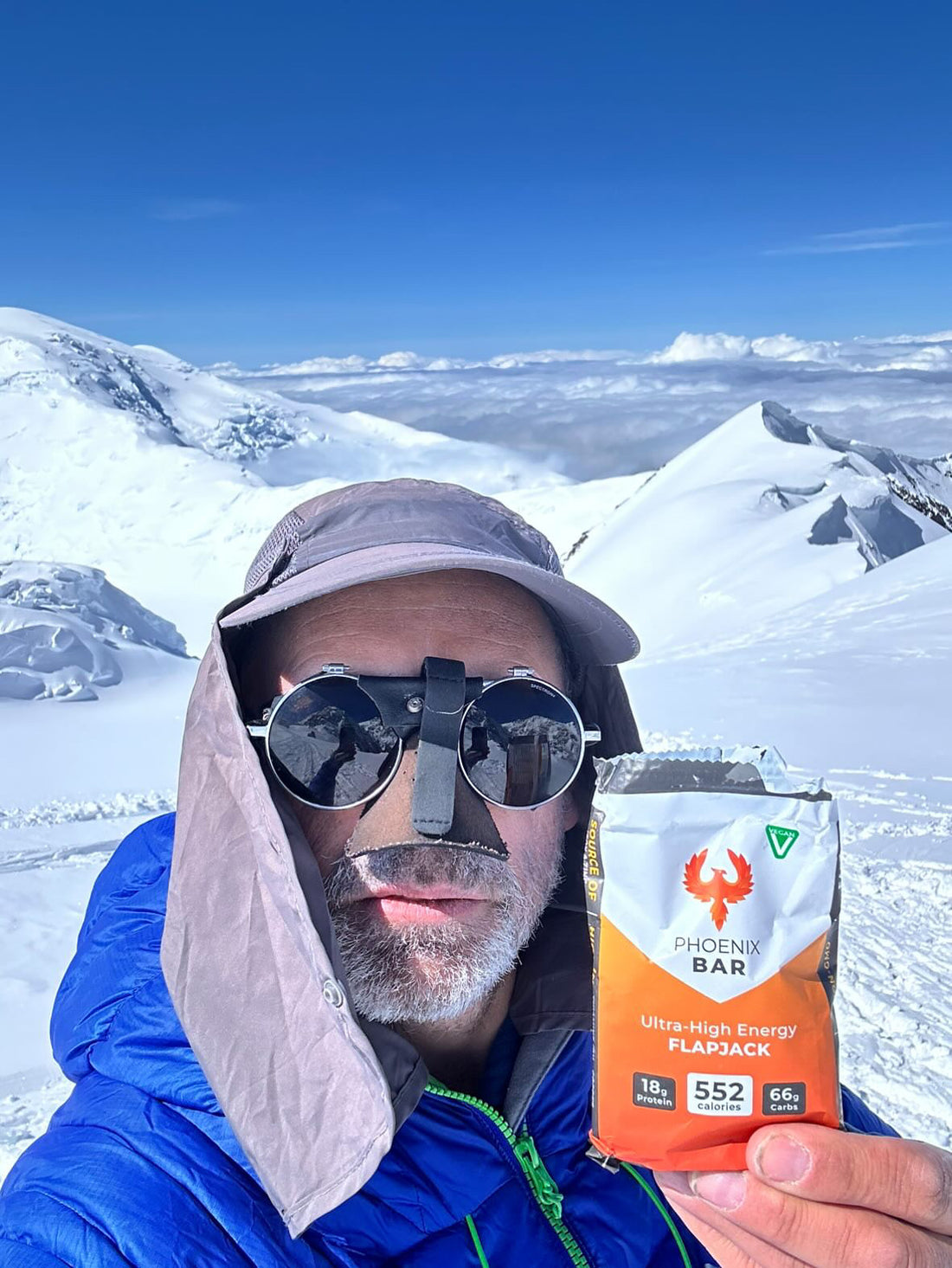
Big calories. Small bar.
Up to 557 calories in a compact, lightweight bar of only 120g, with up to 66g of carbs and 19g of protein. Eat it whole, break it into pieces over a few hours, or mix it with water or milk for porridge.
Easy to eat, easy to digest and not sickly sweet. Customers have eaten them at -45°C and through the heat of the Marathon des Sables, and they keep for up to 2 years, so they work on a mountain, on a night shift, or at home on days when eating enough feels hard.
- 557 calories in only 120g (529 to 557 by flavour)
- 4.6 calories per gram
- 66g carbs per bar (up to)
- 19g protein per bar (up to)
Declare withdrawal
Please fill out the following form to declare your withdrawal from the contract.

