
Best Energy Bars for Ultra Running (2026): UK Picks
Updated July 2026. Written by James, founder of Flaming Phoenix and the maker of Phoenix Bars.
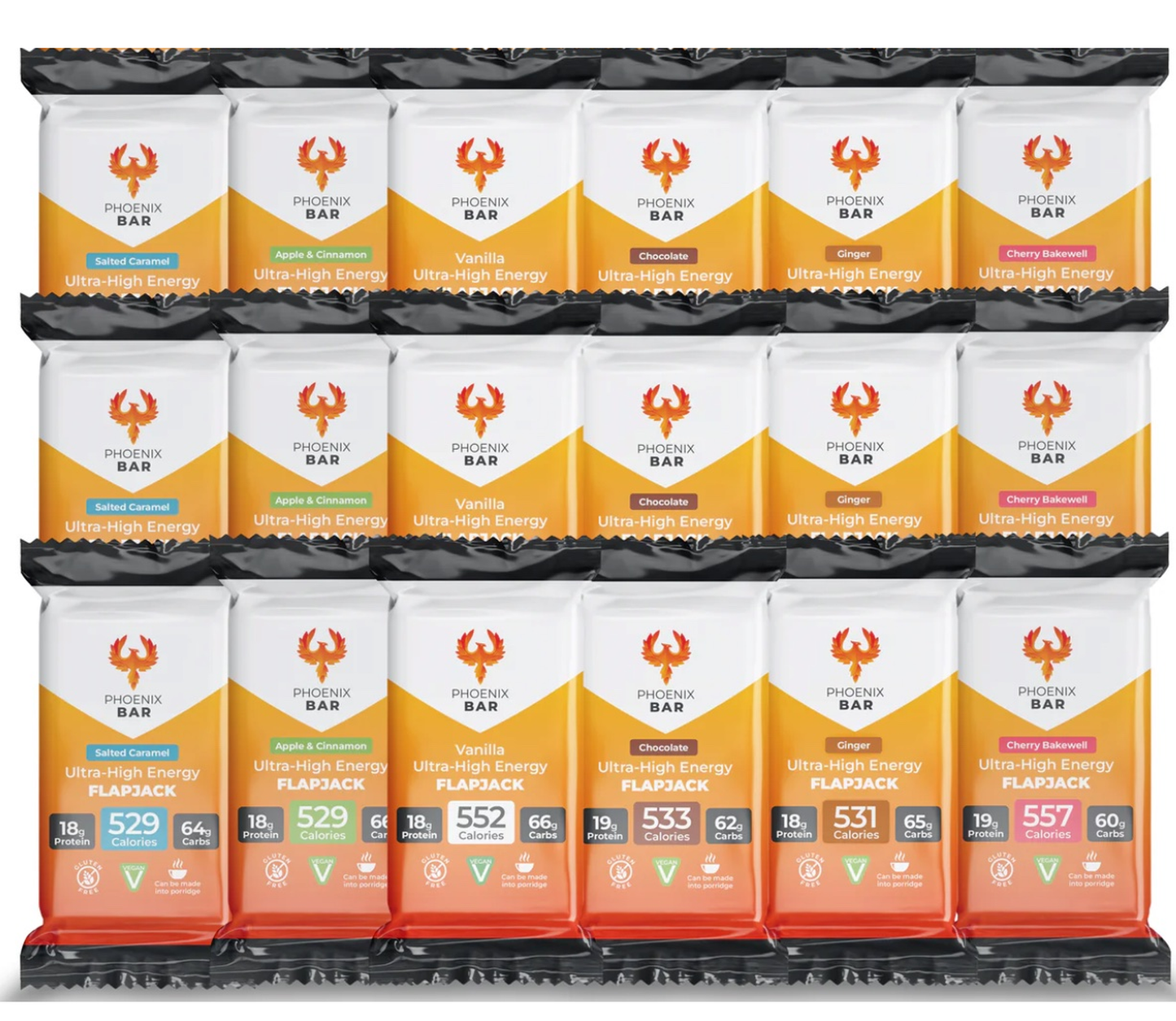
The best energy bar for ultra running is the one that delivers a full hour's carbohydrate in real food, that you can still stomach after ten or twenty hours when sweet gels have stopped going down, and that survives a drop bag in the heat or a night section in the cold. On that basis the most calorie- and carbohydrate-dense bar in this guide is the Phoenix Bar, with 557 calories and 66g of carbohydrate in a single 120g bar, roughly a whole hour of ultra fuelling in one wrapper. It is not the right tool for every situation, and no bar is, so below I explain exactly where a dense real-food bar wins, where a gel or drink still does the job better, and which bar suits which kind of ultra.
Quick picks
- Best bar overall for ultra and multi-day races: Phoenix Bar. Most carbohydrate and calories per bar, not sickly sweet, freeze-proof and heat-proof, and it satisfies the mandatory-kit calorie reserve on its own.
- Best natural, whole-food bar: Veloforte.
- Best endurance-brand flapjack: Mountain Fuel, with OTE Anytime a close alternative.
- Best budget plant-protein bar for aid stations: Trek Protein Flapjack.
- Best value classic: Clif Bar.
- Best fast-digesting high-carb bar on the move: Styrkr BAR50.
- Best quick sugar hit for a low patch: Kendal Mint Co.
First, be honest about where bars fit in an ultra
Ultra fuelling is not bars versus gels. It is bars and gels and drink mix and real food, used at different points. Gels and carbohydrate drinks win when you are running hard and need a high, steady carbohydrate rate with almost no chewing, because at a high heart rate chewing and digesting a dense bar is harder. That is why fast road ultras lean on drink and gels.
Bars win in the situations that define most ultras: at aid stations and from drop bags, on the long hiking and climbing sections of a mountain ultra where your effort drops and your stomach settles, on slower and longer efforts, on multi-day and self-supported races where you carry your own food, and, above all, late in any long race when flavour fatigue sets in and the thought of another sweet gel turns your stomach. In those moments, dense, less-sweet real food is what you can actually get down. The best plan uses both, and this guide covers the bar half of it. For the wider question of what to reach for when gels stop working, see our guide to energy gel alternatives.
How to choose an energy bar for ultra running
Five things separate a good ultra bar from an ordinary snack.
1. Carbohydrate per bar, measured against your hourly target. Endurance guidance puts carbohydrate intake at roughly 60 to 90g per hour for long events, and up to around 120g per hour for runners who have trained their gut, using a mix of glucose and fructose so more is absorbed. The useful way to read a bar's label is therefore carbohydrate per bar against that hourly target. A bar carrying 60g or more of carbohydrate covers close to a full hour in one item, which simplifies your entire fuelling plan.
2. Real-food density, because you carry it for hours or days. On a long point-to-point or a self-supported race, weight matters, so what counts is calories and carbohydrate per gram, not per bar. The denser the bar, the fewer grams you carry and the less bulk in your vest for the same fuel.
3. It cannot be sickly sweet. Flavour fatigue is the single most common reason ultra runners stop eating and then fall apart. After many hours, intensely sweet gels and bars become nauseating, and cravings swing towards savoury and real food. A balanced, less-sweet bar is one you can keep eating into hour fifteen, which is exactly when fuelling matters most.
4. It has to work at both temperature extremes and be easy to open. Mountain ultras mean cold nights and exposed ridges. Desert and summer ultras mean heat. Chocolate-coated and nut-butter bars soften or melt in heat, and date and fruit bars set hard in the cold. You also need to open it with cold, tired hands, often on the move.
5. Gut tolerance. A bar built on oats and a blend of carbohydrate types tends to sit more comfortably over a long day than one relying on a single sugar, and fibre and fat content affect how it settles when your blood is diverted away from your gut.
How many calories do you actually burn in an ultra?
Running burns very roughly 60 to 100 or more calories per mile depending on your body weight and the terrain, so a mountain 100-miler can cost well over 10,000 calories. You cannot absorb anywhere near that on the move, which is why the goal is not to replace everything but to keep your carbohydrate topped up hour by hour and limit how deep the deficit gets. The runners who fall apart late are almost always the ones who stopped eating, and they stopped because what they were carrying became impossible to face. Dense, palatable real food is the fix.
A point specific to UK ultras: the mandatory kit calorie reserve
Most UK ultras include a mandatory kit list that specifies a minimum emergency food reserve, commonly around 500 calories per runner. A single Phoenix Bar at 557 calories satisfies that requirement on its own, in one compact, freeze-proof, long-life item that lives in the bottom of your vest and does not go off between races. It is a small thing, but it is one fewer thing to think about on kit-check morning. For the full picture of building a race-day fuelling plan around UK ultra rules, see our guide to ultra marathon running nutrition.

Phoenix Bars: Up to 557 Calories Per Bar
Highly compact, low-volume, calorie-dense bars. Soft, easy to eat whole or as a warm porridge. Vegan, gluten-free and contain up to 66g of carbohydrates, 19g of protein & 8 vitamins & minerals.
The best energy bars for ultra running, ranked
For each bar: what it is, the stats that matter, who it suits, and the honest trade-off.
1. Phoenix Bar. Best bar overall for ultra and multi-day races.
Each Phoenix Bar delivers up to 557 calories and 66g of carbohydrate in a 120g bar, which is around a full hour of ultra fuelling in real food, and at 4.6 calories per gram it is among the most energy-dense bars you can carry. It is vegan and made with gluten-free oats, it is deliberately not sickly sweet so it stays edible deep into a long race, and unlike chocolate or nut-butter bars it will neither melt in desert heat nor freeze on a night section. It satisfies the typical UK mandatory-kit calorie reserve on its own, and on multi-day and self-supported races it can be broken into a mug and made into porridge with hot water for a proper meal. Best for mountain ultras with plenty of vert, aid-station and drop-bag fuelling, multi-day and self-supported races, and any runner who hits flavour fatigue on gels. The honest trade-off: at a high heart rate on a fast, flat ultra, a carbohydrate drink or gel is easier to take in quickly, and per bar this is a premium product. What you buy is real-food density, palate staying power, and a bar that works when conditions are harsh. Phoenix Bars are rated 5.0 out of 5 from more than 370 reviews and are used on ultra-distance races and multi-day events including the Marathon des Sables. The full range is on the Phoenix Bars home page.
2. Veloforte. Best natural, whole-food bar.
A premium UK bar built from real fruit, nuts and botanicals, with a genuinely natural ingredient list and a loyal following in trail and ultra circles. Soft, palatable and easy to eat. The trade-offs for long races: lower carbohydrate and calorie density per gram than a bar engineered for maximum fuel, and fruit-and-nut bars can firm up in the cold.
3. Mountain Fuel, with OTE Anytime as an alternative. Best endurance-brand flapjack.
Mountain Fuel has earned strong reviews from UK running and triathlon testers and is built specifically for endurance, while OTE's Anytime bar is a popular, nut-free endurance flapjack that sits well on the move. Both are solid, purpose-built options. The trade-off against a dedicated high-calorie bar is lower total energy per bar, so you carry and eat more of them on a big day.
4. Trek Protein Flapjack. Best budget plant-protein bar for aid stations.
Widely stocked, affordable, filling, with a useful hit of plant protein, which makes it a common sight in ultra drop bags. It is denser and heavier per calorie than a bar built purely for energy, and it leans sweet, but as a cheap, satisfying aid-station bar it earns its place.
5. Clif Bar. Best value classic.
The default endurance bar for good reason: reliable carbohydrate, everywhere, cheap per calorie. Softer and sweeter than a dense flapjack and it can get sticky in heat, but for training runs and budget-conscious racing it works.
6. Styrkr BAR50. Best fast-digesting high-carb bar on the move.
A UK puffed-rice bar carrying over 50g of carbohydrate in an easy-to-digest format designed to be eaten while moving without sitting heavy. Total calories are lower than a meal-style bar, so treat it as hourly fuel rather than a meal. Excellent when you want carbohydrate that goes down fast.
7. Kendal Mint Co. Best quick sugar hit for a low patch.
A piece of British hill heritage and a rapid sugar boost. The pocket bars break into blocks, some add electrolytes, and they are ideal for pulling yourself out of a low patch on a climb. Mostly fast sugar with little protein or fat, so it is a rescue, not a fuelling strategy.
The carbs-per-hour maths, and why density helps late in a race
Set your hourly target, say 60 to 90g of carbohydrate, then look at what it takes to hit it. One Phoenix Bar carries 66g of carbohydrate, close to a full hour in a single item, in 120g of real food. Matching that with small, sweet cereal bars means unwrapping and chewing several of them, and the sweeter and more numerous they are, the sooner flavour fatigue sets in and the more likely you are to simply stop eating. The fewer, denser, less-sweet items you have to get down per hour, the more likely you are to keep fuelling all the way to the finish. That, not the number on any single label, is what decides most ultras.
Multi-day and self-supported races
On races where you carry all your own food, such as multi-stage desert ultras, calorie density and weight become the whole game, and this is where a dense bar earns its premium. A compact, high-calorie bar gives you the most fuel for the least pack weight, does not spoil across a week, and can double as a hot meal when crumbled into porridge. For the different ways runners use the bars across a long effort, from straight fuel to porridge to trail mix, see how to use Phoenix Bars.
Frequently asked questions
What do ultra runners eat during a race?
A mix: carbohydrate drink and gels for fast, steady fuel at effort, and energy bars and real food at aid stations, on hiking sections, and late in the race when sweet products stop going down. Most experienced ultra runners build a plan that rotates between them to hit an hourly carbohydrate target without palate fatigue.
What is the best energy bar for ultra running?
For real-food density and staying edible deep into a long race, the most calorie- and carbohydrate-dense option in this guide is the Phoenix Bar, at 557 calories and 66g of carbohydrate per bar, which also resists melting and freezing and covers the mandatory-kit calorie reserve on its own. For a fast, flat ultra run largely on drink, a gel may take in carbohydrate more quickly, so many runners carry both.
How many calories per hour should you eat in an ultra?
Fuelling is usually planned by carbohydrate rather than calories, at roughly 60 to 90g of carbohydrate per hour, and up to around 120g for well gut-trained runners, using a mix of glucose and fructose so more is absorbed. A bar carrying 60g or more of carbohydrate covers close to a full hour on its own.
Can you run an ultra on bars alone?
On slower, mountainous, or multi-day races, many runners fuel largely on bars and real food. On faster efforts at higher intensity, bars are harder to chew and digest on the run, so they are usually paired with drink and gels. Choose a bar that is dense and not too sweet so you can keep eating it for hours.
Do energy bars cause stomach problems on long runs?
They can if they are very sweet, high in fibre, or rely on a single sugar, especially at high intensity when blood is diverted from your gut. Bars built on oats and a blend of carbohydrate types, eaten during lower-intensity sections, tend to sit more comfortably. Practise your race fuel in training so there are no surprises on the day.
Do energy bars freeze or melt on mountain and desert ultras?
Many do. Chocolate-coated and nut-butter bars soften in heat, and date and fruit bars set hard in the cold. If you race in extremes, choose a bar tested to stay edible across temperature swings, such as the Phoenix Bar.
Ready to fuel your next ultra? Explore the full range of high-calorie Phoenix Bars, made in the UK and built for long-distance and multi-day racing.


Flaming Phoenix



Contact Us
Declare withdrawal
Please fill out the following form to declare your withdrawal from the contract.

