
3-day emergency food supply list (UK): food you would actually eat
In this guide

 Written by James Frost, founder of Flaming Phoenix and the maker of Phoenix Bars. Updated November 2026 and checked against the government's Be Ready checklist.
Quick answer: For a 3-day emergency food supply in the UK, stockpile long-life food that needs no cooking: tinned fish, meat, beans and fruit, oatcakes, nut butter, nuts, dried fruit and dense bars. Each adult needs about 6,000 to 7,500 calories for the three days, plus 9 litres of drinking water (3 litres a day). Start with food your household already eats.
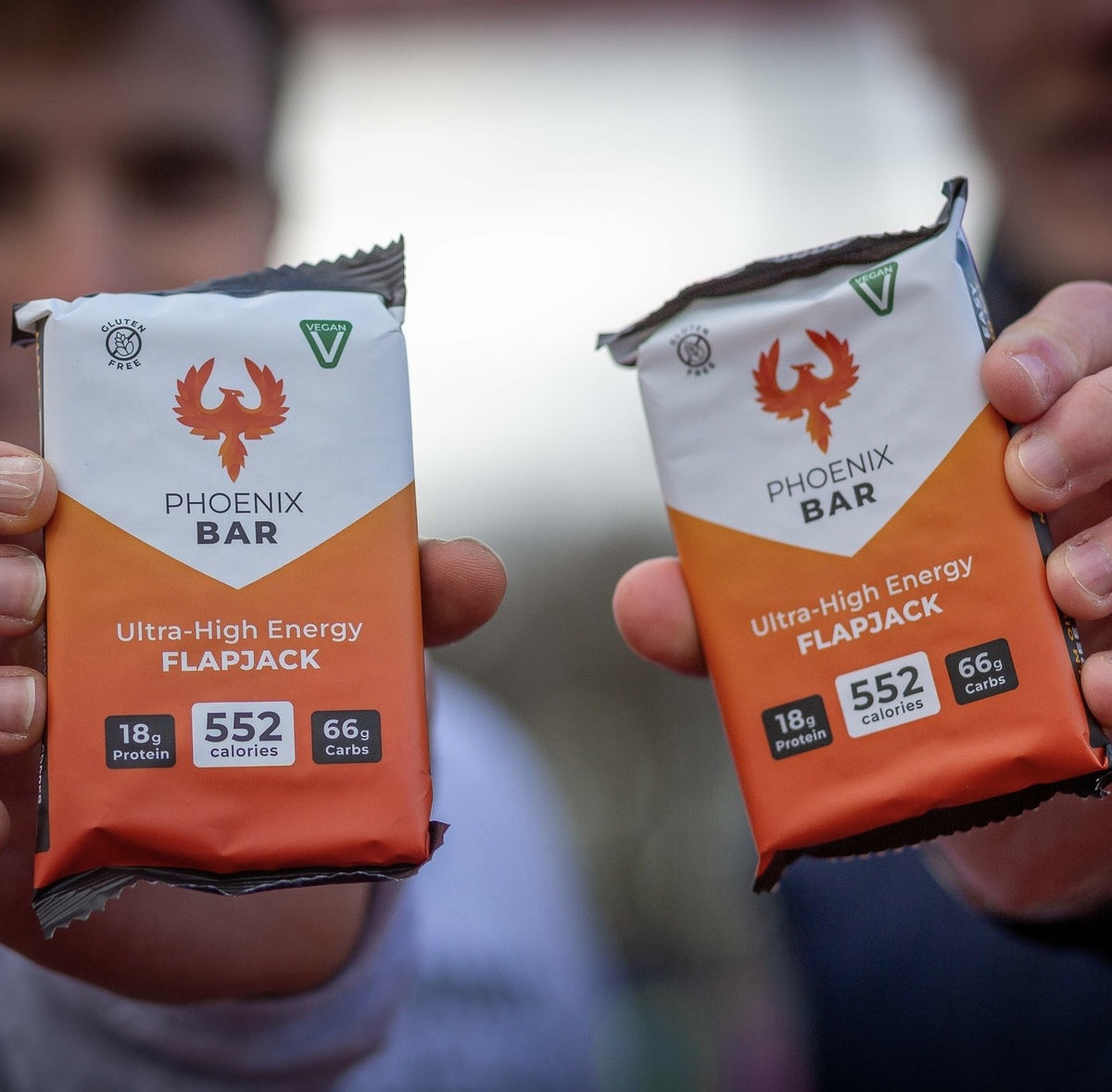
A Phoenix Bar, which I make, carries up to 557 calories in a compact, 120g bar, needs no cooking and keeps for up to two years. The shopping list below comes to 7,178 calories for one adult and fits on a single cupboard shelf.
That matches the government's new Be Ready advice, published on 22 October 2026, which asks every household to be ready to manage on its own for 3 days while help reaches the people who need it most. You do not need to buy it all at once, and you do not need a bunker. Most UK emergencies are short: when Storm Arwen cut power to nearly a million homes in November 2021, Ofgem's review found 82% were reconnected within 24 hours, although nearly 4,000 homes went without power for over a week.
Why I wrote this guide. Phoenix Bars started as my university project: a nourishing, very high-calorie bar designed to do the job of an emergency ration better. Since then, customers have taken them through the Marathon des Sables and to the South Pole, and I have spent years talking to people about what they can actually eat when there is no kitchen. I also keep bars back from every production run and taste them every three months to check how they hold up over their shelf life. This guide applies the same thinking to a kitchen cupboard: calories you can count, food you will actually eat, and a supply that is easy to keep fresh.
What is the government's Be Ready advice?
Be Ready is the government's emergency preparedness campaign. It replaced the old Prepare website on 22 October 2026 and asks households to be ready for 3 days of disruption, such as a long power cut, a water outage, severe weather or a problem with phone and payment systems. You can download the official Be Ready checklist and print it.
The checklist, in short:
- Water: bottled water for 3 days, at 3 litres per person per day for drinking, with more needed for cooking and washing.
- Food: non-perishable food for 3 days that needs no fridge and no cooking, such as tinned meat, fish or vegetables, dried fruit and nuts, ideally food you already eat.
- Hygiene: hand sanitiser, wet wipes and bathroom products.
- Light and warmth: a torch with spare batteries (torches are safer than candles), plus blankets, sleeping bags and warm clothing, because homes cool quickly when the heating stops.
- Communication: a battery or wind-up FM radio, and a charged power bank for phones or compatible medical devices.
- Money and documents: cash in coins and notes as well as cards, printed copies of important documents, and a written list of phone numbers and any regular medication and doses.
- Medical: a first aid kit and essential medication, ordering repeat prescriptions up to 5 working days before you need them.
- Baby and pet products: ready-to-feed formula, nappies and wipes, and pet food and water.
Compared with the old Prepare advice, the 3-day target is now explicit, the water figure is a drinking figure of 3 litres per person per day, and cash, document copies and a written list of numbers and medicines are on the list. The checklist also asks you to set a reminder every six months to check dates. The spirit is the same: build it gradually during normal shopping trips, starting with what is already in your cupboards. There is no need to panic buy. For the full kit beyond food, see our home emergency kit checklist and our guide to emergency water storage.
A 3-day emergency food supply list for one adult (with calories)
An adult needs about 6,000 to 7,500 calories for three days, based on the NHS guide of around 2,000 calories a day for women and 2,500 for men. This list reaches that using only UK supermarket food that needs no cooking. Calories are worked out from McCance and Widdowson's UK food tables.
- Oatcakes, 300g: 1,359 calories.
- Smooth peanut butter, 200g: 1,214 calories.
- Sardines in oil, 180g drained (two small tins): 396 calories.
- Corned beef, one 340g tin: 697 calories.
- Baked beans, two 400g tins, eaten cold if need be: 648 calories.
- Fruit cocktail in juice, two 400g tins: 360 calories, and the juice counts as fluid.
- Salted peanuts, 200g: 1,204 calories.
- Milk chocolate, 100g: 519 calories.
- Two shop-bought flapjacks, 180g: 781 calories.
Total: 7,178 calories, about 2,400 a day, in roughly 3.1kg of food before tins and packaging. It fits on one cupboard shelf, and every item is something most people eat anyway, which makes rotating it easy. Add 9 litres of drinking water per person.
Meat-free version: swap the corned beef and sardines for two 400g tins of chickpeas or mixed beans (about 550 calories drained) and an extra 100g of peanuts (about 600 calories), which keeps the total at roughly 7,200 calories.
No tin opener? Choose ring-pull tins where you can, and keep a manual tin opener in the same box anyway.
How much food and water does your household need for 3 days?
Work it out person by person, then add pets. Water is the same for everyone: 3 litres per person per day for drinking, so 9 litres each for three days. My emergency food calculator adds it all up for your household. Food varies by age:
- Adults: about 6,000 to 7,500 calories each for three days.
- Teenagers: close to adult amounts.
- Primary school children: roughly 1,600 to 2,000 calories a day, so about 5,000 to 6,000 for three days.
- Under-fives: roughly 1,000 to 1,400 calories a day plus their usual milk, and ready-to-feed formula for babies.
- Pets: three days of their usual food plus water. A common rule of thumb for dogs is about 50ml of water per kg of body weight a day, so around 1 litre a day for a 20kg dog. Ask your vet if your pet has particular needs.
Worked examples:
- One adult: about 7,000 calories (the list above) and 9 litres of water.
- Two adults: about 13,500 calories and 18 litres of water, which is nine 2-litre bottles.
- Two adults and a 20kg dog: about 13,500 calories, 21 litres of water and three days of dog food.
- Two adults and two primary-age children: about 24,000 calories and 36 litres of water, or eighteen 2-litre bottles.
- Four adults: about 27,000 calories and 36 litres of water.
The simplest way to scale the shopping list is one copy per adult and about three quarters of a copy per primary-age child. For most families water takes far more room than food: 36 litres of bottles fills more space than three days of food for all four people.
What food should you stockpile in the UK?
The best foods to stockpile need no fridge or cooking, keep for months, and are things your household already eats: tinned fish, meat and beans, tinned fruit, oatcakes and crackers, nut butter, nuts, dried fruit, UHT milk and dense bars. Our guide to the best food to stockpile in the UK lists 50 foods to buy, aisle by aisle, with how much you need for 3 days, a week or a month, and our non-perishable food list shows how long each one keeps. A calorie-dense bar can also stand in for a meal when cooking is off the table, and my guide to meal replacement bars compares the main UK options.
High calorie emergency food: more calories in less space
If space is the limit, choose food above about 4 calories per gram that needs no preparation: salted peanuts (6.0), chocolate (5.2), oatcakes (4.5), flapjack (4.3) and dense bars at 4.3 to 4.6. Phoenix Bars carry up to 557 calories in only 120g (4.6 calories per gram), need no cooking or water, and keep for up to two years (12 months for Cherry Bakewell). Our guide to calorie-dense foods ranks more of them.
Do chocolate bars and cereal bars count as emergency food?
Yes, with two catches. Chocolate is calorie-dense and almost everyone eats it, but it melts in a warm car or a hot summer. Many supermarket cereal bars carry only about 100 to 200 calories each, so three days of them would take a whole box per person.
Dense, long-life high calorie bars close that gap. One Phoenix Bar carries up to 557 calories and will not freeze or melt, so it suits a car or a grab bag as well as the cupboard. To compare what's on sale, my ranking of the highest calorie bars in the UK lists them per bar and per gram.
What food to put in an emergency grab bag
Be Ready suggests keeping a few essentials in a spare bag in case you have to leave home quickly. A bag gets carried, so aim for about a day of no-cook food in around 500g: two Phoenix Bars, 150g of salted peanuts and a 100g bar of milk chocolate come to about 2,500 calories in 490g. Our full emergency grab bag list covers everything else to pack, from documents and medication to how heavy the bag should be. If you need to plan for 72 hours away from home, my bug out bag list covers that bigger kit.
What food to keep in your car in winter
Be Ready recommends a few essentials in the car boot in case you get stuck in wintry weather, including a torch, an in-car phone charger, warm clothes and blankets, high-visibility clothing, jump leads, food and drink, a shovel for snow and a first aid kit. My winter car kit checklist goes through each item.
For the food, keep water and compact food that copes with cold and heat: nuts, flapjack and dense bars. Chocolate can melt in summer, and tins add weight and need an opener. Cars get hot in summer and cold in winter, so check car food every few months and replace it well before its date.
Emergency food for older relatives and anyone with a small appetite
Be Ready asks households to agree a backup plan with anyone who might need extra support, particularly people who live alone, and to check on neighbours if the power goes out. Food is part of that plan.
Someone with a small appetite may only manage a few mouthfuls at a time, so a full tin of stew can be too much. Small portions of calorie-dense food that can be eaten cold work better, little and often:
- Nut butter on oatcakes.
- A handful of nuts, or smooth nut butter if chewing is hard.
- Tinned rice pudding or custard.
- Dried fruit.
- A few squares of chocolate.
A dense bar can be broken into pieces through the day, or mixed with water or milk into a soft porridge. Our guides to high-calorie foods for older adults and what to eat when your appetite is low go into more detail.
If someone relies on a medical device or takes regular medication, keep their medication list in the kit and check whether they can join the Priority Services Register, which tells energy and water companies that a household needs extra support during an outage. Many households qualify, including those with children under five.
If anyone in your home eats vegan or gluten-free, or avoids particular allergens, build their supply from foods they already trust and check every label. Phoenix Bars are vegan and gluten-free.
Emergency food for families with children and babies
For children, the best emergency food is food they already know and eat happily on a normal day, because an emergency is a bad time to introduce anything new. Include their usual cereal bars, crackers, dried fruit and tinned fruit, and something warm if you have a safe way to boil water.
For babies, Be Ready advises ready-made or ready-to-feed formula, because you may not be able to boil water to make up powdered formula safely.
What are emergency rations, and are they worth buying?
Emergency rations are compressed, long-life biscuits and bars made to keep for 5 to 20 years and be eaten straight from the pack, at around 2,300 to 2,500 calories per 500g. They suit grab bags, cars and boats, where food has to sit untouched for years and then work first time; for a home supply, food you already like is easier to rotate. Our guide to emergency rations in the UK compares Seven Oceans, NRG-5, Datrex, SOS, ration packs and more.
Emergency food kits
Ready-made emergency food kits range from single-person 72-hour boxes to months of freeze-dried tins. Before buying one, divide the total calories on the label by the number of days claimed, and check whether the meals need hot water. A 3-day kit that supplies 1,200 calories a day is a very different thing from one that supplies 2,400.
Which emergency foods last longest?
Freeze-dried tins last longest, sold with shelf lives of up to 25 years, then compressed emergency rations at 5 to 20 years; tinned food, ration packs and dense bars sit around one to a few years. For everyday foods ranked by how long they keep, see my guide to long life food.
- Freeze-dried meals in tins: up to 25 years, according to sellers such as ReadyWise, but every meal needs hot water. Freeze-dried meals are excellent if you have a gas hob or camping stove; in an evacuation you may not.
- Emergency rations: 5 years for most lifeboat biscuits and ration bars, up to 20 years for NRG-5, ready to eat.
- Military ration packs: the MOD requires at least 24 months of shelf life to remain when packs enter its supply chain; our guide to army ration packs covers what is inside them.
- Tinned food: check the best before date on each tin and rotate.
- Phoenix Bars: up to two years (12 months for Cherry Bakewell). I keep bars back from every production run and taste them every three months to check how they hold up.
For a side-by-side of freeze-dried buckets, ration packs, biscuit rations and pantry staples, see our guide to survival food in the UK.
How do you rotate an emergency food supply?
Be Ready suggests a reminder every six months to check dates and swap out anything that needs replacing. I would check every three months: open the cupboard, use anything within a few months of its date in everyday meals, and put fresh stock at the back. It takes about ten minutes.
First in, first out solves the biggest problem with emergency food, which is forgetting it exists. Eat the tins for a lazy dinner, and take the nuts and bars on a walk or into long shifts. With food that keeps for a year or two, nothing should ever reach its date.
What should you eat first in a power cut?
Eat chilled food first, then defrosted food that needs no cooking, then perishable food kept at room temperature, and only then the tinned, bottled and dried food in your supply. That order comes from the Food Standards Agency, which says a fridge stays cold for up to 4 hours and a full freezer for up to 48 (24 if half full) with the doors kept shut.
To report a power cut, call 105 in England, Scotland and Wales, or 03457 643643 in Northern Ireland. Write the number on paper, because your phone may be flat.
What about preparing for longer than 3 days?
For anything longer, scale the same plan up with cupboard staples and make water your first priority. For a week, multiply the three-day list by two and a third, and add rice and pasta if you have a safe way to cook.
The old Prepare website allowed about 10 litres per person per day for drinking, basic cooking and washing. That is 70 litres per person for a week, so water, not food, is usually what limits a longer supply. If you want to go further than the basics, my beginner's guide to prepping in the UK is the place to start.
A warm meal makes a long disruption much easier to live with. Only cook indoors on a gas hob or on a camping stove that the manufacturer says is safe for indoor use; the Food Standards Agency warns that most camping stoves and barbecues are designed for outdoor use only.
Common questions about emergency food
Is the government telling people to stockpile food?
Not in the panic-buying sense. Be Ready asks households to build up 3 days of supplies gradually, during normal shopping trips, starting with what they already have. It is preparation for short disruptions such as storms and power cuts, not a reason to clear the shelves.
Does the government give out free emergency kits?
No. Be Ready is advice and a downloadable checklist rather than a free kit. It suggests checking what you already have first, and if you have spare items, donating them to people who cannot afford to prepare.
How much water does a family of four need for 3 days?
36 litres for drinking, which is 3 litres per person per day, or eighteen 2-litre bottles. You would need more for cooking and washing.
How much food do two adults and a dog need for 3 days?
About 13,500 calories for the two adults (two copies of the list above) plus three days of the dog's usual food. For water, allow 18 litres for you and roughly 3 litres for a 20kg dog.
Can I just buy supermarket food for emergencies?
Yes, and for a home supply it is the best option. Tinned fish and meat, beans, tinned fruit, oatcakes, crackers, nut butter, nuts and UHT milk cover most needs, as the three-day list above shows. Supermarket food only falls short for a grab bag or car kit, where weight and space matter; there, compact, calorie-dense options that need no preparation work better.
Should I buy military ration packs?
They work, and one or two make a good addition to a cupboard supply. A British Army 24-hour pack holds around 4,000 calories, more than most people need while sitting out a power cut, and its main meals are heavy wet pouches. Our guide to army ration packs lists the current menus. For the US equivalent, my guide to MREs in the UK covers what's inside and where to buy them.
What about freeze-dried meals?
They are light and keep for years, and many taste good, but every meal needs hot water. In a power cut you may still have a gas hob; in an evacuation you may not. Build the core of your supply around food that needs no water or preparation, and treat freeze-dried meals as an extra for when you can boil a kettle.
Does tinned food go off after its best before date?
Best before dates are about quality, not safety, so an undamaged tin past its best before date is usually still safe to eat; make it the first thing you use when you rotate. Use by dates are about safety, so do not eat food past its use by date. Throw away any tin that is bulging, leaking or badly dented.
I live in a flat with limited storage. What is the minimum kit?
For one person for three days: 9 litres of bottled water, about 7,500 calories of no-cook food (the grab-bag list above three times over weighs about 1.5kg), a torch, a radio and a power bank. That fits in one box under a bed, and it covers the short disruptions that are by far the most common in the UK. Twelve Phoenix Bars, which I make, carry over 6,300 calories in only 1.44kg and need no cooking or water.
Sources: GOV.UK Be Ready, be ready for emergencies; Be Ready checklist (PDF); Priority Services Register; Food Standards Agency, food safety in a power cut; British Red Cross, prepare an emergency kit; NHS, understanding calories; Ofgem, Storm Arwen review; CoFID 2021; Seven Oceans and ReadyWise product listings, checked October 2026.

Big calories. Small bar.
Up to 557 calories in a compact, lightweight bar of only 120g, with up to 66g of carbs and 19g of protein. Eat it whole, break it into pieces over a few hours, or mix it with water or milk for porridge.
Easy to eat, easy to digest and not sickly sweet. Customers have eaten them at -45°C and through the heat of the Marathon des Sables, and they keep for up to 2 years, so they work on a mountain, on a night shift, or at home on days when eating enough feels hard.
- 557 calories in only 120g (529 to 557 by flavour)
- 4.6 calories per gram
- 66g carbs per bar (up to)
- 19g protein per bar (up to)
