
Wild Camping in the UK: Where It's Legal, and Where to Go
Updated September 2026. Written by James, founder of Flaming Phoenix and the maker of Phoenix Bars.
Wild camping is legal in most of Scotland and on the Dartmoor commons in Devon. Everywhere else in the UK it needs the landowner's permission, though in a few upland areas it is widely tolerated in practice if you arrive on foot, pitch late, and leave at first light.
That one distinction between legal and tolerated is the thing most guides skip, and it matters. If you have a right to be there, nobody can move you on. If you are being tolerated, a landowner can ask you to pack up, and you have to go.
Is wild camping legal in the UK?
It depends which nation you are standing in.
Scotland: yes, by statute. The Land Reform (Scotland) Act 2003 gives everyone a right of responsible access to most land and inland water, and that right includes lightweight camping. The conditions are set out in the Scottish Outdoor Access Code. The right does not cover enclosed fields with crops or farm animals in them, land next to a house, school grounds, golf courses, or building sites. One important exception: Loch Lomond and The Trossachs National Park operates camping management zones where you need a permit during the main season. Check the park's current dates and zone map before you go, because they have changed more than once.
England: no general right, with one legal exception. The Countryside and Rights of Way Act 2000 opened up a lot of mapped open country to walkers, but access on foot is not the same as a right to sleep there, and camping is specifically excluded. The exception is Dartmoor. Section 10(1) of the Dartmoor Commons Act 1985 gives the public a right of access to the commons for open-air recreation, and on 21 May 2025 the Supreme Court ruled unanimously that this includes backpack camping. That ruling ended a case brought by landowners Alexander and Diana Darwall, who had won in the High Court in January 2023 before losing at the Court of Appeal in July 2023. Dartmoor is now the only place in England where you can camp in open country without asking anyone.
Wales: no right. Eryri, the Bannau Brycheiniog and the rest of Wales are all permission-only. Camping high on the Carneddau or in the Rhinogydd is often left alone, but the national park actively discourages it at the busy honeypots, and that is a request worth respecting rather than a rule worth testing.
Northern Ireland: no right. Camping needs the landowner's consent. Forest Service sites are the straightforward option, and the Mournes are managed carefully enough that turning up unannounced is not welcome.
Where can you wild camp in the UK?
The places that are genuinely worth the walk are mostly in Scotland, because that is where the law is on your side.
The far northwest is the best of it. Assynt and Sutherland give you sandstone hills standing alone above bog and lochan, with almost nobody in them outside August. Torridon has the most dramatic ground for the least effort. Knoydart can only be reached on foot or by boat, which does the crowd control for you. Glen Affric is the gentler option, all pinewood and water, and forgiving if it is your first night out.
For high camps, the Cairngorm plateau is the biggest area of genuinely arctic ground in Britain, and it should be treated that way rather than as a summer stroll. Rannoch Moor and Glen Etive are easy to reach from the A82, which is exactly why the roadside pull-ins get abused and now carry restrictions in places. Walk in twenty minutes and the problem disappears.
Out on the islands, the machair and beaches of Harris, the Uists and Barra are hard to beat, and Jura will give you a week without meeting anyone.
In England, Dartmoor is the one place you can pitch with a clear conscience and no permission, and the national park authority publishes a map of where camping is permitted across the commons. Check it before you set off rather than after, because the permitted areas are not the whole moor.
In the Lake District there is no legal right anywhere, but camping high on the fells above the highest field wall has been tolerated for decades, and the National Trust has generally taken a pragmatic view of small tents pitched late and gone early. I am deliberately not naming individual tarns here. The best-known ones are already suffering from being named, and a page that sends another few thousand people to the same patch of grass is part of the problem rather than a guide.
What does responsible wild camping actually mean?
Small tent, high ground or well away from roads and houses, one or two tents rather than a group, arrive in the evening and be gone in the morning. No fires: they scar the ground for years, and on peat they can burn underground for weeks. Everything you carry in comes out with you, including food scraps, because orange peel and teabags do not vanish and they teach animals to scavenge. Toilet waste goes in a hole at least 30 metres from water, and paper comes home in a bag. Wash away from streams and lochs, and skip the soap.
If someone asks you to move, move. Politely and immediately. The tolerance that makes camping possible in England and Wales exists because most people have done this for years without causing trouble.

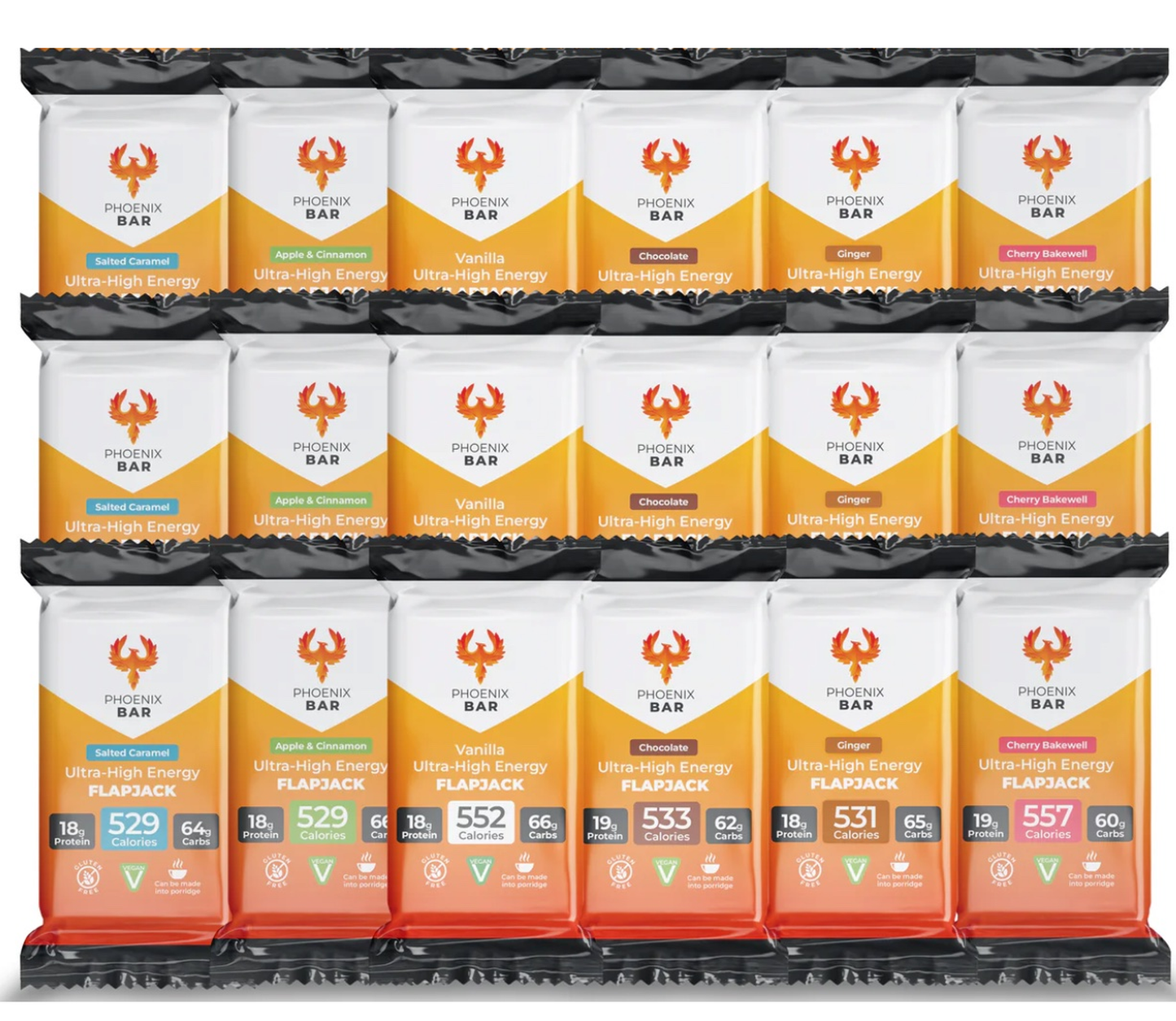
Phoenix Bars: Up to 557 Calories Per Bar
Highly compact, low-volume, calorie-dense bars. Soft, easy to eat whole or as a warm porridge. Vegan, gluten-free and contain up to 66g of carbohydrates, 19g of protein & 8 vitamins & minerals.
What to eat when you are carrying everything on your back
The legal definition of wild camping is doing the exact thing that makes food difficult. To have a right of access in Scotland, or to be left alone in the Lakes, you need to be on foot, carrying what you need, with no fire and often no stove worth the fuel for a single night.
So the food that works is food that needs nothing doing to it. Cold, dense, and high in calories per gram, so that a night out costs you grams rather than kilos. A hill day and a night out can easily run past 3,500 calories once you add the cold, and you can check your own figure with our walking calorie calculator or the hiking calorie calculator.
The efficient answer is to stop thinking in meals and start thinking in calories per gram. Nuts, hard cheese, olive oil, flapjack and chocolate all beat anything freeze-dried once you count the water and the fuel you would need to cook it. Our guide to the lightest high calorie food for backpacking ranks the usual options by calorie density, and wild camping food covers what to actually pack for a single overnight.
This is the problem I built Phoenix Bars to solve. Each one is 120g and 557 calories, which is 4.64 calories per gram, and they are vegan, gluten free and need no cooking, no water and no stove. Two of them cover a day's hill food in 240g. If you want to see how they compare on the numbers, our high calorie bars are made specifically for people carrying their own food, and the highest calorie bars in the UK page puts them side by side with the alternatives. They are rated 4.9 out of 5 from more than 390 reviews and are used on multi-day mountain and desert events including the Marathon des Sables.
For the rest of the kit, see our wild camping kit list and, if you are going for longer, what to pack for a multi-day hike.
Questions people ask
Is it illegal to go wild camping in the UK? Not in most of Scotland, where it is a statutory right under the Land Reform (Scotland) Act 2003, and not on the Dartmoor commons, where the Supreme Court confirmed the right in May 2025. Elsewhere, pitching without the landowner's permission is a civil trespass rather than a criminal offence. In practice that means you can be asked to leave, and refusing is where it starts to become a problem.
What is the punishment for wild camping in the UK? For simple trespass in England and Wales, there is no criminal penalty and no fine. The landowner can ask you to go and can use reasonable means to remove you. It changes if you cause damage, light a fire, or stay after being asked to leave, and some places have byelaws with fines attached, which is why the permit zones in Loch Lomond and The Trossachs are worth checking.
Is there anywhere in the UK you can camp for free? Yes. Anywhere in Scotland covered by the access rights, and the permitted areas of the Dartmoor commons. Both are free and need no booking.
Can you wild camp on beaches in the UK? In Scotland, generally yes, above the high tide line and away from houses. In England and Wales, most of the coast has an owner, often the Crown Estate, the National Trust or a local authority, and most have byelaws against overnight camping. The Hebridean beaches are the ones worth travelling for.
Can you camp in the woods in the UK? Only with permission. Forestry England, Natural Resources Wales and Forestry and Land Scotland all own large blocks of woodland, and none of them permit camping as a general rule, though Scottish access rights apply on much of the Scottish estate.
Do you need a permit to wild camp in Scotland? Not in general, but yes inside the camping management zones in Loch Lomond and The Trossachs National Park during the managed season. Check the park's current map and dates.
Can you wild camp with a campervan? No. Access rights in Scotland cover people on foot, by bike or on horseback, not vehicles. Van overnighting is a separate question governed by local parking rules.


Flaming Phoenix



Contact Us
Declare withdrawal
Please fill out the following form to declare your withdrawal from the contract.

