
Gut Training for Ultras: How to Absorb More Carbs and Avoid GI Distress
The short version: Your stomach is trainable in exactly the way your legs are. Gut training means progressively practising high-carbohydrate fuelling on your long runs so your gut learns to absorb more without rebelling. Start at around 30 grams of carbohydrate an hour, then build over several weeks toward your race target of 60 to 90 grams an hour. The adaptations that make this possible, more carbohydrate transporters in your intestine and faster stomach emptying, begin to show up in as little as two weeks. Since gut distress is the single most common reason runners do not finish an ultra, and since under-fuelling is the other, training your gut is one of the highest-return things you can do before race day. The rule that ties it together: practise your exact race fuel, in race-day amounts, in training.
What is gut training, and why does it matter for ultras?
Gut training is the deliberate practice of taking on carbohydrate and fluid during exercise, at gradually increasing amounts, so your digestive system adapts to handle race-day fuelling without distress. The concept was formalised by sports scientist Asker Jeukendrup in his 2017 Sports Medicine review "Training the Gut for Athletes," which pulled together the evidence that the gut is highly adaptable and that its capacity to absorb fuel can be improved with training.
This matters more in ultras than in any other event, because of two hard facts. First, gut distress is the leading cause of runners failing to finish. More than 90% of ultramarathon runners report stomach symptoms during a race, and across endurance sport generally somewhere between 30 and 50% of athletes experience symptoms like nausea, cramping, bloating or worse, according to a 2014 review by de Oliveira and colleagues. Second, fuelling is what separates finishers from non-finishers: those who complete an ultra consistently take in more than 250 calories an hour, while those who drop out average under 200. A gut that cannot absorb fuel forces you to eat less, which leaves you under-fuelled, which is how the day comes apart. Gut training breaks that cycle. If you have not yet built your overall race plan, start with our first ultramarathon nutrition guide and our ultra-endurance and expedition nutrition guide, then come back here to train the system that delivers it.
Why do ultrarunners get GI distress in the first place?
Understanding the causes tells you what gut training can and cannot fix. There are four main drivers, and they stack on top of each other over a long race.
The biggest is physiological. During hard, prolonged exercise your body redirects blood away from the digestive system toward your working muscles and your skin for cooling. With less blood flow, the gut empties and absorbs more slowly, and fuel can sit in your stomach. The second is mechanical: the repetitive up-and-down jostling of running physically agitates the gut in a way that cycling, for instance, does not, which is part of why runners tend to suffer more than cyclists. The third is psychological. Pre-race and mid-race anxiety genuinely affects gut function. The fourth is nutritional: certain foods, very high sugar concentrations, and too much fuel too fast can all irritate a gut that is already under stress. Heat makes all of this worse by further reducing gut blood flow and slowing stomach emptying, which is why fuelling needs adjusting when it is hot, something we cover in fuelling in the heat.
Gut training works directly on the physiological and nutritional drivers, and indirectly on the psychological one, because confidence comes from having rehearsed the plan.
Can you actually train your gut? What the research shows
Yes, and the evidence is unusually clear for a nutrition topic. The gut adapts in three measurable ways: it empties faster, it becomes more comfortable at a given fuelling load (perceptions of fullness decrease), and crucially, it grows more of the specific transporters that pull carbohydrate across the intestinal wall.
That last point is the heart of it. Glucose is absorbed by a transporter called SGLT1, and fructose by a different one called GLUT5. Eating a high-carbohydrate diet increases the number and activity of these transporters, which raises how much fuel you can absorb. Animal work cited in Jeukendrup's review found that raising dietary carbohydrate from 40% to 70% of calories roughly doubled the relevant transporters in just two weeks. In humans, Costa and colleagues showed in 2017 that as little as two weeks of gut training improved gut symptoms and performance, and Miall and colleagues found that two weeks of repeated gut challenge reduced both GI symptoms and malabsorption. The landmark performance study, Cox and colleagues in 2010, put trained cyclists through 28 days of high daily carbohydrate intake and measured a genuine increase in how much ingested carbohydrate their bodies actually burned during exercise afterwards. The practical takeaway: meaningful adaptation appears within two to four weeks, so gut training belongs in your final training block, not as an afterthought the week before.
One myth worth killing. "Train low, race high," the idea of training on minimal fuel and then loading up on race day, is not an evidence-based way to prepare your gut. The gut adapts to what you regularly ask of it, so if you want to absorb a lot of fuel on race day, you have to regularly practise absorbing a lot of fuel.

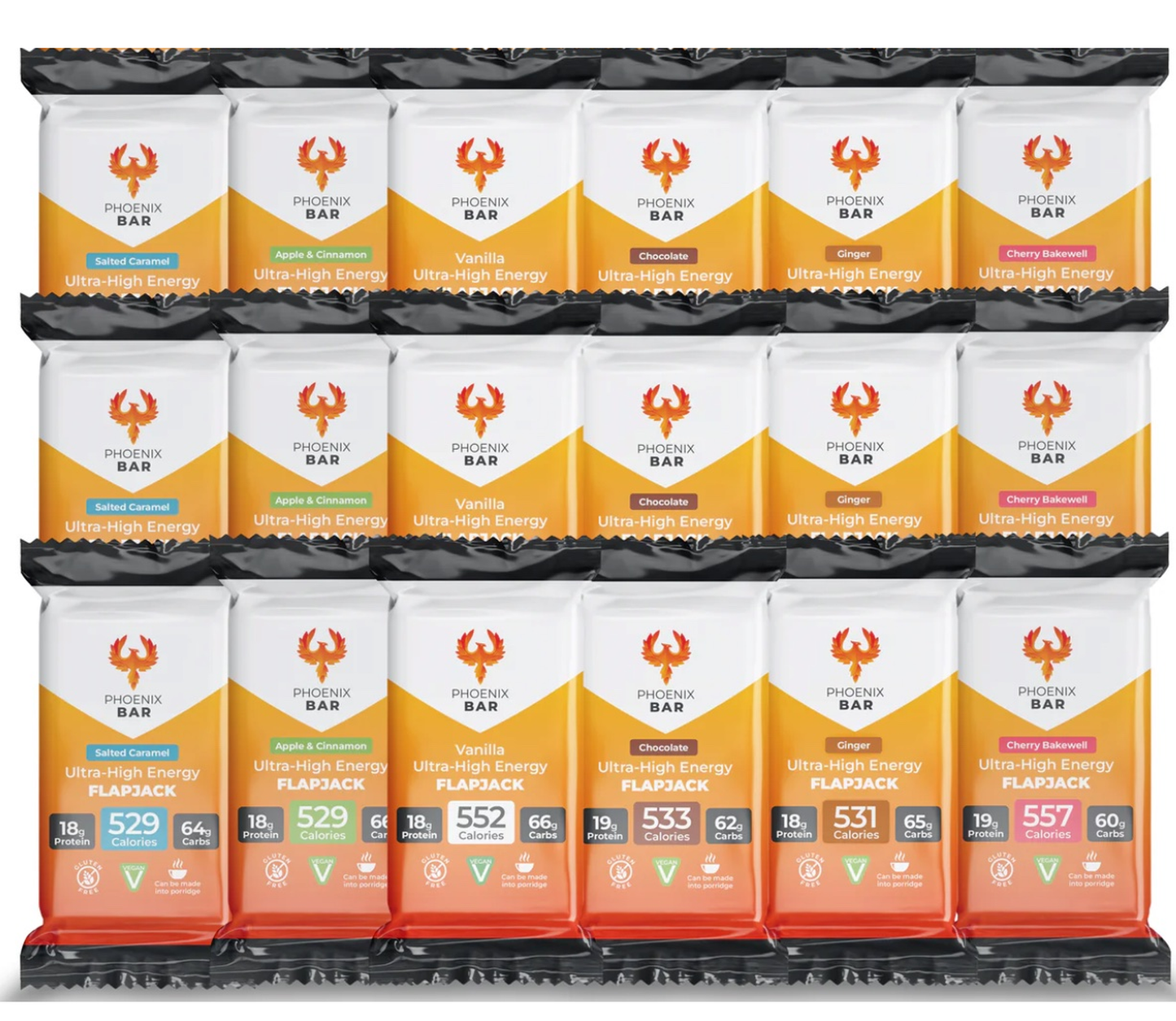
Phoenix Bars: Up to 557 Calories Per Bar
Soft, easy to eat whole or as a warm porridge. Low volume, two-year shelf life.
How much carbohydrate should you be training toward?
Build your target around the science of those two transporters. A single carbohydrate source, glucose on its own, saturates SGLT1 and tops out at around 60 grams an hour no matter how fit your gut is. Combine glucose with fructose, which rides the separate GLUT5 transporter, and a trained gut can absorb 90 and even up to 120 grams an hour. This is why modern fuels list "2:1" or "dual-source" carbohydrate, and why your gut training should use the same mixed-source fuel you will race on.
For most ultrarunners the working target is 60 to 90 grams of carbohydrate an hour, set toward the lower end for shorter or steadier efforts and the higher end for long or hard races where you have trained for it. You do not need to chase 120 grams for your first few ultras. A reliable 60 to 80 grams an hour that your stomach genuinely tolerates beats an ambitious 100 that leaves you nauseous. Alongside this, keep your everyday training diet carbohydrate-rich, in the region of 7 to 10 grams per kilogram of body weight on heavy days, both to refill muscle glycogen within 24 hours and to keep those transporters upregulated.
A step-by-step gut training protocol
Treat this as a framework to personalise over your final eight to twelve weeks of training, not a rigid prescription.
Begin early in the block by fuelling your long runs at around 30 grams of carbohydrate an hour, taken in small, regular amounts every 15 to 20 minutes rather than in one hit. Once that feels comfortable, raise the hourly dose in roughly 10 to 15 gram steps every week or two, always on your long runs, working up toward your race target of 60 to 90 grams an hour. By the final few long runs you should be rehearsing the full race-day load.
Make the practice as race-specific as possible. Run at the effort and, where you can, the time of day you will race, because gut blood flow and tolerance change with intensity and circadian rhythm. Use the exact products and real foods you intend to race on, in the same proportions, because unfamiliar food is far more likely to upset a stressed gut, which is the real meaning of the old "nothing new on race day" rule. Practise drinking to your plan too, since fluid tolerance is trainable in the same way and dehydration slows stomach emptying. A useful habit borrowed from experienced ultrarunners is to portion each hour's fuel into its own bag so you can see whether you are on track. And practise eating early in the run, before you feel you need it, because the gut handles fuel far better before fatigue sets in. Doing this consistently is also your best insurance against running low on energy late in a race.
What to practise with: gels, drinks and real food
Early in a race, fast carbohydrate from gels, chews and drinks is the most efficient way to hit your hourly target, so train with these first. But an ultra is long enough that two things change in the back half: your body starts craving savoury, salty, calorie-dense food, and you hit flavour fatigue, the point where one more sweet gel becomes genuinely hard to swallow. This is not weakness, it is well documented, and the runners who finish strong are the ones who trained their gut to handle real food late in the effort. That means practising soft, easy options such as energy gel alternatives, soft high calorie foods and warm food on your long runs, not just gels. If your stomach is especially sensitive, trialling lower-FODMAP foods in training can help you find what sits best. And if you find yourself unable to eat mid-run, the cause is usually under-fuelling or low sodium rather than too much food, which we explain in can't eat mid-race? nausea and appetite loss explained.
How Phoenix Bars fit your gut training
Full disclosure, I make these, so weigh this accordingly. I built Phoenix Bars after speaking with more than 150 endurance athletes and expedition teams, around one recurring problem: it is genuinely hard to eat enough real food when you are deep into a long effort. Phoenix Bars are 120g, vegan and gluten-free, and they pack a large amount of energy into a small, low-volume, easy-to-eat format, which is exactly the kind of dense real food worth training your gut on for the second half of an ultra.
Use them in training the way you would in a race: as the substantial, palatable calories you rotate in once sweet gels start to pall, alongside your fast-carb fuel rather than replacing it. Because a Phoenix Bar can be broken up and made into a quick high calorie porridge, you also get a soft, warm, almost no-chew option to rehearse for the late stage when solid food becomes a chore, which is exactly when most runners stop eating. The point of gut training is that nothing on race day is new, so if bars and porridge are part of your race plan, they need to be part of your long runs. There is more on this in how to use Phoenix Bars, or see the range on the buy Phoenix Bars page.
Gut training for ultras: common questions
How long does it take to train your gut? Measurable adaptations appear within two to four weeks of regular high-carbohydrate fuelling during training, based on studies by Costa, Miall and Cox and colleagues. Build it into your final training block rather than the taper.
How much carbohydrate can the gut absorb? A single source like glucose caps at around 60 grams an hour. Combining glucose and fructose, which use different transporters, lets a trained gut absorb 90 to 120 grams an hour. Most ultrarunners aim for 60 to 90.
Why do I get stomach problems only on long runs? Because the longer and harder you go, the more blood is diverted away from your gut, the more the running motion agitates it, and the more fuel accumulates. Training the gut, and starting to fuel early, reduces all three.
Can I train my gut if I have a sensitive stomach? Usually yes. Start low, around 30 grams an hour, build slowly, use familiar foods, and trial lower-FODMAP options if needed. The fix for a sensitive gut is almost never to eat less, it is to train it to handle more.
Does gut training help in the heat? It helps, but heat independently slows the gut, so you will likely need to lean on liquid and low-volume calories when it is hot. See fuelling in the heat for the adjustments.
Written by James Frost, founder of Flaming Phoenix and a runner. He developed Phoenix Bars after more than 150 conversations with endurance athletes and expedition teams, and now supplies ultrarunners, expedition crews and adventurers in over 19 countries.


Flaming Phoenix



Contact Us
Declare withdrawal
Please fill out the following form to declare your withdrawal from the contract.

