
6,000 Calorie Meal Plan: How to Eat and Carry That Much
A 6,000 calorie meal plan is an extreme intake, for people with an enormous energy burn: ultra-endurance athletes, expeditions, and very large or very hard-training people. The challenge is twofold. Eating that much without being permanently stuffed, and, for anything on the move, physically carrying it. Calorie density is the answer to both, since it is the only way to fit 6,000 calories into food you can manage and pack. For the foods it draws on, see calorie-dense foods.
This is far more than most people will ever need, so the first job is making sure 6,000 is genuinely your number rather than a figure plucked from the air. Work out your own target with how many calories to gain weight, and treat this as a template to scale.
Who actually needs 6,000 calories a day?
Very few people, and it is worth being honest about that before you start. Six thousand calories suits ultra-endurance athletes in heavy training or racing, people on expeditions and big days out where the burn is relentless, and very large, hard-training athletes with an already high requirement.
For most people it is two to three times what the body uses, and the surplus simply becomes fat. It is also not a number to jump straight into, as a sudden leap to this level is hard on the body and hard to sustain. If you have a genuine need for it, build up to it gradually. If your requirement is lower, the same approach works at any figure, so see the 5,000 calorie meal plan or 4,000 calorie meal plan for more moderate targets.
The twin challenge: eating it, and carrying it
At 6,000 calories, volume is the enemy on two fronts. First, you have to get that much down without spending the whole day over-full, which is only possible if the food is dense rather than bulky. Second, if you are fuelling on the move, you have to carry it, and 6,000 calories of low-density food is more than any pack or pocket will hold.
Both problems have the same solution: calories per gram. The more calories each mouthful and each gram carries, the more manageable 6,000 becomes, whether you are eating it at a table or pulling it out of a jersey pocket. For the least bulky foods, see high calorie low volume foods.

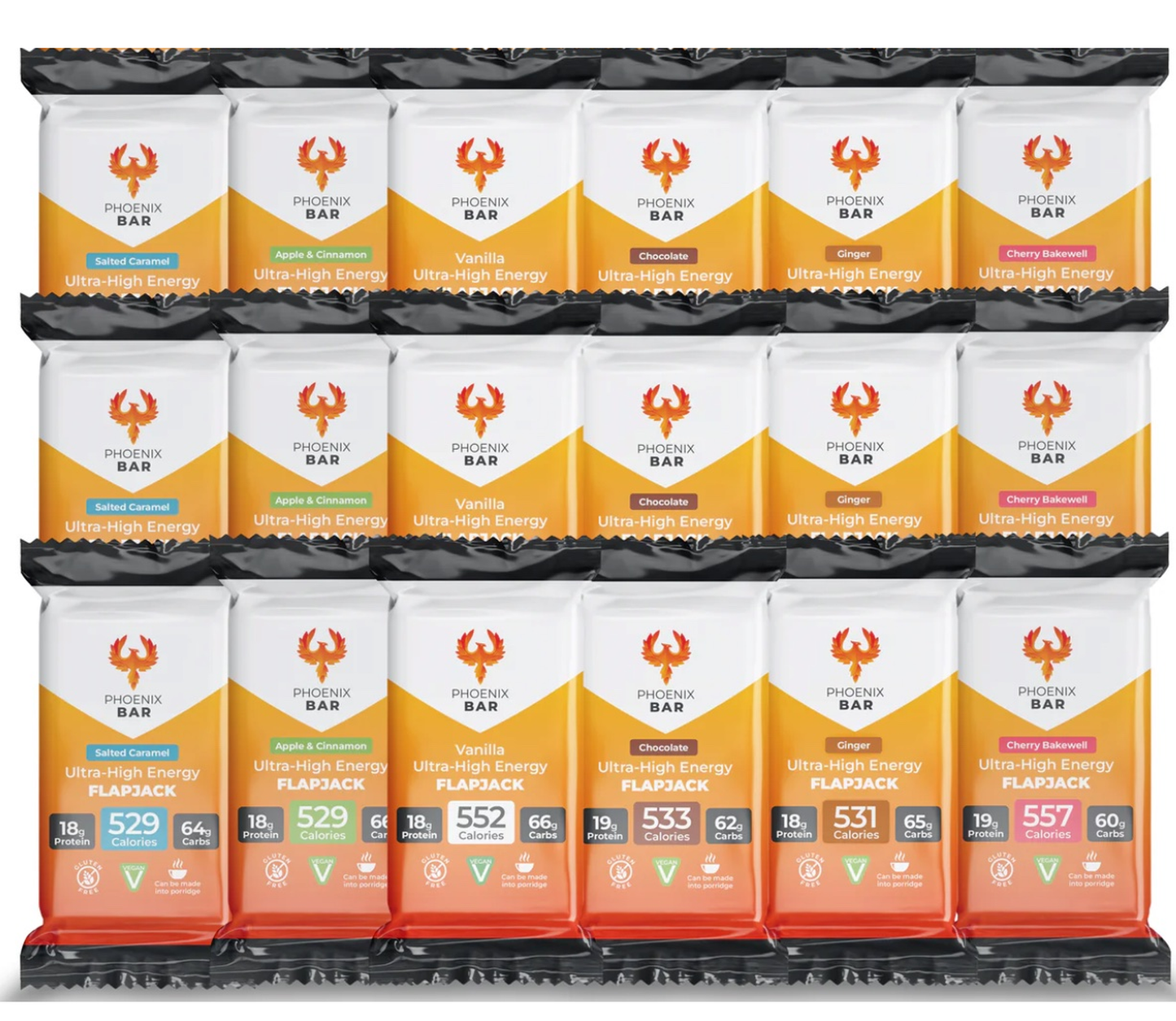
Phoenix Bars: Up to 557 Calories Per Bar
Highly compact, low-volume, calorie-dense bars. Soft, easy to eat whole or as a warm porridge. Vegan, gluten-free and contain up to 66g of carbohydrates, 19g of protein & 8 vitamins & minerals.
A 6,000 calorie meal plan
Here is a sample day of around 6,000 calories, built on dense foods and spread across seven feeds so no single sitting is punishing. On the move or on an expedition, some of these become portable food carried in a pack rather than meals at a table. Adjust portions to your target.
Breakfast, around 950 calories. A large bowl of porridge made with 100g of oats and whole milk, two tablespoons of peanut butter, a sliced banana and honey.
Mid-morning, around 700 calories. A large shake of whole milk, oats, two tablespoons of peanut butter and a banana.
Lunch, around 1,100 calories. A loaded sandwich of sourdough, mayonnaise, avocado and cheddar, with a handful of nuts and a flapjack alongside.
Afternoon, around 700 calories. Full-fat Greek yoghurt with granola, a handful of nuts, dried fruit and a drizzle of honey.
On the move, around 650 calories. A couple of our high calorie bars, or trail mix with a banana, the kind of thing you can eat without stopping.
Dinner, around 1,150 calories. A coconut curry made with full-fat coconut milk and oil, over a generous portion of rice with flatbread.
Evening, around 750 calories. A shake, or a bowl of chocolate peanut butter overnight oats.
That lands close to 6,000, and it fits into meals a person can finish because the calories come from density rather than sheer bulk.
How to eat and fuel 6,000 calories
The tactics below are what make an intake this size possible. Every one works by concentrating the calories.
Feed little and often. Seven or eight smaller feeds are the only realistic way to spread 6,000 calories. Three huge meals will leave you stuffed and behind.
Drink a large share of it. Shakes and smoothies are the easiest way to take in big numbers, because liquid does not fill you like solid food and you can take it steadily. Two or three shakes can cover a quarter of the day. See high calorie drinks and smoothies.
Carry dense, portable food for the move. If you are fuelling activity, the food you carry has to be high in calories per gram, or the pack simply will not hold enough. Compact, no-cook options are what work here.
Add fat everywhere, and choose the dense version. Oil, nut butter, cheese and cream lift any meal without adding bulk, and dried fruit over fresh, whole milk over skimmed, does the same. See easy ways to eat more calories.
A compact way to carry serious calories
At this level, the food that earns its place is whatever gives the most calories for the least size and effort, especially anything you carry.
That is the whole point of the product. Each of our high calorie bars is up to 557 calories in a small 120g bar, so it delivers a large block of your day in something that slips into a pocket and needs no preparation. It is vegan and gluten-free, stays edible in the cold, and can be stirred into hot milk or water to make porridge at camp or at home. For an intake built around calories per gram, it is exactly the kind of food that makes 6,000 achievable. You can see the full range of high calorie bars on the homepage.
Frequently asked questions
Who needs to eat 6,000 calories a day?
Very few people. It suits ultra-endurance athletes in heavy training or racing, people on expeditions with a relentless burn, and very large, hard-training athletes with an already high requirement. For most people it is far more than the body uses, so it is worth confirming your own target before adopting it.
How do you eat 6,000 calories a day?
By concentrating the calories and spreading them out. Eat seven or eight smaller feeds rather than a few huge meals, take a large share as shakes, lean on calorie-dense foods, and add fat to everything. This lets you reach the number without being permanently over-full.
Is 6,000 calories a day too much?
For almost everyone, yes, and the excess becomes fat. It only fits people with a genuinely enormous energy burn, such as endurance athletes and those on expeditions. It is also not something to jump straight into, so if you have a real need for it, build up gradually rather than switching overnight.
How do endurance athletes eat 6,000 calories?
They spread it across the day and on the move, lean heavily on liquid calories and calorie-dense portable food, and prioritise calories per gram so they can carry enough. The limiting factor on a long effort is usually how much you can eat and carry, not how much you need, which is why density matters so much.
Related guides
For more moderate targets, see the 5,000 calorie meal plan and 4,000 calorie meal plan. For your own number, see how many calories to gain weight. For the least bulky foods, see high calorie low volume foods. For the porridge method, see how to use Phoenix Bars.
Written by James Frost, Founder of Flaming Phoenix. James started Flaming Phoenix in 2024 and has spent the years since working out how to get the most calories into the least food, building and testing compact, calorie-dense recipes with endurance athletes and expeditions. He can be reached at jfrost@flaming-phoenix.co.uk. Last reviewed: June 2026.


Flaming Phoenix



Contact Us
Declare withdrawal
Please fill out the following form to declare your withdrawal from the contract.

