5,000 Calorie Meal Plan: Who Needs It & How to Eat It
Written by James Frost, Founder of Flaming Phoenix. Last reviewed 8 May 2026.
Eating 5,000 calories a day is harder than it sounds. The number itself is straightforward: roughly two and a half times what most adults need. The problem is that 5,000 calories of typical Western food weighs around 2.5 to 3 kilograms, which is more than most stomachs will tolerate even when motivation is high. Most published 5,000 calorie meal plans assume an enthusiastic bodybuilder with a kitchen, a meal prep schedule, and an unbroken appetite. They are unhelpful for the people who actually struggle to hit the target, including ultra-endurance athletes in heavy training blocks, mountaineers and polar explorers preparing for expeditions, hard-gainers with fast metabolisms, and people advised by a dietitian to increase intake during a period of unintended weight loss. This guide explains who genuinely needs 5,000 calories a day, why standard meal plans fail in practice, and how to use calorie density to make the target physically achievable rather than aspirational. If you are not yet at the 5,000 mark and the 3,000 figure feels closer to your reality, our 3,000 calorie meal plan is the better starting point.
Who actually needs 5,000 calories a day?
A 5,000 calorie daily intake is appropriate for a narrow group of people. Most adults need between 1,800 and 2,800 calories per day, so 5,000 sits well outside the normal range and is rarely the right target without a specific reason.
The five groups that genuinely need this level of intake are: competitive bodybuilders and powerlifters in heavy bulking phases, particularly large-framed athletes over 90kg with high training volume; ultra-endurance athletes in intense training blocks, including ultra cyclists, ultra runners, and triathletes whose weekly training volume regularly exceeds 20 hours; mountaineers, polar explorers, and expedition athletes operating in cold or high-altitude environments where thermoregulation alone burns 1,000 to 1,500 calories on top of activity; hard-gainers with naturally fast metabolisms who maintain weight at intakes most people would gain on; and people working with a dietitian to recover weight after a period of unintended loss, where a high-calorie target is part of a structured plan.
Tour de France cyclists during a Grand Tour stage routinely exceed 6,000 calories per day. Marathon des Sables competitors burn 4,500 to 6,000 calories per day across the 250km event. Atlantic ocean rowers need 5,000 to 6,000 calories per day for the duration of a 40 to 70 day crossing, as covered in our ocean rowing nutrition guide. Polar explorers manhauling sledges in sub-zero conditions can hit 7,000 calories per day, which is why our polar expedition nutrition page goes into the calorie density question in detail. For everyone outside these contexts, 5,000 is likely too high and the wrong target.
Is it healthy to eat 5,000 calories a day?
Yes, when matched to a genuine energy need. Eating 5,000 calories a day is healthy if your daily energy expenditure justifies it. A 90kg athlete training 25 hours a week may genuinely burn 5,000 calories a day, in which case eating 5,000 maintains weight. A 70kg office worker eating the same amount with no compensating activity will gain weight rapidly and accumulate fat mass, which carries cardiovascular and metabolic risk over time. The number on its own is not healthy or unhealthy. The match between intake and expenditure is what matters.
Two practical caveats apply. First, food quality matters more, not less, at high intake levels. A 5,000 calorie day made up of refined carbohydrates and ultra-processed foods will cause gut distress, blood sugar swings, and nutrient gaps that a 2,500 calorie day of the same food would not. Higher intake amplifies whatever you are eating, good or bad. Second, sustained intake at this level should be reviewed with a registered dietitian if it is being maintained for medical reasons or for elite training contexts. Self-prescribed 5,000 calorie diets without a corresponding training or expenditure plan are rarely a good idea.
Why does eating 5,000 calories a day feel impossible?
Because it usually is, at typical food density. The average Western diet provides roughly 1.5 calories per gram of food. At that density, 5,000 calories means eating roughly 3.3 kilograms of food per day. For comparison, a typical home-cooked meal weighs around 500g, which means you would need to eat the equivalent of six and a half full meals every day to hit 5,000 calories at average density.
This is the failure mode of most published 5,000 calorie plans. They tell you to eat 1.5 cups of oats, 16 ounces of milk, four whole eggs, a bagel, two cups of rice, eight ounces of chicken, two cups of cottage cheese, and so on. Each item is reasonable. Together they add up to a volume of food that most people physically cannot finish, particularly anyone with reduced appetite, a small stomach, or a busy schedule that does not allow for six leisurely meals a day. The result is that people start strong on Monday, fall short on Tuesday and Wednesday, and abandon the plan entirely by Thursday.
Three structural problems make the standard approach worse. Appetite drops as training volume rises, which is the opposite of what most people expect. Hard endurance training suppresses ghrelin (the hunger hormone) for hours afterwards, which means the days you most need to eat are the days you least feel like eating. Time becomes a constraint, because eating six big meals a day requires a kitchen, prep time, and the willingness to interrupt your day every two hours. And palate fatigue sets in quickly when you are eating the same volume-driven foods day after day, which causes most people to start under-eating without noticing.
The solution is calorie density, not willpower. The same problem and approach is covered in more detail for everyday struggles in more calories without eating more, but at 5,000 calories the density question is structural, not optional.
How is a 5,000 calorie day different from a 3,000 calorie day?
The jump from 3,000 to 5,000 calories is not a 67 percent increase in eating, even though that is what the maths suggests. It is a categorical shift in how you have to eat.
At 3,000 calories, most people can hit the target through bigger portions of normal food and a few strategic snacks. Three meals of 700 calories each plus a 900 calorie snack distribution gets you there, and the volume of food is manageable. At 5,000 calories, bigger portions stop working because you run out of stomach capacity before you run out of calorie target. You have to add eating occasions (typically 5 to 6 per day rather than 3 to 4), increase calorie density across most of what you eat, and add liquid calories because drinks pass through faster than solid food and let you fit more in.
The other shift is around food selection. At 3,000 calories, most foods are still on the menu and you can prioritise based on personal preference. At 5,000 calories, low calorie density foods become inefficient. A bowl of plain green salad takes up the same stomach space as a bowl of granola but delivers a tenth of the calories. Vegetables still belong in the diet for nutrient density and gut health, but they cannot be the bulk of any meal, and meal composition shifts towards starches, fats, dairy, nut butters, oils, and other dense foods. Our calorie-dense foods guide covers the principle in detail.
What does the macro breakdown look like at 5,000 calories?
For most people targeting 5,000 calories per day, the macro split that works is roughly 55 to 65 percent carbohydrate, 20 to 30 percent fat, and 15 to 20 percent protein. In gram terms that comes to roughly 700 to 800g of carbohydrate, 110 to 165g of fat, and 190 to 250g of protein per day.
The protein number is worth pausing on. Most bulking content online recommends very high protein intakes, sometimes 300g or more per day. The evidence on muscle protein synthesis suggests that beyond roughly 1.6 to 2.2g of protein per kg of body weight per day, additional protein offers diminishing returns. For a 90kg athlete that is 145 to 200g of protein per day, well below the 300g+ that some bulking plans recommend. The remaining calories are better spent on carbohydrate, which fuels training, and fat, which is calorie-dense and helps you hit the target without massive volume.
The carbohydrate number is high because endurance athletes and high-volume trainers need glycogen replacement, and because carbohydrate is the easiest macro to consume in volume without gut distress. Fat is calorie-dense at 9 calories per gram (vs 4 for carbs and protein), which means it does most of the heavy lifting on density. A tablespoon of olive oil drizzled over rice adds 120 calories with almost no added volume. Two tablespoons of nut butter on a banana adds 200 calories. These small additions are what take a 600 calorie meal to 1,000 calories without changing the plate.
Some people cover one of the day's meals with a bar rather than a plate. If that's part of your plan, I've compared the main meal replacement bars in the UK and which type genuinely delivers the most energy.
If you're using bars to bridge the gaps between meals, start with the UK's highest calorie bars ranked. At this intake, the difference between the top and bottom of that list is several hundred calories a day.

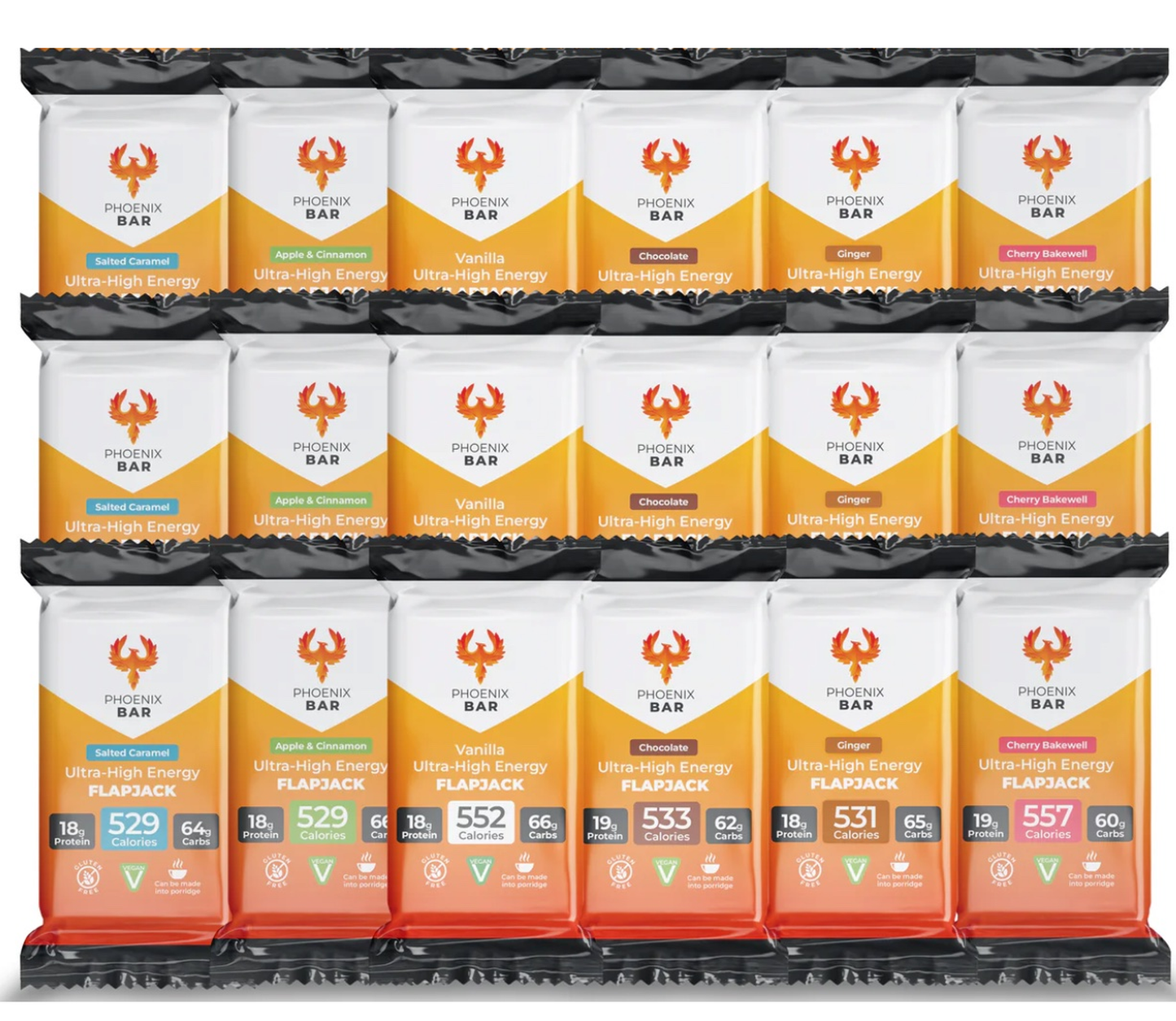
Phoenix Bars: Up to 557 Calories Per Bar
Highly compact, low-volume, calorie-dense bars. Soft, easy to eat whole or as a warm porridge. Vegan, gluten-free and contain up to 66g of carbohydrates, 19g of protein & 8 vitamins & minerals.
What does a realistic 5,000 calorie day look like?
The structure that works for most people is five to six eating occasions spread across the day, with two to three of them being calorie-dense and the rest being smaller fills. The example below is built around a 90kg athlete in a heavy training block. Adjust portions to your own body weight and training load.
A pre-training breakfast at 6am of overnight oats made with whole milk, two tablespoons of nut butter, banana, honey, and protein powder delivers roughly 800 calories. A post-training meal at 9:30am of three eggs scrambled with a bagel, butter, avocado, and a glass of whole milk adds 950 calories. A mid-morning snack of a 557 calorie Phoenix Bar with a coffee and full-fat milk adds 700 calories total. Lunch at 1pm of a chicken and rice bowl with olive oil, mixed beans, cheese, and a piece of fruit delivers 1,100 calories. A pre-evening top-up of a smoothie with whole milk, banana, peanut butter, oats, honey, and protein powder adds 700 calories. Dinner of salmon, sweet potato, vegetables, butter, and rice rounds out the day at 950 calories. Total: roughly 5,200 calories across six eating occasions.
The total weight of this food is around 2 kilograms, significantly less than the 3 kilograms you would need at average density. The reason is that every meal is constructed to be calorie-dense, not just calorie-positive. The bagel has butter and avocado on it. The rice has olive oil drizzled over it. The smoothie includes nut butter and oats. None of these additions take up meaningful stomach space, but each one adds 100 to 250 calories. This is the leverage that makes 5,000 calories physically possible.
The most important meal in the day is often the one that fits in least conveniently: the mid-morning or mid-afternoon top-up. This is where most people fall short because they are at work, on the move, or training. Calorie density and portability matter more in this slot than in any other. A Phoenix Bar at 557 calories in 120g, eaten with a coffee, is the same calorie equivalent as a cooked breakfast and takes 90 seconds to consume. There is more on this in our guide to how to use Phoenix Bars.
How do you fit 5,000 calories in if you have a small appetite?
Three levers, in order of impact. First, increase calorie density everywhere. Add olive oil, butter, avocado, nut butter, full-fat dairy, and dried fruit to every meal where they make sense. A meal that was 600 calories becomes 900 calories with two density additions and almost no extra volume. Second, add liquid calories. Smoothies, milk, drinking yogurts, and protein shakes pass through your stomach faster than solid food, which means you can absorb more calories without feeling full. A single 700 calorie smoothie at mid-morning fills a gap that a solid meal could not. Our guide to high-calorie drinks covers this in detail. Third, increase eating frequency. Five to six eating occasions a day is more sustainable than three large meals because each occasion can be smaller and the spacing prevents the "I'm too full to eat" cycle.
For people whose stomachs feel full after small portions, the additional layer is texture. Soft, calorie-dense foods that require minimal chewing pass through faster and feel less heavy than the same calories in dense, dry form. Porridge, smoothies, dairy-based desserts, and soft bars all work better than hard bread, dry granola, or chunks of meat. Phoenix Bars are designed with this in mind, and the porridge variant (mix the bar with hot water for a 557 calorie bowl in two minutes) is particularly useful when solid food feels like too much. The same principles are covered in our guide to soft high-calorie foods and to feeling full after a few bites.
What is calorie density, and why does it matter so much at 5,000 calories?
Calorie density is the number of calories per gram of food. It is the single most important variable in any high-calorie diet because it determines how much you have to eat to hit your target.
Vegetables sit at roughly 0.3 to 0.5 calories per gram. Fruits at 0.5 to 0.8. Cooked rice and pasta at 1.3 to 1.6. Bread at 2.5 to 3. Cheese, dried fruit, and most meats at 3 to 4. Chocolate, granola, nuts and nut butters at 5 to 6. Oils and fats at 8 to 9. The same plate of food at 1.5 calories per gram (typical mixed meal) versus 4 calories per gram (calorie-dense) holds 250 versus 670 calories. That is the difference between hitting your target and falling 1,500 calories short.
For 5,000 calorie days specifically, the average density of your daily food intake needs to be around 2.5 to 3 calories per gram, which means most of what you eat needs to be deliberately dense. This is not the same as eating "junk food." Calorie-dense whole foods include nuts, nut butters, oats, granola, dried fruit, hard cheese, dark chocolate, olive oil, avocado, and fatty fish. The same density principle applies to compact bars, which is why Phoenix Bars at 4.6 calories per gram are useful in a 5,000 calorie context. A single bar gets you 11 percent of the way to the daily target in 120g of food.
How does 5,000 calories work on expedition or in extreme conditions?
Expedition contexts amplify every challenge of high-calorie eating. Cold weather increases calorie burn (thermoregulation alone can add 1,000 calories per day at sub-zero temperatures), reduces appetite (cold suppresses ghrelin), and limits food access (you carry what you brought, and cooking takes time and fuel). Altitude further suppresses appetite, slows digestion, and can make some textures intolerable. Polar explorers, high-altitude mountaineers, ocean rowers, and Marathon des Sables competitors all face this combination, and the practical answer is consistent across the disciplines: maximise calorie density and rely on compact, soft, easy-to-eat formats.
For Marathon des Sables, where competitors carry all their food for the seven-day event in their pack, calorie density is regulated by the race (minimum 2,000 calories per day) and most experienced runners aim for 2,500 to 3,500 calories per day across the event despite burning 5,000 to 6,000. The deficit is unavoidable because pack weight is the binding constraint. This is covered in Marathon des Sables nutrition.
For high-altitude mountaineering, where Everest expeditions can require 6,000 to 8,000 calories a day during summit pushes, the realistic target is to minimise the deficit rather than match expenditure. The same applies to polar manhauling, where sledge weight and meal-prep time impose hard ceilings. Phoenix Bars have been carried on South Pole expeditions and Atlantic ocean rows specifically because the combination of calorie density, soft texture (still edible at minus 45 Celsius), water-resistant packaging, and 2-year shelf life solves several expedition constraints at once. There is more in our guides to high-altitude mountaineering nutrition and the ultra-endurance and expedition nutrition guide.
How do Phoenix Bars fit into a 5,000 calorie meal plan?
Phoenix Bars deliver up to 557 calories per bar in a 120g flapjack, with 66g of carbohydrate, 18g of protein, and 8 vitamins and minerals. At 4.6 calories per gram, they are roughly three times more calorie-dense than a typical mixed meal. For a 5,000 calorie target, they solve the two problems that derail most plans: the mid-morning and mid-afternoon top-up slots where you are away from a kitchen, and the moments where you need calories but solid meals feel impossible.
A practical pattern that works for most users in heavy training or expedition contexts is two to three Phoenix Bars per day alongside three normal meals and one or two liquid top-ups. Two bars contribute 1,114 calories, three contribute 1,671, which closes a third of the daily target in food that takes minutes to consume rather than hours. The six flavours (Apple & Cinnamon, Cherry Bakewell, Chocolate, Vanilla, Salted Caramel, and Ginger) prevent the palate fatigue that causes most calorie-dense foods to be abandoned within a week, which is one of the reasons our customers in Marathon des Sables prep, polar expeditions, and ultra cycling routinely use them as a daily staple rather than an occasional snack.
Compact bars make a high daily total far easier to reach between meals, which is why it helps to knowwhich bar packs the most calories.
Frequently asked questions
How much weight will I gain on a 5,000 calorie diet? That depends on your daily energy expenditure. If your body burns 5,000 calories a day through training and basal metabolism, you will maintain weight. If your expenditure is 3,500, you will gain roughly half a kilogram per week from the surplus. For weight gain specifically, see our guide to how to gain weight.
What foods should I eat on a 5,000 calorie meal plan? Calorie-dense whole foods: oats, rice, pasta, bread, eggs, full-fat dairy, lean and fatty meats, oily fish, nuts and nut butters, avocado, olive oil, dried fruit, dark chocolate, and granola. Vegetables and fruits remain important for nutrient density but should not be the bulk of any meal at this calorie level.
Is a 5,000 calorie diet too much for an average person? Yes. Most adults need 1,800 to 2,800 calories per day. A 5,000 calorie target is appropriate only for competitive athletes in heavy training, expedition athletes, hard-gainers with very high metabolism, or people working with a dietitian on weight recovery. For most people, the 3,000 calorie meal plan is a more realistic target.
Can I eat 5,000 calories a day without supplements or bars? Yes, with planning. The challenge is volume: 5,000 calories of typical food is roughly 3kg of eating per day. Most people who succeed at this level rely on calorie-dense whole foods (nut butter, oils, dairy, dried fruit) rather than bars and supplements. Bars become useful when time, kitchen access, or appetite makes whole-food meals impractical, which is most often during training, work, or expedition contexts.
How many meals a day should I eat to reach 5,000 calories? Five to six eating occasions works for most people. Three large meals a day rarely fits 5,000 calories without exceeding stomach comfort. The structure that works is three main meals of 800 to 1,100 calories plus two or three top-ups of 500 to 700 calories.
Can I drink my calories? Partly. Liquid calories pass through your stomach faster than solid food, which means smoothies, milk drinks, and protein shakes are useful for fitting in calories without feeling overly full. A 700 calorie smoothie is a tested way to close the mid-afternoon gap. But all-liquid 5,000 calorie diets are not recommended because they cause blood sugar instability, gut issues, and nutrient gaps over time.


Flaming Phoenix