
How to Gain Weight
In this guide

 Written by James Frost, founder of Flaming Phoenix. Updated October 2026.
Quick answer: To gain weight healthily, adults should eat around 300 to 500 extra calories a day on top of what their body uses, as the NHS suggests. Kept up for weeks, that adds roughly 0.25 to 0.5kg a week. If a small appetite is the problem, make the food you already eat denser rather than eating more of it.
If you want to put on weight, knowing the method is rarely the hard part. Doing it every day is, because appetite, work and cooking all get in the way. I have spent years on one narrow problem, getting the most calories into the least food, and I answer every customer email myself. So this guide is mostly practical: what 300 to 500 calories looks like in ordinary UK food, two worked days of eating, how long it really takes, and what to do when you are simply not hungry.
What are the healthy ways to gain weight?
NHS advice for adults is to gain weight gradually: add around 300 to 500 calories a day, eat smaller meals more often, and build muscle with strength exercise or yoga. Here is that advice turned into what it looks like on an ordinary day.
- Eat little and often. Have something at about 11am, 4pm and before bed as well as your three meals, so no single sitting has to be big.
- Add calories to meals with cheese, nuts and seeds. 30g of grated cheddar on beans on toast adds about 125 calories; a tablespoon of mixed seeds on porridge adds about 60.
- Drink calories between meals, not before them. A milkshake or a glass of whole milk at 11am counts; a pint of water just before lunch takes up room you need for food.
- Include protein at most meals: eggs, fish, meat, beans, lentils and dairy. Two large eggs scrambled in butter come to about 200 calories and take five minutes.
- Keep snacks that need no preparation, such as a yoghurt, a pot of rice pudding or a handful of nuts.
- Do some strength work or yoga. More of what you gain ends up as muscle, and the NHS notes that exercise can also improve appetite.
The NHS also says not to rely on chocolate, cakes and sugary drinks. They do add calories, but a diet built on them is short of protein, vitamins and minerals, and being underweight already makes you more likely to miss out on those.
If you are not sure you need to gain weight, the NHS BMI calculator tells you whether you are in the underweight range. If you have lost weight suddenly or without trying, or controlling food has become a way of coping with how you feel, speak to your GP before changing anything. The NHS lists all three as reasons to get checked.
Free download
Free guide: how to eat 500+ calories in under 2 minutes
A short PDF of the simplest ways people get more calories from less food. Free, sent straight to your inbox.
Free. Unsubscribe anytime. Privacy policy
How many calories do you need to gain weight?
You need your maintenance calories, the amount that keeps your weight steady, plus 300 to 500 a day. NHS figures put an average man's maintenance at about 2,500 calories and an average woman's at about 2,000, so typical gaining targets are 2,800 to 3,000 for men and 2,300 to 2,500 for women.
Those are averages, and people trying to gain weight are often lighter or more active than average, which can move the number by several hundred calories either way. For your own figure, the weight gain calculator estimates maintenance from your age, sex, height, weight and activity, then adds the surplus. If it puts your maintenance at 2,200, your target is 2,500 to 2,700 calories, every day. That gap is one good snack, not a second dinner.
To gain 1kg you need roughly 7,700 extra calories in total, the metric version of the long-standing rule of thumb that a pound of body weight takes about 3,500. Spread over a week that is 1,100 a day; spread over a month it is about 250 a day. The real figure shifts with how much of the gain is muscle, and my guide to how many calories to gain weight walks through the numbers and where the rule breaks down.
How long does it take to gain weight?
At 300 to 500 extra calories a day, expect to gain roughly 0.25 to 0.5kg a week, or 1 to 2kg a month. Visible changes, such as clothes fitting differently, usually take 8 to 12 weeks of consistent eating.
The working: 300 extra calories a day is 2,100 a week, which at 7,700 calories a kilo is about 0.27kg. 500 a day is 3,500 a week, about 0.45kg. So at a 500-calorie daily surplus, expect roughly 0.5kg a week, or 2kg a month.
Do not judge the first week or two. The scale often jumps early because of water, stored carbohydrate (glycogen) and the extra food sitting in your gut, then settles into a slower climb. Weigh yourself once a week, on the same day and before breakfast, and judge the trend over three or four weeks rather than any single reading.
Gaining faster is possible. A surplus of 500 to 1,000 calories a day can add 0.5 to 1kg a week, and some people training hard for muscle choose that. The cost is that more of the extra weight is fat, and the eating becomes much harder to keep up. The NHS advises gaining gradually, so I would start at 300 to 500 and only go higher if the scale has not moved for three weeks. My guide to how to gain weight fast covers the faster approach properly.
Why is it so hard to gain weight?
Most people struggling to gain weight have a surplus that only exists on paper: busy days, a small appetite and empty gaps between meals cancel it out without you noticing. Five patterns do most of the damage.
- Appetite does not keep pace with need. With quiet hunger signals nothing nudges you towards the extra food, so it has to be planned rather than waited for.
- Bigger plates backfire. If you already finish a normal portion with effort, a larger one tends to go unfinished, and you eat less at the next meal because you still feel full.
- One good day does not carry over. A 500-calorie surplus on Monday is wiped out by a skipped lunch on Tuesday. Weight follows the weekly total, not your best day.
- The gaps stay empty. Breakfast at 8am, lunch at 1pm and dinner at 7pm leave two five-hour stretches with nothing going in, and that is where extra calories are easiest to add.
- Intake is lower than it feels. Tracking for a week or two with an app such as MyFitnessPal can show a shortfall of a few hundred calories a day. Once you have seen it, you can usually stop counting and keep the habits.
If you have tried all of this and the scale still will not move, my guide on why you can't gain weight goes through the less obvious causes.
What to eat to gain weight
Eat the foods you already like, made denser, plus small calorie-heavy extras: whole milk, oil, butter, cheese, nuts, nut butter, oats and dried fruit. Each of the additions below adds calories without adding much to the plate. Figures are rounded and approximate for standard UK portions, so check the label on what you buy.
- A 250ml glass of whole milk: about 160 calories, roughly 40 more than the same glass of semi-skimmed.
- A tablespoon of olive or rapeseed oil stirred into pasta, soup or mash: about 120 calories.
- 30g of grated cheddar on a jacket potato, soup or beans: about 125 calories.
- A tablespoon (about 15g) of peanut butter on toast or in porridge: about 90 calories.
- A 30g handful of mixed nuts: about 180 calories.
- 10g of butter on toast, vegetables or potatoes: about 75 calories.
- Three medjool dates: about 200 calories.
- A 150g pot of rice pudding: about 150 calories.
Three of these together put you inside the NHS range with no bigger meal: a glass of whole milk at breakfast (160), a handful of nuts mid-morning (180) and a tablespoon of oil in dinner (120) come to 460 calories.
Protein matters as well, especially if you are lifting, so keep eggs, fish, meat, beans, lentils, Greek yoghurt and milk in rotation. To set a daily protein figure, use the protein calculator for weight gain. For snacks ranked by calories per bite, see high calorie snacks, and for a wider shopping list, calorie-dense foods.
What does a day of eating to gain weight look like?
A day of eating to gain weight looks like a normal day with six eating occasions instead of three, each made a little denser than usual. Here are two worked examples. The figures are rough, and you do not need to count every calorie to make this work.
Worked day 1, for maintenance of about 2,200 calories
- Breakfast, 8am: porridge made with 50g oats and 250ml whole milk, a tablespoon of peanut butter stirred in and a sliced banana on top. About 550 calories.
- Mid-morning, 11am: a 30g handful of nuts and a 200ml glass of whole milk. About 300 calories.
- Lunch, 1pm: a cheese sandwich on buttered wholemeal bread, then a pot of full-fat Greek yoghurt with a spoon of honey. About 650 calories.
- Mid-afternoon, 4pm: a Phoenix Bar, eaten whole or in pieces over an hour or two. Up to 557 calories.
- Dinner, 7pm: 75g of pasta (dry weight) with a tablespoon of olive oil and 10g of grated parmesan stirred through, plus vegetables. About 450 calories.
- Evening, 9pm: a mug of hot chocolate made with whole milk. About 220 calories.
That comes to roughly 2,700 calories, about 500 above maintenance, from plates that look fairly normal. If you would rather not use a bar, swap in three dates and a glass of milk (about 330 calories) and the day still lands near 2,500, the bottom of the target.
Worked day 2, for a small appetite and maintenance of about 1,650
This one is for someone smaller who struggles to eat much, say a 30-year-old woman who is 160cm tall, weighs 50kg and is lightly active. The weight gain calculator puts her maintenance at about 1,650 calories, so her target is roughly 1,950 to 2,150. Portions stay small and drinks come between meals.
- Breakfast, 8am: one slice of toast with butter and a tablespoon of peanut butter, and a 150ml glass of whole milk. About 350 calories.
- Mid-morning, 10.30am: a 30g handful of mixed nuts. About 180 calories.
- Lunch, 1pm: half a 400g tin of tomato soup with a tablespoon of olive oil and 30g of grated cheddar stirred in, plus a slice of buttered bread. About 530 calories.
- Mid-afternoon, 3.30pm: a 150g pot of rice pudding. About 150 calories.
- Dinner, 6.30pm: a small jacket potato with 10g of butter, 30g of cheddar and half a tin of baked beans. About 550 calories.
- Evening, 8.30pm: a mug of hot chocolate made with 200ml whole milk. About 200 calories.
That comes to roughly 1,950 to 2,000 calories, at the bottom of her target. None of it is a large portion: the extra comes from oil, butter, cheese and milk added to food she would eat anyway, and from two small snacks in the gaps. For a full week of meals, see my weight gain meal plan, or the 3,000 calorie meal plan if your number is higher.
How to gain weight when you have no appetite
When you have no appetite, eat small amounts by the clock rather than waiting for hunger, and make every mouthful as calorie-dense as you can. Quiet hunger does not arrive on cue, so the plan has to do the work instead.
- Set times for small eating occasions every two to three hours and treat them like any other appointment. A few mouthfuls on schedule beat a large meal that never happens.
- Choose the densest version of everything: whole milk, full-fat yoghurt, a spoon of nut butter in porridge, oil or butter stirred into soup and mash. My guide to high calorie low volume foods lists the ones that fill you up least.
- Drink between meals rather than before them. Water and fizzy drinks take up stomach space, while a glass of whole milk, a smoothie or a hot chocolate made with milk adds calories instead.
- Use smaller plates and bowls. A small, full plate is far less daunting than a big plate with the same food on it.
- Use the time of day you are hungriest. For some people that is the morning, so a high-calorie breakfast does most of the work; for others it is the evening.
- Keep food you like within reach: on your desk, in your bag, by the sofa. If eating means going to the kitchen, deciding and then preparing something, many of those small meals will not happen.
- Try a short walk or some fresh air before eating. The NHS notes that exercise can improve appetite, though it does not work for everyone.
Cold or soft foods are often easier on days when a hot meal feels like too much. My guide to what to eat when your appetite is low goes into this in more detail, and why do I get full so fast explains the fullness side.
If your appetite has dropped suddenly, or you are losing weight without trying, speak to your GP before anything else. This guide is about food, and a change like that is worth getting checked.
Do you need to lift weights to gain weight?
No, food alone moves the scale, but strength exercise on at least two days a week means more of the weight you gain becomes muscle rather than fat. Two days a week is also the NHS guideline for all adults.
It does not need a gym. The NHS counts carrying heavy shopping, press-ups, resistance bands and yoga, and for a beginner, squats, lunges and press-ups at home are plenty. Training uses calories too, so eat a little more on the days you train, not less. If you train a lot and still struggle to gain, my guide to gaining weight with a fast metabolism deals with that situation.
Where Phoenix Bars fit, and where they don't
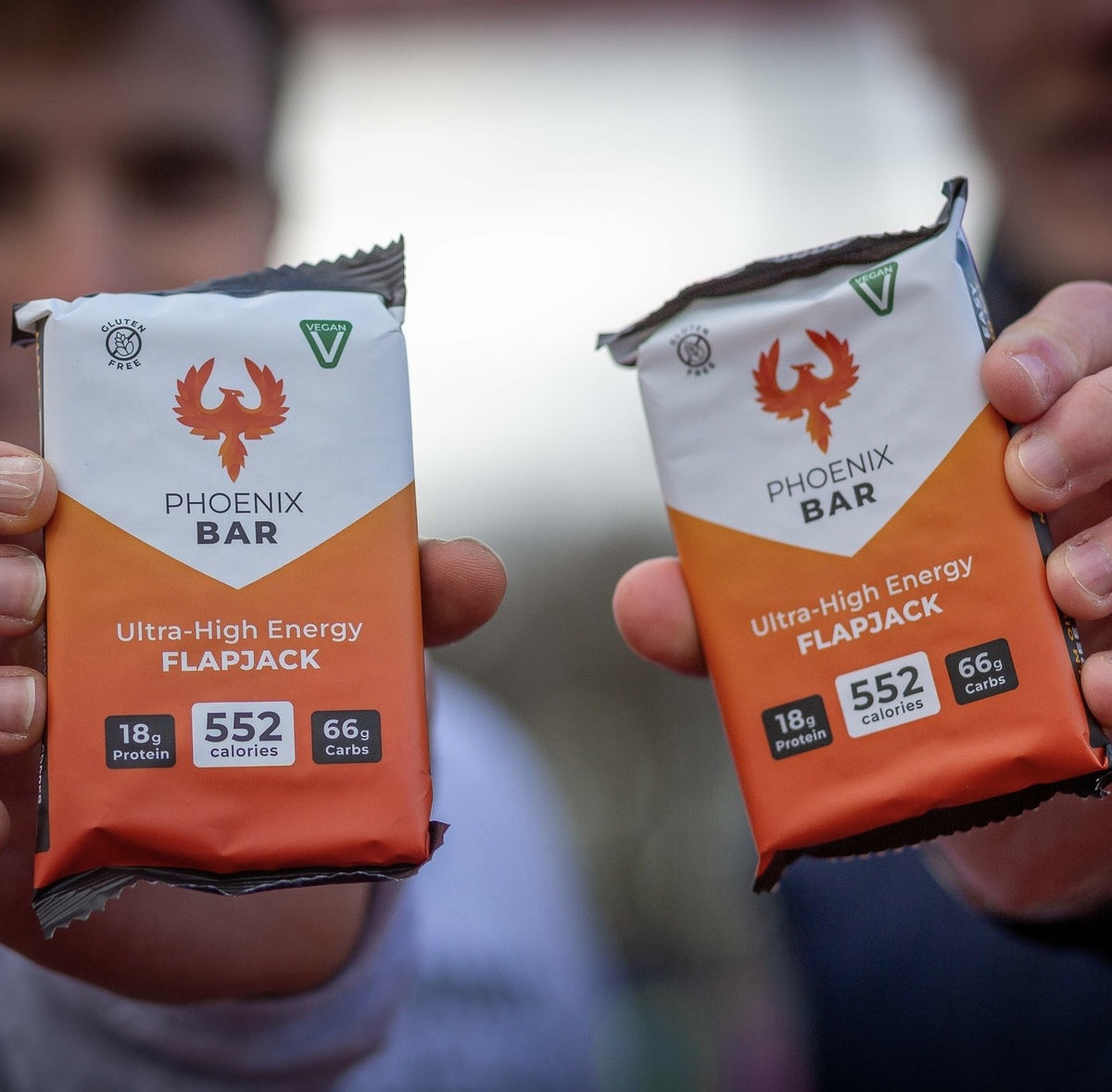
I make Phoenix Bars, so read this with that in mind. Each one has up to 557 calories in only 120g, enough on its own to cover a 300 to 500 calorie surplus. They are vegan and gluten-free, soft enough to break into pieces and graze over an afternoon, and can be stirred into hot water or warm milk as a high-calorie porridge. They suit the gap that otherwise stays empty: the desk drawer at work, a bag on a long day, an afternoon when a meal feels like too much.
They are not the cheapest way to add calories. At £5.25 a bar, a glass of whole milk and a handful of nuts give you about 340 calories for much less, and if you have the time and appetite for those, use them. The bars are food, not a supplement, and they sit alongside meals rather than replacing them. On days when a meal itself is the barrier, my meal replacement bars UK comparison covers which bars carry enough to stand in for one. To compare bars on calories, see how the highest-calorie bars compare and the best energy bars for weight gain, or browse our high calorie bars for weight gain.
Frequently asked questions
Is it possible to gain 1kg in a week?
On the scale, yes; as real body tissue, rarely. The scale can rise by a kilo overnight after a big, salty meal, but that is mostly water and food in your gut, and it drops again within days. A true kilo of tissue in a week would take about 1,100 extra calories every day, and much of it would be fat.
How can I gain 5kg in a month?
As real weight, you almost certainly can't. Five kilos at about 7,700 calories each is 38,500 extra calories, roughly 1,280 a day on top of maintenance for 30 days straight. At a sustainable 1 to 2kg a month, 5kg takes about two and a half to five months, and with strength training more of it will be muscle.
Is it better to eat more meals or bigger meals?
More meals. Five or six smaller meals and snacks are usually easier than three big ones, because large portions are hard to finish when appetite is low and often leave you too full for the next meal. Small, frequent, calorie-dense eating adds up to a higher total across the day, and it is easier to keep up for weeks.
Can I gain weight without eating junk food?
Yes. Nuts, nut butters, full-fat dairy, olive oil, oats, eggs, cheese and dried fruit carry as many calories per mouthful as most junk food, with more protein, fibre, vitamins and minerals. The NHS advises against relying on chocolate, cakes and sugary drinks to gain weight. Treats are fine; they just should not be the plan. If you also want more protein, my high calorie high protein diet guide shows a full day with targets by body weight.
Do I need weight gain shakes or supplements?
No. A shop-bought mass gainer is mostly calories in powder form, and a homemade shake does the same job. Blend 300ml of whole milk, a banana, 40g of oats and a tablespoon of peanut butter for about 530 calories, and drink it between meals rather than with them. My homemade weight gainer shakes guide has more recipes.
What are the best carbs for weight gain?
Easy-to-eat carbs work best, especially made denser: oats, granola, bread, pasta, rice, potatoes, bananas and dried fruit. Drier carbs such as granola, oats and dried fruit carry the most calories per mouthful because they hold less water. Pairing a carb with a fat, such as peanut butter on toast or olive oil on pasta, raises the calories without making the portion bigger.
Related guides
- How many calories to gain weight
- Calorie-dense foods: what they are and when they help
- Soft high-calorie foods
- How to get more calories without eating more food
- 3,000 calorie meal plan
- High-calorie snacks ranked by calories per bite
If you have a question about any of this, email me at jfrost@flaming-phoenix.co.uk or ring 07990 519422. I answer every email myself.
Sources: NHS, Healthy ways to gain weight; NHS, Understanding calories; NHS, Physical activity guidelines for adults aged 19 to 64; NHS, BMI calculator for adults.

Big calories. Small bar.
Up to 557 calories in a compact, lightweight bar of only 120g, with up to 66g of carbs and 19g of protein. Eat it whole, break it into pieces over a few hours, or stir it into hot water or warm milk for porridge.
Easy to eat, easy to digest and not sickly sweet. Customers have eaten them at -45°C and through the heat of the Marathon des Sables, and they keep for up to 2 years, so they work on a mountain, on a night shift, or at home on days when eating enough feels hard.
- 557 calories in only 120g (529 to 557 by flavour)
- 4.6 calories per gram
- 66g carbs per bar (up to)
- 19g protein per bar (up to)
