3,000 Calorie Meal Plan
Who This Guide Is For (And Who It Is Not For)
There are two very different groups of people searching for a 3,000 calorie meal plan, and they have almost nothing in common.
The first group is bodybuilders and gym-goers in a bulking phase. They have strong appetites, access to kitchens, and the time and motivation to meal prep. Most 3,000 calorie guides are written for them. This guide is not.
The second group is people who need 3,000 calories but find it genuinely difficult to eat that much. That includes ultra-endurance athletes in heavy training blocks who burn through calories faster than they can replace them. It includes people recovering from illness, surgery, or treatment who have been told by a doctor or dietitian to increase their intake. It includes people in physically demanding jobs. And it includes anyone experiencing a period of reduced appetite where eating enough to maintain weight has become a daily challenge.
If you fall into that second group, this guide was written specifically for you. I work with both audiences through Phoenix Bars, and the approach that works for someone who loves eating and wants to eat more is completely different from the approach that works for someone who finds eating 3,000 calories a genuine struggle.
I am James Frost, founder of Flaming Phoenix. I have spent over two years developing calorie-dense nutrition for ultra-endurance athletes and people managing low appetite. I work with these customers daily and have fulfilled over 2,100 orders to date. I am not a dietitian. If you have been given a specific calorie target by a healthcare professional, follow their guidance. This page offers practical strategies based on my experience, not medical advice. Last reviewed: July 2026.
Why 3,000 Calories Is Harder Than It Sounds
Most people assume that eating 3,000 calories just means eating a bit more than usual. In practice, it is roughly 50% more than the average adult's daily intake of 2,000 calories. That extra 1,000 calories has to come from somewhere, and for people with limited appetite, small stomachs, or busy schedules, finding space for it is the real challenge.
Here is what a fairly typical day of eating looks like for someone who is not actively trying to hit a calorie target:
Breakfast: toast with butter and a cup of tea with milk. Roughly 300 calories.
Lunch: a sandwich, a packet of crisps, and an apple. Roughly 550 calories.
Dinner: chicken breast, rice, and vegetables. Roughly 600 calories.
Snacks: a biscuit with tea, maybe a banana. Roughly 250 calories.
Total: approximately 1,700 calories.
That person is 1,300 calories short of 3,000. To close the gap by simply eating bigger portions, they would need to increase every single meal and snack by roughly 75%. That means a bigger breakfast, a bigger lunch, a bigger dinner, and more snacks. For someone with a good appetite, that is manageable. For someone who already feels full at their current intake, it feels impossible.
This is where most 3,000 calorie guides fail. They provide recipe lists and 7-day meal plans packed with massive portions of chicken, rice, and broccoli, and assume the reader has both the appetite and the kitchen time to prepare and eat it all. In my experience with customers, the people who genuinely need 3,000 calories are often the people least able to eat that much through conventional meals.
The Strategy That Actually Works: Add Calories, Not Volume
The approach I recommend, and the one I have seen work consistently with customers, is not to eat more food. It is to make existing food more calorie-dense and to fill the gaps between meals with compact, high-calorie options.
I will walk through this meal by meal, showing how to take that same 1,700-calorie day and bring it to 3,000 without dramatically changing what or how much you eat.
Breakfast: from 300 to 650 calories
The original: toast with butter and tea. 300 calories.
Three changes. First, switch to two slices of toast with a thick layer of peanut butter instead of a thin layer of butter. That alone adds roughly 150 calories. Second, have a glass of whole milk alongside the tea. That adds 130 calories. Third, add a sliced banana on top of the peanut butter. That adds 100 calories.
New total: approximately 680 calories. The meal is barely larger. You have not added a second course or a side dish. You have made the same toast deliver more than twice the calories.
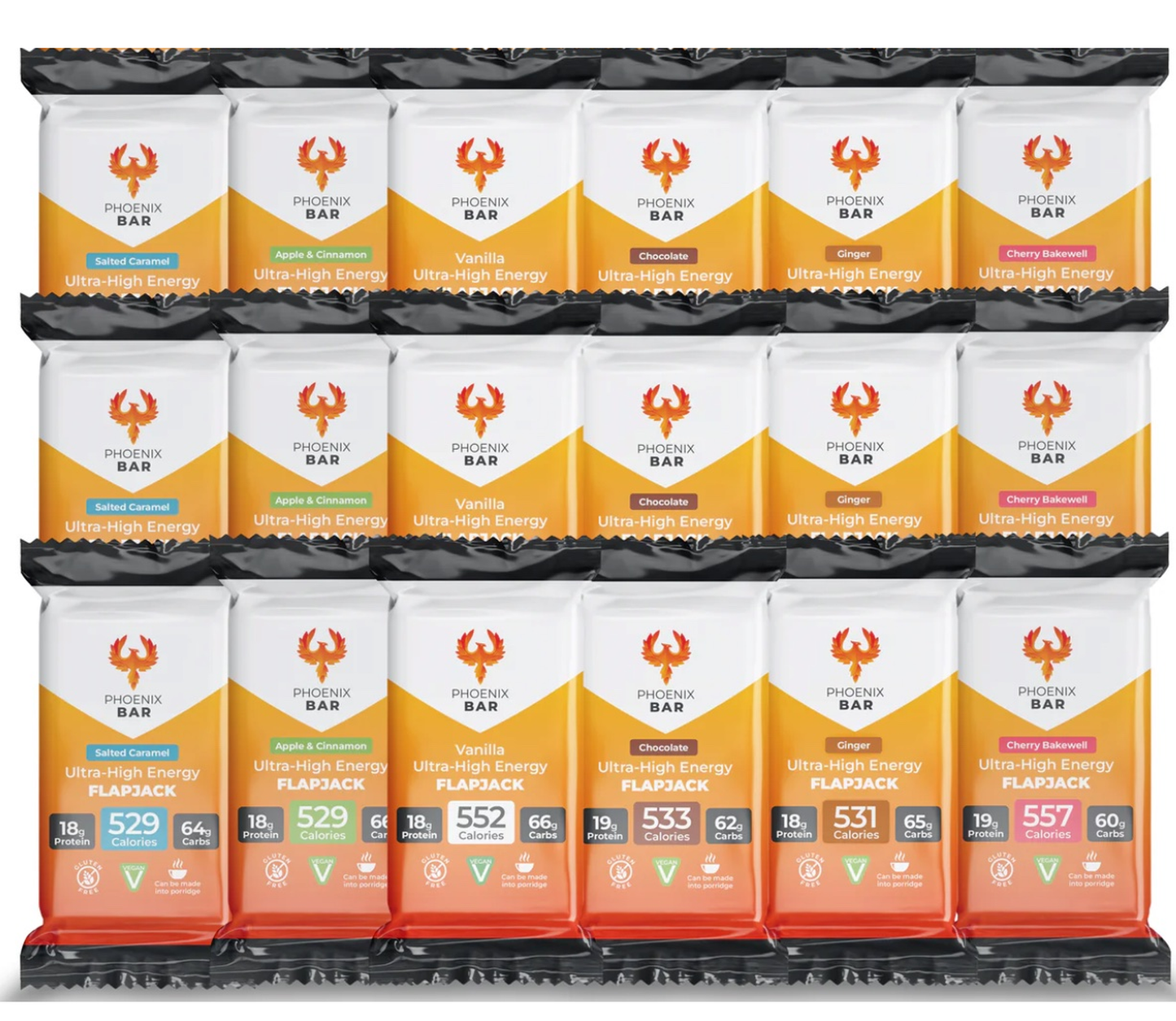
Alternatively, if you struggle to eat solid food in the morning, crumble one Phoenix Bar into hot water or milk to make a porridge. That is up to 557 calories in a format that takes two minutes and feels manageable even with low appetite. For more detail on this approach, see High-Calorie Breakfast Ideas.
Mid-morning: adding 300 calories that did not exist before
The original day had no mid-morning food. This is the single biggest opportunity in most people's days. A gap between breakfast and lunch where an extra 200-400 calories can slot in without affecting appetite for the next meal. It is the gap our weight gain bars were built to fill.
Half a Phoenix Bar (approximately 280 calories) with a cup of tea made with whole milk takes less than five minutes and does not require preparation. Alternatively, a handful of nuts (30g, roughly 180 calories) and a piece of cheese (30g, roughly 120 calories) achieves a similar result.
The key is that this is not a meal. It is not something you sit down and eat with cutlery. It is something small you consume mid-morning without thinking about it much. People who successfully hit 3,000 calories almost always eat between meals. People who struggle almost always rely on three meals alone.
Lunch: from 550 to 750 calories
The original: a sandwich, crisps, and an apple. 550 calories.
Two changes. First, add cheese or avocado to the sandwich (approximately 120 calories). Second, replace the apple with a high-calorie snack like a handful of trail mix (approximately 200 calories). The sandwich is the same sandwich. You have added one ingredient to it and swapped one side for a more calorie-dense alternative.
New total: approximately 750 calories.
If one of these snack slots regularly becomes a meal in its own right, my guide to meal replacement bars in the UK covers which type is worth that job.

Phoenix Bars: Up to 557 Calories Per Bar
Highly compact, low-volume, calorie-dense bars. Soft, easy to eat whole or as a warm porridge. Vegan, gluten-free and contain up to 66g of carbohydrates, 19g of protein & 8 vitamins & minerals.
Afternoon: adding another 300 calories
Same approach as mid-morning. A Phoenix Bar eaten in chunks over an hour while working, studying, or travelling delivers up to 557 calories. Even half a bar (roughly 280 calories) fills this gap comfortably. A smoothie made with whole milk, a banana, and peanut butter works here too (approximately 500 calories) and goes down easily. For ideas, see High-Calorie Drinks, Smoothies and Milkshakes.
Dinner: from 600 to 800 calories
The original: chicken, rice, and vegetables. 600 calories.
Three small changes that are invisible on the plate. Cook the rice in a splash of olive oil (adds approximately 120 calories). Add a tablespoon of butter or coconut oil to the vegetables (adds approximately 100 calories). Use a slightly larger portion of rice (adds approximately 60 calories).
New total: approximately 880 calories. The plate looks almost identical to the original.
Evening: adding a final 200-300 calories
A small bowl of Greek yoghurt with honey and nuts (approximately 350 calories). Or a glass of whole milk with a spoonful of peanut butter stirred in (approximately 280 calories). This is not a fourth meal. It is a final calorie top-up before bed.
The revised day
Breakfast: 680 calories.
Mid-morning: 300 calories.
Lunch: 750 calories.
Afternoon: 280 calories.
Dinner: 880 calories.
Evening: 300 calories.
Total: approximately 3,190 calories.
This day contains the same three meals as the original. The portions are only slightly larger. The difference comes from calorie-dense ingredient swaps within those meals and three small between-meal additions that individually take less than five minutes. No meal prep. No batch cooking. No force feeding.
Where People Go Wrong
I see the same mistakes repeatedly in customers who are trying to increase their intake.
Trying to hit 3,000 from day one. If you are currently eating 1,700 calories, jumping straight to 3,000 will make you feel bloated, nauseous, and discouraged. Increase by 200-300 calories per week. Your stomach capacity and appetite will adjust over time. Give yourself three to four weeks to reach the target comfortably.
Relying on three large meals instead of five or six smaller eating moments. Three meals of 1,000 calories each is technically 3,000 calories, but very few people with reduced appetite can eat 1,000-calorie meals. Five to six smaller eating moments of 500-600 calories each are far more manageable and keep energy levels steadier throughout the day.
Choosing low-calorie "healthy" foods. Salads, rice cakes, low-fat yoghurt, and diet drinks are the opposite of what you need when trying to reach 3,000 calories. Every food choice should be the full-fat, calorie-dense version. For a comprehensive list, see Calorie-Dense Foods.
Drinking water with meals. Water fills the stomach and suppresses appetite. Drink between meals instead. If you need to drink with food, choose something with calories: whole milk, juice, or a high-calorie smoothie.
Forgetting weekends and rest days. Calorie needs do not disappear on days off from training. If you eat 3,000 on weekdays and 2,000 on weekends, your weekly average drops to 2,700. Consistency matters more than perfection on any single day.
How Phoenix Bars Fit Into a 3,000 Calorie Day
I want to be transparent about what my product does and does not do here.
Phoenix Bars are not a meal replacement and they are not designed to be the foundation of anyone's diet. They are a calorie-dense supplement that fills gaps. In a 3,000-calorie day, one or two bars (557 to 1,114 calories) can cover the between-meal additions that are the hardest part for most people to sustain.
The practical advantage is convenience. Nuts, cheese, and smoothies all work as between-meal calorie sources, but they require either refrigeration, preparation, or cleanup. A Phoenix Bar requires none of those things. It sits in a bag, a drawer, or a pocket. It has a two-year shelf life. It can be eaten as a bar, chopped into chunks for snacking over an hour, or crumbled into hot water as a porridge. That versatility is why customers who need consistent daily calories tend to build the bars into their routines.
A Starter Bundle of 12 bars provides approximately 6,600 additional calories. At two bars per day to fill the between-meal gaps, that covers six days. An Essential Bundle of 18 bars covers nine days. For someone working towards 3,000 calories consistently, the subscription option ensures a regular supply without the need to reorder.
To fill the gaps between meals without much extra volume, here arethe most calorie-dense bars compared.
When 3,000 Calories Might Not Be Right for You
Not everyone needs 3,000 calories. If you are sedentary, of average height and build, and not recovering from illness or training heavily, 3,000 calories may exceed your needs and lead to unwanted weight gain. The strategies in this guide should only be applied if you have a genuine reason to eat at this level.
If you have been advised to eat 3,000 calories by a GP, dietitian, or specialist, follow their specific guidance on macronutrient balance and food choices. This guide provides general strategies for reaching a calorie target; it does not replace individualised nutritional advice.
If you are experiencing unintentional weight loss or persistent loss of appetite, please speak to a healthcare professional before trying to increase your intake independently. There may be underlying causes that need attention.
If you have any questions about using Phoenix Bars as part of a 3,000-calorie routine, contact me directly. I am happy to help with quantities and timing based on your specific situation.


Flaming Phoenix