

Rucking Calorie Calculator: How Many Calories Does Rucking Burn?
In diesem Leitfaden

An 80 kg person carrying a 15 kg pack at 5 km/h burns roughly 400 kcal per hour on flat pavement, rising to 600 to 700 kcal per hour on hills or soft ground. Rucking, or yomping as the Royal Marines have always called it, burns more than walking, but how much more depends on your pack weight, pace, gradient and the surface under your boots. This calculator works in kilograms and km/h first, because you shouldn't need to convert your own bodyweight to use an American tool.
How this calculator works
The engine is the Pandolf load-carriage equation, developed at the US Army Research Institute of Environmental Medicine and still the most widely cited model for the energy cost of walking under load. It takes your body mass, pack mass, speed, gradient and a terrain factor: pavement or a treadmill counts as 1.0, a dirt trail 1.1, grass or light brush 1.2, rough ground 1.5, and soft sand 2.1, meaning sand more than doubles the cost of moving the same load. Because field validation studies have shown the original laboratory equation underestimates real-world cost, particularly at heavier loads, this calculator applies a 15% field correction and says so, which is more than most rucking calculators will tell you about their numbers.
What actually drives the burn
What most rucking marketing skips: at an easy pace on tarmac, the pack itself adds less than you'd think. A 15 kg pack at 5 km/h adds roughly 15 to 20% over unloaded walking for an 80 kg person. What multiplies the burn is everything else. Push the same ruck onto a 6% gradient and the hourly cost climbs toward 650 kcal. Move it onto soft sand and you're near 700. Lift the pace to a 6.4 km/h military standard and the number rises again. Pack weight matters, but speed, hills and surface are the real levers, which is what the equation predicts and what anyone who has yomped across Dartmoor already knows in their legs.
Reference figures
For an 80 kg person with a 15 kg pack, expect roughly 400 kcal per hour on flat pavement, around 480 at a brisk 6 km/h, about 650 per hour on rolling hills, and up to 700 per hour on sand or bog. A 20 km ruck at military pace, three hours at 6.4 km/h with that load, costs in the region of 1,500 to 1,700 kcal, which is most of a full extra meal's worth of calories on top of a normal day.
Rucking on a treadmill
Set the terrain to pavement and enter your treadmill incline as the gradient. A 1% incline is often suggested to mimic outdoor conditions, and anything above 5% with a loaded pack turns a walk into serious work.
Fuelling a ruck
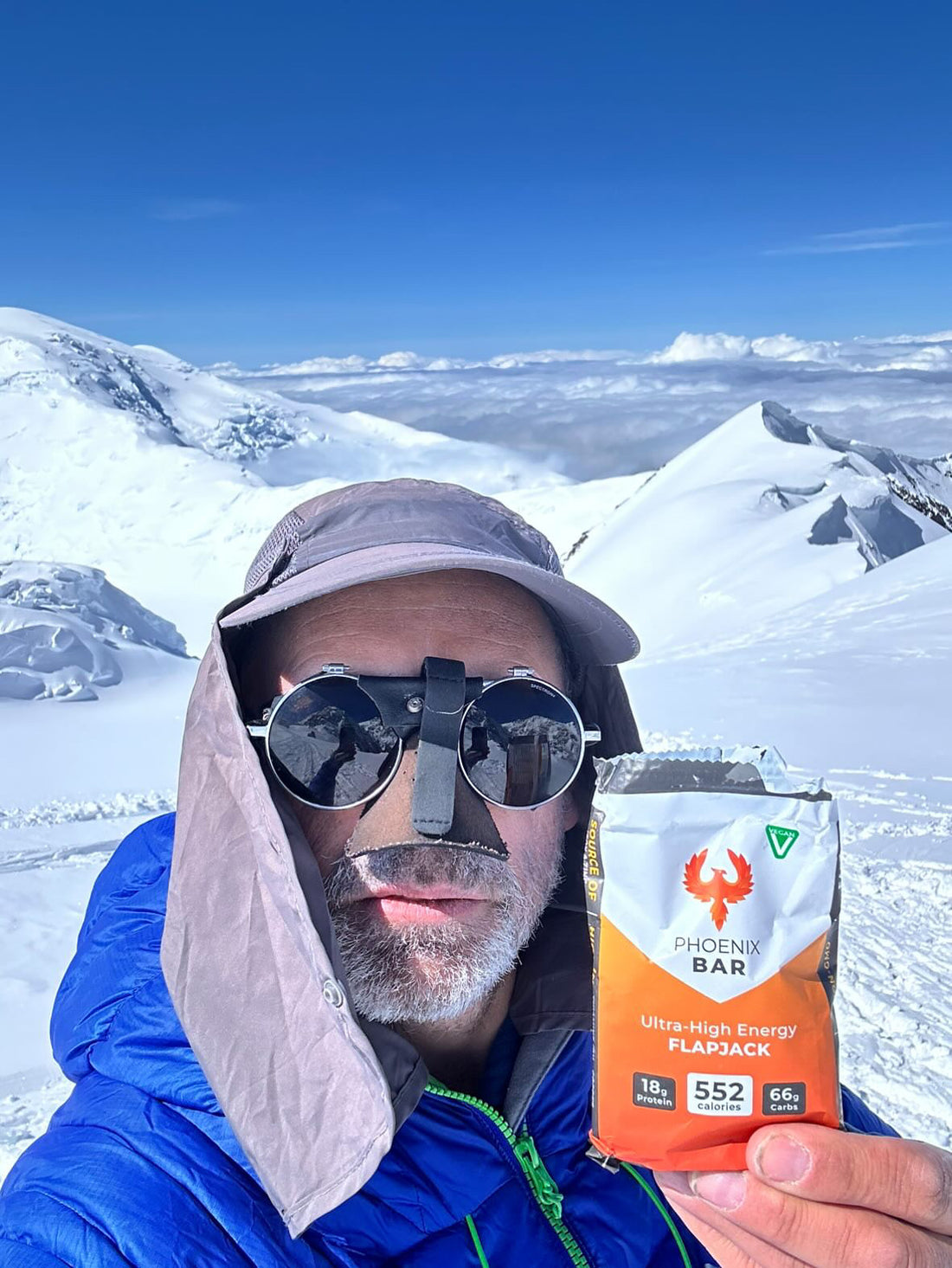
Rucking has a built-in irony: the activity is about carrying weight, and the fuel to sustain it adds more weight. That makes calories per gram the number that matters in your pack. Our high calorie bars are built for this. A Phoenix Bar carries up to 557 kcal in only 120g, about 4.6 kcal per gram, so one bar covers well over an hour of loaded marching for the weight of a water bottle's dregs. For longer days under a bergen, see our guides to military field nutrition and the lightest high-calorie foods for backpacking, our pick of the best energy bars for hiking, and the highest calorie bars in the UK ranked by energy per gram.
Frequently asked questions
How many more calories does rucking burn than walking? At easy pace on flat tarmac, a moderate pack adds around 15 to 20%. Add hills, pace and rough ground and loaded marching can approach double an easy unloaded walk, though claims of triple the burn generally assume heavy loads, fast paces and steep terrain all at once.
How many calories does rucking with 30 lb burn? A 30 lb pack is about 13.6 kg. For an 80 kg person at 5 km/h on the flat, that's roughly 390 to 400 kcal per hour, and meaningfully more on gradients.
How many calories does a 12 mile ruck burn? Around 19 km at military pace takes about three hours, and with a 15 kg load costs a typical carrier roughly 1,500 to 1,700 kcal depending on terrain.
Can I use this for weighted vest walking? Yes. Enter the vest weight as the pack weight; the equation models carried load the same way, and a vest's central position, if anything, carries slightly more efficiently than a high pack.
Hiking without a load? See calories burned hiking. Working out other sports, try our cycling calorie calculator, ultra running calorie calculator and swimming calorie calculator.
Written by James, founder of Flaming Phoenix and the maker of Phoenix Bars. Calculator methodology based on the Pandolf load-carriage equation with a stated 15% field correction. Updated August 2026.
Viele Kalorien. Kleiner Riegel.
Bis zu 557 Kalorien in einem kompakten, leichten Riegel von nur 120 g, mit bis zu 66 g Kohlenhydraten und 19 g Protein. Im Ganzen essen, über ein paar Stunden in Stücken essen oder mit Wasser oder Milch zu Porridge verrühren.
Leicht zu essen, leicht verdaulich und nicht zu süß. Kunden haben sie bei -45 °C und in der Hitze des Marathon des Sables gegessen, und sie sind bis zu zwei Jahre haltbar: für die Berge, die Nachtschicht oder zu Hause, an Tagen, an denen genug zu essen schwerfällt.
- 557 Kalorien in nur 120 g (529 bis 557 je nach Sorte)
- 4,6 Kalorien pro Gramm
- 66g Kohlenhydrate pro Riegel (bis zu)
- 19g Protein pro Riegel (bis zu)
Widerruf erklären
Füllen Sie das folgende Formular aus, um Ihre Widerrufserklärung abzugeben.

