
Best Ultra Marathons in the UK (2026/27): 30 Races Ranked by Distance and Difficulty
Written by James, founder of Flaming Phoenix and the maker of Phoenix Bars. Updated September 2026.
Quick answer: the best UK ultra marathons depend on the distance you are ready for. For a first ultra, Race to the Stones (100K on the Ridgeway, over 90 percent completion) and Centurion's South Downs Way 50 are the standout choices. For a first 100 miles, the Thames Path 100 is the flattest and the South Downs Way 100 the classic. The Montane Lakeland 100 is the most loved mountain hundred, the Arc of Attrition the toughest coastal one, and the Winter Spine (268 miles, January) is the hardest race in Britain by some distance. If you want multiple days, the Dragon's Back Race (380 km across Wales) is the one everybody talks about. Below you will find all 30 races with next dates, distances, ascent, cut-offs and prices, plus who each race suits and how to get in.
Why this list is different
Most "ultra marathons UK" pages are either calendars with hundreds of names and no opinion, or short listicles with no dates, prices or cut-offs. This page tries to be both useful and honest. Every race below has been checked against the organiser's own website for its next date, distance and entry fee at the time of writing (September 2026), and I have grouped them by the decision most runners actually face: which distance, which nation, and how hard.
A quick note on who I am. I make high-calorie energy bars that a lot of ultra runners carry in their vests and drop bags, so I spend most of my working week talking to people who are training for these exact races. That is the perspective here: I am not affiliated with any of the organisers named on this page, none of them endorse this guide, and every race is listed on its merits. Dates and fees change every year, so always confirm on the organiser's site before you enter.
What counts as an ultra marathon, and how long they take
An ultra marathon is any running event longer than the 42.195 km marathon distance. In practice the common UK distances are 50 km (31 miles), 50 miles, 100 km (62 miles) and 100 miles, with a growing tier of 200-mile and multi-day events above that. Typical finish times in UK events run roughly 5 to 10 hours for 50 km, 9 to 15 hours for 50 miles, 12 to 25 hours for 100 km and 20 to 40 hours for 100 miles, though a mountainous course can double the time of a flat one at the same distance. Cut-offs matter more than distance when you are choosing: a 50-mile race with a 13-hour limit on the South Downs is a very different proposition from 55 miles in the Lake District with 24 hours.
The best first ultras: 50K and 50 miles
Race to the Stones (Threshold Trail Series) is the obvious first ultra for most people and it earns that reputation. It follows the Ridgeway, England's oldest road, finishing at Avebury stone circle, with 100 km non-stop, a two-day 100 km with a basecamp, and two 50 km options (Thames Valley and Ridgeline). The 100 km has around 1,350 m of ascent and a generous 25-hour-plus cut-off, well over 20,000 people have finished it since 2013, and in 2025 more than 40 percent of entrants planned to hike or mix walking and running, so nobody looks out of place. Next edition 10 to 11 July 2027. Fees at the time of writing: 100 km non-stop £180 to £200, two-day £160 to £190, 50 km £85 to £100.
Race to the King (Threshold Trail Series) is the sister event in the South Downs, now based at West Dean Gardens near Chichester, with 30, 50, 80 and 100 km options and the same 25-hour-plus cut-off. The two 50 km courses (a Coastal 50 via Bosham and a Castle 50 past Arundel Castle) are among the friendliest first ultras in the country. Next edition 19 June 2027; 30 km from £55, 50 km from £75, 100 km from £155.
The Ultra Challenge series runs more than 20 walk, jog or run events a year, most with 100 km, 50 km and 25 km distances, aid every 10 to 15 km, and around half the field walking. Thames Path Challenge (September), London 2 Brighton (May), Jurassic Coast (May), Lake District Challenge (June) and Cotswold Way Challenge (June) are the pick. If you want your first ultra to feel like a supported day out rather than a race, this is where to start. Early-bird deposits are as low as £5, with the full fee due later.
Centurion South Downs Way 50 (Worthing to Eastbourne, 50 miles, about 5,700 ft of ascent, 13-hour cut-off) is the classic step up for runners who want a proper race rather than a challenge event. Next edition 10 April 2027, £118. Centurion's North Downs Way 50 (15 May 2027, 5,600 ft, 13 hours, £118) and Chiltern Wonderland 50 (September, 5,600 ft, £115) are cut from the same cloth, and its Hurtwood 50K (20 March 2027, 4,000 ft, 9 hours, £80) is a good early-season test.
Montane Lakeland 50 (55 miles, Dalemain to Coniston, roughly 3,000 m of ascent, 24-hour cut-off) is the first mountain ultra for thousands of British runners, sharing a finish line and a weekend with the Lakeland 100. Next edition 23 to 25 July 2027. Entries sell out fast when they open.
Highland Fling (53 miles along the West Highland Way, Milngavie to Tyndrum, around 2,300 m of ascent, 90 percent trail) is Scotland's best-loved 50-miler. Note that it moved from its traditional April slot to late summer (the 2026 race was 29 August), and it requires a recent marathon or ultra finish to enter (check the current qualifying window). Confirm the 2027 date with the organiser.
The Lap is a 47-mile circuit of Windermere for runners and walkers with a 24-hour limit, run anticlockwise in September and clockwise in May (next 8 May 2027). Manchester to Liverpool 50 (GB Ultras, flat Trans Pennine Trail, 14-hour cut-off) is one of the flattest 50-milers in Britain and a sensible choice if you live in the north-west and want a time rather than a view.
If this is your first ultra, the two things that go wrong most often are pacing and eating, not fitness. I wrote a separate guide on fuelling your first ultramarathon, and the ultramarathon training plan on this site has 50K and 50-mile schedules keyed to these race dates.

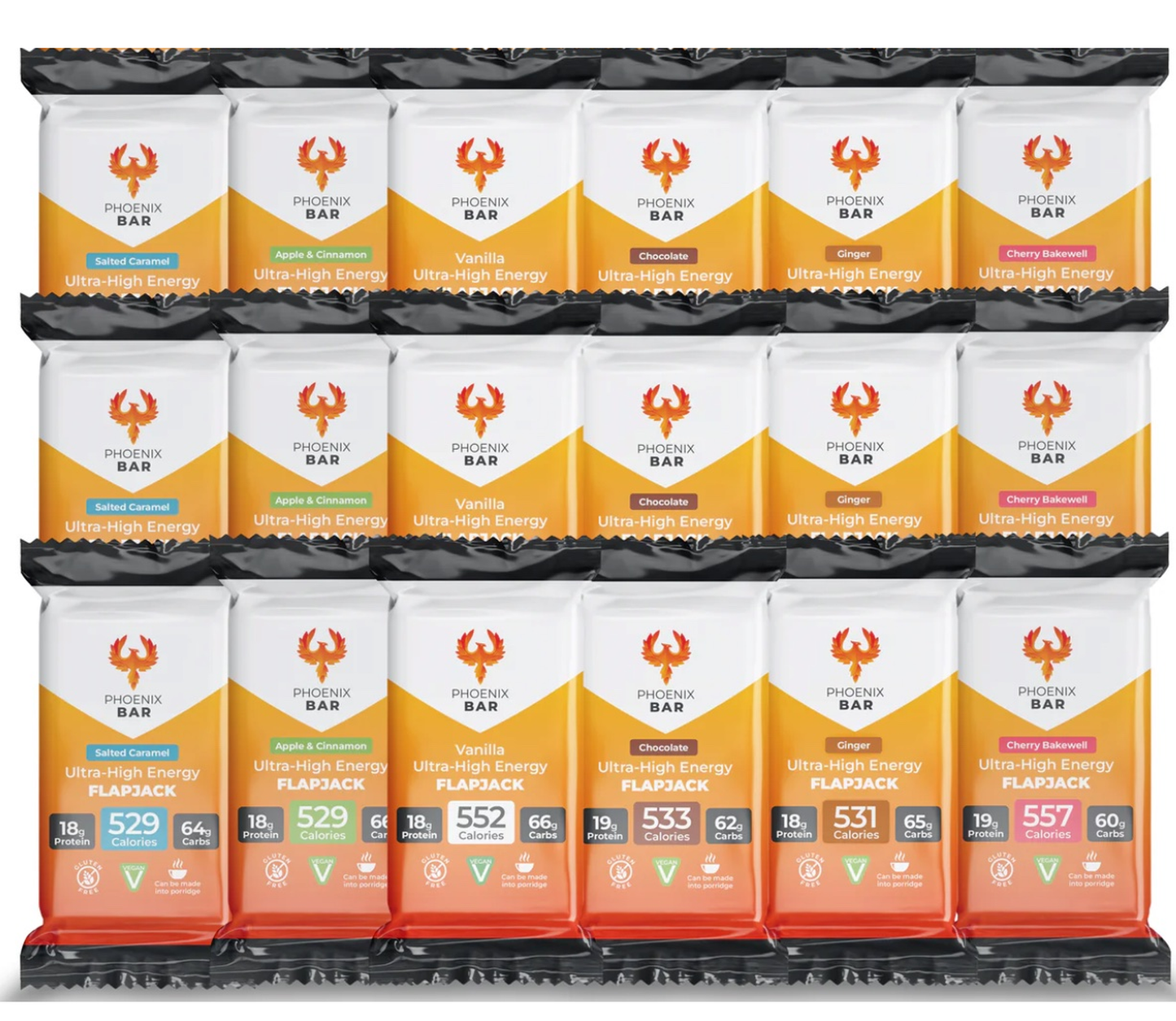
Phoenix Bars: Up to 557 Calories Per Bar
Highly compact, low-volume, calorie-dense bars. Soft, easy to eat whole or as a warm porridge. Vegan, gluten-free and contain up to 66g of carbohydrates, 19g of protein & 8 vitamins & minerals.
The best 100K races
Ultra X Scotland (1 to 2 May 2027, based around Inverness and the Great Glen) offers a single-stage 110 km with a 30-hour limit or the same distance split over two days with a camp, which is the gentlest way to experience a multi-day format. There are also 100-mile, 60 km, 50 km, 25 km and 16 km options, aid roughly every 10 km, and free under-23 entries subject to availability.
Race to the Stones 100 km (above) remains the most popular 100K in the country. Ultra-Trail Snowdonia 100K (106 km, 5,400 m of ascent) is the serious mountain 100K, run in May and part of the UTMB World Series; from 2027 the event is being renamed Eryri by UTMB. Arc of Attrition 100K (82.7 km and 2,700 m of ascent along the South West Coast Path in Cornwall, 23 January 2027) sold out early for 2027, which tells you how the race has grown since it started with 50 runners in 2015. Devon Coast to Coast also offers a 100 km leg from Chagford to Lynmouth with a 25-hour cut-off (17 to 18 April 2027, £126).
For anything over 12 hours, gut training becomes a performance skill in its own right. My guide to gut training for ultras covers how to get from 40 to 90 g of carbohydrate an hour without paying for it later.
The best 100-mile races
Montane Lakeland 100 is the race most British runners name as their dream hundred: 105 miles around the Lake District from Coniston with 6,300 m of ascent, a 40-hour cut-off and a historic dropout rate of 40 to 50 percent. It was created in 2008 and the atmosphere in Coniston on race weekend is unlike anything else in UK ultra running. Next edition 23 to 25 July 2027.
Centurion South Downs Way 100 (Winchester to Eastbourne, 12,700 ft, 30 hours, 12 June 2027, £225) is the classic English hundred and the one most people should choose first. Thames Path 100 (1 May 2027, only 1,900 ft of ascent, 30 hours, £225) is flatter still and the best chance of a first buckle. North Downs Way 100 (103 miles, 11,000 ft, 30 hours, 7 August 2027, £220) and the Autumn 100 (four out-and-back spurs from Goring, 5,000 ft, 28 hours, October, £220) complete Centurion's grand slam. Centurion also runs the Winter Downs 100 and 200 in December (the 200 has 22,500 ft of climb and a 96-hour limit, £600).
Arc of Attrition 100 (173 km and 5,500 m along the Cornish coast path in late January, 22 January 2027) is the toughest hundred on this list because of the season: wind, rain, darkness and mud on technical coast path. Ultra-Trail Snowdonia 100M (163 km, 9,200 m of ascent) is the most mountainous, and Hardmoors 110 (Cleveland Way) and Hardmoors 160 (Sutton Bank to Helmsley, more than 7,000 m, 50-hour limit) are the North York Moors classics from a series that has been running since 2008.
Devon Coast to Coast (112 miles non-stop from Wembury to Lynmouth via the Erme-Plym Trail and the Two Moors Way, 38-hour limit, 17 to 18 April 2027, £231, mandatory tracker) crosses both Dartmoor and Exmoor. The Wall (Rat Race, 70 miles from Carlisle Castle to Newcastle Quayside along Hadrian's Wall, 26-hour limit, 12 June 2027, £245) is not quite a hundred but has a completion rate above 90 percent and is the most popular "big step up" in the north. West Highland Way Race (Milngavie to Fort William, 95 miles, founded 1985) is the oldest ultra in Britain, limited to 300 runners, with ballot registration each October for the following June (next race 19 June 2027).
A hundred miles is a fuelling problem as much as a running problem. The 100-mile ultramarathon nutrition guide and my page on drop bags and aid stations cover the hour-by-hour plan; the short version is that solid, calorie-dense food you can eat while walking becomes essential once gels stop working, which is exactly why I built Phoenix Bars at 527 to 557 kcal each.
The hardest ultra marathons in the UK
Montane Winter Spine Race is the answer to "what is the hardest ultra marathon in the UK". It is 268 miles of the Pennine Way from Edale to Kirk Yetholm in mid-January, non-stop, with 10,732 m of ascent, a 156-hour limit and a £1,345 entry fee. The 2027 race starts on 10 January, has 150 places, and requires a previous 100-mile-plus mountain or moorland ultra finish (or a Spine Challenger finish) to qualify. The Spine Challenger South (108 miles, Edale to Hardraw), Challenger North (160 miles) and Sprint (46 miles) are the stepping stones. If you are going to attempt any of it, read my Pennine Way food guide first, because keeping calories going in at minus five with wet gloves is the whole game.
Dragon's Back Race covers 380 km and 16,400 m of ascent in six days from Conwy Castle to Cardiff Castle every September. Entry has historically cost £400 to £900 or more. There are now two-day versions (Dragon's Fire in the north and Dragon's Tail across Bannau Brycheiniog to Cardiff) for runners who want a taste. I have a dedicated guide on what to eat on the Dragon's Back Race built from customers who have run it.
Race Across Scotland (GB Ultras) is 215 miles coast to coast on the Southern Upland Way from Portpatrick, single stage, with a 100-hour limit. Northern Traverse (300 km, St Bees to Robin Hood's Bay across three national parks) and The Wrath (the planned non-stop successor to the Cape Wrath Ultra, see the 2026 changes below) are the other expedition-length British races, and the Arc 100 and Lakeland 100 are the hardest of the "normal" hundreds.
By nation: the best ultra in England, Scotland, Wales and Northern Ireland
England has the deepest calendar. Beyond the races above, Lakes in a Day (50 miles from Caldbeck to Cartmel in October, around 4,000 m of ascent, over Blencathra and the Helvellyn ridge) is the best one-day tour of the Lake District, and the Cotswold Way Century and Thames Trail Ultra are strong autumn options.
Scotland has the West Highland Way Race, the Highland Fling, Ultra X Scotland, Race Across Scotland, and the Glen Ogle 33 (November) as a friendly first ultra. Fuelling on the West Highland Way has its own quirks (long gaps between towns), which I cover in the West Highland Way food guide.
Wales has Ultra-Trail Snowdonia (Eryri by UTMB), the Dragon's Back Race, the Beacons Ultra (November, Talybont-on-Usk), the Gower Peninsula Challenge (Ultra Challenge, July) and the Slate Trail Ultra (November).
Northern Ireland is missed by almost every list, which is a shame because it has two excellent ultras. The Mourne Way Ultra (Newcastle to Rostrevor and back along the Mourne Way, around 84 km at the time of writing, organised by 26 Extreme, 26 June 2027) is the tougher of the two, and the Causeway Coast Ultra (64 km out and back from Portballintrae past the Giant's Causeway, September) is one of the most scenic coastal ultras in the British Isles.
The best backyard ultras
If you like the idea of running until you cannot, the backyard format (a 6.7 km loop every hour, on the hour, until one person is left) has exploded in the UK, with more than 40 events a year. I have written a complete, separate guide to every UK backyard ultra and how the format works, including which events are silver-ticket qualifiers for the world championships.
What changed in 2026
The UK ultra scene had a turbulent year. Ourea Events, which ran the Dragon's Back Race, Cape Wrath Ultra and Northern Traverse, went into administration in March 2026. Ultra X acquired the Dragon's Back Race and Northern Traverse and honoured the September 2026 Dragon's Back; Northern Traverse 2026 entries were moved to 2027. The Cape Wrath Ultra did not run in 2026, and the trademark was acquired by a new company planning a non-stop event called The Wrath along the Cape Wrath Trail for 2027. UTMB now owns the Arc of Attrition and Ultra-Trail Snowdonia, and the latter becomes Eryri by UTMB from 2027. None of this changes the routes, but it does change where you enter and who you are paying, so check the organiser's own site rather than an old blog post.
Entry routes, ballots and what it costs
Most UK single-day ultras cost between £40 and £120 to enter at the time of writing, with the big-brand challenge events (Threshold, Ultra Challenge, Rat Race) sitting at £85 to £250 depending on distance, Centurion hundreds at £220 to £225, multi-day races in the hundreds of pounds, and the Winter Spine at £1,345. Charity places are often cheaper up front but come with a fundraising pledge.
Three entry routes exist. Open entry (most events) means first come, first served, and the popular ones (Lakeland, Arc, Rasselbock backyards) sell out within hours or days. Ballots (West Highland Way Race, with registration from 1 to 14 October 2026 for 300 places in the 2027 race) mean you may wait a year. Qualification (Winter Spine, Highland Fling, and any UTMB World Series race that needs Running Stones for the finals) means you need to build a race history first. If you are aiming for a hard race in 2028, the practical path is a 50-miler in spring 2027, a hundred in summer or autumn, and the qualifier the following winter.
A month-by-month UK ultra calendar
January brings the Arc of Attrition (22 to 24 January 2027) and the Winter Spine (10 January 2027). March has Centurion's Hurtwood 50K and the Rasselbock Sherwood Pines backyard. April is the South Downs Way 50 (10 April), Devon Coast to Coast (17 to 18 April) and the Beecraigs backyard in Scotland. May is the busiest month: Thames Path 100 (1 May), Ultra X Scotland (1 to 2 May), Ultra-Trail Snowdonia, North Downs Way 50 (15 May), London 2 Brighton and the Jurassic Coast Challenge. June has the South Downs Way 100 (12 June), The Wall (12 June), Race to the King (19 June), the West Highland Way Race (19 June), the Lake District and Cotswold Way Challenges, the Mourne Way Ultra and the Suffolk backyard. July is Race to the Stones (10 to 11 July) and Lakeland 50 and 100 (23 to 25 July). August has the North Downs Way 100 (7 August) and, since 2026, the Highland Fling. September is the Dragon's Back Race, Chiltern Wonderland 50, the Thames Path Challenge, the Causeway Coast Ultra and Hardmoors 60. October has the Autumn 100 and Lakes in a Day; November the Wendover Woods 50, Beacons Ultra and Glen Ogle 33; December the Winter Downs 100 and 200.
How to fuel a UK ultra (the short version)
Aid stations in Britain are generous with crisps, cake and cola, but they are unreliable as a strategy on a wet night when your stomach has turned. Aim for 60 to 90 g of carbohydrate an hour that you have practised in training, carry some real food you can eat while walking, and use the ultra running calorie calculator to see how far behind you will inevitably fall. My comparison of the best energy bars for ultra running explains why calorie density per gram matters so much in a vest, and why our own bar, at 120 g and over 500 kcal, is built to stay soft in the cold and edible at hour 20 when sweet gels are the last thing you want. Then plan your recovery in the days after the race as carefully as the race itself.
Frequently asked questions
Are there any ultra marathons in the UK? Hundreds. The main race calendars list more than 300 UK ultra events a year, from 50 km trail races to 268-mile winter expeditions, plus more than 40 backyard ultras. The 30 races on this page are the ones I would recommend first.
What is the hardest ultra marathon in the UK? The Montane Winter Spine Race: 268 miles of the Pennine Way in January with a 156-hour limit. In its early years only a handful of starters finished. The Dragon's Back Race (380 km over six days) and the Arc of Attrition 100 (Cornish coast in January) are the next hardest.
What is the easiest ultra marathon? The 50 km options at Race to the Stones, Race to the King and the Ultra Challenge events are the most beginner-friendly, with generous cut-offs, frequent aid and large walking fields. The Manchester to Liverpool 50 is the flattest 50-miler and the Thames Path 100 the flattest hundred.
Can a normal person run an ultra marathon? Yes. Race to the Stones has had more than 20,000 finishers, many of them first-timers, and around 40 percent of its entrants walk large sections. With 16 to 24 weeks of consistent training and a sensible eating plan, a 50 km is achievable for most healthy adults who can already run a half marathon.
What ultra marathons are happening in the UK in 2027? The confirmed 2027 dates at the time of writing include the Winter Spine (10 January), Arc of Attrition (22 to 24 January), South Downs Way 50 (10 April), Devon Coast to Coast (17 to 18 April), Thames Path 100 (1 May), Ultra X Scotland (1 to 2 May), North Downs Way 50 (15 May), South Downs Way 100 (12 June), The Wall (12 June), Race to the King (19 June), West Highland Way Race (19 June), Mourne Way Ultra (26 June), Race to the Stones (10 to 11 July), Lakeland 50 and 100 (23 to 25 July) and North Downs Way 100 (7 August).
What are the best 50K ultra marathons in the UK? Hurtwood 50K (March), the Race to the Stones 50 km courses (July), Race to the King 50 km (June), the South Downs Way 50K (June) and the 50 km distances at the Ultra Challenge events.
What are the most prestigious ultra marathons in the UK? The Lakeland 100, the West Highland Way Race (the oldest, since 1985), the Winter Spine, the Dragon's Back Race, the Arc of Attrition and Centurion's South Downs Way 100 carry the most weight in the UK community.
How much does it cost to enter an ultra marathon in the UK? Typically £40 to £120 for a single-day event from a smaller organiser, £85 to £250 for the big challenge brands and Centurion races, and £600 to £1,345 for 200-mile and multi-day expedition races.
Flaming Phoenix is not affiliated with, sponsored by or endorsed by any of the race organisers named on this page. Race names are used for identification only and belong to their respective owners. Dates, distances and fees were checked on organiser websites in September 2026 and may change.


Flaming Phoenix



Contact Us
Widerruf erklären
Füllen Sie das folgende Formular aus, um Ihre Widerrufserklärung abzugeben.

