

Cycling Calorie Calculator: How Many Calories Does Cycling Burn?
In diesem Leitfaden

A 70 kg rider burns about 560 kcal an hour cycling at a moderate 19 to 22.5 km/h, roughly 28 kcal per km. That is 8.0 METs × 70 kg × 1 hour (2024 Adult Compendium), so 10 km costs about 280 kcal and 100 km about 2,800. The cycling calorie calculator below works from speed or average watts.
How many calories does cycling burn per hour?
An hour on the bike burns about 280 kcal riding gently and 840 kcal at a fast 25.5 to 30.5 km/h for a 70 kg rider. Each speed band in the calculator, per hour:
- Gentle, under 16 km/h (10 mph): about 280 kcal (4.0 METs)
- Steady, 16 to 19 km/h (10 to 12 mph): about 475 kcal (6.8 METs)
- Moderate, 19 to 22.5 km/h (12 to 14 mph): about 560 kcal (8.0 METs)
- Brisk, 22.5 to 25.5 km/h (14 to 16 mph): about 700 kcal (10.0 METs)
- Fast, 25.5 to 30.5 km/h (16 to 19 mph): about 840 kcal (12.0 METs)
- Racing, 32 km/h (20 mph) and over: about 1,120 kcal (16.0 METs)
- Mountain biking on mixed trails: about 595 kcal (8.5 METs)
Heavier riders burn proportionally more: at 85 kg add about a fifth to every figure, at 60 kg take about a seventh off. Speed bands cannot see hills, headwinds or the shelter of a group; the watts section below deals with that.
How many calories does a 10 km, 50 km or 100 km bike ride burn?
At a moderate 20 km/h, a 70 kg rider burns about 28 kcal per kilometre, so 10 km costs about 280 kcal and 100 km about 2,800. Common ride distances at that pace:
- 5 km: about 140 kcal (15 minutes)
- 10 km: about 280 kcal (30 minutes)
- 14 km: about 390 kcal (42 minutes)
- 10 miles (16 km): about 450 kcal (48 minutes)
- 22 km: about 615 kcal (1 hour 6 minutes)
- 20 miles (32 km): about 900 kcal (1 hour 37 minutes)
- 50 km: about 1,400 kcal (2 hours 30 minutes)
- 100 km: about 2,800 kcal (5 hours)
- 100 miles (161 km): about 4,500 kcal (8 hours)
On the flat, riding faster changes the cost per kilometre less than you might expect, because you finish sooner: about 27 kcal per km at 17.5 km/h, 28 at 20, 29 at 24 and 30 at 28 km/h for a 70 kg rider. Body weight matters more. Worked example: an 85 kg rider doing a 100 km sportive at 24 km/h is in the Brisk band. 100 km ÷ 24 km/h = 4.17 hours, and 10.0 METs × 85 kg × 4.17 hours = about 3,540 kcal.
For gravel and farm tracks the Compendium has no dedicated value; its nearest entry, dirt or farm road at a moderate pace, rates 5.8 METs. Off-road speed says little about effort, so watts mode is the better tool there. Planning an event? See our list of UK gravel races.
How do you convert watts to calories?
Multiply your average power in watts by 3.6 to get kilojoules of work per hour, then count each kilojoule as roughly one kcal burned. The shortcut works because 1 kcal is 4.184 kJ and riders turn only about 20 to 25% of the food calories they burn into work at the pedals, according to TrainerRoad's explanation of gross efficiency; at around 24% the two numbers cancel out.
Worked example: 2 hours 30 minutes at an average 180 W is 180 × 3.6 × 2.5 = 1,620 kJ, so about 1,620 kcal. A less efficient rider at 20% would burn more for the same work: 1,620 ÷ 4.184 ÷ 0.20 = about 1,940 kcal. Because 24% sits near the top of that range, the watts figure is more likely to understate your burn than overstate it. Power also sees what speed cannot: the same 180 W is the same cost whether you are climbing, riding into a headwind or sitting in a group.
How the cycling calorie calculator works
In speed mode the calculator multiplies a MET value by your weight in kilograms and your ride time in hours: calories = METs × kg × hours. Calculated using MET values from the 2024 Adult Compendium of Physical Activities bicycling list (4.0 to 16.0), matched to the Compendium's own speed bands in mph. Two caveats: the Compendium marks the 16 to 19 mph value (12.0) and the mountain biking value (8.5) as estimates, and our racing setting uses 16.0, a little under the Compendium's 16.8 for solo racing above 20 mph.
In watts mode it calculates average watts × 3.6 × hours. Both modes give gross calories, which include what your body burns at rest; subtract your weight in kg × hours for the net cost. A moderate hour at 70 kg is 560 kcal gross and about 490 net.
How many calories do indoor and e-bike rides burn?
Indoors, use watts mode: smart trainers and most spin bikes report power, and speed means little on a turbo. Without power, the Compendium rates a general stationary bike at 6.8 METs, a spin class at 9.0 and an interactive virtual ride at 8.8, so an hour of virtual training at 70 kg is roughly 615 kcal.
On an e-bike the motor does part of the work, and the Compendium has separate values for it: 6.8 METs with the motor off, 6.0 on light assistance and 4.0 on high assistance. At 70 kg that is about 475, 420 and 280 kcal an hour. Pick Steady for an unassisted e-bike ride and Gentle for one on high assistance.
How much should you eat per hour of cycling?
Start with calories: a 100 km ride at 70 kg costs about 2,800 kcal, and nobody eats all of that back on the bike, so the aim is to keep carbohydrate coming in. Sports scientist Asker Jeukendrup recommends about 30g of carbohydrate an hour for rides of one to two hours, up to 60g an hour for longer rides, and up to 90g an hour beyond two and a half hours using mixed sugars such as glucose and fructose. Rides under 30 minutes need nothing. Start eating in the first hour rather than waiting until you feel empty.
Jersey pockets are small, so calories per gram decides how much you can carry. Our high calorie bars were built around that problem: Phoenix Bars carry up to 557 calories and up to 66g of carbohydrate in a compact, lightweight 120g bar, so half a bar an hour gives roughly 265 to 280 kcal and up to 33g of carbohydrate. Robert Welman wrote that he "managed a 180km cycle through the hills of Dorset" on them. For more detail, see high-carb solid foods, long-distance cycling nutrition, gravel cycling nutrition, the best energy bars for long-distance cycling and the highest calorie bars in the UK ranked by calories per gram. Ultra runners face the same sums on foot, and our ultra running calorie calculator sets their burn against an hourly fuelling plan.
Frequently asked questions
How many calories does 30 minutes of cycling burn? About 280 kcal for a 70 kg rider at a moderate 19 to 22.5 km/h, 140 kcal riding gently under 16 km/h and 420 kcal at a fast 25.5 to 30.5 km/h. An 85 kg rider burns about a fifth more at each pace, so a moderate half hour comes to about 340 kcal.
How long do you need to cycle to burn 100 calories? About 11 minutes at a moderate pace for a 70 kg rider, 21 minutes riding gently and 7 minutes at a fast 25.5 to 30.5 km/h. In watts terms, 100 kcal is about 100 kJ of work, which is 9 minutes at an average 180 W.
How do you burn 1,000 calories cycling? Ride about 1 hour 47 minutes at a moderate pace, roughly 36 km at 20 km/h, if you weigh 70 kg. At a fast 28 km/h it takes about 1 hour 11 minutes and 33 km. With a power meter, it is 1,000 kJ of work: 1 hour 33 minutes at 180 W.
Does cycling burn more calories than running or walking? Per hour, moderate cycling (8.0 METs, about 560 kcal at 70 kg) sits between walking at a normal 5 km/h (3.8 METs, about 266 kcal) and running at 6 mph (9.3 METs, about 650 kcal). Compare your own numbers with our running calorie calculator and walking calorie calculator.
Why does my bike computer or app show a different number? If your app uses a power meter, its figure is built on kilojoules of work like our watts mode, and you can trust it over a speed-based estimate. Without power, apps estimate from speed, heart rate and their own models, and those methods can differ widely on a long ride. Neither is a measurement.
Working out other sports? Try our running calorie calculator, walking calorie calculator, swimming calorie calculator, hiking calorie calculator and rucking calorie calculator.
Sources: 2024 Adult Compendium of Physical Activities, bicycling, walking and running MET values (Herrmann and colleagues, Journal of Sport and Health Science, 2024); TrainerRoad, Calories and power; Asker Jeukendrup, Recommendations for carbohydrate intake during exercise.
Written by James Frost, founder of Flaming Phoenix. Calculator method: 2024 Adult Compendium of Physical Activities and average power. Updated October 2026.
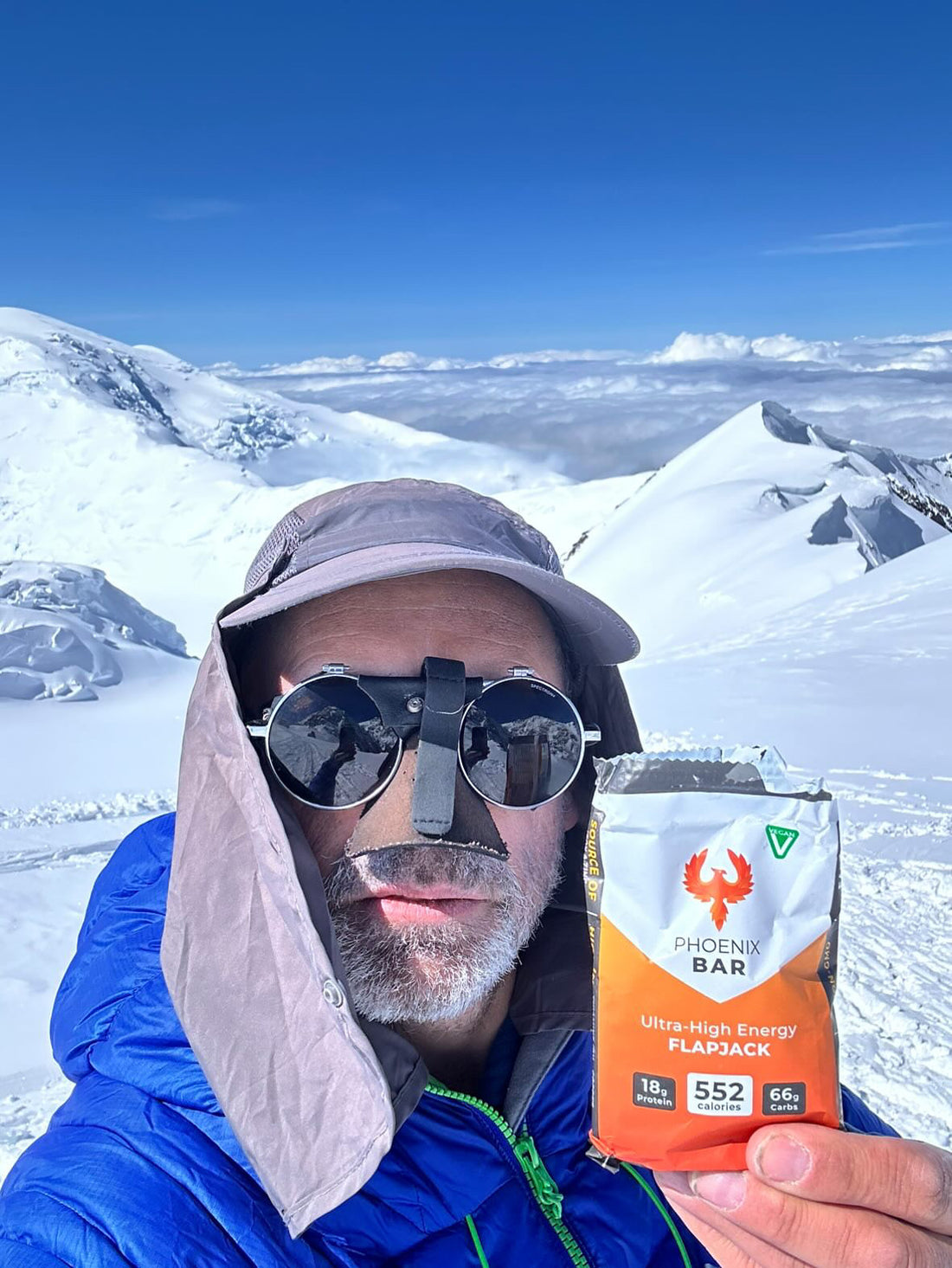
Viele Kalorien. Kleiner Riegel.
Bis zu 557 Kalorien in einem kompakten, leichten Riegel von nur 120 g, mit bis zu 66 g Kohlenhydraten und 19 g Protein. Im Ganzen essen, über ein paar Stunden in Stücken essen oder mit Wasser oder Milch zu Porridge verrühren.
Leicht zu essen, leicht verdaulich und nicht zu süß. Kunden haben sie bei -45 °C und in der Hitze des Marathon des Sables gegessen, und sie sind bis zu zwei Jahre haltbar: für die Berge, die Nachtschicht oder zu Hause, an Tagen, an denen genug zu essen schwerfällt.
- 557 Kalorien in nur 120 g (529 bis 557 je nach Sorte)
- 4,6 Kalorien pro Gramm
- 66g Kohlenhydrate pro Riegel (bis zu)
- 19g Protein pro Riegel (bis zu)
Widerruf erklären
Füllen Sie das folgende Formular aus, um Ihre Widerrufserklärung abzugeben.

