
Highest Calorie Bars UK Ranked: Per Gram & Per Bar (2026)
Written by James Frost, founder of Flaming Phoenix. Last reviewed: July 2026.
One disclosure before the numbers: I make one of the bars on this list. Phoenix Bars exist because I could not find a bar with enough calories for ultra-endurance racing, so the honest thing is to show you every option, including the one measure where another product wins, and let the numbers speak. Figures are taken from manufacturers' own published nutrition listings as of July 2026 and rounded; brand names appear for factual comparison only. If a number changes or a product deserves a place here, contact me and I will update the page.
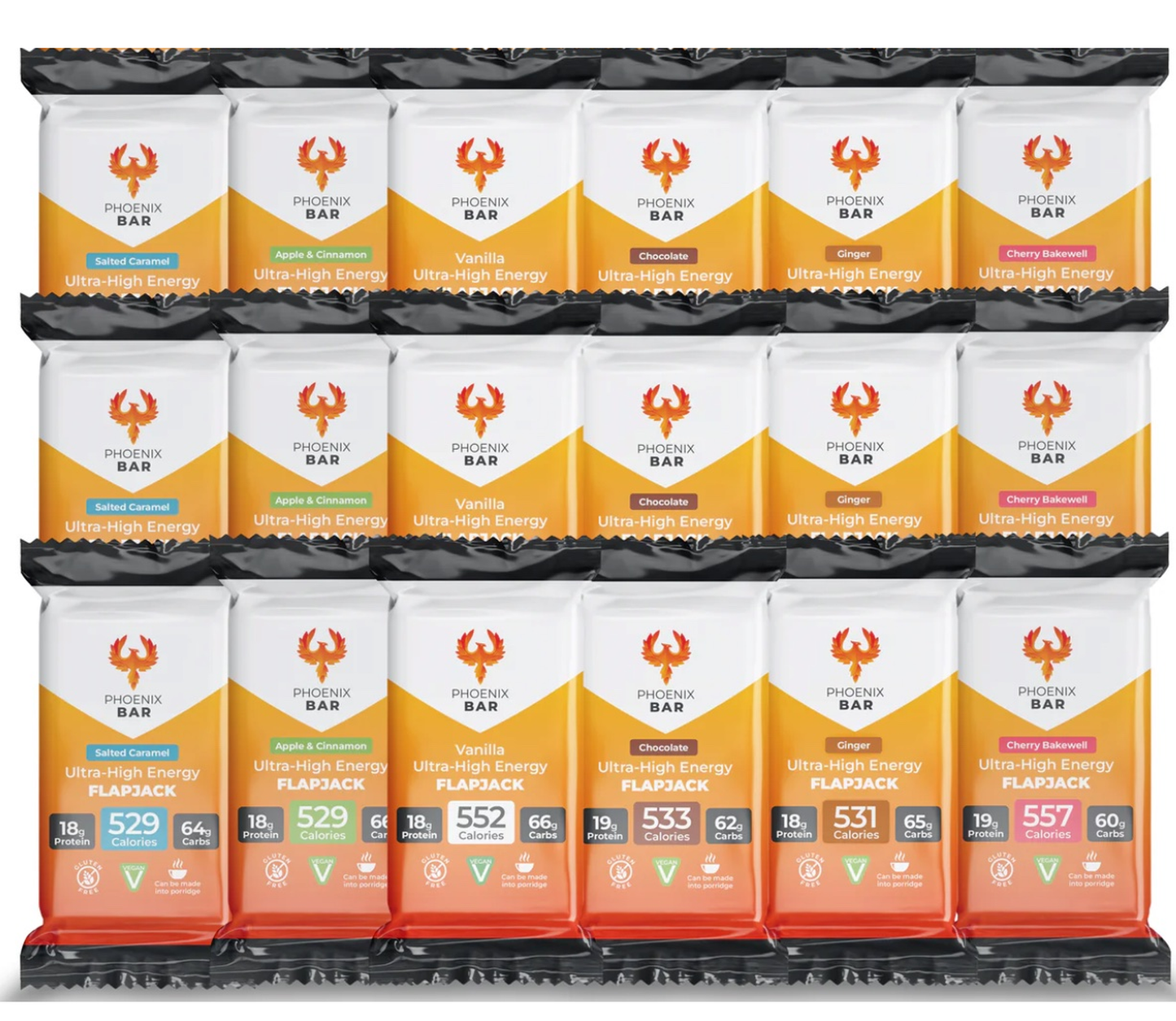
Quick answer: measured per gram, which is the measure that matters when you carry your food, Phoenix Bars are the most calorie-dense purpose-built high calorie bars in the UK at up to 4.6 calories per gram, delivering up to 557 calories in a compact 120g bar. Measured per single bar, the heavier 150g RealMeal meal-replacement bar carries the most at just over 600 calories, though at 4.0 calories per gram it is 25% heavier for around 8% more energy. This guide runs both rankings, then protein, then the 1000 calorie question.
The Highest Calorie Bars Per Gram
Calories per gram is the ranking that decides what goes in a pack, because weight, not wrapper count, is the constraint on an ultra, an expedition, or a multi-day hike.
High tier: 4.0 to 5.0 calories per gram, the purpose-built bars. Phoenix Bars lead this class at 4.4 to 4.6 calories per gram depending on flavour, the highest figure of any bar in the UK designed as actual fuel. Every Phoenix flavour is denser than the heavier 150g meal-replacement format at 4.0, whose extra per-bar calories come with proportionally more weight. Compressed emergency ration bars run at roughly 4.4 to 4.6, in brick form.
Top tier on paper: 5.0 to 6.3 calories per gram, but read on. Plain chocolate and nut confectionery beat everything on raw density, with a Cadbury Boost at roughly 6.3 calories per gram and most chocolate between 5.0 and 5.5. So why not fill a pack with chocolate? Because it melts above about 30 degrees, snaps like glass below zero, causes palate fatigue within a day, and carries almost no protein or micronutrients across a multi-day effort. Density is necessary but not sufficient for fuel: the whole reason purpose-built bars exist is to get as close as possible to chocolate's density while surviving heat, cold, and day-after-day eating. That is the design brief Phoenix Bars were built to, which is why they will not freeze at minus 45 or melt in desert heat, carry up to 19g of plant protein, and come in six deliberately un-sweet flavours.
Mid tier: 3.3 to 4.0 calories per gram. Standard energy bars at 3.5 to 3.8, most protein bars at 3.3 to 3.7, cereal bars just above. This is the tier most people are unknowingly carrying, which is why their packs are heavier than they need to be.
The Highest Calorie Bars Per Bar
The other ranking: one bar, one wrapper, total calories.
Top tier: 500+ calories per bar. Almost nothing in UK retail lives here, and two products share it. Phoenix Bars deliver 527 to 557 calories per 120g bar depending on flavour, the highest-calorie bars in the compact flapjack format and, as above, the densest purpose-built bars in the country. The single bar with the highest total we know of in UK sale is the RealMeal meal-replacement bar at just over 600 calories, achieved through a larger 150g format rather than greater density. Above this tier sit only emergency ration blocks, sold as multi-bar bricks rather than single bars: a typical 3,600 calorie survival ration is nine compressed bars of roughly 400 calories each, designed for liferafts rather than lunches.
High tier: 350 to 500 calories. Giant bakery flapjacks occupy most of this band, with 90 to 120g slabs typically carrying 380 to 520 calories, though they are soft-wrapped, crumble in a pack, and melt their toppings in heat. Press rankings of mainstream chocolate crown the white chocolate Twix Xtra at 376 calories per pack, which is two fingers, not one bar.
Mid tier: 220 to 350 calories. The famous names. A Cadbury Boost is around 305 calories, a Clif Bar around 250 to 260, Trek's larger bars around 230 to 250, a standard Snickers around 245. Snack calories, not meal calories: you would carry and eat two to three of these to match one top-tier bar.
Standard tier: under 220 calories. Most protein bars, including Grenade at around 220, and almost all cereal, granola and fruit bars. Good products built for a different job, usually protein or low-sugar snacking, not calorie delivery.

Phoenix Bars: Up to 557 Calories Per Bar
Highly compact, low-volume, calorie-dense bars. Soft, easy to eat whole or as a warm porridge. Vegan, gluten-free and contain up to 66g of carbohydrates, 19g of protein & 8 vitamins & minerals.
Best High Calorie Protein Bars
Most protein bar rankings sort by protein and ignore calories, which is backwards if calories are your actual goal. The picks, by what each is best at:
The calorie-and-protein combination: Phoenix Bars. 527 to 557 calories with up to 19g of plant protein in a 120g bar, the most calories of any bar at 4.4-plus calories per gram, with protein from soya and pea for muscle maintenance on long efforts, and the only bar in this list that also becomes a porridge or smoothie.
The single-bar heavyweight: the 150g meal-replacement bar covered above. Just over 600 calories with 26g of protein, in a bar that is 25% heavier than a Phoenix for around 8% more energy, with four flavours.
The gym mid-point: builder-style bars. Around 270 calories with about 20g of protein.
The protein-first pick: high-protein low-sugar bars such as Grenade. Over 20g of protein at only around 220 calories, excellent at their actual job, which is protein without calories, usually the opposite of the job that brought you to this page.
The one-line rule: if your target is protein with minimal calories, buy a protein bar; if your target is maximum calories with protein included and minimum weight, buy by density and treat protein as the tiebreak.
Is There a 1000 Calorie Bar?
Not as a single ready-to-eat bar in UK retail, and the physics explain why: even at chocolate-level density a 1,000 calorie bar would weigh 180 to 200g, a brick rather than a bar, which is why manufacturers who need that number make multi-bar ration blocks instead. The practical route is two bars from the top tier: two Phoenix Bars are 1,054 to 1,114 calories in 240g, and because the bars are designed to be eaten in pieces, most endurance customers spread them across a morning rather than forcing one sitting. One Phoenix Bar blended with 200ml of whole milk also passes 680 calories in a glass. Four standard chocolate bars technically reach 1,000 too, with all the melt, sugar and wrapper problems already covered.
If you would rather make your own, the homemade high calorie bars recipe shows the make-versus-buy maths.
How This Ranking Was Built
Every figure comes from the manufacturer's own published nutrition information as of July 2026, rounded to the nearest 5 or 10 calories for competitor products, exact for Phoenix Bars because those numbers are mine to verify. Bars are compared in the format actually sold, one wrapper as one bar, with multi-bar packs and ration blocks labelled as such. Competitor brand names are used only to identify whose published figures are being compared. No brand paid to appear or was excluded; where a category is described rather than named, it is because products in that category vary widely batch to batch.
For the wider view beyond bars, our guide to high-calorie snacks ranked by calories per gram runs the same exercise across all snack foods, and calorie-dense foods covers the full food landscape. If you are choosing between bars and shakes or full meal replacements, see meal replacement bars UK.
Frequently Asked Questions
What is the highest calorie bar in the UK?
It depends on the measure. Per gram, Phoenix Bars are the highest of any purpose-built bar in the UK at up to 4.6 calories per gram, delivering up to 557 calories in a 120g bar. Per single bar, the 150g RealMeal meal-replacement bar carries the highest total we know of at just over 600 calories, at a lower density of 4.0 calories per gram. Emergency ration blocks hold more total calories but are multi-bar bricks, not single bars.
Which bar has the most calories per gram?
Among bars built as fuel, Phoenix Bars lead the UK at 4.4 to 4.6 calories per gram across all six flavours, against 4.0 for the heavier 150g meal-replacement format and 3.5 to 3.8 for standard energy bars. Plain chocolate is denser still, with a Cadbury Boost at roughly 6.3 calories per gram, but it melts in heat, freezes solid in cold, and fatigues the palate, which is why it fails as expedition fuel.
Is there a 1000 calorie bar?
No single UK retail bar reaches 1,000 calories. The closest practical option is two Phoenix Bars at 1,054 to 1,114 calories combined in 240g, eaten across a morning, or multi-bar emergency ration blocks.
What are the best high calorie protein bars?
For maximum calories with meaningful protein in the lightest format, Phoenix Bars lead at up to 557 calories with up to 19g of plant protein per 120g bar. The heavier 150g meal-replacement format carries the largest single-bar totals at just over 600 calories with 26g of protein. Conventional protein bars such as Grenade carry over 20g of protein but only around 220 calories, because they are built for the opposite job.
Why do high calorie bars cost more than chocolate bars?
Because they are engineered rather than just made: climate-stable recipes that survive minus 45 to plus 50, meaningful protein and micronutrients, and formats large enough to replace meals. At £5.25 for up to 557 calories, a Phoenix Bar works out under £1 per 100 calories, comparable to most protein bars at a quarter of the size.


Flaming Phoenix



Contact Us
Widerruf erklären
Füllen Sie das folgende Formular aus, um Ihre Widerrufserklärung abzugeben.

