
Flapjack Bars: UK Guide and Easy Recipe
A flapjack bar is a British oat bar made from rolled oats, fat, sugar and golden syrup, cut into a rectangle and usually wrapped to eat on the go. Most weigh between 50 and 120 g and contain 430 to 480 kcal per 100 g. In North America “flapjack” means a pancake, and the nearest equivalent is an oat bar or chewy granola bar.
Written by James Frost, founder of Flaming Phoenix and the maker of Phoenix Bars. Updated October 2026.
What is a flapjack bar?
A flapjack bar is a dense, sweet bar of oats held together by melted fat and sugar syrup, then baked or pressed in a flat tin and cut into portions. The classic recipe is four ingredients: oats, butter, brown sugar and golden syrup. Everything else, from chocolate tops to added protein, is a variation on that base.
The word is older than the bar. The Oxford English Dictionary records “flapjack” from the early 1500s, when it meant a flat tart or pancake, and Shakespeare mentions “flap-jacks” in Pericles. Its use for an oat bar is much more recent, with one food reference work dating it to 1935.
How is a flapjack bar different from a granola bar or cereal bar?
A flapjack bar is heavier and richer than either. The fat and syrup soak into the oats, so a flapjack typically delivers 430 to 480 kcal per 100 g. Cereal bars are lighter, usually 350 to 420 kcal per 100 g, and smaller, at 40 to 60 g a bar. Granola bars are the American cousin: toasted oats, nuts and seeds bound with honey or syrup, sold either crunchy or chewy.
A protein flapjack is a flapjack with whey, soy or pea protein added. An energy bar is a broader label for anything designed to be eaten during exercise, and plenty of energy bars are flapjacks under another name.
How do you choose a flapjack bar?
Five checks on the back of the pack tell you most of what you need.
- Calories per bar, not per 100 g. Flapjacks are all similar per 100 g, so the size of the bar decides how much energy you get. A 50 g bar is a snack. A 120 g bar is closer to a meal.
- Price per 100 kcal. Divide the price by the calories and multiply by 100. It is the fairest way to compare a small cheap bar with a large expensive one.
- Protein. A plain flapjack has 5 to 7 g of protein per 100 g, all from the oats. Bars with added protein reach 15 g or more.
- Dietary labels. Traditional flapjacks contain butter, and ordinary oats are not gluten free. If either matters to you, look for the words “vegan” or “gluten free” on the pack and read the allergen statement.
- Shelf life and wrapping. Bakery flapjacks are at their best within weeks. Individually sealed bars made for travel can last a year or more.
Which flapjack bar suits which job?
The best flapjack bar depends on where you plan to eat it.
Lunchbox or desk drawer. A 50 to 80 g bakery flapjack is ideal. Soft texture and flavour matter more here than shelf life.
Hill days and camping. Weight and robustness matter. Look for the most calories per bar in a wrapper that survives a rucksack. My guides to the best energy bars for hiking and the best camping snacks compare options.
Long rides and runs. You need a bar you can break into pieces and chew while breathing hard, which rules out anything sticky or brittle. See the best energy bars for long distance cycling, or my round-up of energy gel alternativesif you are tired of sweet gels.
Eating enough when appetite is small. Here the aim is the most energy in the least food. A large, dense bar does more than several small ones, which is why people use high calorie bars for weight gain. I compare the wider field in the best energy bars for weight gain.
A missed meal. A 500 kcal flapjack bar with some protein covers a breakfast or lunch on the move. My guide to the best meal replacement bars in the UK looks at that use.
Where do Phoenix Bars fit?
I make Phoenix Bars, so read this section as the maker’s view.
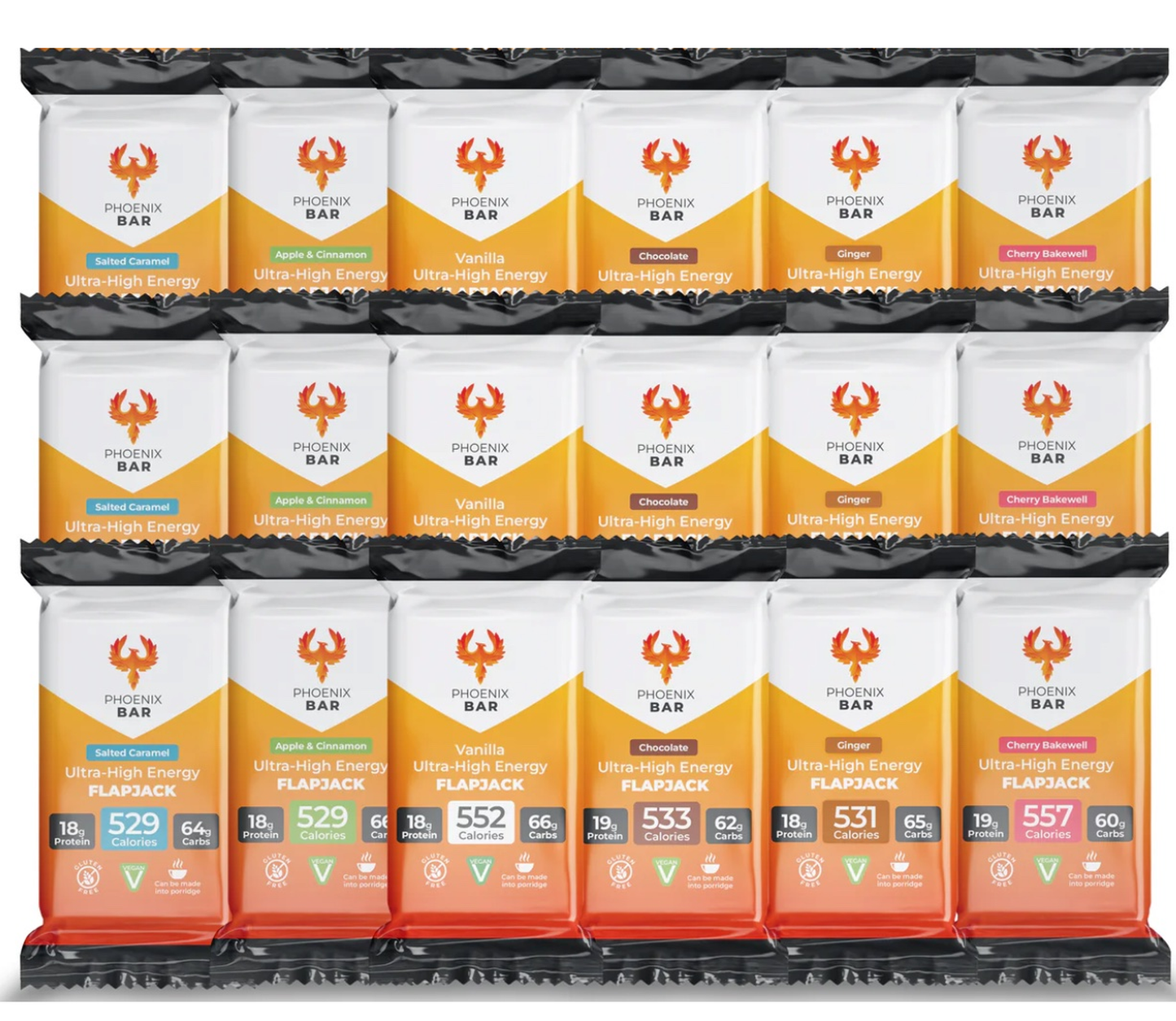
Phoenix Bars are 120 g oat flapjack bars built for the last three jobs above. The wrapper calls them an Ultra-High Energy Flapjack. Each bar has 527 to 557 kcal, 60 to 66 g of carbohydrate and about 18 g of protein, and all six flavours are vegan and made with gluten free oats. They are sold as high calorie bars at £5.25 each and keep for up to two years.
They are not a bakery flapjack, and my reviews show both sides of that. Of 397 published reviews, averaging 4.9 out of 5, 42 use the word flapjack, nearly all of them to describe the bar. Two say it is not like one. “I also wouldn’t describe it as a flapjack,” wrote Catherine C., who gave it one star in May 2025.

Phoenix Bars: Up to 557 Calories Per Bar
Highly compact, low-volume, calorie-dense bars. Soft, easy to eat whole or as a warm porridge. Vegan, gluten-free and contain up to 66g of carbohydrates, 19g of protein & 8 vitamins & minerals.
The difference is texture. Phoenix Bars are made with coconut oil instead of butter and carry added soy and pea protein, so they are firmer and drier than a tray-bake. Dryness comes up in 34 reviews, not always as a complaint. For some people that is the appeal. Paul B. described “what appeared to be a dense mass of flapjack” that “basically melted once in the mouth”. Justin M., who carried half a bar through a marathon, wrote: “I was very pleasantly surprised that it hadn’t crumbled when I took it out at the 20-mile stage.” Others disagree. Naomi L., who gave four stars in June 2026, found “they were so crumbly I kept losing bits of them”.
I changed the recipe in 2025 in response, and reviewers have noticed. Samantha R. wrote in October 2025: “I recently tried the new, moister, less crumbly recipe”. A sip of water with each bite helps too, and 55 reviews mention mixing the bar with water or milk to make porridge, which is covered in how to use Phoenix Bars.
They are also expensive per calorie. At £5.25 for up to 557 kcal, a Phoenix Bar costs about 94p to £1 per 100 kcal before delivery, and a supermarket flapjack costs far less. What the extra buys is size, protein, shelf life and a bar that is both vegan and gluten free. As Paul B. put it: “I know it appears expensive but it’s worth it”. You may reasonably decide otherwise, and if price per calorie is your main concern, baking your own wins every time.
Allergen note: Phoenix Bars contain soy, the Cherry Bakewell flavour contains almonds, and some flavours contain sulphites. The label carries a “may contain” warning for milk, egg, nuts, peanuts and sesame.
How do you make flapjack bars that cut cleanly?
Use the 4:2:3 ratio by weight: 4 parts oats, 2 parts fat, 3 parts sugar and syrup combined. Compare popular UK recipes and those proportions keep appearing, give or take a spoonful. Stay close to them and the bars hold together.
For 12 bars in a 20 cm square tin
- 300 g porridge oats
- 150 g butter or baking block
- 100 g soft light brown sugar
- 120 g golden syrup
Method
- Heat the oven to 180C (160C fan, gas mark 4) and line the tin with baking paper.
- Melt the fat, sugar and syrup together over a low heat, then stir in the oats.
- Press very firmly into the tin and bake for 22 to 25 minutes, until golden at the edges.
- After 10 minutes out of the oven, score the slab into two rows of six with a sharp knife.
- Leave until completely cold, then cut through the score lines. Each bar will be about 10 cm by 3 cm and weigh a little over 50 g.
Scaling up. For a 23 cm square tin, use 400 g of oats and scale everything else to match, which gives 16 bars. For a 30 by 20 cm traybake tin, use 450 g of oats for 18 bars. Baking time stays the same because the depth is the same.
Wrapping. Wrap each bar in baking paper and keep them in an airtight tin for up to a week, or freeze for up to three months.
For dietary versions, see my recipes for vegan flapjacks and gluten free flapjacks. For a richer bar with nut butter and chocolate, see the high-calorie flapjack recipe.
Frequently asked questions
Why do the British call oat bars flapjacks?
Because the word changed meaning in Britain and did not elsewhere. “Flapjack” originally described a flat tart or pancake, which is the sense that survives in the United States and Canada. In Britain and Ireland the name moved to the baked oat bar during the twentieth century.
What is the American equivalent of a flapjack?
The closest American equivalent is a chewy oat bar or granola bar. The match is not exact, because a British flapjack is softer, more buttery and bound with golden syrup, which is not a common ingredient in American kitchens.
What does a flapjack taste like?
A flapjack tastes of toasted oats and caramel. Butter and golden syrup give it a rich, toffee-like sweetness, and the texture runs from soft and chewy to crisp, depending on how long it is baked.
How many calories are in a flapjack bar?
Most flapjack bars contain 430 to 480 kcal per 100 g. That is about 230 kcal for a 50 g homemade bar, around 400 kcal for a 90 g shop bar, and 527 to 557 kcal for a 120 g Phoenix Bar.
Are flapjack bars good for hiking and cycling?
Yes, flapjack bars suit long days outdoors. They pack a lot of energy into little weight, need no preparation and do not melt like chocolate. Their weakness is crumbling, so choose a firm bar or carry it in a small bag.
Related guides


Flaming Phoenix



Contact Us
Declare withdrawal
Please fill out the following form to declare your withdrawal from the contract.

