

Energy Gel Alternatives: What to Use When Gels Fail
In this guide

 Written by James Frost, founder of Flaming Phoenix. Updated October 2026.
Quick answer: The best energy gel alternatives give you the same 20 to 25g of carbohydrate in a form you can still face: about 30g of jelly sweets, 40g of dried dates, a 120g banana, four rice cakes or a third of a dense bar. On long races, real food is easier to keep eating.
A gel is a measured dose of sugar. A 60ml SiS GO Isotonic gel carries 22g of carbohydrate and 87 calories (label at Ocado), and a 40g Maurten Gel 100 carries 25g and 100 calories (Run and Become listing). Whatever you swap in has to match that dose, go down on the move and still appeal in hour five. The British Dietetic Association's sport and exercise food fact sheet gives a handy yardstick: two gels, 6 to 10 jelly sweets, two medium-large bananas or one large potato each provide about 50g of carbohydrate.
This page is about replacing the gel. The full ranking of snacks by grams of carbohydrate per 100g lives in the high carb snacks guide, and if gels are making you feel sick mid-race, the guide to nausea and appetite loss covers what to do in the moment.
What can I use instead of energy gels?
Use any food that gives 20 to 25g of carbohydrate in a few bites with little fat or fibre: jelly sweets, dried fruit, bananas, honey, rice cakes, malt loaf, salted potatoes or a piece of a dense bar.
The table shows how much of each food matches one gel. Values come from McCance and Widdowson's CoFID 2021 dataset per 100g, or the pack label where a brand is named; the portion sizes are ours.
| Food | Amount | Carbs | Calories | Good to know |
|---|---|---|---|---|
| SiS GO Isotonic gel | 60ml | 22g | 87 | The benchmark |
| Maurten Gel 100 | 40g | 25g | 100 | Premium-priced benchmark |
| Jelly sweets (fruit gums) | 30g | 24g | 97 | Easy to dose a few at a time |
| Dried dates | 40g | 23g | 94 | About 3g of fibre |
| Banana | 120g peeled | 24g | 97 | Bruises in a pocket |
| Honey | 30g | 23g | 86 | Decant into a soft flask |
| Rice cakes (Kallo, lightly salted) | 4 cakes, about 27g | 22g | 108 | Dry, so drink with them |
| Malt loaf | 35g | 23g | 103 | Sticky, so it holds together |
| New potatoes, boiled in salted water | 160g | 24g | 109 | Savoury; add extra salt |
| Fig rolls | 35g | 23g | 127 | About 4g of fat per portion |
| Phoenix Bar | a third, about 40g | 20 to 22g | 176 to 186 | About twice a gel's calories |
Two patterns stand out. Gram for gram, sweets, rice cakes and honey carry more carbohydrate than most gels, because a gel is partly water. And foods with some fat, such as fig rolls or a dense bar, give you far more calories for the same carbohydrate, which makes little difference in a marathon and a big one in a 30-hour race.
Why do energy gels stop working?
Gels usually fail for one of four reasons: your gut rebels against concentrated sugar, you cannot face another sweet sachet, the cost adds up, or you are out long enough to need more calories than sugar alone can carry.
The gut is the big one. When Stuempfle and Hoffman surveyed 272 runners after the 161km Western States Endurance Run, 96% had some gut symptom and 60% had felt nauseous, mostly in the hottest, hardest part of the course. Taste comes next: the International Society of Sports Nutrition (ISSN) position stand on ultra-marathon running reports that runners found sweet foods, gels and sports drinks in particular, hard to stomach in the heat and in races beyond 60 miles, and leaned towards savoury food instead.
Then there is the arithmetic of a long day. Six SiS gels give 522 calories, and a 100-mile runner can burn that in under two hours. If you have been taking gels on autopilot and start to feel flat, the problem may be total calories rather than the gel itself, which is the subject of the guide to hitting the wall.
What are the best alternatives to gels for a marathon?
For a marathon, the best gel alternatives are the fastest to eat: jelly sweets or chews, sports drink from the water stations, honey from a soft flask, and a banana before the start. At marathon pace you have no time to chew a sandwich, and you are running on carbohydrate alone. My marathon fuelling guide sets out how many gels or swaps to carry for a 3, 4 or 5 hour finish.
Asker Jeukendrup's review of carbohydrate intake during exercise sets the targets: about an hour of hard running needs only small amounts, or even a carbohydrate mouth rinse, while 2 to 3 hours supports up to about 60g an hour from a single sugar source. Here is what that looks like without relying on gels. A runner finishing in 3 hours 30 who fuels at 50g an hour for the last three hours needs 150g of carbohydrate. Two gels (44g), 90g of jelly sweets (about 72g) and 550ml of isotonic drink from the stations (about 34g, using the BDA figure of 50g per 800ml) add up to 150g.
Practise the exact mix on two or three long runs first. Sweets you chew at 8-minute-mile pace feel very different from sweets on the sofa.
What should you eat instead of gels on an ultra?
On an ultra, move from gels to real food as the hours pass: salted potatoes, small sandwiches, malt loaf and dates on the move, soup and flat cola at checkpoints, and a dense bar for the long gaps. The ISSN puts the racing target at 150 to 400 calories and 30 to 50g of carbohydrate an hour, and warns that 90g an hour may be unrealistic beyond six hours.
Real food does not cost you speed. In a 2019 University of Illinois study, cyclists who ate potato purée during a two-hour ride finished the time trial that followed in 33.0 minutes, exactly the same as when they took gels, and both beat water alone (39.5 minutes).
Where food wins outright is calories. A Phoenix Bar has up to 557 calories in only 120g, with up to 66g of carbohydrate and 18 to 19g of protein, and breaks into pieces you can eat across an hour or two. Eat the pieces on the walking climbs. George Johnstone, who has used them on several ultras, wrote: "I don't like gels and these bars are a great way to get more calories in quickly and easily." Andrew Tomlinson, who used them as his main solid food on the Spine Sprint, called them "A welcome change from all the sweeter alternatives and gels."
For how dense high calorie bars compare with each other, see the ranking of the best energy bars for ultra running. Which foods suit each stage of a race is set out in the best foods for ultra running, and the per-hour plan sits in the ultra running nutrition guide. At a checkpoint, a bar stirred into a cup of water becomes porridge; the method is in how to use Phoenix Bars.
What can cyclists use instead of gels?
On a bike you can eat almost anything you can unwrap one-handed, so rice cakes, malt loaf, flapjack, bananas and small jam sandwiches are the classic swaps. Riding also seems kinder to the gut than running: a systematic review by Costa and colleagues found that running and heat both make exercise-related gut disturbance worse.
One naming trap: the "rice cakes" many cyclists talk about are home-made squares of sticky rice, not the puffed supermarket kind. A Kallo puffed rice cake has 5.6g of carbohydrate, so you need four to match one gel. Bikepacking and multi-day rides bring their own problems, covered in cycling and bikepacking nutrition.
What replaces gels on expeditions and multi-day races?
When you carry every gram for days, calories per gram count for more than speed of sugar. A Maurten gel gives 2.5 calories per gram and a SiS isotonic gel about 1.5 per millilitre, against 4.4 to 4.6 per gram for a Phoenix Bar, so a day of gels weighs far more than a day of dense food. The trip-specific guides go further: Marathon des Sables nutrition, ocean rowing nutrition, high-altitude mountaineering nutrition and the ultra-endurance and expedition nutrition guide.
Are energy gel alternatives cheaper?
Per calorie, most alternatives are cheaper than gels; per gram of carbohydrate, plain supermarket food is cheapest of all. The table shows full prices checked at UK retailers in October 2026, divided out per 100 calories and per 25g of carbohydrate, about one gel's worth.
| Product | Price checked | Per 100 calories | Per 25g of carbs |
|---|---|---|---|
| SiS GO Isotonic gel | £7.25 for six (Ocado) | £1.39 | £1.37 |
| Maurten Gel 100 | £2.90 each (Run and Become) | £2.90 | £2.90 |
| Kallo rice cakes | £1.75 for 130g (Ocado) | 34p | 41p |
How do you switch from gels to real food?
Swap one gel at a time on long training runs, never all of them on race day. Jeukendrup's review Training the gut for athletes found that stomach comfort and gastric emptying can be trained, and that a high-carbohydrate diet increases the gut's capacity to absorb sugar. In practice: replace one gel an hour with its food equivalent from the table, eat it on a climb or a walking break, drink a few mouthfuls of water with anything dry, and note what sat well. The full method is in gut training for ultras.
When are gels still the better choice?
Gels win when speed is everything: hard efforts of up to about three hours, the closing miles of a marathon, sprint and Olympic-distance triathlons, and any moment you cannot afford to chew. Many runners end up using both, gels for the fast hours and food for the long ones.
Gel alternative questions
How many gels do I need for a 20-mile run?
It depends on time, not distance. At 30 to 60g of carbohydrate an hour (the American College of Sports Medicine range Jeukendrup cites), a 3-hour 20-mile run needs 90 to 180g: four to eight 22g gels, or about 115 to 225g of jelly sweets. Start at the lower end and build up in training.
Can I make my own energy gel?
Yes. Honey is about 76g of carbohydrate per 100g in CoFID, so 90g of honey loosened with a little water and a pinch of salt in a soft flask carries about 69g, roughly three gels' worth. Test the consistency on a training run, and wash the flask the same day.
Are Phoenix Bars an energy gel alternative?
For long efforts, yes. A third of a bar has about the same carbohydrate as a 22g gel and roughly twice the calories, plus some protein. It suits ultras, long rides and hikes.
Do I need water with gel alternatives?
Usually, yes. Dry foods such as rice cakes, dates and malt loaf go down more easily, and sit better, with a few mouthfuls of water. Plan to eat them just before a refill or a stream rather than at the end of a long dry stretch.
What if I can't face anything sweet?
Go savoury: salted potatoes, crisps, a cheese or Marmite sandwich, instant noodles or soup at a checkpoint. A 25g bag of ordinary crisps gives about 14g of carbohydrate and some salt (CoFID). If nothing at all will go down, slow the pace first; the nausea guide walks through it.
Questions about switching from gels? Email me at jfrost@flaming-phoenix.co.uk.
Sources: British Dietetic Association, Sport and exercise food fact sheet; Tiller and others, ISSN position stand: nutritional considerations for ultra-marathon training and racing (2019); Jeukendrup, carbohydrate intake during exercise (Sports Medicine, 2014); Jeukendrup, Training the gut for athletes (Sports Medicine, 2017); Stuempfle and Hoffman, gastrointestinal distress in a 161km ultramarathon (2015); Salvador and others, potato ingestion versus carbohydrate gels (2019); Costa and others, exercise-induced gastrointestinal syndrome (2017); McCance and Widdowson's CoFID 2021; labels and prices at Ocado (SiS), Ocado (Kallo) and Run and Become (Maurten).
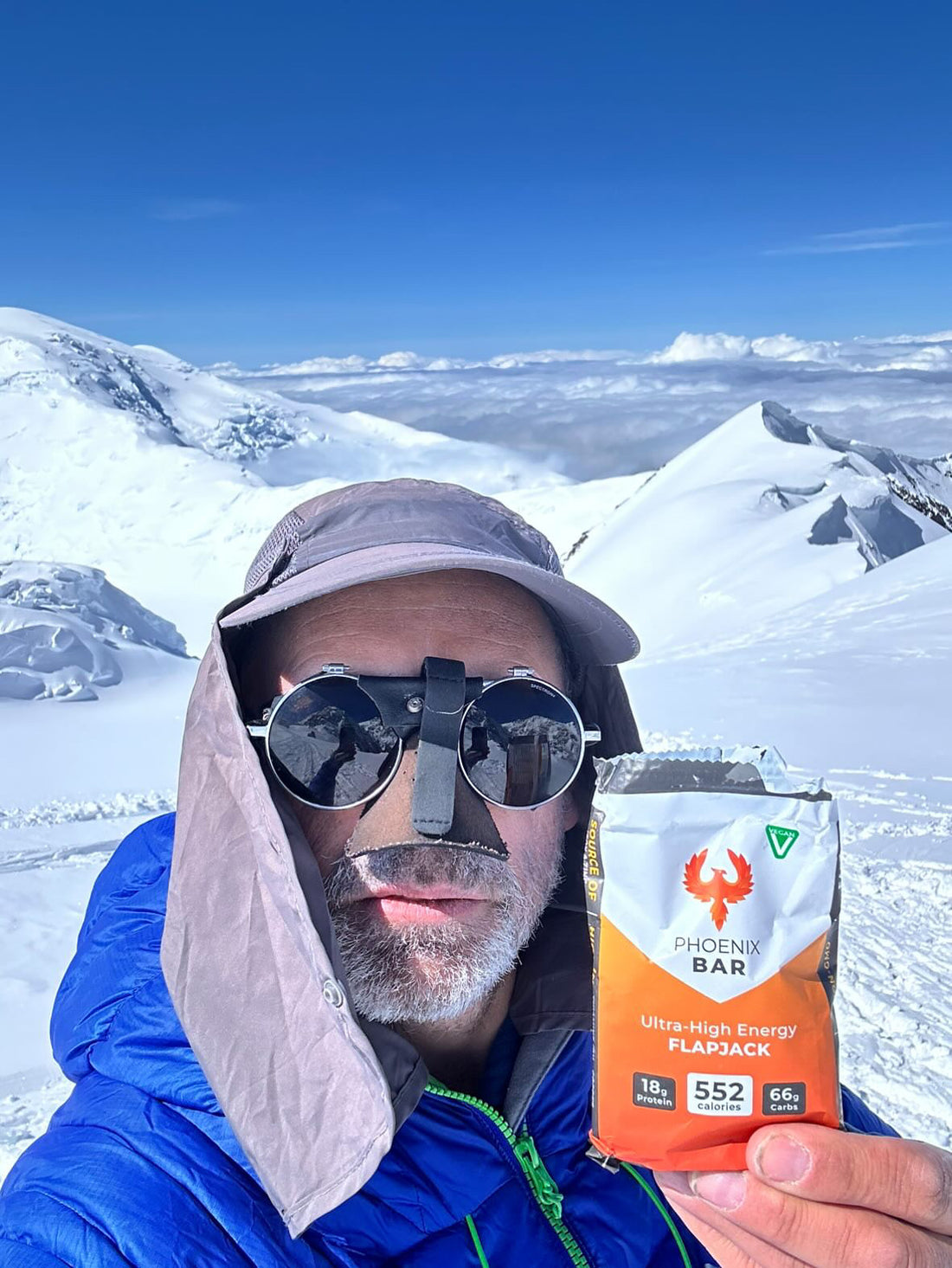
Big calories. Small bar.
Up to 557 calories in a compact, lightweight bar of only 120g, with up to 66g of carbs and 19g of protein. Eat it whole, break it into pieces over a few hours, or mix it with water or milk for porridge.
Easy to eat, easy to digest and not sickly sweet. Customers have eaten them at -45°C and through the heat of the Marathon des Sables, and they keep for up to 2 years, so they work on a mountain, on a night shift, or at home on days when eating enough feels hard.
- 557 calories in only 120g (529 to 557 by flavour)
- 4.6 calories per gram
- 66g carbs per bar (up to)
- 19g protein per bar (up to)
