
Sledging Rations: From Pemmican to the Modern Polar Ration
Quick answer: A sledging ration is the food a polar party carries to travel long distances hauling its own supplies, with no resupply. Three things define it: enough calories to survive extreme cold and huge daily effort, usually 4,800 to 8,000 per person per day depending on the era and the trip; the highest possible calories per gram, because every gram is dragged the whole way; and food that stays edible in extreme cold. Historically that meant pemmican, sledging biscuits and butter. Today it means dehydrated meals, fats, chocolate, nuts and calorie-dense bars, built around a big breakfast, hourly snacks eaten on the move, and a hot dinner in the tent.
I'm James, I built Phoenix Bars after 150 conversations with people who fuel hard trips, including polar guides and expedition skiers, and my bars have been carried to the South Pole, across Greenland and in the Arctic. So this page is the terminology and the history of the sledging ration, plus how the modern version is put together. For the full planning detail on a specific trip, I will point you to the deep guides as we go, starting with the master one on polar expedition nutrition.
What is a sledging ration?
A sledging ration is a ration designed for sledging parties travelling long distances without support vehicles. The whole design problem is that you must carry, or rather haul on a sledge or pulk, every calorie you will eat, so the ration has to be as calorically dense and as light as possible while still keeping you alive and moving in brutal cold. That is why sledging rations are traditionally dehydrated, since water is dead weight you can add later from melted snow.
Two words you will meet immediately. Sledging biscuits are hard, long-life biscuits made from flour, salt, butter, water and a little baking soda, prized because they pack a lot of energy into a durable, non-perishable form. Hoosh is the classic sledging meal, made by crumbling pemmican and sledging biscuit into hot water to make a thick stew. And pemmican, the staple at the heart of it all, is rendered fat mixed with dried meat, which for a century was the densest travel food anyone had, because fat carries more than twice the calories per gram of anything else.
A short history of the sledging ration
The history is really a history of one repeated mistake: underestimating how much a person burns hauling a sled in the cold. Robert Falcon Scott's fatal South Pole expedition is the cautionary tale, his men falling short by an estimated 2,000 to 3,000 calories a day on biscuits and dried meat, which contributed to the exhaustion that killed them. The lesson learned early and painfully in Antarctica was that extreme cold makes you ravenously hungry and that man-hauling burns an enormous amount, and that hunger and hypothermia are linked, because your body can only keep you warm if you keep feeding it.
Rations got more scientific from there. In 1930 the explorer Gino Watkins developed a sledging ration for the British Arctic Air Route Expedition built mostly from pemmican, margarine and fortified biscuits, rounded out with pea flour, oats, sugar, cocoa, chocolate and Horlicks, and set at 5,522 calories a day. It was one of the most popular polar rations until the 1950s. The British North Greenland Expedition ran on a 4,164-calorie ration of pemmican, butter, potato powder, cocoa, chocolate, sugar, oats, dried milk and biscuits, and by 1959 the optimum for sledging crews had been pinned at around 4,800 calories a day. Modern British Antarctic Survey field rations sit lower, around 3,500 calories a day, because a lot of modern fieldwork is less punishing than a full man-hauling traverse, and they lean on freeze-dried mains plus tea, coffee, chocolate, biscuits, butter, sugar and powdered milk, with a supplementary "goodies box" of herbs and treats for morale. The through-line across all of it is the same: fat for density, dehydration for weight, and sweet, familiar treats to keep you eating when appetite and mood sink.
How many calories does a sledging ration provide today?
It depends entirely on what you are doing, and this is where the historical numbers can mislead. A supported science team doing day trips from a base needs far less than a skier hauling a pulk to the Pole. The genuinely hard end, an unsupported man-hauling crossing, is a special case worth understanding, because the honest answer is that you cannot carry enough. Someone dragging a sledge across Antarctica burns roughly 9,000 to 11,000 calories a day, yet most crossings are planned at 6,000 to 8,000, because carrying more food weight than that costs more energy to haul than it gives back. The gap is covered deliberately, by body fat gained before departure, which is why expedition skiers routinely finish 5 to 20 kilograms lighter. The full logic of that trade-off sits in 10,000 calories a day, and the calorie equation for a specific crossing is worked through in Antarctica solo crossing food.

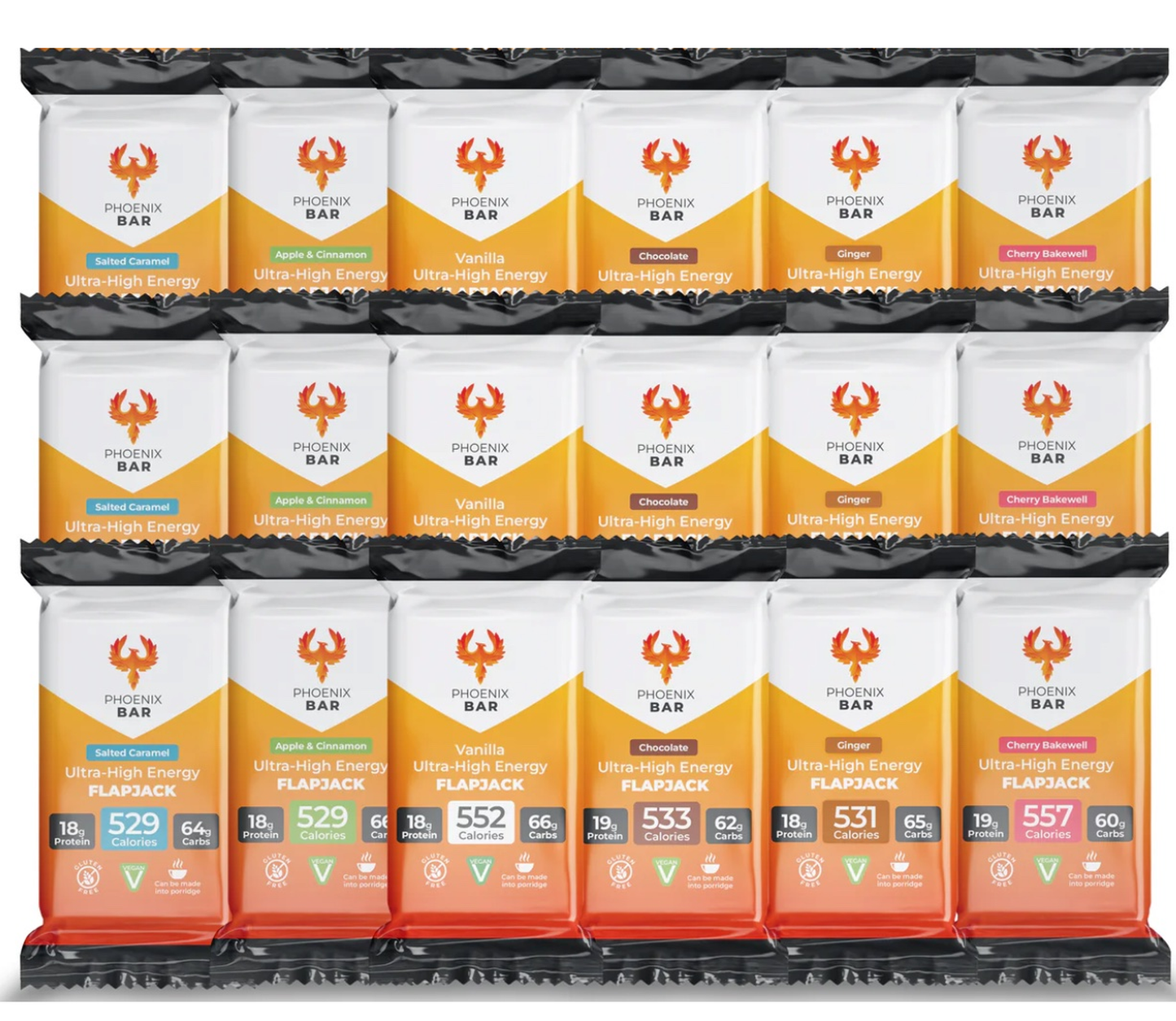
Phoenix Bars: Up to 557 Calories Per Bar
Highly compact, low-volume, calorie-dense bars. Soft, easy to eat whole or as a warm porridge. Vegan, gluten-free and contain up to 66g of carbohydrates, 19g of protein & 8 vitamins & minerals.
Why calorie-to-weight ratio is the whole game
Because you haul every gram, calorie density, the calories delivered per gram of food, is the single most important metric in sledging-ration planning, more than taste, more than nutrition on paper. On a long unsupported crossing the practical floor is around 5 calories per gram across the whole food bag, and below that the pulk simply becomes too heavy to drag the distance. That is why traditional and modern rations alike are fat-heavy. Fat provides about 9 calories per gram, more than double the roughly 4 of carbohydrate or protein, so butter, oils, cheese, salami and pemmican do the density work, while carbohydrates earn their place because your brain and muscles burn them more readily and they need less oxygen to metabolise, which matters at altitude on the polar plateau. The full ranking of foods by density is in calorie-dense foods, and it is the reason most fresh or minimally processed food never makes a sledging ration.
What goes in a modern sledging ration
The modern sledging day has a shape, and the ration is packed to fit it. Breakfast in the tent is a big, warm, calorie-dense sitting, most often a fatted porridge of oats, powdered milk, sugar and added butter or oil, aiming for something like 1,000 to 1,500 calories to lay the day's foundation. The heart of the day is the daytime ration bag, packed per hour, because you eat on the move at brief stops roughly every hour for eight or nine hours, taking in around 450 to 550 calories each time. Dinner is a freeze-dried main in the tent with fat stirred through and a hot drink loaded with milk powder. The full breakdown of this structure, with what to carry and how much, lives in the polar expedition nutrition guide.
The daytime bag is the hard part, and it is worth dwelling on. Those snacks have to be found and opened with huge gloves on, eaten in a few bites without stopping properly, and they must not freeze into something you cannot bite, because in serious cold most bars and flapjacks turn to rock below about -15°C. Nothing in that hourly block should require bare hands, a long stop, or real chewing effort. This is exactly why the daytime bag is rotated relentlessly through chocolate, nuts, cheese, salami, dried fruit and dense bars, both to hit the calories and to hold off the flavour fatigue that sets in over weeks.
Where a cold-stable bar fits
I will be honest about what a bar is and is not here. It is not going to out-density pure butter or pemmican, and on the fat-workhorse job those still win. What a bar does is solve the daytime-bag problem and double as a breakfast base, which is why Phoenix Bars have gone to the South Pole, across Greenland and into the Arctic. They were designed from the start to stay soft and edible in extreme cold, down to around -45°C, where the bars and flapjacks that freeze solid below -15°C become useless, so they can be broken into pieces and eaten with gloved hands at an hourly stop without a fight. Each bar carries up to 557 calories in 125 grams, about 4.5 calories per gram, which is dense for a ready-to-eat whole-food solid, and they come in six flavours precisely because palate fatigue is a real enemy on a multi-week trip. They can be eaten cold on the move, or crumbled into hot water to make a calorie-dense porridge in the tent, which several polar and high-altitude travellers use as their quick breakfast. A two-year shelf life means you can buy them months ahead and ship them with your duffel. For the different ways to use them, see how to use Phoenix Bars, and for bulk expedition provisioning above 50 bars, email me directly for expedition pricing.
Frequently asked questions
What is a sledging ration?
It is the calorie-dense, weight-optimised food a polar party carries to travel long distances hauling its own supplies without resupply, traditionally dehydrated to save weight and built to stay edible in extreme cold.
What is a sledging biscuit?
A hard, long-life biscuit made from flour, salt, butter, water and baking soda, used on polar expeditions because it packs a lot of durable energy into a small, non-perishable form. Crumbled into hot water with pemmican, it makes the classic stew called hoosh.
What is pemmican, and why was it used?
Pemmican is rendered fat mixed with dried meat. It was the staple of historic sledging rations because fat delivers about 9 calories per gram, more than double any other food, giving explorers the most energy for the least hauled weight.
How many calories are in a sledging ration?
Historically around 4,800 to 5,500 calories a day, with modern base-supported field rations nearer 3,500. An unsupported man-hauling crossing is planned at 6,000 to 8,000 a day even though the skier burns 9,000 to 11,000, with the deficit covered by body fat.
What food works below -40°C?
Fats like butter and oil, dehydrated meals reconstituted with hot water, hard cheese and cured meats, chocolate (which freezes but stays chewable), and calorie-dense bars specifically made to stay soft in the cold. Most standard bars and flapjacks freeze solid and become inedible.
How do modern sledging rations differ from historic ones?
The principles are unchanged, fat for density, dehydration for weight, treats for morale, but pemmican and sledging biscuits have largely given way to freeze-dried mains, modern fats, and manufactured snacks and bars, with better understanding of the true calorie burn.
Related guides
For the full planning detail: polar expedition nutrition is the master guide, Antarctica solo crossing food and Greenland crossing food cover specific traverses, 10,000 calories a day explains the burn-versus-intake trade-off, calorie-dense foods ranks the raw materials by density, and adventure nutrition is the overview above all of them.
About this guide: I'm James, founder of Flaming Phoenix and Phoenix Bars, which I developed from more than 150 conversations with people who fuel hard trips, from ultra-runners to polar guides. The bars have been used on South Pole, Greenland and Arctic expeditions and are rated 5.0 out of 5 across more than 370 verified reviews. This guide reflects that experience alongside the documented history of polar rationing. It is general information, not medical or expedition-safety advice, and serious cold-weather travel should be planned with qualified guidance. Last reviewed: July 2026.


Flaming Phoenix



Contact Us
Widerruf erklären
Füllen Sie das folgende Formular aus, um Ihre Widerrufserklärung abzugeben.

