

10,000 Calories a Day: The Meal Plan and the Honest Limits
In diesem Leitfaden

Only a handful of humans genuinely need 10,000 calories a day: polar expedition skiers, ocean rowers and a few strongman competitors. At this level the limiting factor is no longer appetite or stomach space but absorption, which is why real 10,000 calorie plans are built as all-day feeding schedules rather than meals, and why the people who live at this number still lose weight.
Most content about 10,000 calories is challenge content: one enormous day, filmed, followed by 48 rough hours. This page takes the number seriously, because for a small group of people it is not a stunt, it is Tuesday. What they do differently is the most useful nutrition lesson at any calorie level.
Who actually eats 10,000 calories a day?
Three groups, with very different relationships to the number.
The first group burn it. Someone hauling a sled across Antarctica burns roughly 9,000 to 11,000 calories a day, and here is the surprising part: they do not eat that much. Most polar rations are planned at 6,000 to 8,000 calories, because carrying more food weight than that costs more energy than it delivers. The gap is covered by body fat, deliberately gained beforehand, and expedition skiers routinely finish 10 to 20 kilograms lighter. One kilogram of body fat stores roughly 7,700 calories, which means an athlete who gains 12 kilograms before departure is effectively packing 90,000 calories inside their own body. The full logic sits in the polar expedition nutrition guide and the Antarctica solo crossing calorie equation. Ocean rowers face a milder version of the same maths, covered in ocean rowing nutrition.
The second group eat it to grow. Strongman competitors have published diets around this mark: Hafthor Björnsson's widely shared plan ran to roughly 10,000 calories across six to eight feeds, and Eddie Hall reported peaking even higher during World's Strongest Man preparation. Note the structure they all converge on: never three meals, always a feed every two to two and a half hours.
The third group are the curious, usually via two doors: the 10,000 calorie challenge, and the Michael Phelps story. On Phelps, the famous 12,000 figure is a myth he has corrected himself, putting his real training intake at more like 8,000 to 10,000. Even that was exceptional, and it existed to support five to six hours of daily swimming.
Why 10,000 is an absorption problem, not an appetite problem
At 3,000 calories the challenge is appetite. At 7,000 it is repeatability. At 10,000 you hit a harder wall: the rate at which a human gut can move energy into the bloodstream.
During exercise, even a well-trained gut absorbs roughly 90 to 120 grams of carbohydrate per hour, about 360 to 480 calories. Fat digests far more slowly and large fatty meals can sit for hours. Stack those constraints across a waking day and you find that many people can swallow 10,000 calories but cannot process them, which is where the challenge videos end: nausea, bloating and a body that simply parks the surplus in the gut. This is also why polar athletes plan a deficit rather than trying to force-match their burn. The winning strategy at 10,000 is drip-feeding: moderate, frequent, dense feeds that never overwhelm the system, with a meaningful slice taken as liquid.
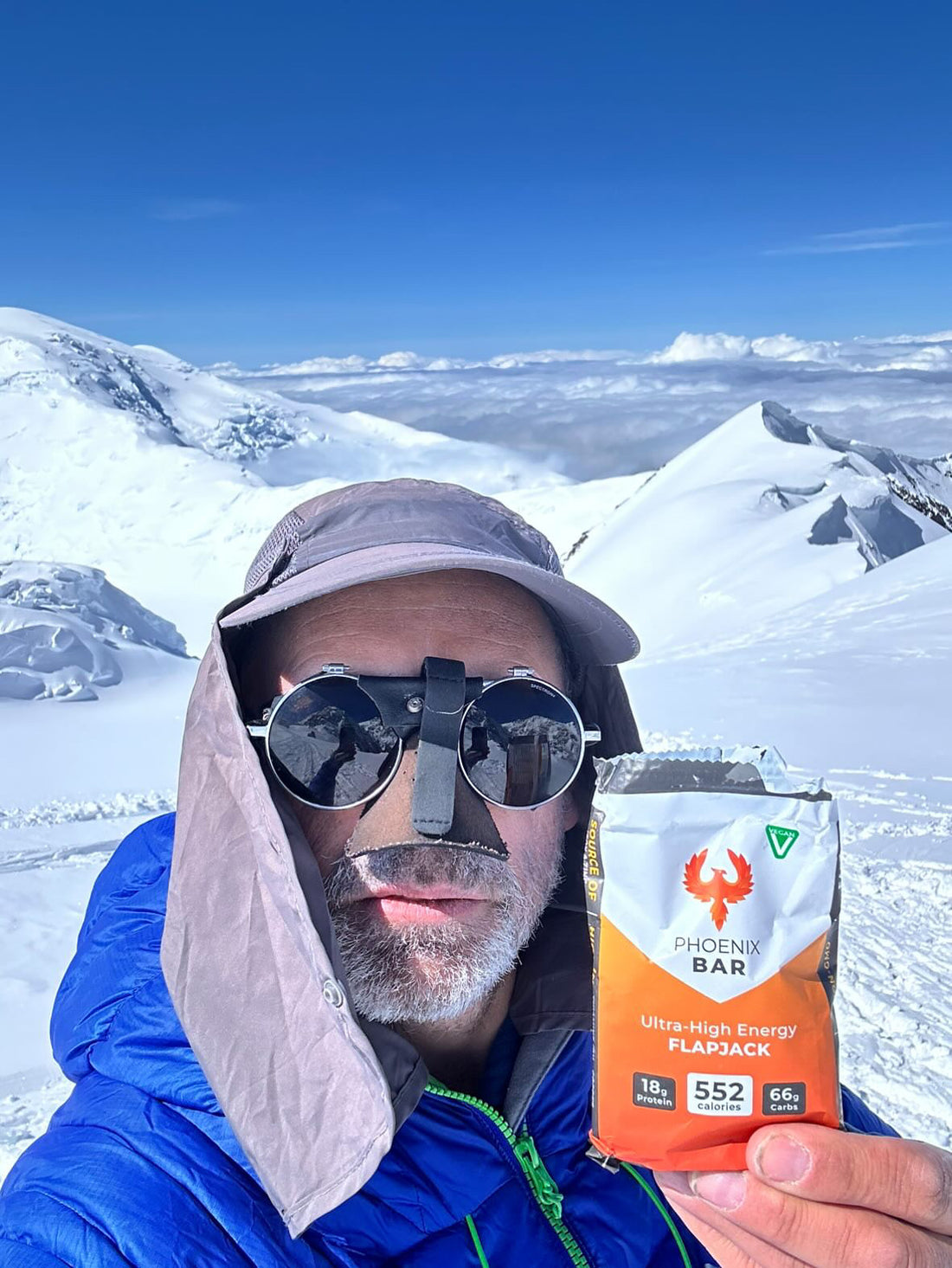
I see the proof of this in my own customers. Shaun Weston, who used Phoenix Bars at the South Pole, described them as easy to eat even at minus 45, and ease of eating is everything when you are trying to graze 500 calories every hour in a hostile environment. Rick W. took 25 bars on a Denali expedition and reported losing 8 pounds where his previous attempt without them cost him 16. He still lost weight, because at extreme output everyone does. He just lost half as much, which on a mountain is the difference between finishing strong and finishing hollow.
The food weight problem at 10,000
Calories per gram becomes brutal arithmetic at this level. At the density of a lean, "clean" plate, roughly 1.3 calories per gram, 10,000 calories weighs about 7.7 kilograms of food, which is physically impossible to eat daily. At a well-designed calorie-dense average of 3 calories per gram, it is still 3.3 kilograms. This is why every serious 10,000 calorie eater, polar or strongman, builds their day from the densest foods available: oils, butter, nut butters, oats, chocolate, dried fruit, enriched drinks and dense bars, the full list of which lives in calorie-dense foods and, for the extreme end, high calorie low volume foods.
For scale: a Phoenix Bar runs at 4.64 calories per gram, up to 557 calories in a 120 gram bar, which is why an 18-bar Essential Bundle of high calorie bars holds roughly 9,900 calories, an entire Antarctic-scale day of energy in a package the size of a shoebox. That ratio, not flavour or branding, is what earns any food a place in a sled or a pack. It is also the first measure in our ranking of the best energy bars for expeditions.
The plan: a 10,000 calorie expedition day
This is the structure polar travellers and long-haul expedition athletes actually use. It assumes 8 to 9 working hours of output.
The breakfast anchor, around 1,500 calories
A fortified porridge eaten hot before setting off: oats or a Phoenix Bar stirred into hot water or milk, enriched with milk powder, sugar or honey, and a spoon of oil or butter. On expeditions, the porridge method matters because hot, soft food goes down in the cold when chewing does not.
The working-hours graze, around 4,500 calories
The heart of the day: roughly 450 to 550 calories every hour, on the move, for eight to nine hours. Polar ration bags are packed per-hour for exactly this reason: a dense bar, chocolate, nuts, fudge, dried fruit, cheese or salami for those who eat them, rotated relentlessly to hold off flavour fatigue. Nothing in this block should require stopping, unwrapping with bare hands, or chewing effort. A trained gut handles this rhythm comfortably; an untrained one does not, which is why gut training is a pre-expedition job, not an on-expedition one.
The hot break, around 800 calories
Where conditions allow, a mid-day stop for soup or a hot drink loaded with milk powder plus something soft and dense. The psychological value is as large as the caloric one.
The dinner anchor, around 2,000 calories
The biggest sit-down feed: a double-portion main meal, deliberately boosted with added oil, butter or cheese, because a spoon of oil adds 120 calories for zero extra volume. Expedition teams routinely energy-boost freeze-dried meals this way.
The evening top-up, around 1,200 calories
A dessert course and an enriched hot drink: hot chocolate made thick with milk powder and cream or coconut milk, plus a pudding, biscuits and nut butter, or a soft bar eaten in the sleeping bag. Going to sleep with fuel on board is part of the plan, not indulgence.
For a strongman-style indoor version, the same total splits into six feeds of roughly 1,650 calories every two and a half hours, with at least two of the six taken as gainer shakes or high calorie drinks, and the food choices drawn from the bulking guide.
Thinking about the 10,000 calorie challenge?
One enormous day will not harm most healthy adults, but go in with accurate expectations: the last 3,000 calories are miserable, the following 24 to 48 hours are uncomfortable, and the scale will show a large, temporary jump that is almost entirely food weight and water, not fat. As a weight gain strategy it teaches nothing, because gaining is won by repeatable surpluses, and the repeatable versions of extreme eating are the 7,000 calorie meal plan and the 8,000 calorie guide. And a quieter note: if your interest in extreme numbers comes from a difficult relationship with food rather than from sport, this is not the right page, and speaking to a professional will do more for you than any meal plan.
Frequently asked questions
Is it possible to eat 10,000 calories in a day?
Yes, most healthy adults could swallow 10,000 calories of dense food in a day. Absorbing it is another matter: the gut's processing rate becomes the bottleneck, which is why sustained 10,000 calorie eaters use hourly drip-feeding and liquid calories rather than giant meals, and why one-day attempts usually end in significant discomfort.
Who needs 10,000 calories a day?
Polar expedition skiers and sled-haulers, who burn roughly 9,000 to 11,000 calories daily, ocean rowers on continuous shift rotations, and a small number of strongman competitors in peak gaining phases. Outside these situations, a 10,000 calorie intake is a large unearned surplus.
Did Michael Phelps really eat 12,000 calories a day?
No. Phelps has said the 12,000 figure was a myth, putting his real training intake at roughly 8,000 to 10,000 calories, supported by five to six hours of daily swimming. It remains one of the most repeated and most exaggerated numbers in sports nutrition.
How much weight would you gain eating 10,000 calories a day?
Against a typical 2,500 calorie maintenance level, 10,000 a day is a surplus of about 7,500 calories, and with one kilogram of body fat storing roughly 7,700 calories, the theoretical gain approaches a kilogram per day. In practice absorption limits and water shifts blur the daily number, but sustained intake at this level without matching output produces very rapid fat gain.
Why do polar explorers lose weight on 10,000 calorie burns?
Because carrying enough food to match the burn would make the sled heavier and the burn bigger. Expeditions ration 6,000 to 8,000 calories a day, deliberately gain body fat beforehand as pre-loaded fuel, and plan to finish 10 to 20 kilograms lighter.
Related guides
7,000 Calorie Meal Plan · 8,000 Calorie Guide · Polar Expedition Nutrition · Antarctica Solo Crossing Food · Calorie-Dense Foods · Ultra-Endurance and Expedition Guide
Written by James Frost, founder of Flaming Phoenix. Phoenix Bars have been carried at the South Pole, on Denali, Everest and across the Marathon des Sables, with over 20,000 bars sold in 21 countries, so the numbers on this page come from fuelling people who genuinely live at them. He can be reached at jfrost@flaming-phoenix.co.uk. Last reviewed: July 2026.
Viele Kalorien. Kleiner Riegel.
Bis zu 557 Kalorien in einem kompakten, leichten Riegel von nur 120 g, mit bis zu 66 g Kohlenhydraten und 19 g Protein. Im Ganzen essen, über ein paar Stunden in Stücken essen oder mit heißem Wasser oder Milch zu Porridge verrühren.
Leicht zu essen, leicht verdaulich und nicht zu süß. Phoenix Riegel schmelzen nicht bei Hitze, frieren bei Minusgraden nicht ein und sind bis zu zwei Jahre haltbar. Sie passen in die Berge, in die Nachtschicht oder nach Hause, an Tagen, an denen genug zu essen schwerfällt. Dazu vegan und glutenfrei.
- 557 Kalorien in einem kompakten 120-g-Riegel (529 bis 557 je nach Sorte)
- 4,6 Kalorien pro Gramm
- 66g Kohlenhydrate pro Riegel (bis zu)
- 19g Protein pro Riegel (bis zu)
Widerruf erklären
Füllen Sie das folgende Formular aus, um Ihre Widerrufserklärung abzugeben.

