
Protein Calculator for Weight Gain

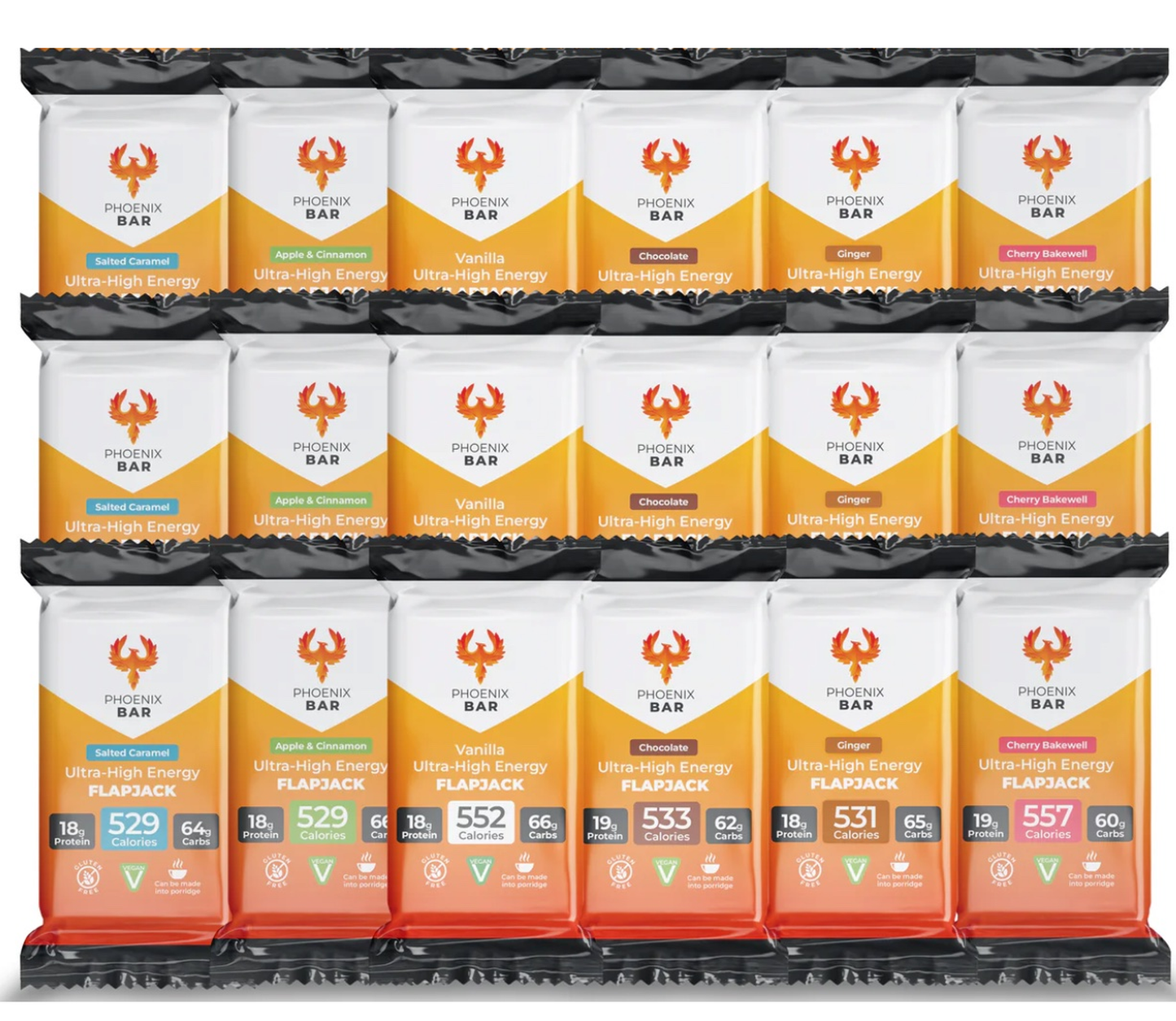
Phoenix Bars: Up to 557 Calories Per Bar
Highly compact, low-volume, calorie-dense bars. Soft, easy to eat whole or as a warm porridge. Vegan, gluten-free and contain up to 66g of carbohydrates, 19g of protein & 8 vitamins & minerals.
Written by James Frost, founder of Flaming Phoenix and the maker of Phoenix Bars. Updated October 2026.
How much protein do you need to gain weight?
For most people trying to gain weight and muscle, the evidence-based target is 1.6 to 2.2 grams of protein per kilogram of body weight per day, spread across three to five feeds of roughly 25 to 40 grams. A 70kg person lands at 112 to 154 grams daily. More than that shows no extra muscle benefit in the research.
That range comes from the largest pooled analysis of resistance training studies, which found muscle gains plateau around 1.6g per kg, with the upper confidence limit near 2.2g per kg. The UK reference intake for adults who are not trying to gain is far lower, about 0.75g per kg, which is why “eat loads of protein” advice confuses so many people: the right number depends entirely on the goal. The calculator above does the maths for your weight and goal.
The uncomfortable truth: protein is rarely your bottleneck
Here is what a decade of talking to people who struggle to gain weight has taught me: almost nobody fails to gain weight because of protein. They fail because of total calories. Protein is the easy half of the equation; 150 grams of it is only 600 calories, and you cannot build new tissue out of protein alone while running an energy deficit.
So treat this page as step one of two. Once you have your protein number, get your calorie number from our weight gain calculator, or set your surplus with the bulking calculator. The usual starting point is 300 to 500 calories above maintenance, from which steady gain follows.
One of our customers, Tim, preparing for the biggest climb of his life, described the whole problem in one review: “Phoenix Bars are helping me to weight gain prior to Everest next year, which is a big problem for me. They contain over 550 calories, and I’ll definitely be taking them on my summit expedition for Everest and Lhotse.”
How to actually hit your protein number
Spread, don’t stack. Four feeds of 30 to 40 grams beat one 120 gram dinner, because muscle protein synthesis responds per meal. Practical UK anchors: a chicken breast or tuna tin runs 25 to 30 grams, 3 eggs about 19, a 250g tub of Greek yoghurt about 25, a scoop of protein powder 20 to 25, 100g of dry lentils about 24. Our full high calorie high protein foods list ranks dozens more by both numbers, because for weight gain you want foods that deliver protein and calories together.
That pairing is exactly how we built Phoenix Bars: each 120g bar is a source of protein with 18 to 19 grams alongside up to 557 calories, so one bar covers a full feed’s protein while doing the calorie job most protein products ignore. Protein contributes to a growth in muscle mass, but only a surplus lets that growth show on the scales, which is why high calorie protein bars outperform low-calorie protein snacks for this goal. If chewing through big meals is the hard part for you, every bar also mixes into a porridge, and our guide to what to eat when appetite is low has gentler routes to the same numbers.
As Luke, an ultra runner, put it in his review: “I also love the fact they have protein in, I usually take some when running ultras, just to try speed up the recovery process! Most endurance fuel is just carbs!”
FAQ
Is 2g of protein per kg too much? No. Intakes around 2g per kg sit inside the evidence-based range for people training to gain muscle, and healthy adults tolerate it well. Going far beyond 2.2g per kg mostly displaces the carbohydrates and fats you need for the calorie surplus itself.
Can you gain weight on protein alone? Not meaningfully. Protein carries just 4 calories per gram, and the body preferentially uses it for repair rather than storage. Weight gain is driven by total energy; protein decides how much of the gain is lean.
How much protein per meal is the maximum? Roughly 0.3 to 0.4g per kg per feed (25 to 40g for most people) maximises the muscle-building response. Bigger servings are not wasted, but spreading intake works better than stacking it.
Does protein timing around workouts matter for weight gain? Far less than daily totals. Hit your day’s grams and calories first; a feed within a few hours either side of training is a refinement, not a requirement.
Rated 4.9 out of 5 from nearly 400 reviews. Hand-packed by James with every order.


Flaming Phoenix



Contact Us
Widerruf erklären
Füllen Sie das folgende Formular aus, um Ihre Widerrufserklärung abzugeben.

