
Homemade High Calorie Bars: My 400+ kcal Recipe (Vegan, GF)
Homemade high calorie bars are oat-based bars built around calorie-dense ingredients like nut butter, coconut oil, syrup and dried fruit, and a well-made batch delivers 400 to 500 calories per bar. Most recipes online manage barely half that, because packing serious energy into a bar that still holds together is harder than it looks.
I know, because I do it for a living. I'm James, founder of Flaming Phoenix, and I've spent the last two years developing and hand-packing 557-calorie Phoenix Bars that have now shipped to 19 countries and been carried everywhere from the Marathon des Sables to the South Pole. Before the recipe was manufactured properly, it started where you might be right now: a home kitchen, a baking tin, and a lot of test batches that fell apart.
This page gives you my honest homemade version: a genuinely high calorie bar you can make in about 15 minutes of hands-on time, plus the things I learned the hard way about why home bars crumble, how to push the calories higher, and when making your own stops being worth it.
The recipe: 400+ calorie homemade bars (vegan and gluten free)
This makes 10 sturdy bars of roughly 415 calories each, or 8 bigger bars of just over 500 calories if you don't mind them being more fragile. The whole batch comes to around 4,100 calories.
Ingredients:
- 250g rolled oats (use certified gluten-free oats if you need the bars to be gluten free)
- 150g smooth peanut butter
- 120g coconut oil
- 140g golden syrup
- 60g soft light brown sugar
- 60g mixed seeds (pumpkin and sunflower work well)
- 80g chopped dates or raisins
- 1 tsp vanilla extract
- Half tsp fine salt
Method:
- Preheat the oven to 160C fan and line a 20cm square tin with baking paper, leaving overhang to lift the bars out.
- Melt the coconut oil, golden syrup, sugar and salt together in a large pan over a low heat, stirring until the sugar has dissolved.
- Take the pan off the heat and stir in the peanut butter and vanilla until smooth.
- Fold in the oats, seeds and dried fruit until every oat is coated. The mixture should look almost too wet; that's what binds it.
- Tip into the tin and press down very firmly with the back of a spoon. Firm pressing matters more than any other step for bars that hold together.
- Bake for 25 to 30 minutes until golden at the edges. It will still feel soft; that's correct.
- Cool completely in the tin, then chill for at least an hour before cutting into 10 bars with a sharp knife.
Per bar (cut into 10, approximate): 415 calories, 38g carbohydrate, 8g protein, 25g fat.
Storage: 5 to 7 days in an airtight container, a little longer in the fridge, or up to 3 months wrapped individually and frozen.
No-bake option: skip the oven, press the mixture into the tin and chill for 2 hours instead. The bars come out softer, need to live in the fridge, and are best eaten within 4 to 5 days.

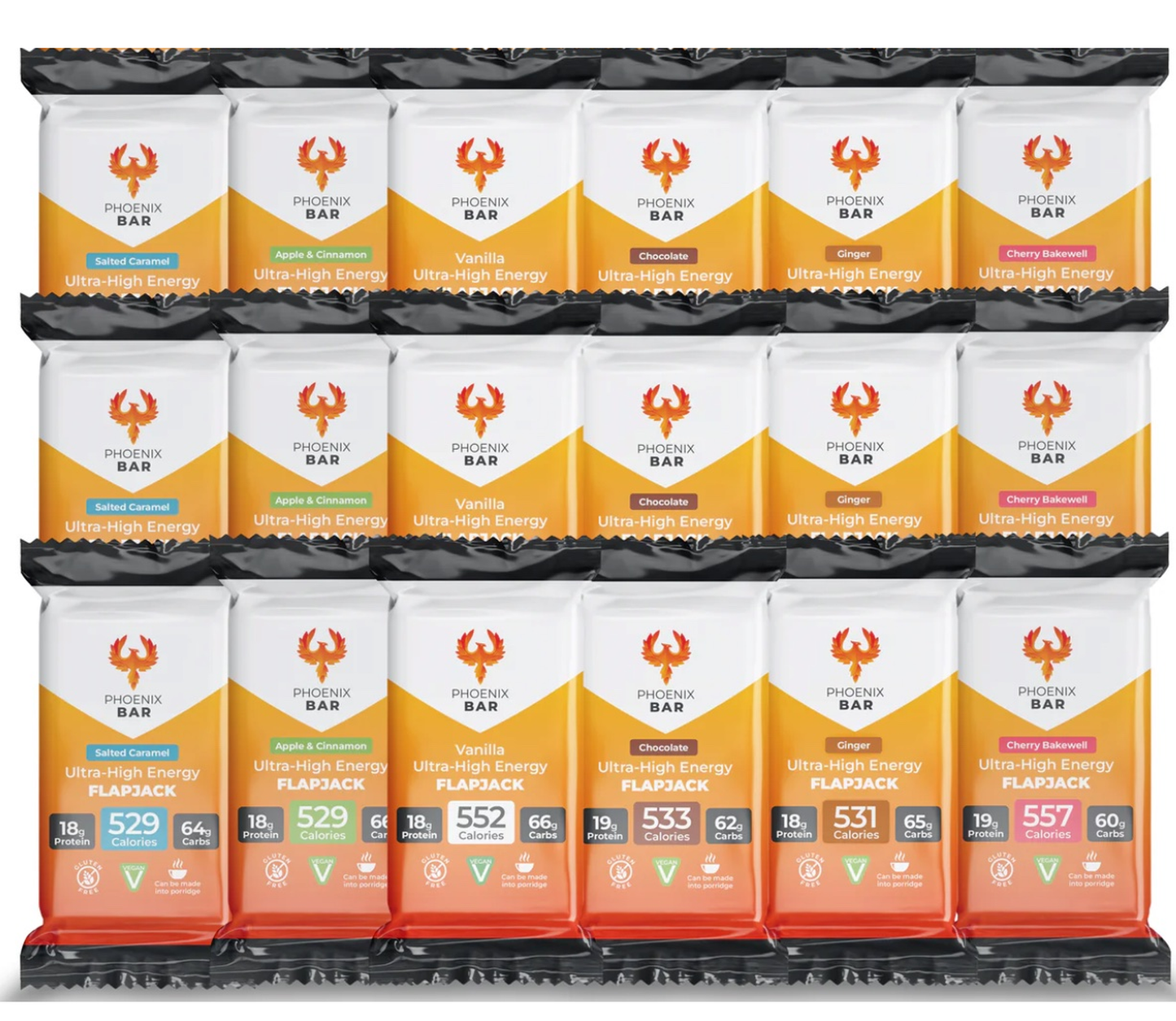
Phoenix Bars: Up to 557 Calories Per Bar
Highly compact, low-volume, calorie-dense bars. Soft, easy to eat whole or as a warm porridge. Vegan, gluten-free and contain up to 66g of carbohydrates, 19g of protein & 8 vitamins & minerals.
Why is it so hard to make a bar over 450 calories at home?
The short answer: physics and binding. Fat carries 9 calories per gram against 4 for carbohydrate and protein, so the only way to push a bar's calorie density higher is to load fat. But fat doesn't bind. Push past a certain ratio and the mixture stops being a bar and becomes greasy rubble, which is exactly what happened to my early test batches.
Commercial bars solve this with ingredients you won't have at home, principally glucose syrup and glycerine, which bind at high density while keeping the texture soft and moist. That's a large part of how a 120g Phoenix Bar carries 557 calories at 4.64 calories per gram and still survives being carried up a mountain in a rucksack pocket. At home, golden syrup and firm pressing get you impressively far, realistically to around 400 to 500 calories a bar, but you'll notice the trade-off: cut them big and they crumble, load more oil and they turn greasy, and the sweetness needed for binding becomes hard going if you're eating several a day.
There's a second ceiling nobody mentions: palate fatigue. A one-off homemade bar tastes great. The fourth one on a long day, or the tenth across a difficult week, is a different experience, which is why commercial recipes are deliberately engineered to be less sweet than home baking.
How do you make homemade bars even higher in calories?
Add fat in forms that don't wreck the structure. In order of effectiveness: swap 30g of oats for 30g of ground almonds, increase the peanut butter to 180g, stir in 40g of chopped roasted nuts, or brush the pressed mixture with a tablespoon of melted coconut oil before baking. Each of those adds 150 to 300 calories per batch. What I'd avoid: adding more loose oil to the pan (greasy bars), chocolate chunks through a warm mixture (they melt and thin the binding), and fresh fruit (moisture ruins shelf life). If your priority is drinks rather than bars, homemade weight gainer shakes are an easier way to add several hundred calories, because liquids don't have a binding problem at all.
Should you make or buy high calorie bars?
Honestly, it depends on where and how you'll eat them, so here's the maths and the trade-offs from someone with an obvious interest, laid out straight.
On ingredient cost, homemade wins clearly: this batch costs roughly £4 to £4.70 in a UK supermarket, which is about 40 to 50p per bar before your time, energy and washing up. Bought specialist bars cost several times that.
Everything else favours purpose-built. A homemade bar keeps for about a week; commercial high calorie bars are engineered for a shelf life measured in years, which matters if you're stocking up for an event, a trip, or the weeks when cooking feels impossible. Homemade tops out around 450 to 500 calories with fragile structure; high calorie bars for weight gain like the ones I make reach 557 calories in a smaller, more robust 120g format that won't crumble in a bag, freeze solid, or melt. And consistency is the quiet one: every batch you bake will vary a little in calories and texture, which is fine at home and a real problem when you're relying on exact fuelling for lightweight backpacking food or a race plan.
My honest steer: if you enjoy baking, you're eating them at home within the week, and budget is the priority, make them, and I hope the recipe above serves you well. If you need calories that travel, keep, stay consistent, or simply appear without effort on the days effort is the whole problem, a purpose-built bar earns its price. Plenty of my customers do both.
Using homemade bars for weight gain or a small appetite
If you're building weight gradually, the NHS suggests adding around 300 to 500 extra calories a day, and one of these bars alongside normal meals does that in a few unhurried bites; their guidance on healthy ways to gain weight is a sensible starting framework. On days when appetite is low, small and gentle beats big and ambitious: cut a bar into six chunks and have one with a cup of tea through the day, or crumble half a bar into warm milk so it softens into something closer to high calorie porridge, which many people find easier than chewing when eating feels like work. There are more low-effort ideas in my guides to what to eat when your appetite is low and easy ways to eat more calories, and if you want to understand the principle behind all of it, it comes down to choosing calorie-dense foods that deliver more energy per bite.
Homemade high calorie bar FAQs
Why do my homemade bars fall apart?
Almost always one of three things: the mixture wasn't pressed firmly enough into the tin, the bars were cut while warm, or the fat-to-syrup ratio drifted too far towards fat. Press hard, cool completely, chill before cutting, and keep the syrup in; it's the binder.
How long do homemade high calorie bars last?
About 5 to 7 days in an airtight container at room temperature, slightly longer refrigerated, and up to 3 months frozen if wrapped individually. Home bars have no preservative system, so this is one of the biggest practical differences from shop-bought bars with long dated shelf lives.
How many calories should a high calorie bar have?
There's no official definition, but most standard snack and cereal bars sit between 100 and 250 calories. I'd call anything over 300 genuinely high calorie, 400 to 500 is excellent for homemade, and purpose-built bars reach the mid-500s per bar.
Can I make these bars gluten free and vegan?
Yes, the recipe already is, provided you buy certified gluten-free oats, since standard oats are often cross-contaminated. If you're building a wider plan around those needs, my guide to high calorie gluten free foods covers the best options beyond bars.
Are homemade bars cheaper than buying them?
On ingredients alone, yes, roughly 40 to 50p a bar against several pounds for specialist bought bars. Factor in time, energy, imperfect batches and a one-week shelf life and the gap narrows, which is why the honest answer is homemade for planned home eating, bought for travel, events and low-effort weeks.
What are the best snacks to eat alongside these bars?
Variety protects you from palate fatigue, so rotate bars with other energy-dense options like nuts, nut butter on toast, full-fat yoghurt alternatives and dried fruit. My full list of high calorie snacks ranks the easiest ones.
Written by James Frost, founder of Flaming Phoenix. I develop, test and hand-pack Phoenix Bars, 557-calorie nutrition bars used by ultra runners, expedition teams and people who struggle to eat enough, with over 20,000 bars shipped to 19 countries. Last updated: July 2026.


Flaming Phoenix



Contact Us
Widerruf erklären
Füllen Sie das folgende Formular aus, um Ihre Widerrufserklärung abzugeben.

