

Backyard Ultra Nutrition: How to Fuel for the Last Loop
In diesem Leitfaden

In a backyard ultra, fueling is the event. Aim for roughly 250 calories an hour, kept mostly to carbohydrate, delivered through a rotation of drink, soft solids and real food so no single flavour wears you down. Add protein and a little fat once you pass 24 hours, plan warm food for the night loops, defend your fluid and sodium, and never put anything in a drop bag you have not already tested in training. The runner still eating comfortably at hour 30 is usually the runner still standing.
This guide is part of our ultra-endurance and expedition nutrition guide. It focuses on the backyard format specifically, because the fueling problem here is unlike any other race.
What is a backyard ultra?
A backyard ultra is a last-one-standing race invented by Lazarus Lake, the race director behind the Barkley Marathons. Runners complete a 4.167 mile loop, called a yard, every hour on the hour, and the winner is simply the last person still able to finish a loop in time. There is no set distance and no finish line. The loop length comes from dividing 100 miles by 24 hours. If you want to try the format, our guide to UK backyard ultras lists the races by nation. BroBible
The ceiling is almost absurd. The current world record is 119 loops, set by Phil Gore in June 2025, which is 495.87 miles run over nearly five days, one loop every single hour. Because the race can stop at any hour or run for days, you cannot save fuel for the end or push through on empty. You have to keep your body topped up indefinitely. Substack
The real limiter is your stomach, not your legs
Ask anyone who has gone deep into a backyard ultra and they describe it the same way. Veterans of Big's Backyard Ultra call it an eating and sleep deprivation contest as much as a running one. For most people the legs can keep turning over an easy loop far longer than the gut can keep absorbing food. The race is won by whoever solves digestion, not whoever has the fastest loop.
The format makes this brutal. When you finish a loop, the clock keeps running, so a 50 minute loop leaves you about 10 minutes to eat, drink, change, use the toilet and sit down before the next bell. Your fueling has to be fast, ready to eat, and easy to get down when you are tired and your appetite has gone. It is the same test that separates the best energy bars for ultra running from the rest.
How many calories should you eat per loop?
A practical starting target for most runners is around 250 calories per hour, held steady throughout the race rather than chased late. Keep the majority of that as carbohydrate, the fuel your body can absorb and burn at running intensity, with most endurance guidance landing around 60 to 90 grams of carbohydrate an hour for a trained gut. Miles Together
The mistake is treating a multi-day effort like a single carb-only race. Once you pass 24 hours, bring in some protein to limit muscle breakdown and a little real food alongside your hourly carbohydrate and electrolyte targets. Carbohydrate stays the priority fuel, but fat and protein slow stomach emptying and give you a break from relentless sugar. For more on the solid-carb side of this, see our guide to ultra high carb solid foods. Tailwind Nutrition
What should you eat during a backyard ultra?
The winning pattern is a rotation, not a single food. Variety is what prevents flavour fatigue and keeps intake consistent over many hours, and most successful plans mix liquids, gels or chews, and real food. Think in three buckets. Umit
Liquid calories carry the early loops. A carbohydrate drink is gentler on the stomach during sleep-deprived, high-volume efforts when solid food becomes harder to tolerate. Sipping 100 to 150 calories of fuel per loop keeps a steady drip of energy in without sitting heavy.
Soft, calorie-dense solids do the real work. This is where high calorie bars earn their place, giving you genuine calories without volume or chewing effort. A small handful of high-calorie snacks per loop, or a soft bar nibbled across the hour, adds up fast. If you want to understand which foods deliver the most energy per bite, our calorie-dense foods guide ranks more than forty of them.
Real food comes in as the hours stack up. Savoury options like ramen, mashed potato, broth, and crisps become far more appealing than sweet gels deep into a race. If gels are already turning your stomach, our energy gel alternatives guide covers what to use instead.
How do you beat flavour fatigue?
Flavour fatigue is the quiet race-ender. After several hours, sweet gels and drinks can become genuinely repulsive, and runners stop eating not because they are full but because they cannot face another mouthful. Experienced backyard runners shift toward savoury foods that need very little chewing, and they avoid overloading on fructose because it is harder to process.
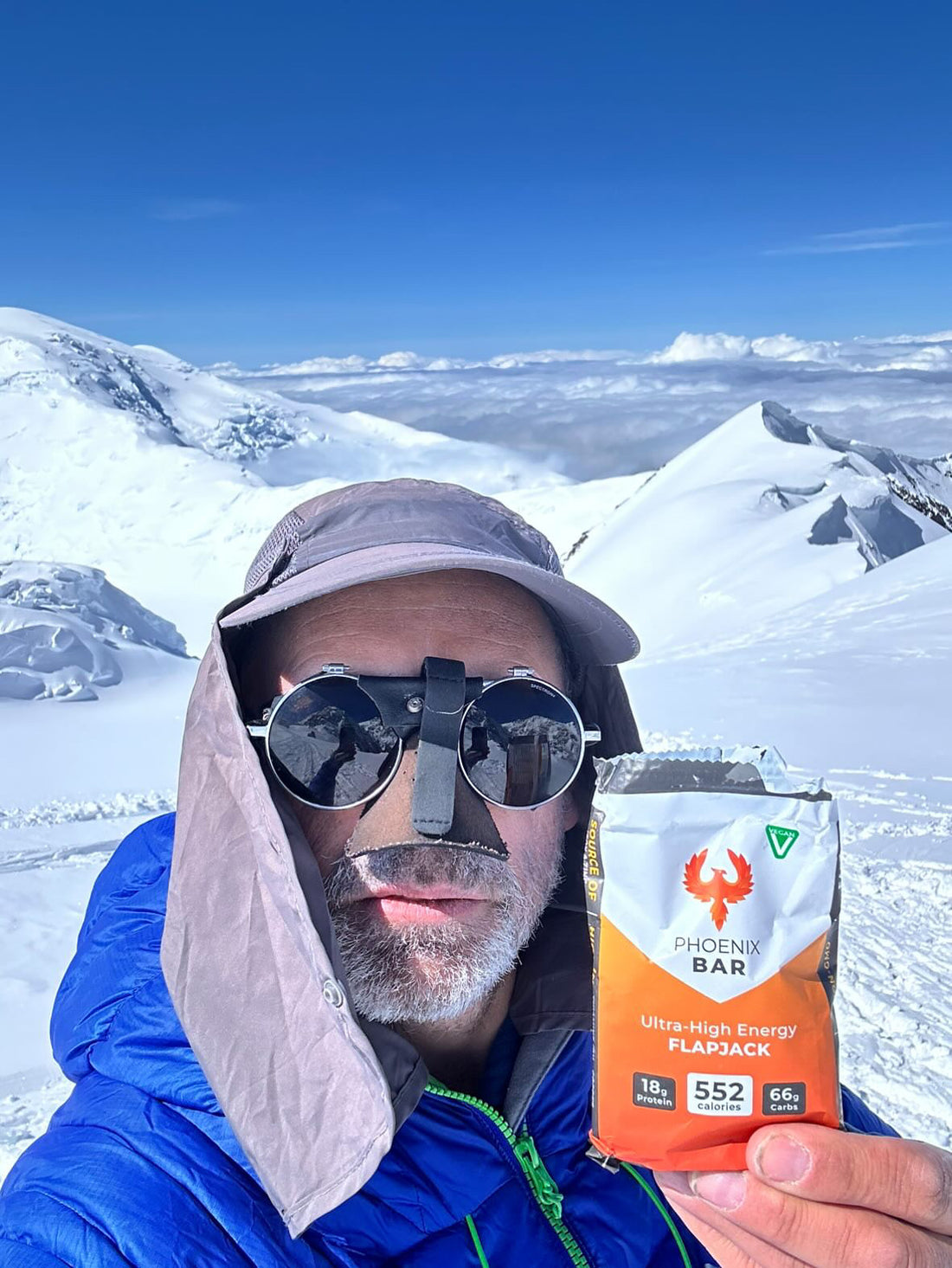
The defences are variety and texture. Rotate sweet and savoury, hot and cold, liquid and solid, so nothing dominates. Pre-portion small amounts so each loop feels like a fresh small bite rather than a chore. One runner who used our bars in a self-supported event described cutting one in half before the start, then nibbling another quarter each hour, which kept hunger away without ever feeling like a meal. For the different ways to eat a dense bar across a long effort, see how to use Phoenix Bars.
What should you eat on the night loops?
The night is where races are lost. It is colder, you are sleep deprived, and appetite drops away. Cold gels and dry bars are hard to face at 3am, so the runners who survive the night plan warm food. A Phoenix Bar stirred into hot water or milk becomes a warm high-calorie porridge with no stove and no cooking, which is one of the most reliable ways to get hundreds of calories in when nothing else appeals. Warm, soft and dense beats cold, dry and bulky every time after dark.
When your appetite disappears completely
At some point appetite simply switches off, and the only thing that works is calorie density: the most energy in the smallest, softest, easiest-to-swallow form. This is the same principle that helps people who struggle to eat enough in everyday life, covered in our calorie-dense foods and soft high-calorie foods guides. When you can only manage a few bites, those bites need to be worth as much as possible.
Hydration and electrolytes
Fluid and sodium keep your gut working and your fuel absorbing. A common starting point is 20 to 24 ounces of fluid and 600 to 900 milligrams of sodium per hour, adjusted up in heat and down in cold. In cooler conditions, 300 to 600 milligrams of sodium an hour is often enough, guided by sweat rate and how salty you run. Avoid the opposite mistake of drinking too much plain water, which dilutes your sodium and can be dangerous over many hours. Let thirst and urine colour guide you rather than forcing fluid.
How do you avoid stomach problems?
Train your gut like you train your legs. The single most repeated rule in ultra fueling is nothing new on race day. Every drink, bar, gel and real food in your plan should have been rehearsed in long training sessions at race effort, so your stomach already knows it. Build the habit of eating small amounts on a schedule rather than waiting until you feel you need it, because by the time you feel empty in a backyard ultra it is already too late to catch up.
A sample loop-by-loop rotation
In the early loops, keep it light and liquid led: a bottle of carbohydrate drink each loop and a few bites of something soft. Through the daytime middle loops, layer in a soft calorie-dense bar nibbled across the hour and start alternating sweet and savoury. As night falls, switch to warm food, hot porridge, broth or soup, and protect your core temperature while you eat. Deep into the second day and beyond, lean on whatever savoury, low-chew, calorie-dense food you can still face, in the smallest portions that hit your hourly target, and keep the fluid and sodium steady. The plan is not to eat perfectly. It is to never stop eating.
Where Phoenix Bars fit
I have not stood in the corral at hour 40 myself. But I built Phoenix Bars after 150 conversations with people who have, and one sentence came up again and again: it was not the legs that stopped them, it was that they could not keep eating.
That is the entire design brief. Each bar packs up to 557 calories into a soft 120 gram flapjack at roughly 4.6 calories per gram, so a few bites are worth a whole handful of ordinary snacks. They are soft enough to eat with no real chewing, you can eat one whole, break it up and nibble a quarter each loop, or stir it into hot water for a warm porridge on the night laps. They are vegan, gluten-free, do not melt in heat or freeze in the cold, and keep for up to two years, so they survive a drop bag in any conditions.
If you want to test them properly before a race, the six-bar Short-Term Bundle is the low-commitment way to trial them across a few long training sessions, which is exactly where your fueling should be proven anyway. Try Phoenix Bars for your backyard ultra.
Related guides
For longer point-to-point efforts, see multi-day ultra running nutrition. For shorter, faster days on the trails, see trail running nutrition. For self-supported running with a pack, see fastpacking nutrition. And for the full picture across every endurance discipline, start with our ultra-endurance and expedition nutrition guide.
Frequently asked questions
How many calories should you eat per loop in a backyard ultra? Around 250 calories per hour is a sound target for most runners, kept mostly as carbohydrate, with protein and a little fat added once you pass 24 hours.
What is the best food for a backyard ultra? A rotation rather than one food: a carbohydrate drink early, soft calorie-dense bars and snacks through the day, and savoury, low-chew real food and warm porridge through the night to beat flavour fatigue.
What should you eat on the night laps? Warm, soft, calorie-dense food. Hot porridge, broth or soup is far easier to face at night than cold gels or dry bars, and helps keep you warm.
How do you stop feeling sick during a backyard ultra? Train your gut in advance, introduce nothing new on race day, avoid overloading on fructose, keep sodium and fluid steady, and eat small amounts on a schedule rather than large amounts occasionally.
How much should you drink per loop? Roughly 20 to 24 ounces of fluid per hour as a starting point, with 300 to 900 milligrams of sodium depending on heat and sweat rate. Avoid drinking large volumes of plain water alone.
Written by James Frost, founder of Flaming Phoenix. I pack every order myself and reply to every email, usually the same day. Last reviewed May 2026.
Viele Kalorien. Kleiner Riegel.
Bis zu 557 Kalorien in einem kompakten, leichten Riegel von nur 120 g, mit bis zu 66 g Kohlenhydraten und 19 g Protein. Im Ganzen essen, über ein paar Stunden in Stücken essen oder mit heißem Wasser oder Milch zu Porridge verrühren.
Leicht zu essen, leicht verdaulich und nicht zu süß. Phoenix Riegel schmelzen nicht bei Hitze, frieren bei Minusgraden nicht ein und sind bis zu zwei Jahre haltbar. Sie passen in die Berge, in die Nachtschicht oder nach Hause, an Tagen, an denen genug zu essen schwerfällt. Dazu vegan und glutenfrei.
- 557 Kalorien in einem kompakten 120-g-Riegel (529 bis 557 je nach Sorte)
- 4,6 Kalorien pro Gramm
- 66g Kohlenhydrate pro Riegel (bis zu)
- 19g Protein pro Riegel (bis zu)
