

Walking Calorie Calculator: Calories Burned by Steps or Time
In diesem Leitfaden

A 70 kg adult walking at a normal 5 km/h burns about 40 calories per 1,000 steps, so 10,000 steps comes to roughly 400 kcal. Thirty minutes at that pace burns about 133 kcal (3.8 METs × 70 kg × 0.5 hours, from the 2024 Adult Compendium). Use the walking calorie calculator below for your own steps or time.
Choose By steps if you have a count from your phone or watch, or By time if you know how long you walked. Weight in stone? Multiply by 6.35, so 11 stone is 70 kg.
How many calories do 1,000 to 25,000 steps burn?
Each 1,000 steps burns about 40 kcal for a 70 kg walker at a normal 5 km/h with the calculator's default 0.75 m stride. Here are the step counts people ask about most, worked through at those settings, with the distance covered and the time it takes:
- 1,000 steps: about 40 kcal (0.75 km, 9 minutes)
- 2,000 steps: about 80 kcal (1.5 km, 18 minutes)
- 3,000 steps: about 120 kcal (2.25 km, 27 minutes)
- 4,000 steps: about 160 kcal (3 km, 36 minutes)
- 5,000 steps: about 200 kcal (3.75 km, 45 minutes)
- 6,000 steps: about 240 kcal (4.5 km, 54 minutes)
- 7,000 steps: about 280 kcal (5.25 km, 1 hour 3 minutes)
- 8,000 steps: about 320 kcal (6 km, 1 hour 12 minutes)
- 9,000 steps: about 360 kcal (6.75 km, 1 hour 21 minutes)
- 10,000 steps: about 400 kcal (7.5 km, 1 hour 30 minutes)
- 11,000 steps: about 440 kcal (8.25 km, 1 hour 39 minutes)
- 12,000 steps: about 480 kcal (9 km, 1 hour 48 minutes)
- 13,000 steps: about 520 kcal (9.75 km, 1 hour 57 minutes)
- 14,000 steps: about 560 kcal (10.5 km, 2 hours 6 minutes)
- 15,000 steps: about 600 kcal (11.25 km, 2 hours 15 minutes)
- 16,000 steps: about 640 kcal (12 km, 2 hours 24 minutes)
- 17,000 steps: about 680 kcal (12.75 km, 2 hours 33 minutes)
- 18,000 steps: about 720 kcal (13.5 km, 2 hours 42 minutes)
- 20,000 steps: about 800 kcal (15 km, 3 hours)
- 25,000 steps: about 1,000 kcal (18.75 km, 3 hours 45 minutes)
For your own weight, multiply your weight in kilograms by 0.57 for each 1,000 steps at a normal pace, or by 0.60 at a brisk 6 km/h. The 0.57 is simply 3.8 METs × the 0.15 hours that 1,000 steps take at 5 km/h. Worked example: an 85 kg (13 st 5 lb) walker logging 15,000 steps at a normal pace burns 85 × 0.57 = 48.45 kcal per 1,000 steps, and 48.45 × 15 = about 727 kcal.
How many calories does 10,000 steps burn for your weight?
Ten thousand steps, about 7.5 km or 4.7 miles, burns roughly 315 to 570 kcal for adults between 55 and 100 kg at a normal pace on level ground:
- 55 kg (8 st 9 lb): about 315 kcal at a normal pace, 330 brisk
- 70 kg (11 st): about 400 kcal normal, 420 brisk
- 85 kg (13 st 5 lb): about 485 kcal normal, 510 brisk
- 100 kg (15 st 10 lb): about 570 kcal normal, 600 brisk
Walking briskly adds only about 5% for the same step count. You work harder each minute, but you get the 10,000 steps done in 1 hour 15 minutes instead of 1 hour 30, so there are fewer minutes to count. Body weight moves the total far more than pace does.
How many steps does it take to burn 500 calories?
About 12,500 steps for a 70 kg walker at a normal pace, which is roughly 9.4 km and just under two hours on foot. Heavier walkers get there sooner:
- 55 kg: about 16,000 steps for 500 kcal, 32,000 for 1,000 kcal
- 70 kg: about 12,500 steps for 500 kcal, 25,000 for 1,000 kcal
- 85 kg: about 10,300 steps for 500 kcal, 20,600 for 1,000 kcal
- 100 kg: about 8,800 steps for 500 kcal, 17,500 for 1,000 kcal
These are gross figures. For 500 calories over and above what you would have burned sitting down, a 70 kg walker needs about 17,000 steps.
How the walking calorie calculator works
The calculator multiplies a MET value for your pace by your weight in kilograms and the hours you walked: calories = METs × kg × hours. One MET is roughly 1 kcal per kilogram per hour, about what you burn sitting still. Calculated using MET values from the 2024 Adult Compendium of Physical Activities for walking on level, firm ground:
- Strolling, under 3.2 km/h: 2.3 METs
- Easy, about 3.2 to 4 km/h: 2.8 METs
- Normal, 4.5 to 5.5 km/h: 3.8 METs
- Brisk, 5.6 to 6.3 km/h: 4.8 METs
- Fast, 6.4 to 7.1 km/h: 5.5 METs
- Very fast, 7.2 to 7.9 km/h: 7.0 METs
In step mode the calculator turns your steps into distance using your stride length, works out how long that distance takes at your chosen pace, then applies the MET value. Worked example: a 62 kg walker logs 12,000 steps at a brisk pace with the stride box set to 0.78 m. 12,000 × 0.78 m = 9.36 km. 9.36 km ÷ 6 km/h = 1.56 hours. 4.8 × 62 × 1.56 = 464 kcal, which the calculator rounds to 465.
Stride length is the box most people skip, and it matters. The calculator's rule of thumb is your height in metres × 0.43, which gives 0.69 m at 1.60 m tall and 0.77 m at 1.80 m. At 70 kg and a normal pace, 10,000 steps then burns about 367 kcal for the shorter walker and 410 for the taller one, because the taller walker has covered 0.8 km more ground. Most people lengthen their stride when they speed up, so measure it at the pace you usually walk: count your steps over a known 100 m and divide 100 by the count.
Gross or net: how many extra calories did the walk burn?
The calculator gives gross calories, which include the roughly 1 kcal per kg per hour your body burns at rest anyway. For the extra cost of the walk, take off your weight × the hours walked. For 10,000 steps at 70 kg and a normal pace, that is 399 minus (70 × 1.5) = about 295 kcal net.
Net is the figure to use if you eat back exercise calories, and it is fairer to slow walkers. With the default stride, 10,000 steps at a stroll comes out at about 403 kcal gross, level with a normal pace, only because the stroll takes an hour longer. Net, the stroll costs about 230 kcal, a normal pace about 295 and a brisk pace about 335.
Free download
Free: the Ultra & Expedition Fuelling Checklist
A printable 2-page plan with your hourly carb targets, race-week plan and pack-weight maths. Free, sent straight to your inbox.
Free. Unsubscribe anytime. Privacy policy
How many calories does walking burn per hour, per km and per mile?
A 70 kg walker burns about 266 kcal in an hour at a normal 5 km/h, 336 at a brisk 6 km/h, 385 at a fast 6.7 km/h and 490 at a very fast 7.5 km/h. Half an hour is half those figures: about 133, 168, 193 and 245 kcal.
By distance, a kilometre at a normal pace costs a 70 kg walker about 53 kcal (3.8 × 70 ÷ 5 km/h), so a mile comes to about 86 and a 10 km walk to about 530. Scale for your weight: an 85 kg walker adds about a fifth, a 60 kg walker takes about a seventh off.
What changes your walking calorie burn?
Hills change it most. The Compendium rates walking up a 1 to 5% slope at a moderate-to-brisk pace at 5.3 METs and a 6 to 10% slope at 7.0, against 3.8 on the flat, so a steady climb costs 40 to 85% more per minute. Trails and fell paths have their own hiking calorie calculator.
A loaded rucksack adds more again: carrying 21 to 40 lb (about 10 to 18 kg) up a 3 to 10% grade rates 7.5 METs. For a weighted vest or a heavy pack, use the rucking calorie calculator.
The most common mistake is picking the wrong pace. The NHS describes a brisk walk as about 3 miles an hour, a pace where you can still talk but cannot sing. That is 4.8 km/h, which is this calculator's Normal setting. Choosing Brisk for an NHS-style brisk walk overstates the hourly figure by about a quarter.
How accurate is a walking calorie calculator?
Close for a typical adult on level ground, not exact for you. The Compendium's authors say plainly that it was not built to give the precise cost of an activity for one person: its MET values are averages, and their note on corrected METs explains that the 1 kcal per kg per hour resting baseline runs high or low depending on age, size and fitness. Mud, wind and stopping at every stile move the real number too. Watches estimate from heart rate and movement with their own models, so a watch and this calculator will rarely agree to the calorie.
How much should you eat on a long walk?
A walk of an hour or two rarely needs food on the way: the 300 to 500 kcal it costs is covered by your next meal. Long days are different. A 30,000-step day on a long-distance walking route is about 22.5 km and roughly 1,200 kcal on the flat for a 70 kg walker, before hills or a pack, and appetite often fades just as the demand peaks. Eat something small every hour or so rather than saving it all for lunch.
Because everything has to be carried, calories per gram counts for more than anything else in the rucksack. That is the problem our high calorie bars were built around: Phoenix Bars carry up to 557 calories in only 120g, about 4.4 to 4.6 calories per gram, and break into pieces for eating on the move. Marc Ryder wrote that he "Recently used them on a 42 mile fast pack across the Brecon Beacons". For multi-day routes, see the lightest high-calorie foods for backpacking, three peaks challenge food and our pick of the best energy bars for hiking. Camping on the way? The best camping snacks list covers what to eat between meals.
Frequently asked questions
Does 10,000 steps really burn 500 calories? Only for heavier walkers. At a normal pace, 10,000 steps reaches 500 kcal at about 88 kg body weight. A 70 kg walker burns about 400 kcal, and only about 295 of that is extra to what they would have burned sitting still. Hills, a pack or a longer stride push the figure up.
How many steps is a 30-minute walk? About 3,300 steps at a normal 5 km/h with a 0.75 m stride, because 30 minutes covers 2.5 km and 2,500 m ÷ 0.75 m is 3,333. At a brisk 6 km/h it is about 3,800 to 4,000. Shorter walkers take more steps for the same ground: around 3,600 at a normal pace for someone 1.60 m tall.
Does walking burn as many calories as running? Not minute for minute. The Compendium rates brisk walking at 4.8 METs and running at 6 mph (9.7 km/h) at 9.3, so a run costs about twice as much per minute. Per kilometre the gap is far smaller: about 67 kcal running against 53 walking at a normal pace for 70 kg. Our running calorie calculator does the same job for runs, with a net figure too.
Why does my fitness tracker show a different number? Trackers estimate from heart rate, movement and their own models, while this calculator uses published MET values for your pace and weight. Many watches also report active calories, which leave out your resting burn, so compare them with the net figure above rather than the gross one. Neither is a measurement: only a lab test of oxygen use is.
Do I need to walk 10,000 steps a day? No. Ten thousand is a round number that caught on. A 2025 review of 57 studies from 35 cohorts in The Lancet Public Health, led by Melody Ding, linked 7,000 steps a day with a 47% lower risk of death from any cause than 2,000 steps, as the American College of Cardiology summarised. More steps still add calories: 3,000 extra is about 120 kcal at 70 kg.
Does a woman burn fewer calories walking 10,000 steps? Only through weight and stride: the MET method does not use sex at all. A 60 kg walker with a 0.68 m stride covers 6.8 km in 10,000 steps and burns about 310 kcal at a normal pace, against about 400 kcal for a 70 kg walker with a 0.75 m stride. Enter your own stride for a closer figure.
Working out other activities? Try our running calorie calculator, cycling calorie calculator, swimming calorie calculator, rucking calorie calculator, climbing calorie calculator and ultra running calorie calculator.
Sources: 2024 Adult Compendium of Physical Activities, walking and running MET values (Herrmann and colleagues, Journal of Sport and Health Science, 2024); NHS, Walking for health; Ding and colleagues, Daily steps and health outcomes in adults, The Lancet Public Health, 2025.
Written by James Frost, founder of Flaming Phoenix. Calculator method: 2024 Adult Compendium of Physical Activities. Updated October 2026.
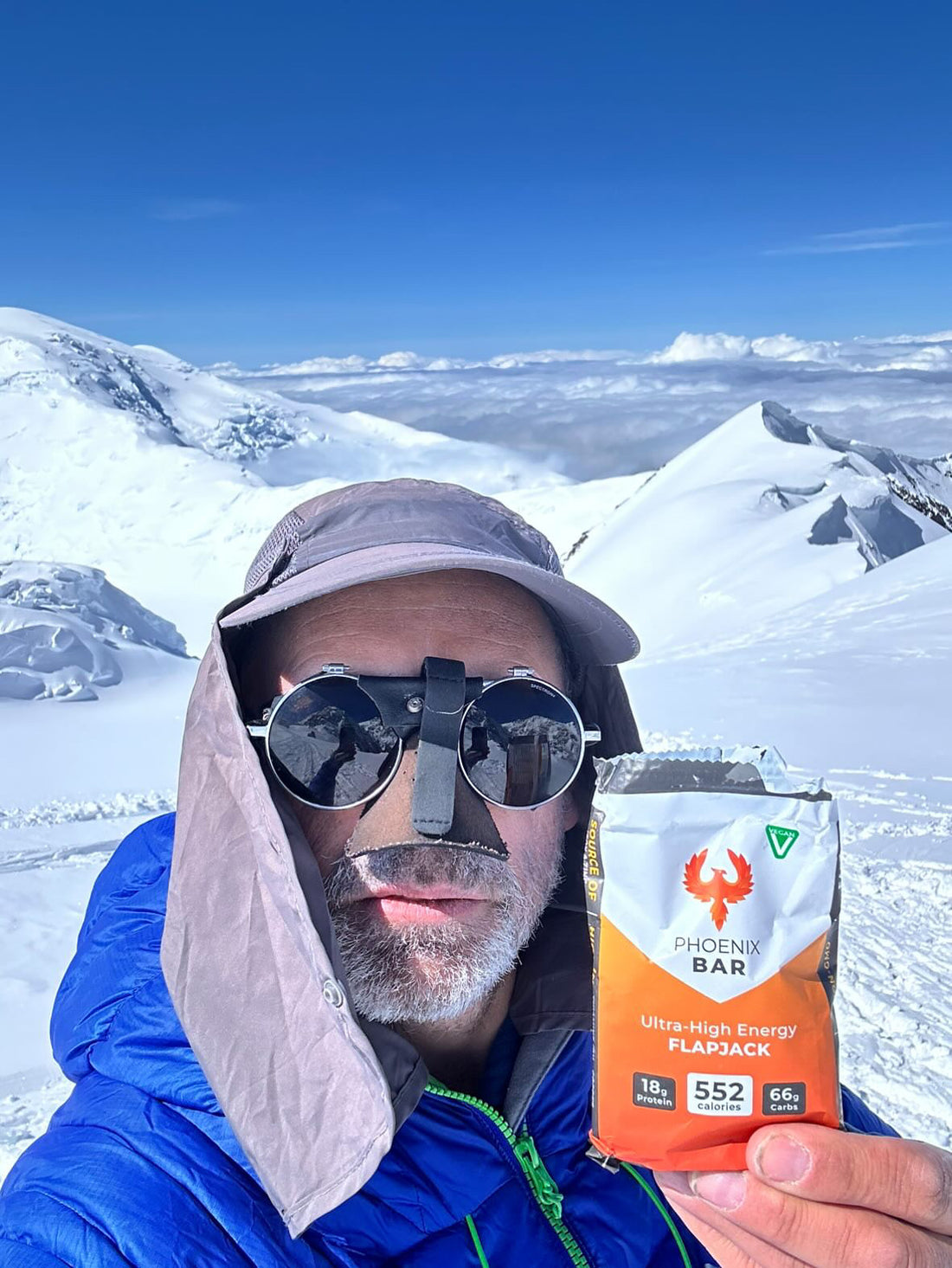
Viele Kalorien. Kleiner Riegel.
Bis zu 557 Kalorien in einem kompakten, leichten Riegel von nur 120 g, mit bis zu 66 g Kohlenhydraten und 19 g Protein. Im Ganzen essen, über ein paar Stunden in Stücken essen oder mit Wasser oder Milch zu Porridge verrühren.
Leicht zu essen, leicht verdaulich und nicht zu süß. Kunden haben sie bei -45 °C und in der Hitze des Marathon des Sables gegessen, und sie sind bis zu zwei Jahre haltbar: für die Berge, die Nachtschicht oder zu Hause, an Tagen, an denen genug zu essen schwerfällt.
- 557 Kalorien in nur 120 g (529 bis 557 je nach Sorte)
- 4,6 Kalorien pro Gramm
- 66g Kohlenhydrate pro Riegel (bis zu)
- 19g Protein pro Riegel (bis zu)
Widerruf erklären
Füllen Sie das folgende Formular aus, um Ihre Widerrufserklärung abzugeben.

