High Calorie Porridge: How to Get More Calories When Standard Porridge Isn't Enough
Porridge has a calorie problem. For most people it's a virtue. A bowl of oats with water delivers around 170 calories, which is why the NHS and most dietitians recommend it as a filling, low-calorie breakfast for weight management. But if you're searching for "high calorie porridge," you're approaching it from the other direction. You want more calories, not fewer, and you want them from a format that's gentle on your stomach, easy to prepare, and simple to eat when appetite is low or energy demands are high.
This guide is for that problem specifically. It covers how many calories you can realistically get from traditional porridge with add-ins, where add-in strategies start to fail, and what to do when you need more calories per bowl than oats alone can sensibly deliver.
In this guide:
- Why making porridge high-calorie is harder than it looks
- The calorie ceiling of traditional porridge
- The most calorie-effective porridge add-ins, ranked
- Where add-in strategies break down
- The low-volume alternative when standard porridge isn't enough
- How Phoenix Bars work as a porridge
- Which approach suits which situation
- Frequently asked questions
About this guide
Written by James Frost, founder of Flaming Phoenix. Phoenix Bars are used by people who need to take in significantly more calories than standard food easily delivers, including endurance athletes, expedition teams, and adults managing low appetite, weight recovery, or reduced eating capacity. This guide reflects two years of product development and feedback from over 2,100 customer orders, many from people who arrived at Phoenix Bars specifically because standard porridge was the first food they tried and the first food that fell short.
This is not medical advice. If you are losing weight unintentionally or managing a health condition that affects eating, the right first step is a conversation with your GP or a registered dietitian.
Last updated: April 2026.
Why "high calorie porridge" is harder than it looks
The paradox of porridge is that it's filling out of proportion to its calories. A 50g serving of dry oats is around 175 calories. Cooked in 250ml of water, it becomes a bowl of roughly 300g of food delivering the same 175 calories. Swap the water for whole milk and you're at about 300 calories for a similar volume.
For someone trying to lose weight or manage blood sugar, that ratio is the point. You get fibre, slow-release carbohydrate, and satiety at a low calorie cost. For someone who needs to hit 2,500 to 5,000 calories a day, the same ratio is the problem. The bowl fills you up long before it delivers useful calories, and you end up either skipping meals later (because porridge is still sitting heavy) or eating less porridge than the calorie maths demands.
This is the real reason "high calorie porridge" is a search term. People aren't looking for a recipe in the ordinary sense. They're looking for a way to break porridge's low calorie density without either making the bowl enormous or making it so rich it becomes unpleasant to eat.
The calorie ceiling of traditional porridge
There is a practical ceiling on how calorie-dense you can make a bowl of porridge before it stops being porridge. Understanding the ceiling helps you decide whether add-ins will solve your problem or whether you need a different approach entirely.
A typical bowl progression looks like this:
- Oats and water (50g oats): about 175 calories
- Oats and whole milk (50g oats, 250ml whole milk): about 335 calories
- Above plus a tablespoon of honey: about 400 calories
- Above plus a medium banana: about 500 calories
- Above plus two tablespoons of peanut butter: about 690 calories
- Above plus a tablespoon of double cream: about 750 calories
- Above plus 30g of mixed nuts: about 940 calories
At around 700 to 800 calories, most people hit a practical limit. The bowl is large, rich, and takes roughly 20 minutes to make properly. More importantly, the texture changes. Beyond a certain level of nut butter, cream, and toppings, porridge stops behaving like porridge. It becomes heavy, greasy, and harder to eat when appetite is already reduced.
The bowl size also becomes a factor. A 940-calorie porridge weighs roughly 500g in the bowl. For someone eating at normal appetite, 500g is achievable if slow. For someone whose appetite is suppressed by illness, treatment, medication, fatigue, or gut discomfort, 500g in one sitting is often impossible.
The most calorie-effective porridge add-ins, ranked
If you're going down the add-in route, not every ingredient is equally useful. Ranked by calories added per gram of ingredient:
- Oils and fats: olive oil, coconut oil, double cream at 5 to 9 calories per gram. The highest density available, but palatability is limited. Most people can stir in a tablespoon. Few can stir in three.
- Nut butters: peanut, almond, cashew butter at roughly 6 calories per gram. Excellent density, good flavour match with porridge, but thicken the bowl and can feel heavy.
- Nuts and seeds whole: walnuts, almonds, pecans at 5.5 to 7 calories per gram. Add texture and calories, but require chewing, which becomes a barrier when fatigued or unwell.
- Whole milk powder: about 5 calories per gram. Useful because it dissolves into the bowl without adding volume. Often overlooked.
- Chocolate: dark chocolate chunks at 5.5 calories per gram. Works surprisingly well stirred in at the end.
- Dried fruit: raisins, dates, dried mango at around 3 calories per gram. Adds flavour and some calories, but the density is lower than most people assume.
- Honey and maple syrup: about 3 calories per gram. Useful for flavour. Modest calorie addition.
- Fresh banana or berries: 0.5 to 0.9 calories per gram. Low calorie density. Adds volume for minimal calorie gain.
The practical hierarchy: if you're aiming to push a bowl of porridge past 600 calories, lead with nut butter and whole milk. If you're aiming for 800 calories or more, you'll also need oil or cream plus nuts. If you're aiming higher still, you're fighting the format.

Phoenix Bars: High Calorie Bars Which Can Be Made into Porridge
Soft, easy to eat whole or as a warm porridge. Low volume, two-year shelf life. Rated 5.0/5 from 344 reviews. £4.99 per bar.
Where add-in strategies break down
For some people, the loaded porridge approach works well. For others, it fails for reasons that have nothing to do with the recipe and everything to do with the situation they're in. The three most common breakdowns:
Appetite can't keep up with bowl size. If you're recovering from illness, managing treatment side effects, caring for an elderly relative, or living with a condition that reduces appetite, the bowl of loaded porridge that looks reasonable on paper becomes impossible to finish. Half-eaten loaded porridge delivers fewer calories than a smaller, denser serving would have.
Prep time is a barrier. Traditional porridge cooked properly takes 10 to 20 minutes. For someone fatigued, busy caring for another person, or eating in circumstances that don't allow a full kitchen, that's time that often results in the meal being skipped altogether.
Fat-loaded porridge can be hard to digest. For people with reduced digestive capacity, whether from illness, treatment, or age, a bowl heavy in nut butter, cream, and oil can cause nausea or discomfort, which ends the meal before most of the calories are consumed.
Consistency over weeks becomes a problem. Loaded sweet porridge is palatable occasionally. Eating it daily for months, which is what weight recovery or chronic appetite management often requires, leads to flavour fatigue. The bowl that worked in week one becomes unappealing by week six.
If any of these describe your situation, the answer isn't a better porridge recipe. The answer is a different format.
The low-volume alternative: high calorie porridge without the bulk
There's a specific use case that the recipe approach cannot solve well: needing a high-calorie warm porridge-style meal in a small volume, quickly, without cooking.
This is where most of our customers find us. They've already tried adding peanut butter and cream to porridge. It didn't hit their calorie target, or it hit the target in a bowl they couldn't finish, or it worked for two weeks and then they couldn't face it. They come looking for something that delivers the calories of a loaded bowl in roughly a quarter of the volume, with a minute of preparation.
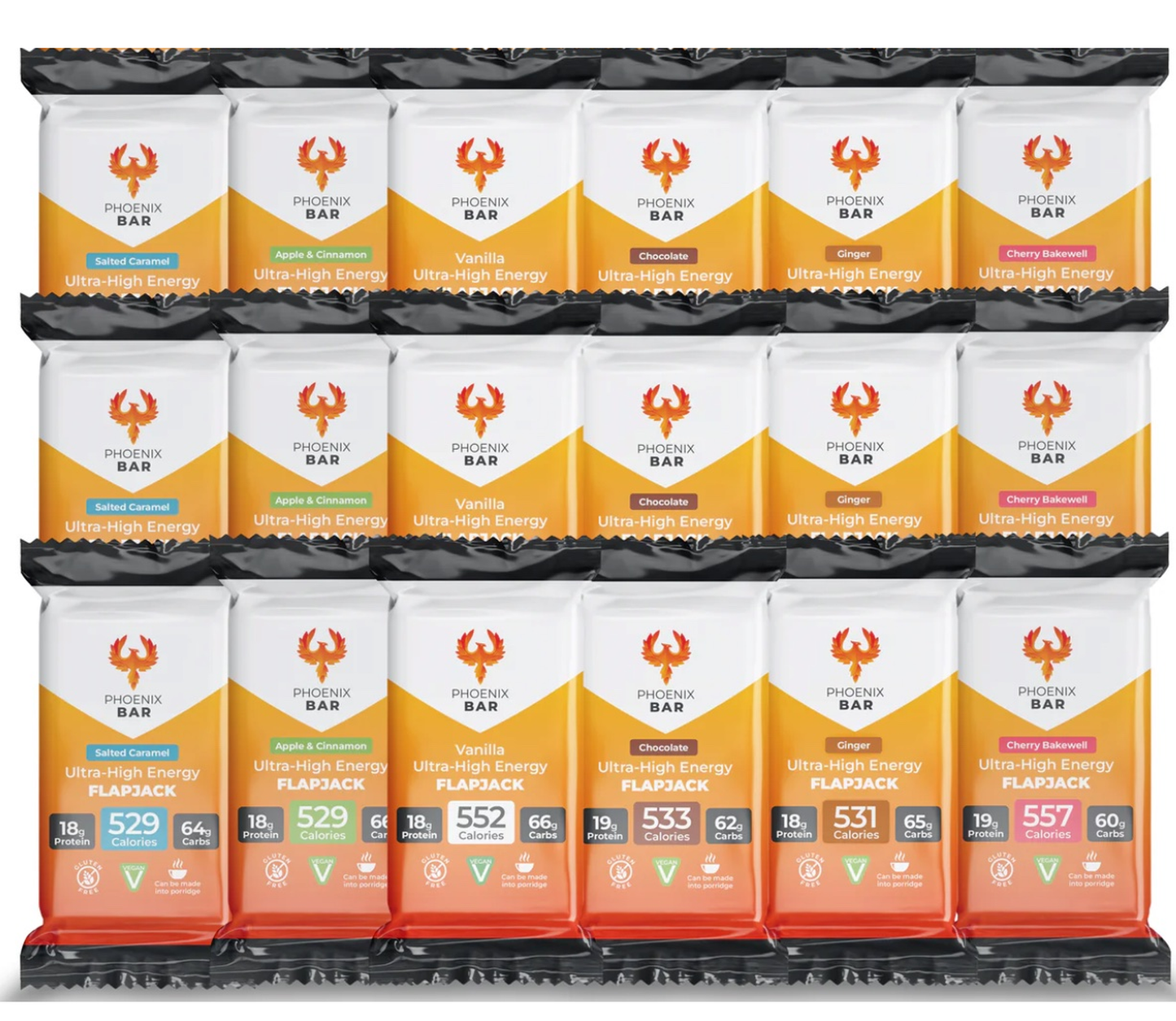
Phoenix Bars are designed for exactly that situation. A single 120g bar delivers 557 calories, and when hot water is added it breaks down into a warm porridge-style meal. The finished volume is around 250ml (roughly half the volume of a loaded bowl of traditional porridge at similar calorie content). The preparation time is under a minute.
For some people this replaces traditional porridge entirely. For others it complements it: loaded porridge on the days they can eat a full bowl, Phoenix Bars as porridge on the days they can't.
How Phoenix Bars work as a porridge
The method is simple. A single 120g Phoenix Bar is broken into a bowl or mug. Hot water (around 150ml) is added. The bar dissolves into a warm, smooth porridge-style meal in about 60 seconds. No cooking, no stove, no clean-up beyond rinsing a bowl.
A step-by-step method with variations is in How to Use Phoenix Bars.
The calorie and volume profile:
- 557 calories in a 120g bar (before water)
- Approximately 250ml volume once prepared
- Calorie density: 2.2 calories per gram of prepared food
By comparison, a 940-calorie loaded traditional porridge is about 500g in the bowl, giving a prepared-food calorie density of 1.9 calories per gram. A plain porridge made with water sits around 0.6 calories per gram.
The practical implication: if you can comfortably eat 250ml of food but not 500ml, Phoenix Bars as porridge lets you take in 557 calories in one sitting where a traditional bowl would only deliver 150 to 200 at the same volume.
The six flavours (Vanilla, Cherry Bakewell, Chocolate, Salted Caramel, Ginger, Apple & Cinnamon) work as porridge as well as they do as bars. Some flavours suit the warm format better than others in practice: Vanilla and Apple & Cinnamon tend to be the most traditional-porridge-like, Ginger is often chosen for mornings when warmth is the main goal, Chocolate and Salted Caramel sit closer to the dessert end. A starter bundle of twelve bars lets people test all six flavours in both bar and porridge formats before committing to a larger order.
Which approach suits which situation
Rather than defaulting to one answer, here's an honest breakdown of when each works best.
Traditional loaded porridge is the right choice when:
- Your appetite is normal and you have time to cook
- You're building calories into a broader varied diet
- You enjoy the texture and flavour of a loaded bowl
- You want the specific benefits of oats (fibre, sustained energy release, slow digestion)
- Cost per calorie matters more than convenience (oats and add-ins are cheap)
Phoenix Bars as porridge is the right choice when:
- Appetite is reduced and volume matters more than ingredient flexibility
- You need a faster format, either because of time pressure or because cooking isn't feasible
- Flavour fatigue from repeated loaded porridge has become a problem
- You need portable high-calorie food that can become a porridge when you want one
- Calorie density (more calories in less food) is the priority
- You need something consistent, replicable, and requiring no measurement or planning
Both together often works best for:
- People recovering weight after illness, treatment, or hospital stays
- Adults managing persistent low appetite, eating small amounts at multiple times during the day
- Carers feeding an elderly relative who struggles with normal meal volumes
- Anyone training at endurance volumes who also needs calorie density on rest days and during recovery
Frequently asked questions
How many calories should a high calorie porridge have?
Depends on what problem you're solving. For weight recovery after illness, 500 to 700 calories per bowl is a common target. For endurance training or expedition preparation, 700 to 1,000 calories per bowl. For managing persistent low appetite, the goal is usually the highest calorie density you can comfortably eat, rather than hitting a specific calorie number.
What's the most calorie-dense way to make porridge with oats?
The highest practical combination for a single bowl is oats cooked in whole milk with added peanut butter, double cream, whole milk powder, and chopped nuts. This can reach 900 to 1,000 calories in a bowl of around 500g. Beyond this, the format becomes difficult to eat.
Can you gain weight eating porridge?
Yes, if the calories consistently exceed your daily burn. The usual challenge is that standard porridge is too low in calories per bowl to support a meaningful surplus, and most people can't eat loaded porridge in the quantities required. This is why people searching for high-calorie porridge specifically are often tackling the density problem, not the quantity problem.
Is high calorie porridge good for weight gain after being ill?
It can be a useful part of a post-illness eating plan, particularly because it's warm, soft, and often tolerated when other foods aren't. The main limitation is volume. If appetite is still reduced after an illness, a smaller, denser format often works better than a large loaded bowl. A GP or dietitian can help plan a post-illness eating strategy.
What about Phoenix Bars versus loaded traditional porridge on calories?
A 120g Phoenix Bar is 557 calories. A heavily loaded traditional porridge can reach 900+ calories in a large bowl. The bar wins on calorie density per gram of food (2.2 vs 1.9), on preparation time (1 minute vs 15 to 20), and on flavour consistency over time. Traditional porridge wins on cost per calorie and on the specific benefits of oats and whole-food ingredients. They solve overlapping but different problems.
Are Phoenix Bars suitable for someone with a reduced appetite?
They were specifically designed with that situation in mind. The high calorie density (557 calories in 120g) and the option to eat as a bar or prepare as a porridge means a reasonable calorie intake is achievable in a smaller food volume than a conventional meal. Customers managing reduced appetite from illness, medication, treatment, or age are a substantial part of our customer base. They are a food, not a medical product, and they are not a replacement for prescribed nutrition support. If a doctor or dietitian has prescribed a specific nutritional plan, that plan comes first.
Can you make porridge with Phoenix Bars in cold water?
Yes, with cold water or cold milk, the texture is different. It becomes more of a cold oat-based smoothie than a warm porridge. Some customers prefer this in warmer weather. Hot water gives the most porridge-like result.
Related guides


Flaming Phoenix