
7,000 Calorie Meal Plan: How to Eat It Day After Day
A 7,000 calorie meal plan only works if it is repeatable: roughly six feeds of 650 to 1,500 calories each, built on carbohydrate, with another 700 to 800 calories drunk rather than eaten. 7,000 a day is what Grand Tour cyclists and expedition athletes sustain in the field, and the hard part is not day one. It is day nine.
Almost everything written about extreme calorie targets treats them as a stunt: eat this for a day, film it, recover. This page is written for the opposite situation, the two-week bike tour, the multi-day ultra block, the long expedition, the genuine hard gainer at the end of the road, where 7,000 has to happen again tomorrow, and the day after that. That changes every decision, from what you eat to when you eat it.
Who actually needs 7,000 calories a day
Two groups search for this number, and they need different advice.
The first group are burners. Grand Tour cyclists average somewhere around 5,000 to 7,000 calories on racing days, with the biggest mountain stages pushing 8,000. Polar travellers hauling sleds, ocean rowers and multi-day ultra runners live in the same territory. Research on human energy limits, published in Science Advances in 2019, found that people can sustain roughly 2.5 times their basal metabolic rate for months on end, while Tour de France riders operate at around 4 to 5 times BMR for three weeks and still finish the race lighter than they started. For a typical adult, 7,000 calories sits at about 4 times BMR. In plain terms: 7,000 a day is sustainable for days and weeks, not months, and even the best-fuelled professionals usually run a small deficit at this level. If that is you, this page is your operating manual, and the ultra-endurance and expedition nutrition guide is the wider map.
The second group are builders, people trying to gain weight who have crept their target up and up. Here is the honest version: almost nobody needs 7,000 calories to gain weight. If you believe you are eating 4,500 a day and not gaining, the problem is nearly always tracking, not metabolism, and the fix is covered in why you can't gain weight. A small number of very tall, very active hard gainers do end up needing numbers in this region, and for them the same rules apply as for the athletes: the target is only hittable with calorie-dense food, which is exactly why high calorie bars for weight gain exist as a category.
Why eating 7,000 once is easy and eating it daily is not
Most healthy adults could hit 7,000 calories tomorrow with a couple of takeaways and a tub of ice cream. What they could not do is repeat it, because three things break down across a week.
Your palate breaks first. By day four, the fourth peanut butter bagel tastes like wallpaper paste. Sports nutritionists call it flavour fatigue, and I hear about it constantly from ultra runners and expedition customers: the food that worked on day one becomes physically hard to swallow by day six. The fix is rotation. Every slot in the plan below has at least two interchangeable options, and nothing appears twice in the same day.
Your gut breaks second. Seven thousand calories of rich, greasy, high-fat food will sit in your stomach like wet cement, because fat is the slowest thing your gut processes. Repeatable big days are carbohydrate-led, with fat used as a dense supporting act rather than the base. If you are fuelling hard exercise, a trained gut can absorb roughly 90 to 120 grams of carbohydrate per hour on the move, and that ceiling is trainable, which is the whole subject of gut training for ultras.
Your willpower breaks third, which is why the plan runs on a clock, not on appetite. At this intake, hunger disappears entirely by mid-morning and never returns. People who wait to feel hungry finish the day 2,000 calories short. People who eat to six alarms hit the number.

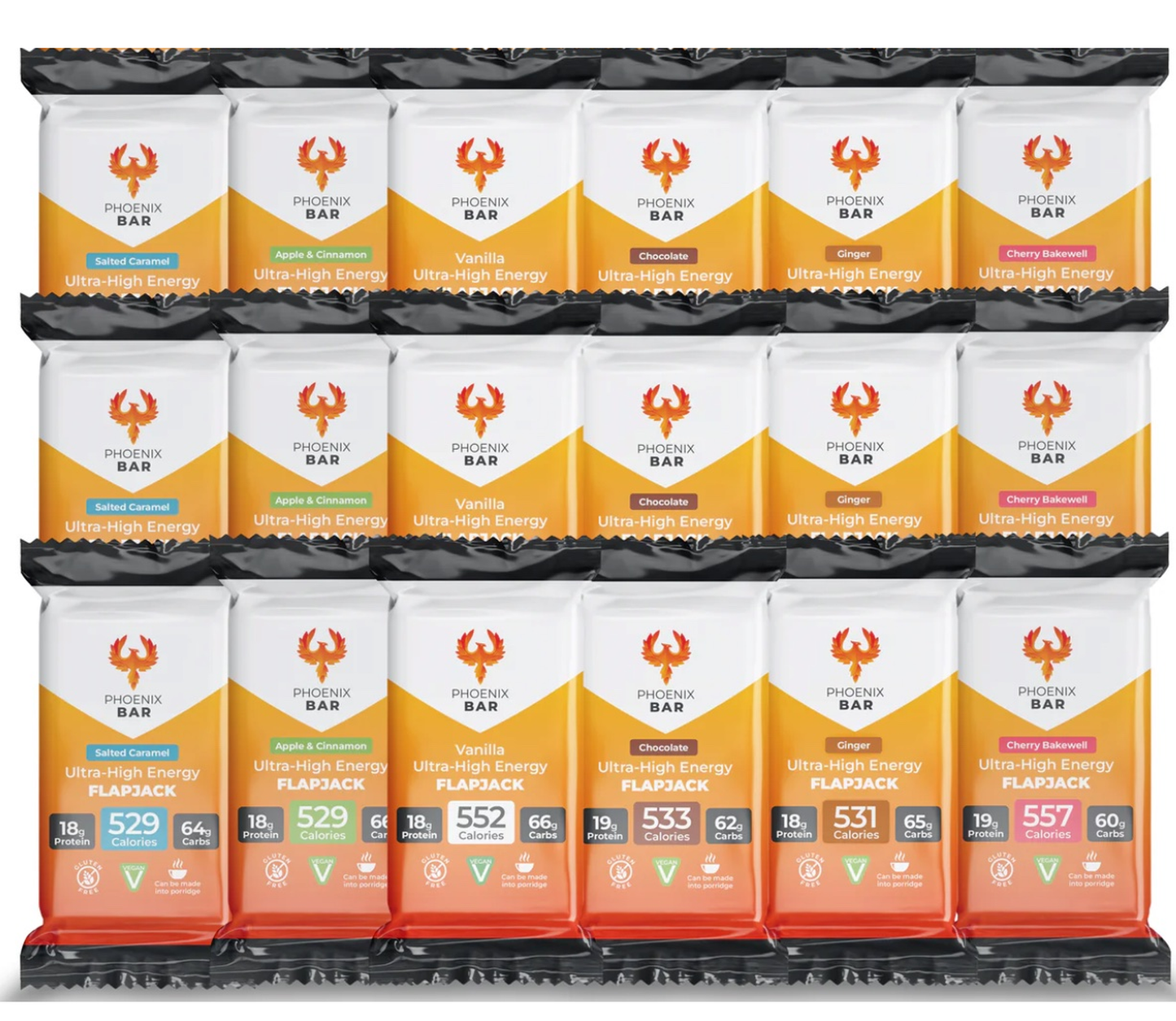
Phoenix Bars: Up to 557 Calories Per Bar
Highly compact, low-volume, calorie-dense bars. Soft, easy to eat whole or as a warm porridge. Vegan, gluten-free and contain up to 66g of carbohydrates, 19g of protein & 8 vitamins & minerals.
The arithmetic that makes 7,000 possible
The single most useful number in extreme-calorie eating is calories per gram, because it decides how much food you physically have to move through your body.
A plate of lean protein, rice and vegetables averages around 1.3 calories per gram, which means 7,000 calories of "clean" eating weighs roughly 5.4 kilograms of food. Nobody can chew and digest 5.4 kilos a day for a week. Shift the average density to 3 calories per gram, using oats, nut butters, oils, dried fruit, flapjack and smooth dairy, and the same 7,000 calories weighs about 2.3 kilograms, which is demanding but genuinely doable. This is the entire logic of calorie-dense foods, and the reason high calorie low volume foods matter so much at the extreme end.
The second lever is drinking a slice of the total. Liquid calories bypass chewing and most of the fullness signal, so putting 700 to 800 calories of the day into a shake and enriched drinks removes an entire meal's worth of effort. The recipes are in high calorie drinks, smoothies and milkshakes and homemade weight gainer shakes.
The plan: a repeatable 7,000 calorie day
Times assume a normal waking day. On heavy training days, shift the afternoon feeds around your session. Every slot lists a swap so that no two consecutive days taste the same.
7:00, breakfast, around 1,200 calories
A big builder's porridge: 150 grams of oats made with whole milk, a sliced banana, two heaped tablespoons of smooth peanut butter and a generous drizzle of honey, with a large glass of fruit juice. Swap option: four slices of thick toast with butter, nut butter and jam, two eggs, and the same juice. More variations are in the high calorie breakfast guide.
9:30, mid-morning, around 650 calories
This is the slot most people skip, and skipping it is how days fail. It needs to be zero-effort. A Phoenix Bar does this job in one wrapper: up to 557 calories in a soft 120 gram bar with up to 66 grams of carbohydrate, eaten as a flapjack or stirred into hot milk as porridge, which is exactly how Phoenix Bars are designed to be used. Add a banana and the slot is done. Swap option: a large bagel with cream cheese and honey plus a whole-milk flat white.
12:30, lunch, around 1,300 calories
A dense plate, carb-led: 150 grams (dry weight) of rice or pasta, a palm-sized portion of salmon, chicken or marinated tofu, a tablespoon of olive oil stirred through, half an avocado, and a full-fat yoghurt with honey to finish. Swap option: a large burrito-style bowl with rice, beans, cheese, guacamole and sour cream.
15:00, afternoon, around 800 calories, drunk not eaten
The gainer shake: 500 millilitres of whole milk, 60 grams of oats, a banana, two tablespoons of peanut butter and a scoop of protein, blended smooth and sipped over half an hour. This is the slot that separates people who hit 7,000 from people who stall at 5,500.
18:30, dinner, around 1,500 calories
The biggest cooked meal of the day, eaten early enough that it clears before bed. A large portion of pasta with an olive-oil-rich sauce and cheese, or a curry with rice, naan and a mango lassi, or a stir fry over a double portion of noodles with cashews. Dessert is not optional at this intake: add a portion of rice pudding, cheesecake or a couple of scoops of ice cream.
21:00, supper, around 750 calories
Something soft and low-effort, because by now you will not want to chew: a bowl of full-fat Greek yoghurt with granola, honey and nuts, or Phoenix Bar porridge made with hot whole milk, or thick toast with banana and nut butter, plus a hot chocolate made with milk.
Across the day, those six slots plus the milk and juice woven through them land within touching distance of 7,000. If you finish the evening 300 short, a glass of whole milk with a spoon of honey closes the gap in ninety seconds.
Stepping up, stepping down and staying honest
If 7,000 feels comfortably beyond your output, drop to the 6,000 calorie meal plan, which follows the same architecture with one fewer feed. If you are heading into genuine expedition territory, the 8,000 calorie guide covers the volume problem at the next level, and the 10,000 calorie day explains where the human ceiling actually sits. Long-distance cyclists have their own version of this problem, covered in long-distance cycling nutrition.
And the honest part: 7,000 calories is a tool for people with 7,000-calorie days. Run this intake without the output and you will gain weight quickly, most of it fat. If your training block ends, step the plan down with it. And if eating has become stressful or complicated for reasons that have nothing to do with sport, a big-numbers meal plan is not the right tool, and talking to a professional is a far better next step than a bigger breakfast.
Frequently asked questions
How many meals is 7,000 calories a day?
Six feeds works best: three main meals of 1,200 to 1,500 calories, two substantial snacks of 650 to 800 calories, and one 750 calorie supper, with 700 to 800 of the total taken as drinks. Three giant meals fails in practice because no comfortable single sitting gets much past 1,500 calories day after day.
Is it possible to eat 7,000 calories in a day?
Yes, and most healthy adults could do it once with junk food. Doing it daily is the real challenge, and it requires calorie-dense food averaging around 3 calories per gram, otherwise you are attempting to chew through more than 5 kilograms of food a day.
Who eats 7,000 calories a day?
Grand Tour cyclists on racing days, polar expedition travellers hauling sleds, ocean rowers, multi-day ultra runners, and a small number of very tall, very active people in a deliberate gaining phase. Research on sustained energy expenditure suggests intakes around this level are maintainable for weeks rather than months.
Will I gain weight eating 7,000 calories a day?
If you are not burning most of it, yes, and fast. A person with a 2,500 calorie maintenance level would be running a surplus of roughly 4,500 calories a day, which in theory is over half a kilogram of fat gain daily. This plan is written for people whose output justifies the input.
What are the best foods for a 7,000 calorie diet?
Carbohydrate-led, calorie-dense foods that stay easy on the stomach at volume: oats, rice, pasta, bread, bananas, honey, nut butters, olive oil, full-fat dairy, dried fruit, flapjack-style bars and blended shakes. Fried and very fatty food adds calories but breaks repeatability because it digests slowly.
Related guides
6,000 Calorie Meal Plan · 8,000 Calorie Guide · 10,000 Calories a Day · Calorie-Dense Foods · High Calorie Drinks and Shakes · Gut Training for Ultras
Written by James Frost, founder of Flaming Phoenix. James has spent the years since 2024 solving one problem: getting the most calories into the least food. Phoenix Bars have now shipped over 20,000 bars to 19 countries and have fuelled the Marathon des Sables, South Pole expeditions and hundreds of multi-day efforts where 7,000 calorie days are normal. He can be reached at jfrost@flaming-phoenix.co.uk. Last reviewed: July 2026.


Flaming Phoenix



Contact Us
Declare withdrawal
Please fill out the following form to declare your withdrawal from the contract.

