
Bulking and Calorie Surplus Calculator (UK)
A lean bulk needs a calorie surplus of roughly 5 to 20% above maintenance depending on your experience, which for most people is 150 to 500 kcal a day, and a weight gain of about 0.25 to 0.5% of body weight a week. This calculator estimates your maintenance, sets a surplus to match your lifting experience and gives you daily protein, fat and carbohydrate targets.
Written by James Frost, founder of Flaming Phoenix and the maker of Phoenix Bars. Updated October 2026.
Bulking calculator
For adults who lift. Estimates use the Mifflin-St Jeor equation and the off-season ranges in Iraki, Fitschen, Espinar and Helms (2019), Sports. Treat the result as a starting point and adjust from your own weekly weigh-ins.

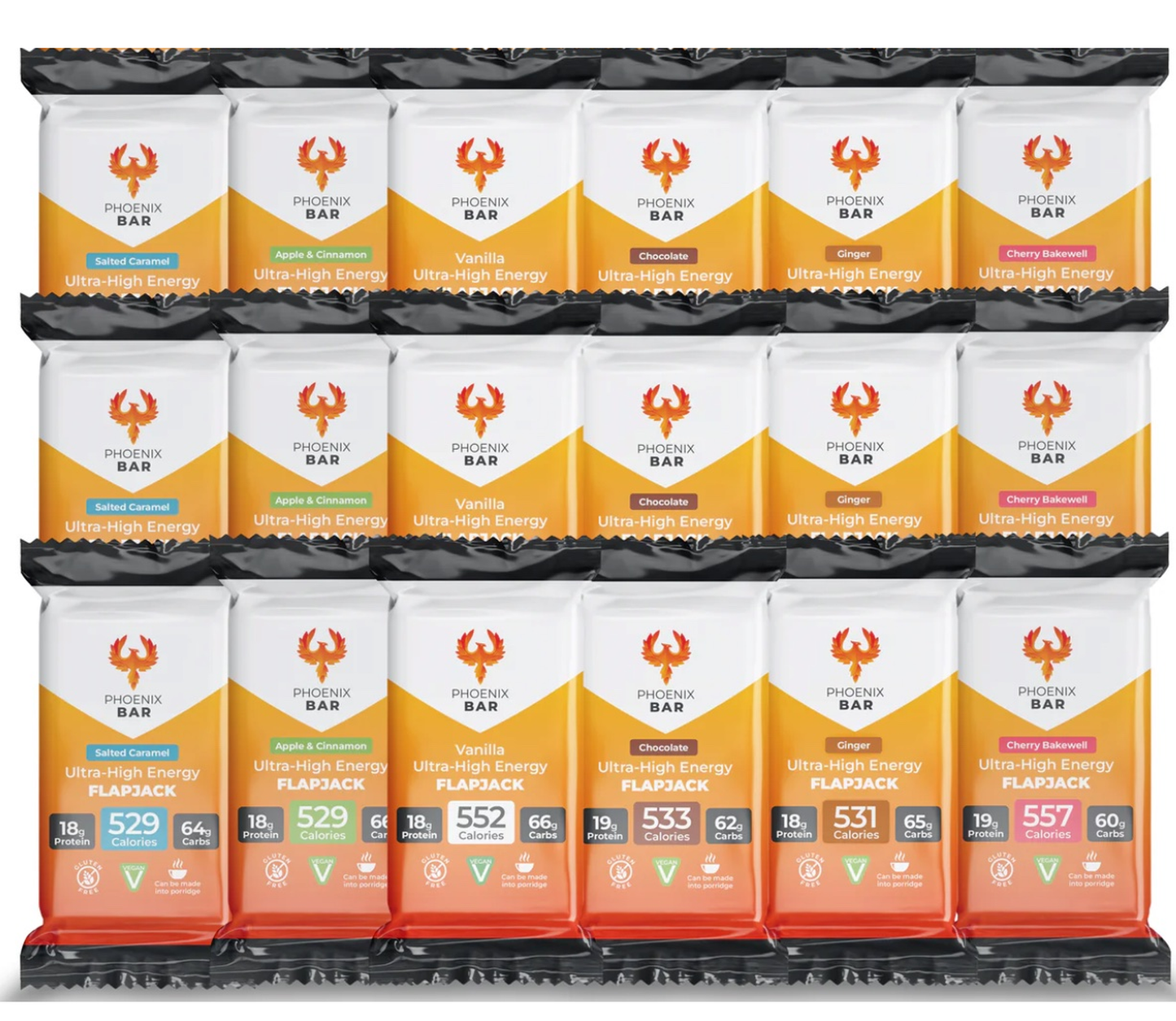
Phoenix Bars: Up to 557 Calories Per Bar
Highly compact, low-volume, calorie-dense bars. Soft, easy to eat whole or as a warm porridge. Vegan, gluten-free and contain up to 66g of carbohydrates, 19g of protein & 8 vitamins & minerals.
How does the bulking calculator work?
The calculator works in four steps, and its ranges come from published research.
- Resting energy. It estimates your basal metabolic rate with the Mifflin-St Jeor equation: 10 x weight in kg, plus 6.25 x height in cm, minus 5 x age, plus 5 for men or minus 161 for women.
- Maintenance. It multiplies that by an activity factor between 1.2 and 1.9 to estimate the calories you burn in a day.
- Surplus. It sets a weekly rate of gain from your lifting experience: 0.5% of body weight for beginners, 0.375% for intermediates and 0.2% for advanced lifters. It converts that to a daily surplus using 7,700 kcal per kilogram, then keeps the result between 5 and 20% of maintenance.
- Macros. It sets protein at 1.8 g per kg of body weight and fat at 1 g per kg, and gives the remaining calories to carbohydrate.
The rates and macro ranges follow the off-season recommendations of Iraki, Fitschen, Espinar and Helms, published in the journal Sports in 2019.
A worked example. A 75 kg man aged 28, 180 cm tall, training three to five times a week, in his first year of lifting. His resting energy is 1,740 kcal and his maintenance is about 2,700 kcal. At 0.5% a week he should gain about 0.38 kg, which needs a surplus of about 410 kcal. His target is 3,110 kcal a day, from roughly 135 g of protein, 75 g of fat and 474 g of carbohydrate.
How big should a calorie surplus be for bulking?
A calorie surplus for bulking should be about 10 to 20% above maintenance for beginners and intermediates, and smaller for experienced lifters. That is the recommendation in the 2019 review by Iraki and colleagues, and it is deliberately modest.
The reason is that muscle can only be built so fast, and calories beyond that rate are stored as fat. In a 2023 trial led by Eric Helms, resistance-trained lifters followed the same programme for eight weeks while eating at maintenance, at a 5% surplus or at a 15% surplus. Seventeen completed it. The larger surplus mainly increased skinfold thickness, with no clear extra gain in muscle thickness, although bench press strength did rise more. The study was small, but it points the same way as the wider evidence: once you are in a surplus, a bigger one mostly buys you more fat.
How fast should you gain weight on a bulk?
Aim to gain 0.25 to 0.5% of your body weight a week, towards the top of that range if you are new to lifting and below it if you are experienced. In practice:
- Beginner (0.5% a week): about 0.35 kg a week at 70 kg, 0.40 kg at 80 kg and 0.45 kg at 90 kg.
- Intermediate (0.375% a week): about 0.26 kg at 70 kg, 0.30 kg at 80 kg and 0.34 kg at 90 kg.
- Advanced (0.2% a week): about 0.14 kg at 70 kg, 0.16 kg at 80 kg and 0.18 kg at 90 kg.
If the scales are climbing faster than that for more than two or three weeks, the extra is unlikely to be muscle. That is the practical difference between a lean bulk and dirty bulking, which I cover in a separate guide.
What macros should you eat when bulking?
Set protein first, then fat, then fill the rest with carbohydrate.
- Protein: 1.6 to 2.2 g per kg a day. A 2018 meta-analysis by Morton and colleagues found the benefit of extra protein for muscle gain levelled off at around 1.6 g per kg, so the calculator’s 1.8 g per kg leaves a margin.
- Fat: 0.5 to 1.5 g per kg a day. The calculator uses 1 g per kg.
- Carbohydrate: whatever calories remain, which should be at least 3 to 5 g per kg to fuel training.
The same review suggests spreading protein over three to six meals of 0.4 to 0.55 g per kg each. For an 80 kg lifter that is 32 to 44 g of protein a meal. My guide to high calorie high protein foods lists what delivers both.
How should you use your number?
Treat the result as a starting estimate and let your own weight correct it.
- Eat at the target for two to three weeks.
- Weigh yourself on at least three mornings a week and compare weekly averages, not single days.
- If the average is rising at your target rate, change nothing.
- If it is flat, add 100 to 200 kcal a day. If it is rising faster than planned, take 100 to 200 kcal away.
- Recalculate when your weight has changed by about 5 kg.
How accurate is a bulking calculator?
A bulking calculator is accurate to within about 10% for most people, which can mean 250 kcal either way. Three things limit it. The Mifflin-St Jeor equation predicts an average person of your size, and you may not be average. The activity factor is a judgement. And 7,700 kcal per kilogram is a planning figure for stored body fat, while new muscle holds less energy but costs more to build. That is why the two-to-three-week check matters more than the first number.
How do you eat in a surplus when you are already full?
For many people the hard part of bulking is not the maths. It is eating the food. A surplus of 300 to 400 kcal sounds small until it has to be found every day on top of meals that already feel big.
What usually works is adding energy without adding much volume: an extra snack between meals, a milky drink with oats and peanut butter, olive oil on rice, a second breakfast after training. I have written guides to how to eat in a calorie surplus, bulking meals and the best high calorie foods for bulking. If you have always struggled to gain, start with the hardgainer’s guide.
Where do Phoenix Bars fit in a bulk?
I make Phoenix Bars, so read this section as the maker’s view.
A Phoenix Bar is a 120 g vegan oat flapjack with 527 to 557 kcal, 60 to 66 g of carbohydrate and about 18 g of protein. Set that against the numbers above and one thing stands out: a whole bar is more than most people’s entire daily surplus. Half a bar is about 260 to 280 kcal, which covers a typical lean surplus. That makes them a simple, countable way to close the gap on days when meals fall short, which is why people buy them as high calorie bars for weight gain.
They are not the cheapest way to do it. Oats, milk, peanut butter and rice cost far less per calorie than a £5.25 bar, and a bulk built on home cooking will always be better value. Where a bar earns its place is convenience: in a work bag, after the gym, or on the days you train and travel. One customer who trains most days described the problem in a review: “As a young professional working in the city, I often struggle to find the time for breakfast or even to step away from my desk during the day.”
Customers who use them to keep weight on tend to say the same thing about volume. Harry C., who ran from Edinburgh to London, called them “a really good way to maximise my calorie intake without having to eat too much”. Tim A., a mountaineer, wrote: “Phoenix Bars are helping me to weight gain prior to Everest next year, which is a big problem for me.”
On protein, be realistic. They are sold as high calorie protein bars because each one has about 18 g, which is a useful contribution, but a bar is mainly an energy food. Your chicken, tofu, eggs, dairy or protein shake still do the heavy lifting.
If you are comparing options, I review the best energy bars for weight gain, the highest calorie bars in the UK and the best meal replacement bars in the UK in separate guides.
Should you use the bulking calculator or the weight gain calculator?
Use this bulking calculator if you lift weights and want to gain muscle with as little fat as possible. It scales the surplus to your training experience and gives you macros.
Use my weight gain calculator if you are not training for muscle and simply want to gain weight steadily, for example after a period of low appetite. It offers a fixed, gentle surplus and no macro targets. For the reasoning behind both, see how many calories you need to gain weight.
Who should not use this calculator?
This calculator is for healthy adults aged 18 and over who do resistance training. It is not designed for anyone under 18, for pregnancy, or for anyone whose diet is being managed by a healthcare professional.
If tracking numbers makes eating feel stressful, or you have had a difficult relationship with food, a calculator is not the right starting point. Please speak to your GP or a registered dietitian instead. You can gain strength without ever counting a calorie.
Frequently asked questions
How many calories should I eat to bulk?
Eat your maintenance calories plus 5 to 20%. For most adults who lift, that puts a bulking intake somewhere between 2,000 and 3,500 kcal a day, depending on size, sex and activity. The calculator gives your own figure.
Is a 500 calorie surplus too much?
For a larger beginner, 500 kcal is within the recommended range. For a smaller or more experienced lifter it is usually more than the body can turn into muscle, so more of it is stored as fat. Smaller surpluses of 150 to 300 kcal suit most intermediate and advanced lifters.
What is a calorie surplus?
A calorie surplus means eating more energy than your body uses in a day. The extra energy is what allows weight gain, and when it is combined with resistance training and enough protein, more of that gain is muscle.
How long should a bulk last?
There is no fixed rule. Many lifters bulk in blocks of three to six months and then reassess. The slower your rate of gain, the longer you can continue before body fat becomes a reason to stop.
Can you build muscle without a calorie surplus?
Beginners and people returning after a break often can. For trained lifters a small surplus makes progress more reliable, which is why the calculator scales it down with experience and never removes it.
Are weight gain bars good for bulking?
They can help with consistency, not with the fundamentals. A bar is a convenient way to add a known number of calories when you are busy. Training, protein and total intake matter more. If you want to try them, Phoenix Bars are the weight gain bars I make, in six flavours.
Sources
- Iraki J, Fitschen P, Espinar S, Helms E. Nutrition Recommendations for Bodybuilders in the Off-Season: A Narrative Review. Sports, 2019. doi.org/10.3390/sports7070154
- Helms ER and others. Effect of Small and Large Energy Surpluses on Strength, Muscle, and Skinfold Thickness in Resistance-Trained Individuals. Sports Medicine Open, 2023. doi.org/10.1186/s40798-023-00651-y
- Mifflin MD and others. A new predictive equation for resting energy expenditure in healthy individuals. American Journal of Clinical Nutrition, 1990.
- Morton RW and others. A systematic review, meta-analysis and meta-regression of the effect of protein supplementation on resistance training-induced gains in muscle mass and strength in healthy adults. British Journal of Sports Medicine, 2018.
This page is general information for healthy adults, not medical or dietary advice.


Flaming Phoenix



Contact Us
Declare withdrawal
Please fill out the following form to declare your withdrawal from the contract.

