
Rock Climbing Nutrition: Why Calorie Density Matters
Written by James Frost, Founder of Flaming Phoenix | Last reviewed: March 2026
This page explains why standard climbing snacks fall short on calorie delivery, what actually matters nutritionally when you are climbing, and how Phoenix Bars compare to the alternatives.
The Problem With Most Climbing Food
Climbers face a specific nutritional constraint that most sports do not: you eat in short windows, often in awkward positions, and everything you carry competes for space with gear that keeps you alive.
Most climbers default to cereal bars, flapjacks, nuts, or gels. These work, but the maths rarely adds up. A typical cereal bar weighs 35 to 45g and delivers 130 to 180 calories. If you are on a full day of multi-pitch climbing burning 3,000 to 4,000 calories, you would need to carry and eat 15 to 20 of those bars to replace what you are burning. Nobody does that. Instead, most climbers finish the day in a significant calorie deficit, which compounds across multi-day trips and directly affects recovery, grip strength, and decision-making.
The issue is not willpower or planning. It is calorie density. Most climbing snacks simply do not deliver enough energy per gram to be practical at the volumes climbers actually consume.
What Climbers Actually Need From Food
Having spoken with climbers across disciplines, from sport climbing to alpine mountaineering, the requirements are remarkably consistent.
Maximum calories in minimum weight and volume. On trad and alpine routes, your rack, rope, protection, and emergency kit already fill your pack. Food needs to earn its space by delivering meaningful energy without bulk. The benchmark most climbers use instinctively is calories per gram. Anything below 4.0 cal/g is taking up space that could go to something more efficient.
Edible in small amounts over time. You rarely sit down for a meal on a climb. You eat a few bites at a belay, a piece on a ledge, a mouthful while your partner leads. Food needs to be something you can break apart, eat a piece of, put back in your pocket, and return to an hour later. Gels do not work this way. Neither do sandwiches.
Stable in all conditions. Rock gets hot. Alpine routes get cold. A bar that melts on sun-baked limestone in the Verdon Gorge is useless, and a bar that freezes solid on a Scottish winter route is equally useless. Climbers need food that holds its form across a wide temperature range.
Not sickly sweet. Palate fatigue is real on long days. Most energy gels and many bars are intensely sweet, which becomes nauseating after several hours of physical effort. Climbers consistently prefer food with a savoury or neutral flavour profile that they can eat repeatedly without their stomach turning.
No complicated packaging. You need to be able to open it with one hand or with gloves on. It cannot leave sticky residue on your fingers before you grab the next hold.
How Phoenix Bars Solve These Problems
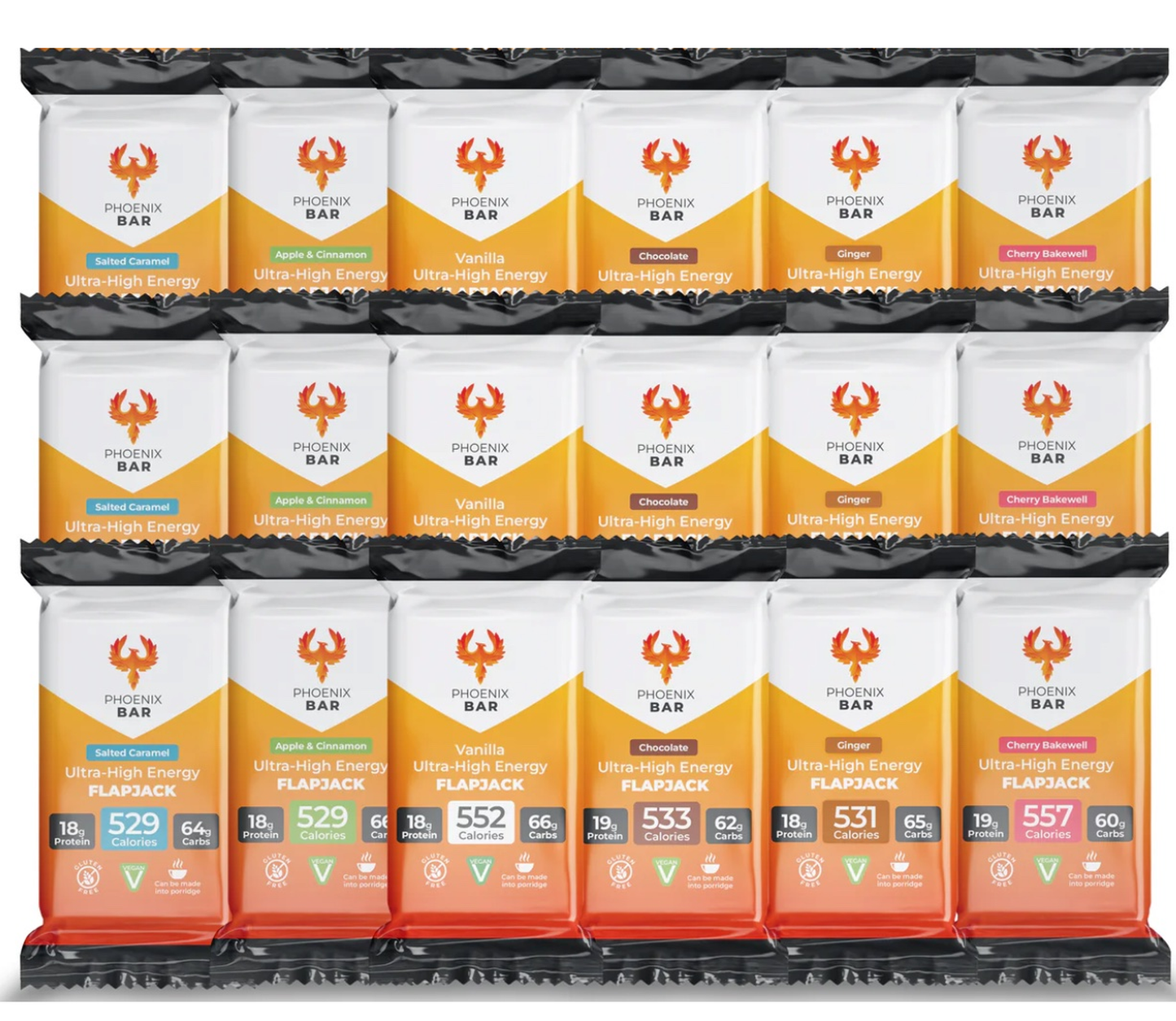
Each Phoenix Bar delivers up to 557 calories in a compact bar of only 120g. That is 4.6 calories per gram, which places it in the top tier of commercially available portable foods, above most flapjacks (4.3 cal/g), cereal bars (3.5 to 4.0 cal/g), and standard protein bars (3.8 cal/g).
In practical terms: two Phoenix Bars weigh 240g and deliver 1,114 calories. To get the same calories from standard cereal bars, you would need seven or eight bars weighing over 300g. On a route where you are counting grams, that difference matters.
Phoenix Bars have been tested in temperatures exceeding 50 degrees Celsius during the Marathon des Sables and on Himalayan expeditions where temperatures dropped well below freezing. They do not melt into a sticky mess in heat, and they remain soft enough to bite into in cold conditions. This is because the base is oat and coconut oil, not chocolate or sugar-based coatings that lose structure in warmth.
The texture is firm enough to break into quarters and keep in a pocket, but soft enough to eat without hard chewing. There is no brittle shell, no chocolate coating, and no crumbly texture that falls apart when you break a piece off at a belay.
They come in six flavours, none of which are excessively sweet. The most popular among climbers are Vanilla and Original, both of which have a neutral, oat-forward flavour that works well across a long day without causing palate fatigue.
Phoenix Bars: up to 557 calories per bar, £5.25. Buy Phoenix Bars
Each bar can also be crumbled into a mug and mixed with hot water to make a warm, calorie-dense porridge. On multi-day alpine trips where you carry a lightweight stove, this means your food doubles as both a climbing snack and a hot meal at camp, without carrying separate items for each.
How Climbers Use Phoenix Bars in Practice
Single-pitch sport climbing: One bar broken into quarters, kept in a chalk bag pocket or jacket. Eat a piece between routes or during longer rests. One bar covers a four to six hour session.
Multi-pitch trad: Two bars per person for a full day. One for the approach and climbing, one for the descent or as a reserve. Break into pieces at the start and distribute between pockets so you can eat without digging into your pack.
Alpine routes: Two to three bars per day. One eaten as porridge at the bivvy with hot water, one or two carried on the route. On longer expeditions, Phoenix Bars have been the primary food source for climbers spending multiple days on the mountain.
Indoor climbing and training: One bar as a pre-session or post-session meal replacement when you do not have time to eat a full meal. At 557 calories with 19g of protein, it covers recovery without needing a separate shake or meal.
Rated 4.9 From Nearly 400 Reviews
Phoenix Bars are rated 4.9 out of 5 based on nearly 400 reviews from endurance athletes, expedition teams, and people who need maximum calories in minimum volume. While climbing-specific feedback is a smaller subset, the requirements that climbers value, calorie density, portability, temperature stability, and taste on long days, are the exact qualities reviewers mention most frequently.
Try Phoenix Bars on Your Next Climb
Most customers start with the Starter Bundle: 12 bars, two of each flavour, for £63. That is over 6,400 calories of climbing fuel, enough for a run of weekend climbing days. Want to test the flavours first? The Short-Term Bundle is 6 bars, one of each flavour, for £31.50.
For a multi-day alpine trip or a long expedition, the 36-bar Complete Bundle (£189) covers you, at the same £5.25 a bar.
International shipping available. Up to 2-year shelf life, so you can keep them in your gear cupboard and grab a couple every time you head out.
Related Guides
You may also find these useful:
High-Altitude Mountaineering Nutrition - for alpine and expedition climbing above 3,000m
Hiking and Trekking Nutrition - for long approaches and multi-day treks
How to Use Phoenix Bars - including the porridge method for hot meals at camp
Calorie-Dense Foods Explained - understanding calories per gram and why it matters
If you have any questions about using Phoenix Bars for climbing, feel free to get in touch directly.
James Frost
Founder, Flaming Phoenix
07990 519422


High-Calorie Protein Bars for Endurance, Expeditions and Weight Gain




Contact Us

Phoenix Bars: Up to 557 Calories Per Bar
Soft, easy to eat whole or as a warm porridge. Vegan, gluten-free, up to 2-year shelf life. Rated 4.9/5 from nearly 400 reviews. £5.25 per bar.


