

High Calorie Breakfast
In this guide

Quick answer: The best high calorie breakfasts are dense rather than big. Porridge made with whole milk and peanut butter, overnight oats, full-fat Greek yoghurt with granola and nuts, eggs scrambled in butter with cheese on toast, or a Phoenix Bar stirred into porridge will each give you 500 to 700 calories without a large plate. If mornings are hard, start small and drink some of it: a smoothie made with whole milk, oats and nut butter is often easier than food.
Written by James Frost, founder of Flaming Phoenix and creator of Phoenix Bars. James has spent over two years developing calorie-dense nutrition for people who need maximum calories in minimum volume, including ultra-endurance athletes and individuals experiencing reduced appetite. For a broader overview of calorie-dense food options, see Calorie-Dense Foods. Last reviewed: October 2026.
Most high-calorie breakfast guides are written for bodybuilders trying to bulk. They assume you have a big appetite, a strong stomach first thing in the morning, and the time to prepare elaborate meals. If that describes you, there are plenty of resources already.
This guide is for everyone else: people who struggle to eat enough calories, who feel full quickly, who have low appetite due to medication, treatment, age, or stress, and endurance athletes who need a calorie-dense start to a big training day or race without feeling bloated. The goal is not to eat more food. The goal is to get more calories into the food you are already eating, or to find options small enough that appetite is not a barrier.
Why Breakfast Matters More When Calories Are a Problem
If you are trying to gain weight or simply maintain it during a period of low appetite, skipping breakfast creates a deficit that is genuinely hard to recover from later in the day. Most people who undereat do not suddenly develop a large appetite at lunch. They continue to undereat, and the daily shortfall compounds over days and weeks.
Breakfast is also the meal where small changes make the biggest difference. Adding 300 to 500 calories to your morning routine, without adding significant volume, can shift a daily intake from inadequate to sufficient. Over a week, that is 2,100 to 3,500 extra calories from one change to one meal.
For endurance athletes, breakfast before a long session or event determines how much glycogen you start with. An underfuelled start means hitting the wall earlier and recovering more slowly. A calorie-dense breakfast that sits well in the stomach lets you begin strong without the discomfort of a heavy meal.
Free download
Free guide: how to eat 500+ calories in under 2 minutes
A short PDF of the simplest ways people get more calories from less food. Free, sent straight to your inbox.
Free. Unsubscribe anytime. Privacy policy
The Principle: Calorie Density, Not Portion Size
The single most useful concept for high-calorie breakfasts is calorie density, meaning calories per gram of food. When appetite is limited or stomach capacity is small, the only way to increase calorie intake is to choose foods that pack more energy into less volume.
For context: a bowl of porridge made with water contains roughly 150 calories. The same bowl made with whole milk contains roughly 280 calories. Add a tablespoon of peanut butter and a drizzle of honey and it reaches 450 calories. The bowl looks the same. The volume is almost identical. The calorie content has tripled.
This principle applies to almost every breakfast food. The rest of this guide shows how to apply it practically.
High-Calorie Breakfast Ideas Ranked by Effort
Minimal effort (under 5 minutes)
Phoenix Bar porridge. Crumble one Phoenix Bar into a bowl, add hot water or milk, stir, and eat. One bar made into porridge delivers up to 557 calories in about two minutes with no cooking required. This is the fastest high-calorie breakfast option available and works particularly well for people who feel full after a few bites, because the porridge format is soft, easy to eat, and does not require much chewing. Add a tablespoon of nut butter for an additional 100 calories. For more detail on the porridge method, see How To Use Phoenix Bars. For the full method, calorie maths and add-ins, see our high calorie porridge guide.
Overnight oats with calorie boosters. The night before, combine 80g rolled oats with 200ml whole milk, a tablespoon of chia seeds, a tablespoon of peanut butter, and a sliced banana. Refrigerate. In the morning, eat cold or microwave for 90 seconds. This takes 3 minutes of active effort and delivers approximately 650 calories. The preparation happens the evening before when appetite and motivation are often higher. The full recipe with variations is in our high-calorie overnight oats guide.
High-calorie smoothie. Blend a banana, a tablespoon of peanut butter, 200ml whole milk, 30g oats, and a handful of frozen berries. This produces roughly 500 calories in a drinkable format, which many people with low appetite find easier to consume than solid food. For more options, see High-Calorie Drinks, Smoothies and Milkshakes.
Toast with calorie-dense toppings. Two slices of wholemeal toast with butter and peanut butter delivers approximately 450 calories. Replace the peanut butter with half a mashed avocado and a drizzle of olive oil for roughly the same. The key is using calorie-dense spreads rather than low-fat alternatives.
Moderate effort (5 to 15 minutes)
Scrambled eggs with extras. Three eggs scrambled in butter with 30g grated cheese on two slices of buttered toast delivers roughly 650 calories. Eggs are one of the most calorie-efficient breakfast proteins, and the butter and cheese add significant calories without adding much volume.
Porridge made with whole milk and toppings. Cook 80g oats with 250ml whole milk. Top with a tablespoon of honey, a tablespoon of peanut butter, and a handful of walnuts. This reaches approximately 700 calories. The difference between this and a basic bowl of porridge made with water is nearly 500 calories, from ingredients that add richness rather than bulk.
Greek yoghurt bowl. 200g full-fat Greek yoghurt with 50g granola, a sliced banana, a tablespoon of honey, and a handful of mixed nuts delivers approximately 650 calories. This works well as a secondary breakfast if you eat something small when you first wake up and something more substantial an hour or two later.
Breakfast wrap. A large flour tortilla with scrambled eggs, cheese, and avocado provides roughly 550 to 650 calories depending on quantities. Wraps compress a significant amount of food into a format that many people find easier to finish than a plate of loose ingredients.
On the go (no cooking, eat on the way)
A Phoenix Bar and a carton of whole milk. No preparation at all: up to 557 calories from the bar plus around 160 from 250ml of milk. Good for early starts, commutes and days when you know you will not stop for breakfast.
A bagel with peanut butter and banana. A plain bagel spread with two tablespoons of peanut butter and topped with a sliced banana comes to roughly 500 calories, takes two minutes and travels well wrapped in foil.
A yoghurt pot you build the night before. Layer 150g full-fat Greek yoghurt, 40g granola and a handful of nuts in a jar with a lid. Around 550 calories, ready to grab from the fridge.
Trail mix and a milky coffee. 50g of nuts, raisins and chocolate chips with a whole-milk latte adds up to around 400 calories, and the trail mix fits in a pocket.
For people with very low appetite
When appetite is genuinely suppressed, whether from medication, treatment, illness, or age, the ideas above may still feel like too much food. In that situation, the priority shifts from meals to calorie-dense additions that can be consumed without effort.
Add calories to drinks you are already having. A cup of tea or coffee with whole milk instead of semi-skimmed adds around 30 extra calories per cup. Over four or five cups a day, that is 120 to 150 extra calories from a change you will not notice. For hot chocolate, use whole milk and add a spoonful of peanut butter or coconut oil.
Eat half a Phoenix Bar mid-morning. Half a bar is roughly 280 calories, is soft enough to eat slowly, and does not require preparation. For people who struggle to eat enough, having a calorie-dense option within arm's reach removes the friction of deciding what to eat and preparing it. Many people with reduced appetite find that the decision and preparation are bigger barriers than the eating itself.
Fortify what you already eat. Add a tablespoon of olive oil or coconut oil to porridge, soups, or scrambled eggs. Each tablespoon adds approximately 120 calories. Stir a spoonful of nut butter into yoghurt, porridge, or a smoothie. Sprinkle ground flaxseed or chia seeds on anything. These additions change the calorie content substantially without changing the appearance or volume of the meal.
High-Calorie Breakfast Foods at a Glance
Rather than listing every food with its calorie count, here are the ingredients that make the biggest difference when added to whatever you are already eating for breakfast.
Nut butters (peanut, almond, cashew): approximately 95 to 100 calories per tablespoon. The single most effective calorie booster for breakfast. Works in porridge, on toast, in smoothies, and stirred into yoghurt.
Nuts and seeds (walnuts, almonds, chia, flaxseed): approximately 150 to 200 calories per 30g handful. Add to porridge, yoghurt, or eat alongside anything else.
Whole milk instead of semi-skimmed or water: roughly 60 to 130 extra calories per serving depending on the quantity used. Applies to porridge, cereal, smoothies, and hot drinks.
Butter and oils (butter, coconut oil, olive oil): approximately 100 to 120 calories per tablespoon. Add to toast, eggs, porridge, or cooking.
Cheese: approximately 120 calories per 30g portion. Works with eggs, on toast, or in wraps.
Avocado: approximately 240 calories per whole avocado. Dense in healthy fats and easy to spread on toast or add to eggs.
Honey and maple syrup: approximately 60 to 65 calories per tablespoon. Useful for adding calories to porridge, yoghurt, or smoothies without adding bulk.
For a broader list of high-calorie snack options to keep alongside breakfast, see that guide.
Plenty of people solve breakfast with a bar instead of a plate. If that's you, I've compared the best meal replacement bars in the UK, including how they differ on calories, protein and price per 100 calories. If you're eating more to put on weight, I've also ranked the best energy bars for weight gain by calories.
How to Make a 1,000 Calorie Breakfast
Some days call for a very big breakfast: a long race or training day, a heavy shift, or a stretch where you are deliberately eating more to gain weight. A 1,000 calorie breakfast is easier than it sounds if you split it rather than piling it onto one plate.
Part one, when you wake up: porridge made with 80g oats and 250ml whole milk, with a tablespoon of peanut butter and a tablespoon of honey stirred in. Roughly 630 calories.
Part two, an hour or two later: a smoothie made with a banana, 200ml whole milk and a tablespoon of peanut butter, or half a Phoenix Bar with a glass of whole milk. Roughly 320 to 400 calories.
Together that is around 1,000 calories without ever facing a huge plate. My 1,000 calorie meals guide has more breakfasts, lunches and dinners at this size. For most healthy adults who need the energy, a breakfast this size is fine. If you are under medical care, or your appetite is very limited, build up gradually and check with your GP or dietitian if you are unsure.
Common Mistakes With High-Calorie Breakfasts
Choosing "diet" or "light" versions of foods. Semi-skimmed milk, low-fat yoghurt, reduced-fat cheese, and sugar-free options all strip calories from foods that should be delivering them. If you need more calories, always choose the full-fat version.
Making breakfast too large and then not finishing it. A 400-calorie breakfast that gets eaten is better than a 700-calorie breakfast that gets thrown away because it was too much. Start with amounts you know you can finish and build up gradually. If finishing a normal bowl feels difficult, try a smaller bowl.
Drinking water before or during breakfast. Water fills the stomach and reduces appetite. If appetite is already low, drink water between meals rather than with them.
Assuming you need a "proper" breakfast. Toast with peanut butter counts. One of our high calorie bars for weight gain with a glass of whole milk counts. A smoothie counts. Breakfast does not need to look like a traditional meal to deliver the calories you need.
When Breakfast Is Not Enough
If you are consistently falling short of your calorie needs despite a higher-calorie breakfast, the issue is usually that the rest of the day is not structured to maintain the momentum. The guide on getting more calories without eating more food covers strategies for the full day, including how to add calories to lunch, dinner, and between-meal snacks without increasing portion sizes.
For people experiencing unintentional weight loss or persistent low appetite, it is always worth speaking to a GP or dietitian to identify any underlying causes.
Frequently Asked Questions
What is a good high calorie breakfast?
One that is calorie-dense rather than large. Porridge made with whole milk and nut butter, overnight oats, full-fat Greek yoghurt with granola and nuts, eggs scrambled in butter with cheese on toast, and a Phoenix Bar made into porridge all reach 500 calories or more without a big portion.
Is 500 calories a high calorie breakfast?
Yes. UK public health guidance uses around 400 calories as a guide for an adult's breakfast, so 500 or more is on the high side. For weight gain or a big training day, 500 to 700 is a useful target.
How many eggs make 500 calories?
A large egg has roughly 80 to 90 calories, so 500 calories would take around six large eggs on their own. It is far easier to scramble two or three eggs in butter, add a little grated cheese and serve them on two slices of buttered toast, which comes to roughly 600 calories or more.
What can I eat for breakfast when I have no appetite?
Start with something small, soft or drinkable: a smoothie made with whole milk, a few spoonfuls of porridge, a yoghurt, or a Phoenix Bar crumbled into warm milk. Eat a little when you wake up and a little more an hour later rather than trying to finish one big meal. My guide to what to eat when your appetite is low has more ideas.
What is a high protein, high calorie breakfast?
Eggs scrambled in butter with cheese on toast, a full-fat Greek yoghurt bowl with nuts, or porridge made with whole milk and peanut butter all combine protein with plenty of energy. A Phoenix Bar has up to 19g of protein, and making it into porridge with milk adds more.
Are there vegan high calorie breakfast ideas?
Yes. Porridge or overnight oats made with oat or soya milk, stirred with nut butter and topped with banana, toast with peanut butter, a smoothie made with plant milk, oats and nut butter, or a Phoenix Bar, which is vegan and gluten-free, all work well. Soya milk has the most protein of the common plant milks.
If you have any questions about using Phoenix Bars as part of a high-calorie breakfast routine, contact me directly. I am always happy to help.
A bar stirred into porridge is one of the fastest high-calorie breakfasts going, so it's worth seeing the best high-calorie bars compared before you pick one.
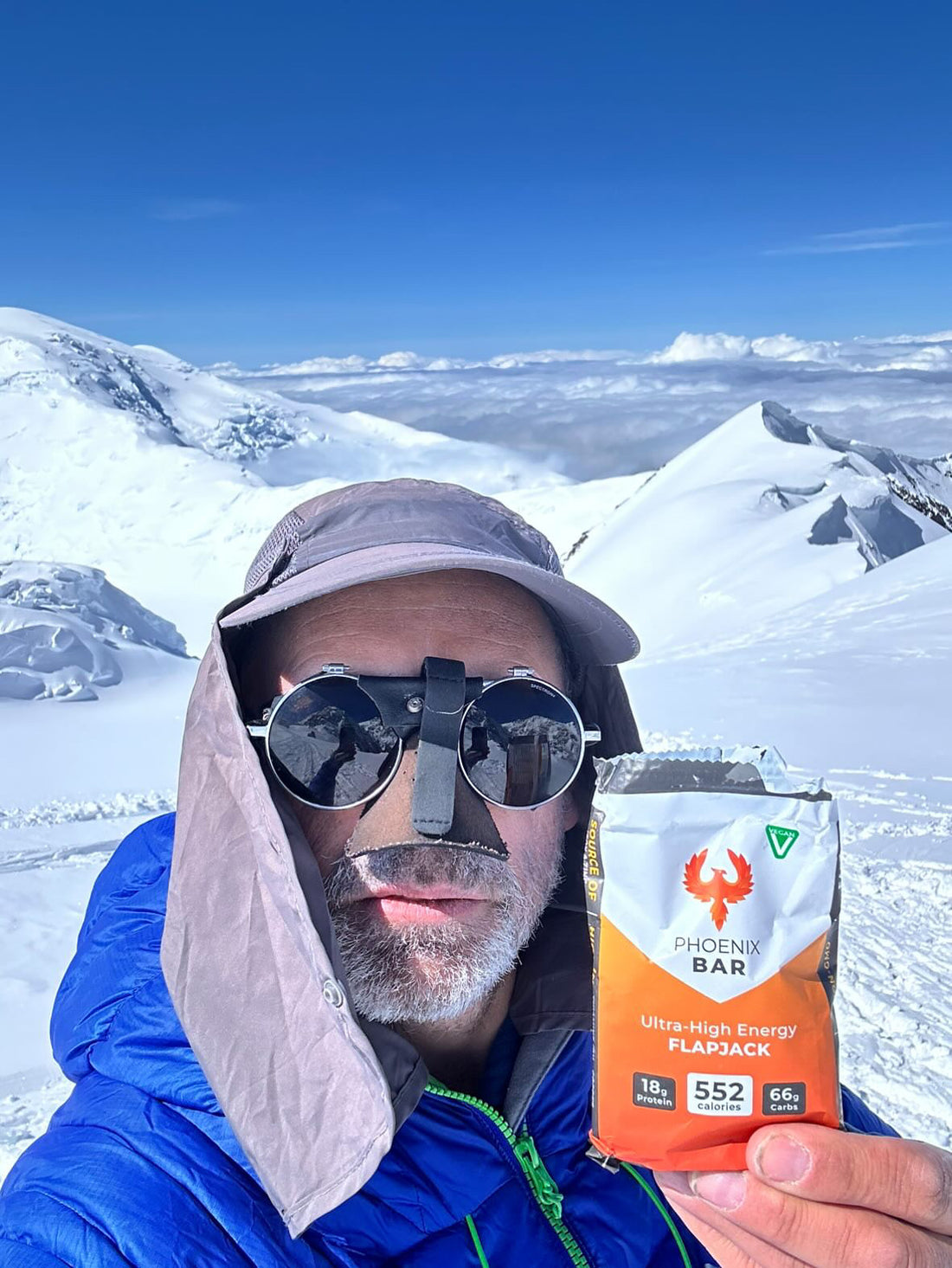
Big calories. Small bar.
Up to 557 calories in a compact, lightweight bar of only 120g, with up to 66g of carbs and 19g of protein. Eat it whole, break it into pieces over a few hours, or stir it into hot water or milk for porridge.
Easy to eat, easy to digest and not sickly sweet. Phoenix Bars do not melt in heat or freeze in sub-zero temperatures and have an up to 2-year shelf life, so they work on a mountain, on a night shift, or at home on days when eating enough feels hard. Vegan and gluten-free too.
- 557 calories in one compact 120g bar (529 to 557 by flavour)
- 4.6 calories per gram
- 66g carbs per bar (up to)
- 19g protein per bar (up to)
