

1000 Calorie Meals
In this guide

A 1,000 calorie meal (1000 kcal) is half the 2,000 calories the NHS gives for an average woman's day and 40% of a man's 2,500. Built from dense UK staples it fits on one plate: 100g dried pasta, 40g green pesto, 150g cooked chicken thigh, a tablespoon of olive oil and 20g parmesan comes to 995 calories.
The sum: pasta 345 + pesto 170 + chicken 270 + olive oil 125 + parmesan 85 = 995 calories, in roughly 430g of food once the pasta is cooked. Stir in 15g of pine nuts and it is 1,100.
Every total on this page is worked out the same way: the weight of each ingredient multiplied by its per-100g value in McCance and Widdowson's Composition of Foods, the UK government's food composition dataset (CoFID 2021), with each ingredient rounded to the nearest 5 calories. Each line says whether a weight is dry, raw or cooked, because 100g of dried pasta and 100g of boiled pasta differ by about 175 calories. Supermarket brands vary, so your own labels will not match to the calorie.
One thing before you start: this page is about eating more. If you searched for a whole day on 1,000 calories, that is a weight-loss target and a very different page. Everything below is for people trying to gain weight, hold their weight through hard training, or fit a big daily total into three sittings.
Who needs 1,000 calorie meals?
Anyone whose daily target is too big for normal-sized meals: a 3,000 calorie day split three ways is 1,000 calories a sitting. In practice that is four groups. People trying to gain weight who find that "just eat more" fails when every meal is 400 calories. Anyone in a bulking phase. Endurance athletes and people in physical jobs, who are many of the people I make Phoenix Bars for. And people whose appetite has shrunk after illness, stress or a rough patch, for whom two or three denser sittings can be easier than six attempts at grazing.
If that last group is you, the section on small appetites further down matters most, and the guide on what to eat when your appetite is low goes further. If you are losing weight without trying, or your eating has suddenly changed, speak to your GP first.
What does a 1,000 calorie meal look like?
A 1,000 calorie meal can be a small bowl or a mountain, because 1,000 calories of food weighs anything from 111g to more than 9kg depending on how many calories each gram carries. This is how much of one food, eaten on its own, reaches 1,000 calories (McCance and Widdowson values):
- Lettuce: about 9.1kg, at 11 calories per 100g.
- Baked potato with its skin: about 1kg, at 97 per 100g.
- Boiled long-grain rice: about 765g, at 131 per 100g.
- Boiled spaghetti: about 710g, at 141 per 100g. That is what 1,000 calories of pasta looks like, from about 290g dried.
- Cheddar: 240g, at 416 per 100g.
- Mixed nuts: about 170g, at 581 per 100g.
- Smooth peanut butter: 165g, at 607 per 100g.
- Olive oil: 111g, about eight tablespoons, at 899 per 100g.
Real meals sit in between, because they mix a starchy base with fat and protein. The 15 meals below run from about 1.4 to 3.2 calories per gram, so most land between 300g and 750g on the plate. At the dense end that looks like an ordinary lunch. At the light end it is a big plate you will want 30 minutes for.
Free download
Free guide: how to eat 500+ calories in under 2 minutes
A short PDF of the simplest ways people get more calories from less food. Free, sent straight to your inbox.
Free. Unsubscribe anytime. Privacy policy
1,000 calorie breakfast ideas
Loaded porridge, about 1,010 calories. 80g porridge oats (305), 300ml whole milk (195), 32g smooth peanut butter, about two tablespoons (195), a 100g peeled banana (80), 20g honey (60) and 30g mixed nuts (175). Added up: 305 + 195 + 195 + 80 + 60 + 175 = 1,010. Porridge is the easiest big breakfast because the peanut butter stirs in and disappears; the high calorie porridge guide has more builds.
Full English, about 995 calories. Two large eggs fried in sunflower oil, 120g out of the shell (240), two grilled pork sausages, 90g cooked (265), one rasher of grilled back bacon, 25g (70), half a 415g tin of baked beans (170), two 40g slices of white bread (175) and 10g butter (75). Grilled tomatoes and mushrooms on the side add almost nothing.
Greek yoghurt bowl, about 1,040 calories. 200g Greek-style yoghurt (265), 60g crunchy nut muesli or granola (270), 32g peanut butter (195), a 100g banana (80), 20g honey (60) and 30g pumpkin seeds (170). It needs no cooking and is the densest of the three, at about 2.4 calories per gram. More morning ideas are in the high calorie breakfast guide.
1,000 calorie lunch ideas
Chicken pesto pasta, about 1,100 calories. 100g dried pasta (345), 40g green pesto (170), 150g cooked chicken thigh (270), 14g olive oil (125), 20g parmesan (85) and 15g pine nuts (105). This is the meal from the top of the page with the pine nuts left in: one pan, about 15 minutes.
Loaded jacket potato, about 1,025 calories. A 300g baked potato with its skin (290), 20g butter (150), 100g grated cheddar (415) and half a 415g tin of baked beans (170). The cheese does most of the work, so weigh 100g once; it is a bigger pile than it sounds.
Tuna melt and a handful of nuts, about 990 calories. Two 40g slices of white bread (175), a drained tin of tuna in brine, about 100g (110), 30g mayonnaise (205), 60g cheddar (250) and 10g butter for the pan (75), with 30g mixed nuts on the side (175). Tuna canned in sunflower oil adds about 50 calories over brine.
Satay chicken rice bowl, about 1,055 calories. 250g cooked long-grain rice (330), 150g cooked chicken thigh (270), 10g rapeseed oil (90), 40g peanut butter loosened with soy sauce and lime as a quick satay (245) and half an avocado, about 70g of flesh (120). For lunches that travel to work in a box, see the high calorie lunch guide.
1,000 calorie dinner ideas
Spaghetti bolognese, about 1,020 calories. 100g dried spaghetti (345), 175g beef mince weighed raw (395), 14g olive oil (125), 200g chopped tomatoes (40), an 80g onion (30) and 20g parmesan (85). The mince is the lever: the same weight of extra-lean mince is about 230 calories, which takes the plate down to 855.
Salmon, roast potatoes and buttered broccoli, about 975 calories. A 150g baked salmon fillet (350), 300g potatoes roasted in rapeseed oil (485), 100g boiled broccoli (30) and 15g butter melted over it (110). The roasting oil is already inside the potato figure, which is why roast potatoes carry about two-thirds more calories than the same weight of baked potato.
Chicken korma with rice and naan, about 1,030 calories. 400g homemade chicken korma (510), 250g cooked basmati rice (290) and an 80g piece of naan (230). Jarred korma sauces vary a lot, so check the label of the one you use.
Burrito bowl, about 1,005 calories. 250g cooked rice (330), 150g cooked chicken thigh (270), 120g drained kidney beans (120), 40g grated cheddar (165) and 70g avocado (120). It is a good batch-cook with one catch: NHS food safety advice is to refrigerate cooked rice within an hour and eat it within 24 hours. Cook the chicken and beans for the week, and cook the rice fresh each day or the night before.
Halloumi and potato traybake, about 1,010 calories. 150g halloumi (470), 250g potatoes roasted in rapeseed oil (400), 100g sliced peppers and a 100g onion (50 together) and 15g tahini to drizzle (90). This is the vegetarian dinner. For plant-based swaps see high calorie vegan foods, and the high calorie dinner guide has evening meals that are not fixed at 1,000.
No-cook and drinkable 1,000 calorie meals
Peanut butter banana shake, about 1,005 calories. 400ml whole milk (260), 60g porridge oats (230), a 100g banana (80), 45g peanut butter (275), 20g honey (60) and a 60g scoop of vanilla ice cream (100). Blend for a full minute so the oats break down. Many people find a drink easier to finish than the same calories on a plate, which is why the homemade weight gainer shakes guide exists; for lighter options see high calorie drinks, smoothies and milkshakes.
No-cook board, about 1,040 calories. 80g cheddar (335), 50g oatcakes, roughly four (225), 30g mixed nuts (175), a 150g apple (75), 50g houmous (155) and 30g raisins (75). It takes two minutes to put together, so it still works on days when cooking feels like too much. When even that is too much, the guide to meal replacement bars in the UK compares grab-and-go options.
Two Phoenix Bars, 1,058 to 1,114 calories. We make these, so weigh that as you read it. Each Phoenix Bar has up to 557 calories in only 120g, so two give 1,058 to 1,114 calories depending on flavour, in 240g of food that needs no cooking or fridge. That makes it the lightest meal on this page. One customer training for a 170km UTMB race wrote: "I enjoyed mixing them with water to make a nutritious porridge for breakfast." Our page on high calorie bars and the energy bars for weight gain comparison set out the alternatives, including other brands.
How do you finish a 1,000 calorie meal?
Eat the densest part of the plate first, while you are hungriest, and leave the salad and vegetables until last. Then:
- Drink calories with the meal rather than water before it. A 200ml glass of whole milk adds 130 calories; the same glass of water adds only fullness.
- On days you are struggling, choose warm, soft food over cold, dry food. That is the idea behind easy to digest high calorie foods.
- Give yourself 30 to 45 minutes. A 1,000 calorie meal eaten slowly counts just the same.
- Put the fat into the cooking, not onto the side of the plate. A tablespoon of olive oil in the pan is 125 calories you will barely notice.
What if your appetite will not stretch that far?
Keep the calories and shrink the food. Every meal above can be rebuilt around high calorie low volume foods: roast potatoes instead of boiled, whole milk instead of semi-skimmed, Greek-style yoghurt instead of plain, and a spoon of oil or nut butter wherever it will not show. Splitting one meal into two halves an hour apart is fine too.
Getting more calories in without more bulk is the problem Phoenix Bars were designed around. They can be eaten whole, broken into pieces across the day, or stirred into hot milk as a warm porridge on days when chewing feels like work. If eating enough is hard most days, not just now and then, read how to eat in a calorie surplus without obsessing.
How do 1,000 calorie meals fit into a full day?
Three of them make a 3,000 calorie day, 500 above the NHS figure for an average man. The 3,000 calorie meal plan lays that day out with snacks, and the high calorie meals overview explains the method for any target. If you want to go further in one sitting, the 2,000 calorie meals page shows how far a single plate can go, and the weight gain calculator gives you your own daily number.
Frequently asked questions
Is it OK to eat 1,000 calories in one meal? For most healthy adults, yes. It is half the NHS's 2,000 calorie figure for an average woman, so it suits people with high needs or few chances to eat in a day. The main downside is fullness spilling into the next meal, so leave three to four hours before eating again.
Is a 1,000 calorie dinner too much? Not if your day needs it. If breakfast and lunch came to about 1,500 calories and your target is 2,500, a 1,000 calorie dinner simply closes the gap. If a big meal late at night sits heavily, eat earlier in the evening or move part of it to a snack before bed.
How do I make any meal 1,000 calories? Start from a starchy base, add a proper portion of protein cooked in fat, then add one or two dense finishers: cheese, nut butter, olive oil, cream or seeds. As a guide, 100g dried pasta or 250g cooked rice gives 330 to 345 calories, and each finisher adds roughly 85 to 200 without much bulk.
What is the easiest 1,000 calorie meal for a small appetite? A liquid or soft one. The peanut butter banana shake reaches about 1,005 calories in one tall glass, and the loaded porridge gets to 1,010 in a single bowl. Both need almost no chewing, and both can be taken slowly over 45 minutes.
Can a vegan meal reach 1,000 calories? Yes. Swap the chicken in the satay rice bowl for 150g of fried tofu (about 390 calories instead of 270) and the bowl comes to about 1,175. Oats, nut butters, oils, avocado, tahini and full-fat coconut milk are all dense plant foods to build from.
Sources: McCance and Widdowson's Composition of Foods Integrated Dataset 2021 (Public Health England); NHS, Understanding calories; NHS, Starchy foods and carbohydrates; Phoenix Bars values from our own pack labels.
Written by James Frost, founder of Flaming Phoenix. Updated October 2026: every meal recalculated from McCance and Widdowson values with the weights shown, plus a new section on what 1,000 calories of single foods looks like.
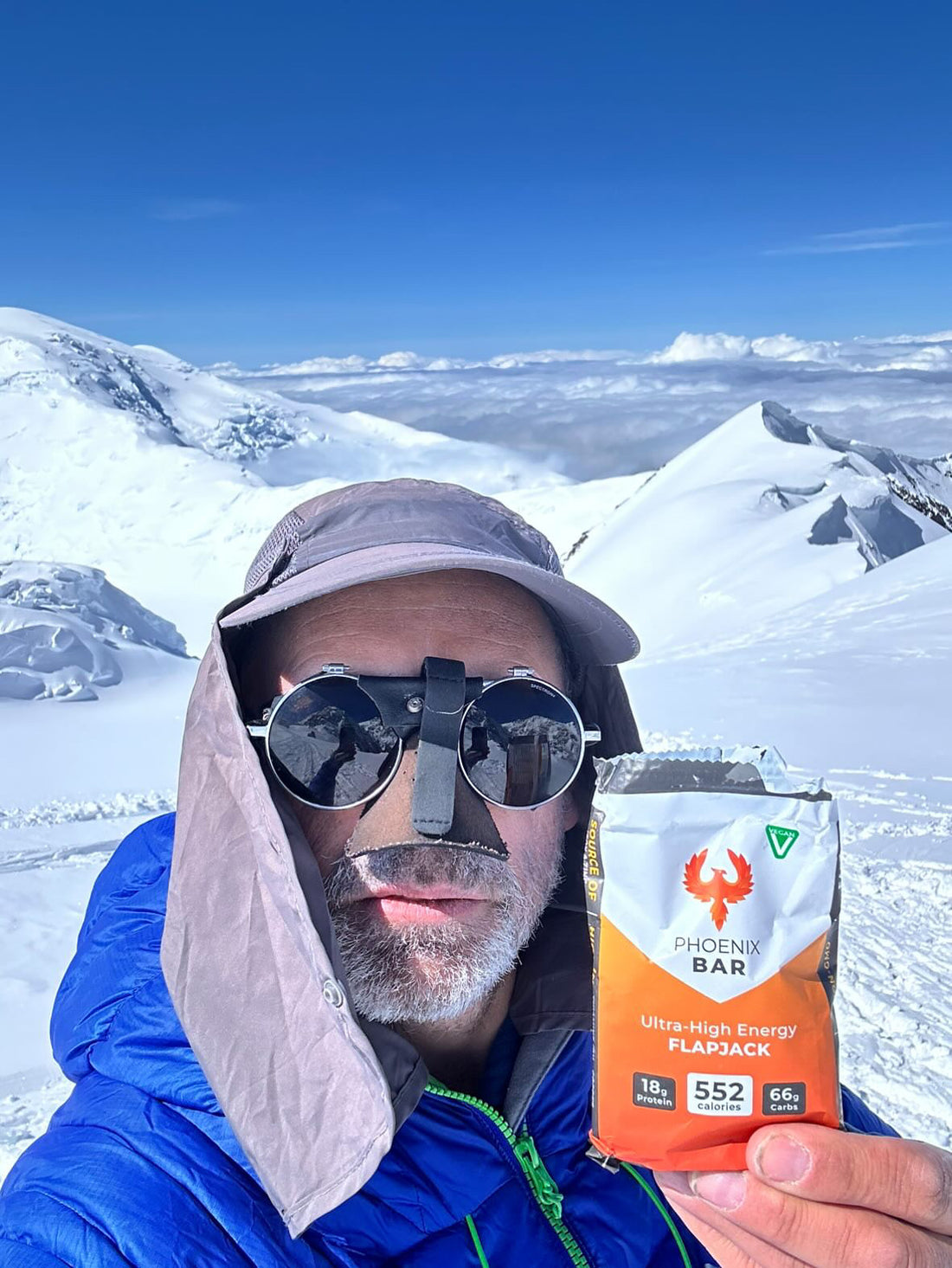
Big calories. Small bar.
Up to 557 calories in a compact, lightweight bar of only 120g, with up to 66g of carbs and 19g of protein. Eat it whole, break it into pieces over a few hours, or stir it into hot water or warm milk for porridge.
Easy to eat, easy to digest and not sickly sweet. Customers have eaten them at -45°C and through the heat of the Marathon des Sables, and they keep for up to 2 years, so they work on a mountain, on a night shift, or at home on days when eating enough feels hard.
- 557 calories in only 120g (529 to 557 by flavour)
- 4.6 calories per gram
- 66g carbs per bar (up to)
- 19g protein per bar (up to)
Declare withdrawal
Please fill out the following form to declare your withdrawal from the contract.

