
Ultra-Endurance & Expedition Nutrition Guide
Ultra-endurance events and expeditions create a problem that most general nutrition advice does not address: energy demands are very high, but appetite, time, carrying capacity, and food tolerance are all limited. The people who perform best in these situations are almost never the ones who eat the most — they are the ones who eat most consistently, using food that delivers maximum calories for minimum weight, volume, and effort.
This guide covers the principles of nutrition for ultra-endurance events, multi-day races, long expeditions, trekking, mountaineering, and remote travel where maintaining adequate calorie intake is difficult. It is based on the practical realities of feeding yourself in demanding conditions — not laboratory recommendations that assume you have a kitchen, a schedule, and a functioning appetite.
For situation-specific guidance, see our dedicated guides to UK multi-day ultra race nutrition, Marathon des Sables nutrition, polar expedition nutrition, high-altitude mountaineering nutrition, and military field nutrition.
Why Nutrition Determines Outcomes in Ultra-Endurance
In a road marathon, nutrition matters but fitness dominates. In a multi-day ultra or an expedition lasting weeks, nutrition becomes arguably the single largest determinant of whether you finish — and in what condition.
The reason is cumulative calorie deficit. A runner covering 50 miles per day over mixed terrain burns roughly 5,000–8,000 calories per day. An expedition member hauling a pulk across polar ice or trekking at altitude may burn 5,000–7,000 calories per day. Even with aggressive fuelling, most people can only absorb 200–400 calories per hour while active. The deficit builds from day one and compounds relentlessly.
Research on ultra-endurance athletes consistently shows that calorie deficit is associated with impaired cognitive function, reduced physical output, slower recovery between stages, increased injury risk, and — in extreme cases — hypothermia, because the body cannot generate sufficient heat without fuel. A study published in the British Journal of Sports Medicine found that ultra-endurance competitors who maintained higher calorie intake relative to expenditure demonstrated significantly better performance maintenance across multi-day events.
The goal of an ultra-endurance nutrition plan is not to eliminate the deficit — that is practically impossible in most events. The goal is to minimise it enough that you retain the physical capacity, cognitive function, and morale to keep going. The difference between a manageable deficit and a race-ending one is often just a few hundred calories per day — which is why the calorie density of the food you carry matters enormously.
Why Calorie Density Is the Defining Metric
Calorie density — the number of calories a food provides per gram of weight — is the most important number in expedition and ultra-endurance nutrition. It determines how much energy you can carry for a given pack weight, and it determines how much you need to eat to hit a calorie target.
Here is how common endurance foods compare:
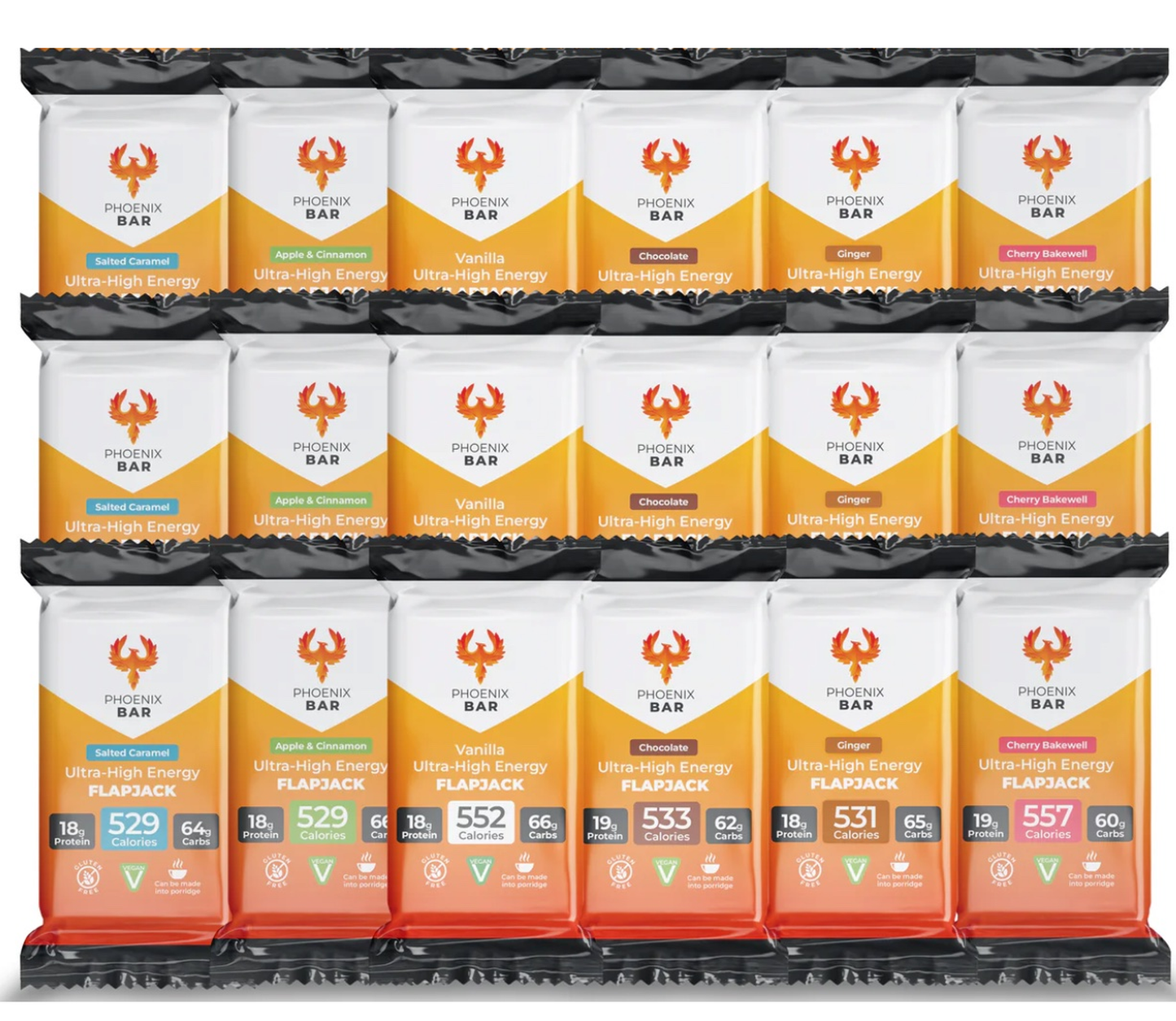
Fresh fruit provides roughly 0.5–0.9 calories per gram. Bread sits at approximately 2.5 calories per gram. Cooked rice and pasta deliver about 1.3–1.7 calories per gram. Energy gels provide approximately 2.5–3.0 calories per gram (mostly water weight). Standard energy bars range from 3.5–4.5 calories per gram. Nuts and nut butters deliver 5.5–6.5 calories per gram. Dark chocolate provides approximately 5.0–5.5 calories per gram. Freeze-dried meals deliver roughly 3.5–4.5 calories per gram before water is added. Phoenix Bars provide approximately 4.5 calories per gram, delivering up to 557 calories in a 120g bar.
The practical implication is significant. If you need 3,000 supplementary calories per day on a five-day self-supported race, carrying food at 2.0 calories per gram means 1,500g of food per day — 7.5kg for the event. Carrying food at 4.5 calories per gram means 667g per day — 3.3kg for the event. That 4.2kg difference is roughly the weight of a two-person tent.
For a detailed explanation of calorie density and how it applies across different situations, see our guide to calorie-dense foods.

Phoenix Bars: Up to 557 Calories Per Bar
Highly compact, low-volume, calorie-dense bars. Soft, easy to eat whole or as a warm porridge. Vegan, gluten-free and contain up to 66g of carbohydrates, 19g of protein & 8 vitamins & minerals.
The Five Nutrition Challenges of Ultra-Endurance
Ultra-endurance athletes and expedition participants face five challenges that interact and compound over time. Understanding them individually helps you plan for all of them.
Appetite suppression. Prolonged exertion, heat, cold, altitude, fatigue, dehydration, and sleep deprivation all suppress appetite — often dramatically. The International Society of Sports Nutrition notes that exercise-induced appetite suppression is well documented in endurance athletes, and that the effect worsens with duration and environmental stress. In practical terms, this means that by the time you most need calories — day three of a multi-day race, hour 20 of a 100-miler, the third week of an expedition — your desire to eat may be at its lowest. The solution is not willpower. It is choosing food that remains easy to eat when appetite has collapsed: soft, mild-flavoured, calorie-dense, requiring no preparation. For strategies on eating when appetite fails, see our guide on low appetite and difficulty eating enough calories.
Palate fatigue. Eating the same flavours and textures repeatedly across days or weeks creates food aversion. This is distinct from appetite suppression — you may be hungry but unable to face the food you have. Sweet foods are typically the first casualty. Gels, sweet energy bars, and sugary drinks that worked perfectly on day one become repulsive by day three. The countermeasure is variety: multiple flavours, a mix of sweet and savoury, different textures, and at least one food option that is specifically mild and neutral enough to tolerate when everything else has become unbearable. See our guide to high-calorie snacks for options.
Pack weight and volume constraints. On self-supported events and expeditions, every gram of food competes with water, equipment, shelter, and clothing. Low-calorie, high-volume foods consume pack space without delivering proportional energy. This is why calorie density is not a nice-to-have — it is a fundamental constraint on how much energy you can physically carry.
Digestive tolerance under exertion. Running, hiking, or hauling with a full stomach causes nausea, cramping, and GI distress in many people. Foods high in fibre, fat, or protein digest more slowly and can sit uncomfortably during sustained effort. The most practical approach is to eat small amounts frequently rather than large meals infrequently — a handful of food every 20–30 minutes rather than a full meal every three hours. Food that can be broken into pieces, eaten one-handed while moving, and consumed gradually over an hour is far more practical than food that demands a sit-down meal format. For more on foods that are gentle on the digestive system, see our guide to soft high-calorie foods.
Cumulative deficit over time. Each individual missed snack or shortened meal feels insignificant. But a 300-calorie daily shortfall — the equivalent of skipping one substantial snack per day — compounds to 1,500 calories over five days. That is enough to noticeably impair performance, mood, and recovery. The insidious nature of cumulative deficit is that you do not feel its full effect until days after it begins, by which point the deficit is difficult to reverse mid-event.
Building a Practical Nutrition Plan
The most effective ultra-endurance nutrition plans are simple, redundant, and easy to execute when you are exhausted. Complexity is the enemy of execution at hour 30 of a race.
Think in three layers.
Layer 1 — main meals. These provide routine, variety, and the largest single calorie contributions. Porridge or a calorie-dense breakfast bar in the morning. A freeze-dried or dehydrated meal in the evening. A sandwich, wrap, or substantial hot food at a checkpoint. Main meals deliver 500–1,000 calories per sitting and provide the psychological anchor of a "proper meal." For ideas on calorie-dense breakfast approaches, see our guide to high-calorie drinks, smoothies and milkshakes.
Layer 2 — snack calories. These are the foods you eat between meals — on the move, at rest stops, during transitions. In a multi-day event, snacks often account for 30–50% of total calorie intake. They need to be compact, accessible without stopping, and easy to eat one-handed. Nuts, flapjacks, cheese, chocolate, dried fruit, nut butter sachets, and calorie-dense bars all work. The critical thing is to carry enough and to eat them proactively — by the clock, not by hunger.
Layer 3 — backup calories. This is the food you carry specifically for when layers 1 and 2 fail. When your main meals become unappealing, when your snacks trigger nausea, when you cannot face eating but you know you need calories — the backup is what keeps you moving. It needs to be the most calorie-dense, easiest-to-eat, most reliable item in your pack. Something you can eat in any condition, in any state of fatigue, without preparation or decision-making.
Test everything in training. This is not optional advice — it is the single most important recommendation in this guide. Your digestive system, your taste preferences, and your tolerance for specific foods under exertion at hour 15 may be completely different from what you experience eating the same food at your kitchen table. Test your complete nutrition plan during long training sessions, ideally in conditions that approximate your target event. Discovering that your stomach rejects your chosen bar after three consecutive days is far better learned during a training weekend than on day three of a race.
Common Fuelling Mistakes
Most ultra-endurance nutrition problems come from planning errors rather than lack of effort during the event.
Underestimating total calorie needs. Many people simply do not carry enough usable calories. A five-day self-supported race requiring 3,000–5,000 calories per day means 15,000–25,000 total calories. Calculate your total need, calculate the weight of food required to meet it, and then check whether that weight fits your pack and your carrying capacity.
Carrying food that is too bulky for its calorie value. A plan can look good on paper but fail in practice if the food takes up too much space, weighs too much relative to its calorie content, or requires preparation that conditions do not allow.
Over-relying on sweet foods. Gels and sweet bars work well for the first 12–18 hours of most events. After that, palate fatigue sets in and sweet foods become increasingly difficult to tolerate. A nutrition plan that consists entirely of sweet products is a plan that will fail in the second half of any multi-day event.
Eating reactively instead of proactively. In ultra-endurance, appetite is an unreliable guide to calorie needs. By the time you feel hungry, you are already in deficit. The most effective approach is to eat on a schedule — every 20–30 minutes — regardless of whether you feel like eating. Set a timer on your watch if necessary.
Leaving fuelling decisions to race day. Decision fatigue is real in ultra-endurance. If you are standing at a checkpoint at hour 40, exhausted and nauseous, trying to decide what to eat from a pile of unfamiliar food, you will probably eat nothing. Pre-plan every meal and every snack. Remove the decision-making. Make calorie intake automatic.
Where Phoenix Bars Fit
Phoenix Bars were designed specifically for the conditions described in this guide — prolonged effort, limited appetite, constrained carrying capacity, and environments where food needs to be reliable, compact, and easy to eat when nothing else works.
Each bar delivers up to 557 calories and 66g of carbohydrates in a 120g package. They remain soft and edible in temperatures from desert heat above 50°C to polar cold below -45°C. They can be eaten whole, broken into pieces for gradual on-the-move grazing, or crumbled into hot water to make a calorie-dense porridge at a checkpoint or in camp. They are available in six flavours — Vanilla, Cherry Bakewell, Chocolate, Salted Caramel, Ginger, and Apple & Cinnamon — specifically because flavour variety across multi-day events helps prevent the palate fatigue that makes runners stop eating.
Phoenix Bars have been used on South Pole expeditions at -45°C, on Everest and five other 8,000m peaks, across the Sahara Desert during the Marathon des Sables, on Atlantic Ocean rowing crossings, and across hundreds of UK ultra races including the Spine, Lakeland 100, and Ultra-X series.
In the three-layer plan described above, Phoenix Bars work across all three layers: as a quick, calorie-dense breakfast (layer 1), as an on-the-move snack broken into pieces across an hour (layer 2), and as the reliable backup food that works when everything else has become intolerable (layer 3).
For practical guidance on different ways to use them, see How to Use Phoenix Bars.
Real-World Use in Ultra-Endurance and Expeditions
Phoenix Bars have been used by endurance athletes and expedition teams in some of the most demanding environments on earth. Three themes emerge consistently from their feedback:
They work when appetite collapses. The mild, non-sickly flavour profile and soft texture mean they remain tolerable deep into multi-day efforts when sweet gels and standard bars have become repulsive. Multiple users describe them as the last food they could still eat when everything else had stopped working.
They remain edible in extreme conditions. At -45°C at the South Pole, at -40°C during the Beyond The Ultimate Ice Ultra, and in 50°C+ desert heat during the Marathon des Sables, Phoenix Bars stayed soft and edible when other foods in the same pack had either frozen solid or melted.
The calorie-to-weight ratio changes how much you need to carry. At 557 calories per 120g bar, Phoenix Bars allow runners and expedition teams to carry fewer grams of food for the same total calorie supply — a meaningful advantage when pack weight directly affects performance.
"I always struggle with finding enough calories when competing at long races. The Phoenix Bar has answered that question. It also tastes delicious."
"Used in -45°C on a South Pole expedition and still easy to eat. An outstanding high-calorie food source for extreme conditions."
"Phoenix Bars helped me climb Mount Denali and complete a 100-mile race. The last time I climbed Denali, I lost 16 pounds. With Phoenix Bars, I only lost 8 pounds."
"Tastes mild enough to be eaten for days and days without making you sick. High in calories, which is great for ultras. Genuinely a different alternative to what's out there."
"I have one open in my pocket and just nibble away at it like a mouse as they are so calorie-dense."
For the full product range and nutritional information, see Phoenix Bars.
Frequently Asked Questions
What is the best food for ultra-endurance events and expeditions? The best food is food that is calorie-dense, compact, practical to carry, easy to eat when tired, and tolerable across multiple days of use. No single food meets all needs — the strongest plans combine main meals, portable snacks, and at least one reliable backup option.
Why does calorie density matter in multi-day events? Calorie density determines how much energy you can carry for a given pack weight. On self-supported events and expeditions where every gram matters, higher calorie density means more usable energy in less space and less weight.
How many calories do ultra-endurance athletes need per day? Typically 4,000–8,000 calories per day depending on activity type, intensity, terrain, conditions, and body weight. Most athletes cannot consume this much during the event — the goal is to minimise the deficit rather than eliminate it. The British Nutrition Foundation provides general guidance on energy requirements for active individuals.
How do I avoid under-fuelling during an event? Eat proactively on a schedule rather than waiting for hunger. Carry enough calorie-dense food to meet your target. Test everything during training. Carry a reliable backup food for when your primary nutrition becomes unappealing. Use the three-layer approach described above.
What should I eat when I can't face sweet food? Palate fatigue with sweet foods is the most common reason athletes stop eating in the second half of multi-day events. Savoury checkpoint food, mild-flavoured bars, cheese, nuts, and broth-based soups all help. The key is having at least one food option that is specifically not sweet, so you can continue eating when gels and sweet bars have become intolerable.
This guide is the first in our series on nutrition for specific endurance situations. For environment-specific and event-specific guidance, see:
- UK Multi-Day Ultra Race Nutrition — fuelling in cold, wet, overnight conditions
- Marathon des Sables Nutrition — desert multi-stage racing
- Polar Expedition Nutrition — extreme cold environments
- High-Altitude Mountaineering Nutrition — altitude and appetite
- Cycling and Bikepacking Nutrition — long-distance cycling
- Ocean Rowing Nutrition — offshore endurance
- Military Field Nutrition — supplementing ration packs
- Wild Camping Food — food planning for UK wild camping
- Calorie-Dense Foods — understanding calorie density
- How to Use Phoenix Bars — practical guidance including the porridge method
Written by James Frost, Founder of Flaming Phoenix. James developed Phoenix Bars following over 150 conversations with ultra-endurance athletes, expedition teams, and people experiencing difficulty eating. Last updated: March 2026.


Flaming Phoenix
High-Calorie Protein Bars for Endurance, Expeditions and Weight Gain




Why I built Phoenix Bars
Hi, I'm James.
I started Phoenix Bars at 23 after 150 conversations with ultra endurance athletes, extreme adventurers and people who struggle to eat enough calories.
Every design choice came directly from one of those conversations.
I pack every order from my home in Surrey, and I reply to every email myself, usually the same day.
Made in the UK. Hand-packed by James in Surrey. Used at Marathon des Sables, the South Pole, and in everyday situations where food feels hard.
