
Carb Loading Calculator: Grams Per Day (UK)
Carb loading means eating 10 to 12 g of carbohydrate per kilogram of body weight each day for the 36 to 48 hours before an endurance event that will last longer than 90 minutes. For a 70 kg person that is 700 to 840 g a day. Use the calculator to get your own number, then build a day of food that reaches it.
Written by James Frost, founder of Flaming Phoenix and the maker of Phoenix Bars. Updated October 2026.
Carb loading calculator
Build your day: tap foods until the bar is full
Carbohydrate figures are typical UK values for the portions shown. Brands vary, so check your own labels. Guideline source: Thomas, Erdman and Burke (2016), Medicine and Science in Sports and Exercise.

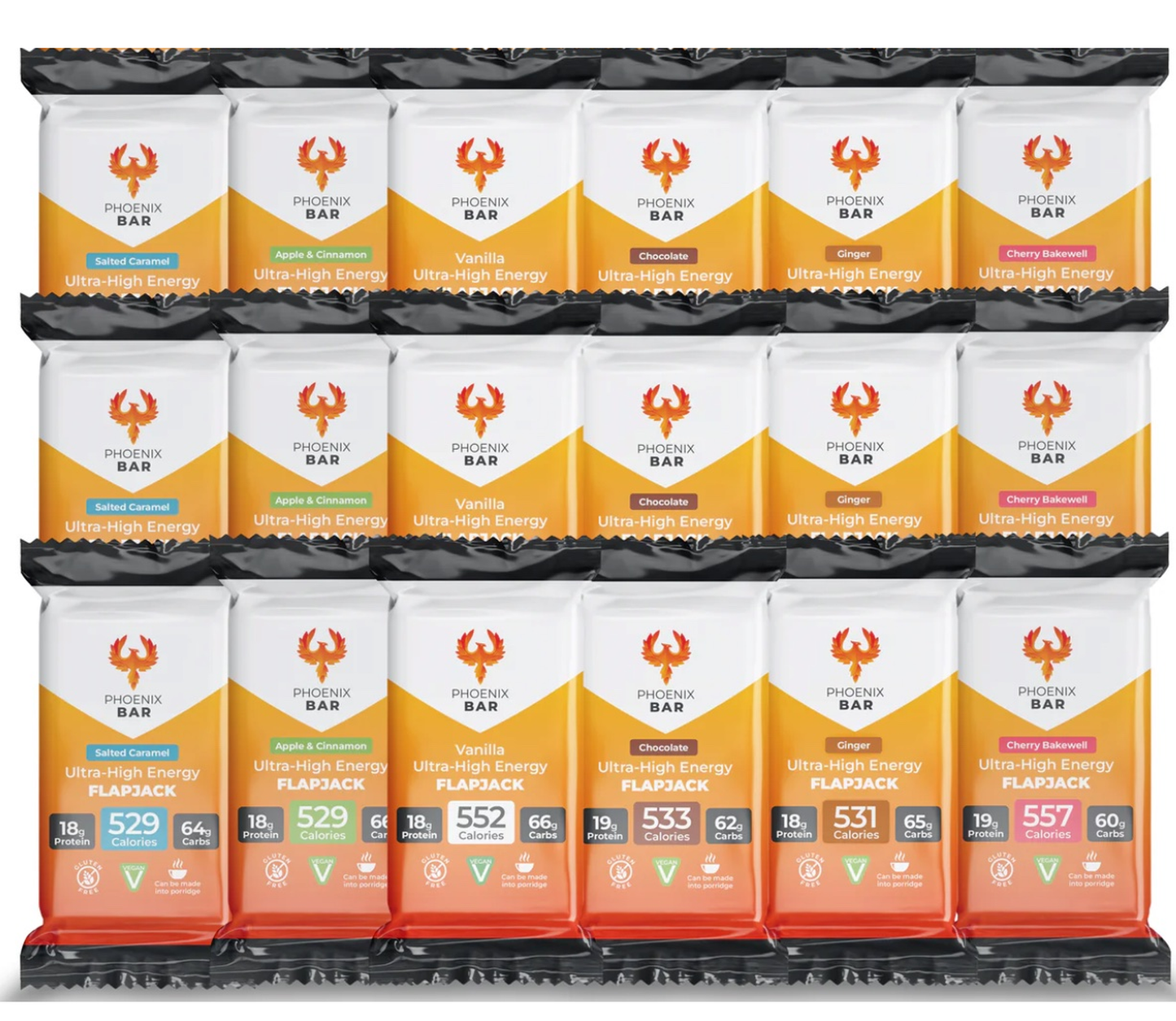
Phoenix Bars: Up to 557 Calories Per Bar
Highly compact, low-volume, calorie-dense bars. Soft, easy to eat whole or as a warm porridge. Vegan, gluten-free and contain up to 66g of carbohydrates, 19g of protein & 8 vitamins & minerals.
How does the carb loading calculator work?
The calculator multiplies your body weight in kilograms by a carbohydrate target in grams per kilogram. The targets come from the joint position statement on nutrition and athletic performance by Thomas, Erdman and Burke (2016), which is the most widely used guideline in sports nutrition:
- Events over 90 minutes: 10 to 12 g per kg a day for 36 to 48 hours beforehand.
- Events under 90 minutes: no full load. Eat 7 to 12 g per kg in the 24 hours before.
- Race-morning meal: 1 to 4 g per kg, eaten 1 to 4 hours before the start.
The “gentle” setting of 8 g per kg sits below the published range. It is there because many people cannot comfortably eat 10 g per kg, and a smaller load spread over three days is better than a full load abandoned at lunchtime.
As a guide, a full load of 10 to 12 g per kg works out as:
- 55 kg: 550 to 660 g a day
- 60 kg: 600 to 720 g a day
- 70 kg: 700 to 840 g a day
- 80 kg: 800 to 960 g a day
- 90 kg: 900 to 1,080 g a day
What is carb loading, and does it work?
Carb loading is a short period of high carbohydrate eating and light training that fills your muscles and liver with glycogen, the body’s stored carbohydrate. Normal glycogen stores cover roughly 90 minutes of hard effort. Starting with fuller stores delays the point at which they run low.
The evidence supports it for long events only. A widely cited review by Hawley and colleagues in Sports Medicine (1997) concluded that loading improves performance by 2 to 3% in events lasting more than 90 minutes, and makes little difference in shorter ones. If you have ever run out of energy late in a race, that is the problem carb loading addresses. My guide to hitting the wall explains what is happening.
Do you need to carb load for your event?
It depends on how long you will be moving, not on the distance printed on the entry form.
- 5K and 10K: no. Normal stores are enough.
- Half marathon: only if you expect to take longer than 90 minutes, and one high-carbohydrate day is plenty.
- Marathon: yes. This is the event carb loading was designed for.
- Long sportives and middle or long-distance triathlon: yes.
- Ultra marathons: yes for the start line, though at ultra pace what you eat during the event matters more than what you stored before it.
- Multi-day events: you can only load before day one. After that, your evening meal and breakfast do the work each day.
How many days before a race should you start carb loading?
Start 36 to 48 hours before the start, which for a Sunday morning race means starting on Friday. You do not need a week, and you do not need the old “depletion” phase of hard training on low carbohydrate first. Sherman and colleagues showed in 1981 that a simple taper with high carbohydrate intake fills glycogen stores without it.
One day can be enough if you rest. In a 2002 study by Bussau and colleagues, eight trained men ate 10 g per kg while staying inactive. Their muscle glycogen reached its peak after one day and did not rise further by day three. Two days gives you a margin for a meal that falls short.
What should you eat when carb loading?
Eat familiar, low-fibre, low-fat carbohydrate foods, and drink some of your carbohydrate. Fibre and fat fill you up before you reach your number, and a large volume of fibre the day before a race is a common cause of stomach trouble during it.
Good choices are white rice, white pasta, bagels, white bread, crumpets, potatoes without skins, porridge, bananas, rice pudding, jam, honey, fruit juice and sports drink. This is the one week of the year when white bread beats wholemeal.
An example day at 700 g (70 kg at 10 g per kg)
- Breakfast, about 113 g: porridge made with 80 g of oats, a banana, a tablespoon of honey and 250 ml of fruit juice.
- Mid-morning, about 88 g: a bagel with jam and 500 ml of sports drink.
- Lunch, about 138 g: 300 g of cooked white rice with a little chicken or tofu, a banana and 250 ml of fruit juice.
- Afternoon, about 97 g: two crumpets with honey and 50 g of jelly sweets.
- Dinner, about 150 g: 350 g of cooked white pasta with tomato sauce and two slices of white bread.
- Evening, about 103 g: 400 g of rice pudding with jam and 500 ml of sports drink.
That comes to roughly 690 g. Notice how much of it is drunk or eaten as snacks. Three big meals alone rarely get there.
Why do you gain weight when carb loading?
You gain weight because glycogen is stored with water, around 3 g of water for every gram of glycogen. A full load typically adds 1 to 2 kg on the scales within two days. It is not fat, it is fuel and fluid you will use during the event, and it is a sign the load has worked. Many athletes simply avoid the scales that week.
What should you eat on race morning?
Eat 1 to 4 g of carbohydrate per kg of body weight, 1 to 4 hours before the start. The closer to the start you eat, the smaller the meal should be. A simple rule is 1 g per kg for every hour you have: 3 g per kg if you eat three hours before, 1 g per kg if you only have an hour.
Breakfast is where many people struggle, and my customers’ reviews show it. Of 397 published reviews of my bars, 31 mention breakfast. “I always struggle eating prior to a race especially if it’s an early start,” wrote Alex B., who was training for a winter 100-mile race. Lisa N. gives herself more time: “I initially find the bars challenging to digest so I have to eat one at least 2 hours before, but once it settles it works a treat.” Both are describing the same lesson, which is to practise your race breakfast in training and find your own timing.
Where does a Phoenix Bar fit in a carb load?
I make Phoenix Bars, so read this section as the maker’s view, including the part where I tell you not to rely on them.
A Phoenix Bar contains 60 to 66 g of carbohydrate, which is more than a bagel. But it also contains 21 to 27 g of fat, so only 43 to 50% of its energy comes from carbohydrate. The foods that should carry a carb load are nearer 75 to 90%. Build your loading days on rice, pasta, bread and juice, not on my bars.
There are three places where one earns its spot:
- As one snack in a loading day, when you are tired of sweet, soft food. Zac B., a long-distance triathlete, reviewed them as “Great to get a good amount of carbs in without feeling like you are eating too much.”
- As race-morning breakfast, especially for people who cannot face a large bowl of anything at 5am. One bar is 527 to 557 kcal in 120 g, and it can be eaten as it is or stirred into hot water as high calorie porridge. Max C. ate one before the London Marathon “as a way of topping up the carbs before the race”.
- During long events, when you need solid food that is not another gel. That is what these high calorie bars were designed for, and my guide to ultra high carb solid foods compares the alternatives.
Whatever you choose, do not try it for the first time on race week. Freddie L., who ate my bars after the London Marathon and not before, explained why in his review: he “didn’t want to try anything new before the day”. He was right.
What are the most common carb loading mistakes?
- Eating too little. A big bowl of pasta the night before is one meal of about 100 to 150 g. The target is five or six times that, for two days.
- Adding fat instead of carbohydrate. Creamy sauces, pizza and pastries fill you up with the wrong fuel.
- Too much fibre. Save the wholegrains, beans and big salads for after the race.
- Training hard through the load. Glycogen only accumulates if you are not burning it. Keep sessions short and easy.
- Trying new foods. Use what you have eaten before long training days.
- Loading for a short event. For a 10K it adds weight without adding anything useful.
How many carbs do you need during the event?
Carb loading fills the tank. It does not replace eating on the move. The usual guidance is 30 to 60 g of carbohydrate an hour for events lasting up to about two and a half hours, and up to 90 g an hour for longer ones, according to Burke and colleagues (2011).
To plan that side of your race, use my ultra running calorie calculator or cycling calorie calculator, and read about gut training for ultras if high intakes upset your stomach. I also compare the best energy bars for ultra running and for long distance cycling.
Who should not rely on this calculator?
This calculator is for healthy adults preparing for endurance events. If you manage your blood sugar with medication, are pregnant, or follow a diet set by a healthcare professional, speak to them before making a large change to your carbohydrate intake.
If counting grams of food makes eating feel stressful, skip the numbers. Eat a familiar carbohydrate food at every meal and snack for two days, drink some juice, rest, and you will get most of the benefit.
Frequently asked questions
Is 700 g of carbs a day too much?
For everyday eating, yes. For a 70 kg athlete in the two days before a marathon, 700 g is the standard guideline of 10 g per kg. It is a short-term fuelling strategy for a specific event and not a way to eat year-round.
Should you carb load for a half marathon?
Only if you will be running for more than 90 minutes. If so, one day at 7 to 10 g per kg and a good breakfast is enough. Faster runners can simply eat normally with a little extra carbohydrate the day before.
Can you carb load in one day?
Yes, if you rest completely and reach about 10 g per kg. Research in trained athletes found glycogen stores peaked after a single day of high intake without exercise. Two days is more forgiving.
What are the best foods for carb loading?
The best foods are low in fibre and fat and easy to eat in quantity: white rice, pasta, bagels, white bread, potatoes without skins, bananas, rice pudding, jam, honey, fruit juice and sports drinks.
Does carb loading work for cycling and triathlon?
Yes. The guideline is based on the duration of the effort and applies to any continuous endurance sport lasting longer than 90 minutes.
Can you carb load on a vegan or gluten free diet?
Yes. Rice, potatoes, bananas, juice, jam and sports drinks suit both. Choose gluten free pasta, bread and oats where needed. Phoenix Bars are vegan and made with gluten free oats, and they are sold as high calorie protein bars for endurance events.
Sources
- Thomas DT, Erdman KA, Burke LM. Nutrition and Athletic Performance. Medicine and Science in Sports and Exercise, 2016. doi.org/10.1249/MSS.0000000000000852
- Burke LM, Hawley JA, Wong SHS, Jeukendrup AE. Carbohydrates for training and competition. Journal of Sports Sciences, 2011. doi.org/10.1080/02640414.2011.585473
- Bussau VA, Fairchild TJ, Rao A, Steele P, Fournier PA. Carbohydrate loading in human muscle: an improved 1 day protocol. European Journal of Applied Physiology, 2002. doi.org/10.1007/s00421-002-0621-5
- Hawley JA, Schabort EJ, Noakes TD, Dennis SC. Carbohydrate-loading and exercise performance: an update. Sports Medicine, 1997.
- Sherman WM, Costill DL, Fink WJ, Miller JM. Effect of exercise-diet manipulation on muscle glycogen and its subsequent utilization during performance. International Journal of Sports Medicine, 1981.
This page is general information for healthy adults, not medical or dietary advice.


Flaming Phoenix



Contact Us
Declare withdrawal
Please fill out the following form to declare your withdrawal from the contract.

