
Survival Food UK: How to Choose What’s Actually Worth Storing
Written by James Frost, founder of Flaming Phoenix and the maker of Phoenix Bars. Updated October 2026.
Search for survival food in the UK and you get a wall of buckets, biscuit tins and ration packs with 25 year promises and almost no way to compare them. This guide fixes that with a simple framework, then runs every category through it honestly, including where our own product fits and, just as importantly, where it does not.
My qualification for writing it: I run a UK company that makes dense expedition food, and our bars have been eaten in places where resupply genuinely was not an option, from an Atlantic rowing boat to the South Pole. Survival food is just expedition food with a longer wait. The UK government’s Prepare campaign now encourages every household to keep enough non-perishable food and bottled water to get through about three days of disruption, so this is no longer a niche hobby; it is the national advice.
What makes a good survival food?
A good survival food scores well on four numbers: calories per 100 grams (above 400 is dense), cost per 1,000 calories (your true price), water required to eat it (ideally none, since water is the scarcer resource in most UK emergencies), and realistic shelf life. Taste is the hidden fifth factor, because food you dread eating gets eaten last and wasted first.
Run every product you consider through those four numbers and the marketing evaporates. Here is how the main categories score.
Freeze-dried meal buckets (ReadyWise, Mountain House and similar)
The 25 year champions. Light, genuinely long-lasting and the right backbone for a long-duration store. The catches: every meal needs clean water, ideally hot, which is exactly what a flood or extended power cut takes away first; calorie counts per serving are often modest, around 200 to 400, so check servings against real appetites; and cost per 1,000 calories typically lands around £9 to £14. Best for the deep store you hope never to open. Our guide to the best freeze dried meals for backpacking rates the brands that taste of something.
Military ration packs
A British Army style 24 hour pack delivers roughly 4,000 calories of ready-to-eat food for about £15 to £20, which works out near £4 to £5 per 1,000 calories with zero cooking required. Heavy, around 1.5 to 2kg per day, and shelf lives are a realistic 2 to 3 years rather than decades, but for a grab-and-go 72 hour supply they are hard to fault on the framework. We have taken that category apart properly in our army ration packs guide.
Emergency biscuit rations (NRG-5, Seven Oceans, BP-ER)
The lifeboat standard: compressed blocks at roughly 450 to 500 calories per 100 grams, five to twenty year shelf lives, and the cheapest dense calories you can buy, often £3 to £5 per 1,000. The trade is that they are survival in the bleakest sense, dry, crumbly and joyless, which matters more than people admit: in a real emergency, especially with children or anyone whose appetite collapses under stress, palatability decides whether calories go in. Buy some, but taste one first.

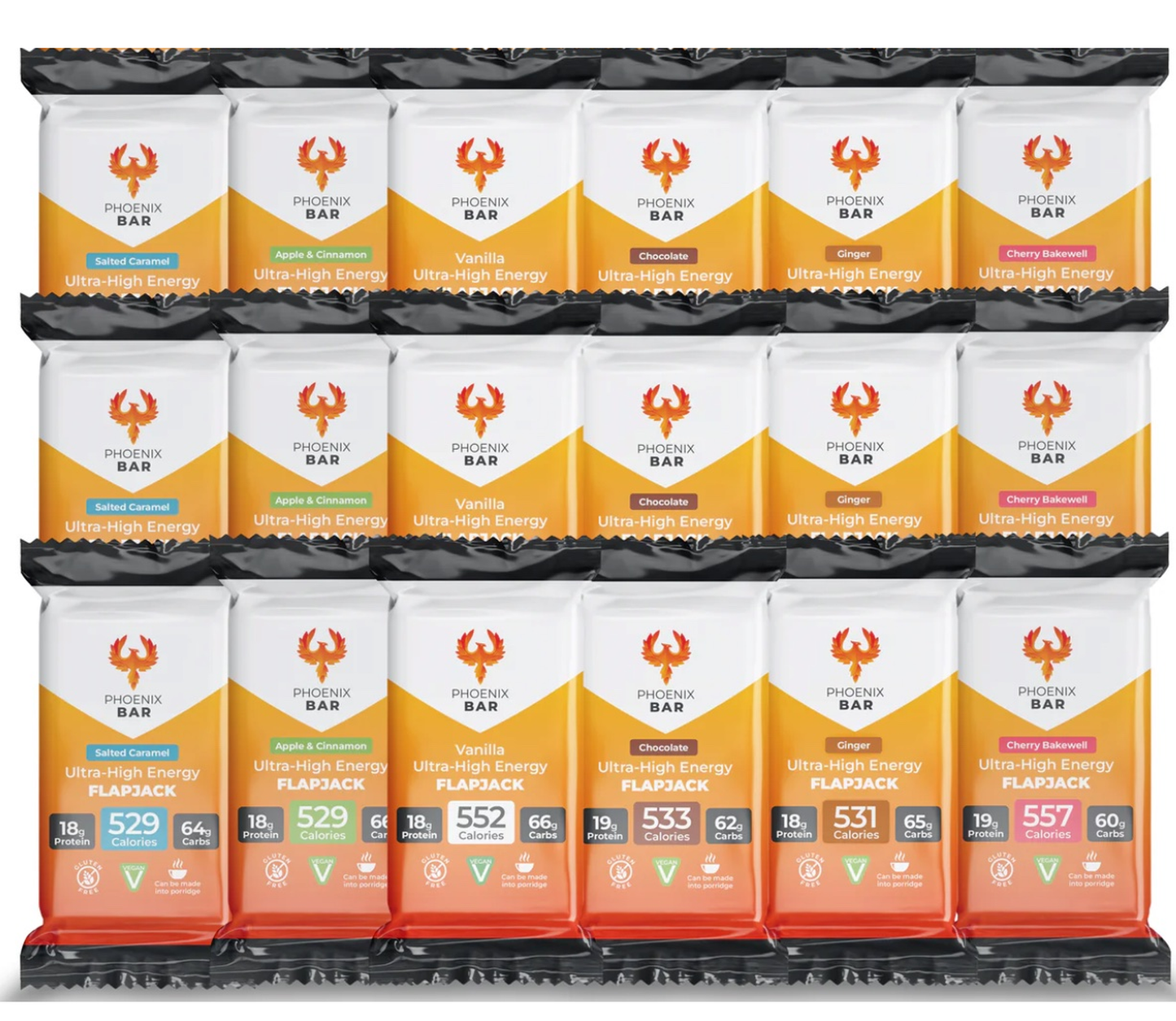
Phoenix Bars: Up to 557 Calories Per Bar
Highly compact, low-volume, calorie-dense bars. Soft, easy to eat whole or as a warm porridge. Vegan, gluten-free and contain up to 66g of carbohydrates, 19g of protein & 8 vitamins & minerals.
Ready-to-eat bars: where we fit, honestly
High-calorie bars are the bridge category: no water, no cooking, no preparation, dense, and actually pleasant. A 120g Phoenix Bar carries up to 557 calories, about 460 per 100 grams, which puts it level with the lifeboat biscuits on density while being food you would choose to eat; each bar is vegan, made with gluten free oats, keeps for up to two years, and can be mixed with any water you do have into a warm, easy porridge. One customer, John, summed up the use case in his review: “I think that they are an amazing emergency ration to have, considering their long shelf life, compact size, and substantial calorie count. I’ll definitely keep one in my bag at all times, just in case.”
The honest limits: at £5.25 a bar they cost more per 1,000 calories than biscuits or bulk rations, and a two year shelf life means they belong in the rotating layer of your store, not the 25 year layer. Where they beat everything else is the grab bag, the car boot and the office drawer: places where weight, volume, zero preparation and willingness-to-eat decide everything. They have been proven in harsher places than a power cut; Charlie packed 60 for his 2024 Atlantic row and wrote “On the water, I lost my appetite for plenty of different types of food but not Phoenix Bars,” and Shaun called them “a star of my South Pole food supply. Easy to eat, even at minus 45.” You can compare the whole category in our highest calorie bars UK guide, or go straight to the high calorie bars themselves.
Pantry staples: the cheap foundation
Rice, pasta, oats, tinned fish, beans, peanut butter, honey and oil remain unbeatable on cost, often under £1 per 1,000 calories, and familiar food is a morale asset. The weaknesses are water and cooking for most of it, and the discipline of rotation. Treat the pantry as your volume, the categories above as your resilience.
How to build a sensible UK supply
Start with the government’s three day baseline per person: around 6,000 to 7,500 calories of no-cook food and at least 10 litres of water, in one place you can lift and carry. A balanced version looks like a layer of ready-to-eat (bars and rations) for the first 24 to 48 hours when you may have no water, gas or inclination to cook, a layer of boil-only food behind it, and the deep freeze-dried or pantry store behind that. Then put a date in your calendar twice a year to eat and replace the shorter-dated layer; a store you never rotate is a bin you filled in advance. The full planning method, water, storage conditions and household checklists live in our emergency food preparedness guide, and the outdoor-skills side of self-reliance is covered in bushcraft food.
FAQ
What food should I stockpile in the UK? Three days of no-cook, long-life food per person is the government-encouraged baseline: think ready-to-eat bars or rations, tinned food with a tin opener, biscuit rations, and 10 litres of water per person, scaled up as budget and space allow.
What survival food has the longest shelf life? Properly stored freeze-dried meals and emergency biscuit rations lead, at up to 25 and 20 years respectively; honey, white rice and salt are effectively indefinite if kept dry. Everything else, including ration packs and bars, belongs in a rotating 1 to 3 year layer.
Is it worth buying survival food, or just extra shopping? Both. Extra shopping covers familiar disruption cheaply; purpose-made survival food earns its price on the four numbers when water, cooking or carrying come into play, which is precisely when tins and pasta fail you.
How many calories per day do you need in an emergency? Plan around 2,000 to 2,500 per adult for sedentary sheltering, and considerably more if you are walking, repairing or cold. Stress also suppresses appetite, which is why dense, palatable food matters more in an emergency than on paper.
Phoenix Bars are made in the UK, rated 4.9 out of 5 from nearly 400 reviews, and hand-packed by James with every order. Build the store you hope stays shut, and make the first layer something you would actually want to eat.


Flaming Phoenix



Contact Us
Declare withdrawal
Please fill out the following form to declare your withdrawal from the contract.

