
First Ultramarathon Nutrition: How to Fuel Your First Ultra
The short version: Your first ultramarathon is decided by whether you eat enough, early enough, and whether your stomach lets you. Aim for roughly 60 to 90 grams of carbohydrate an hour once you are past the first 45 minutes, drink to thirst with 400 to 800mg of sodium an hour, and start fuelling before you feel like you need it. Most first-timers struggle not because their legs give out but because they fall behind on calories or their gut rebels. Practise your exact race-day food on long training runs, lean on easy-to-digest real food as the hours stack up, and treat fuelling as a discipline you rehearse rather than something you wing on the day.
Why most first ultras are decided by the stomach, not the legs
There is an old line in the sport that an ultramarathon is an eating contest with some running thrown in. It is a cliché because it is true. Once your race passes about four hours, the problem stops being your fitness and starts being your fuelling. The data is blunt about this. In analyses of ultra finishers, those who complete the race consistently take in more than 250 calories an hour, while those who drop out average under 200. The most common reason runners do not finish is not their legs. It is their gut: more than 90% of ultramarathon runners report stomach symptoms during a race, with nausea topping the list.
So the first thing to understand about first ultramarathon nutrition is that you are managing two risks at once. You have to take in enough energy to keep moving for hours, and you have to do it without overwhelming a digestive system that is being starved of blood and jostled with every step. Get the balance right and the distance becomes possible. Get it wrong in either direction, too little food or too much too fast, and the day comes apart. If you want the full picture of how endurance fuelling fits together, start with our ultra-endurance and expedition nutrition guide.
How many calories and carbs do you need for your first ultra?
For a first ultra, build your plan around carbohydrate per hour rather than total calories, because carbohydrate is the fuel your working muscles burn fastest. The widely accepted guidance, set out in the International Society of Sports Nutrition position stand on ultra-endurance, is to aim for at least 60 grams of carbohydrate an hour for shorter ultras under about eight hours, and to work toward 60 to 90 grams an hour for longer events.
The reason the ceiling sits around 90 grams comes from the science of how your gut absorbs sugar. Sports scientist Asker Jeukendrup's research established that glucose alone tops out at roughly 60 grams an hour because it saturates a single intestinal transporter. Combine glucose with fructose, which uses a different transporter, and a trained gut can absorb up to 90 and sometimes 120 grams an hour. This is why modern gels, drinks and bars use mixed carbohydrate sources. For your first ultra you do not need to chase the top of that range. Hitting a reliable 60 grams an hour without stomach trouble will serve you far better than aiming for 90 and spending the back half of the race nauseous.
On total energy, expect to burn somewhere in the region of 600 to 900 calories an hour depending on your pace, the terrain and your body weight. You cannot absorb anything close to that while running, so a calorie deficit across the race is completely normal and nothing to fear. The job is not to break even, it is to take in enough to keep your blood sugar and your spirits up, then eat properly afterwards. We cover the maths in our guide to how many calories you burn running an ultra or on expedition.
Why your gut is the real bottleneck, and how to train it
Here is the part most first-timers do not realise until it is too late: your stomach can be trained, exactly like your legs. The capacity to absorb 90 grams of carbohydrate an hour is not something you are born with. It is an adaptation you build by practising high intake on long runs.
The protocol is simple and it works. Start your long-run fuelling at around 30 grams of carbohydrate an hour early in your training block, and step it up gradually over the weeks toward your race target of 60 to 90 grams. Your gut adapts by increasing transporter activity and emptying faster, so a fuelling load that would have made you queasy in month one feels routine by race day. Faster runners actually report more gut trouble, not less, because they are pushing more fuel at higher intensity, which is all the more reason to rehearse it. The fix for a sensitive stomach is almost never to eat less, it is to train it to handle more. We go deep on the full method in our guide to gut training for endurance.
The other half of gut management is familiarity. The old advice "nothing new on race day" exists because unfamiliar food is far more likely to upset you when blood is being diverted away from digestion. Eat the same foods, in the same quantities, that you have already proven on your long runs.

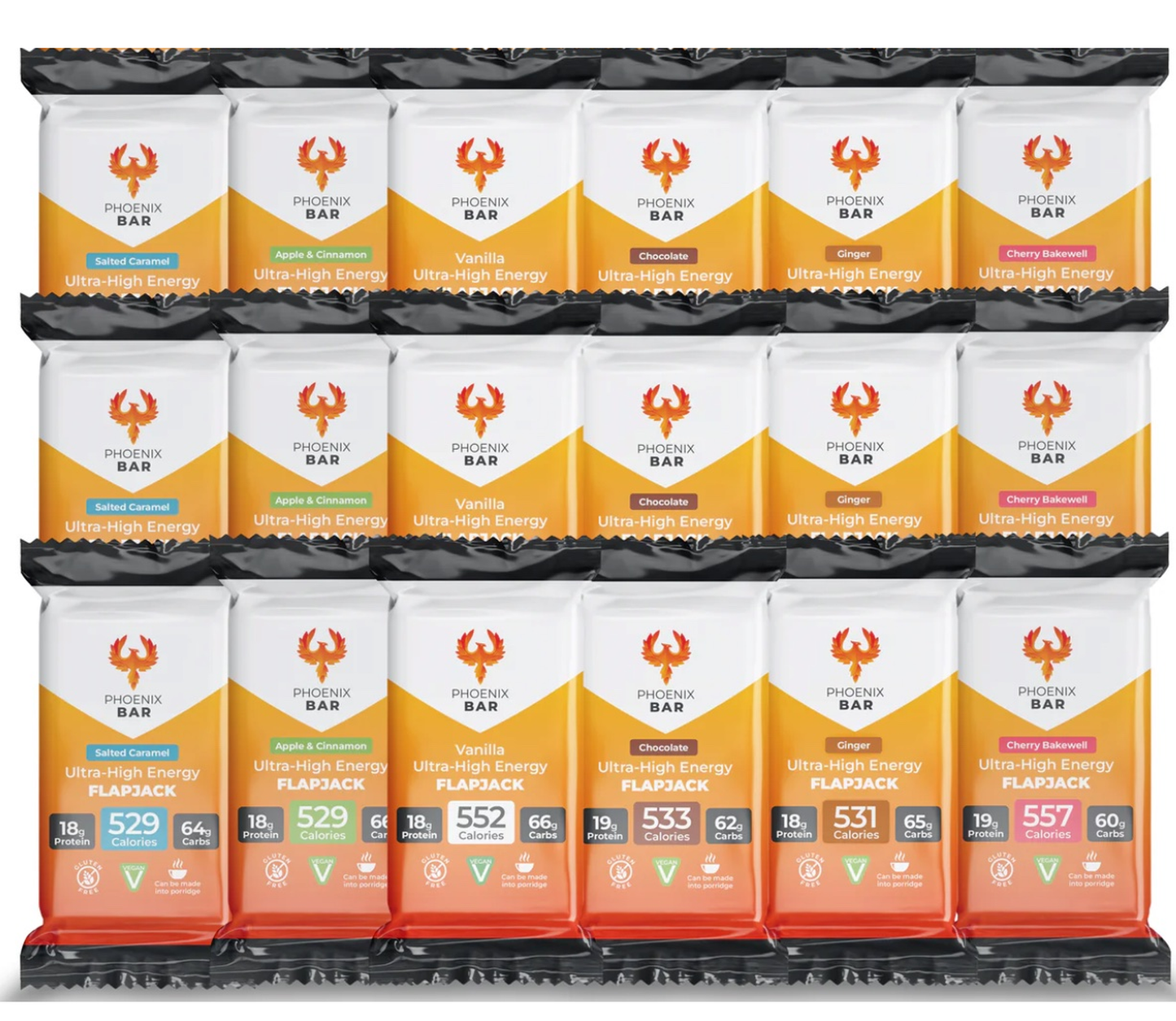
Phoenix Bars: Up to 557 Calories Per Bar
Soft, easy to eat whole or as a warm porridge. Low volume, two-year shelf life.
Gels or real food: what should you actually eat?
For a first ultra the honest answer is both, and the mix should shift as the hours go by.
Early in the race, when you are running at a decent clip, your body struggles to digest anything heavy, so fast carbohydrate wins: gels, chews, sports drink and other simple sugars that convert to energy quickly and ask little of your stomach. This is the same fuelling you would use for a marathon, and for the first few hours it is the most efficient way to hit your carbohydrate target.
As the race stretches on, two things change. Your body starts craving savoury, salty, fattier food, and you develop what is best described as flavour fatigue, the point where one more sweet gel becomes genuinely hard to swallow. This is not a failure of willpower. In events like the Marathon des Sables, runners have described sugary gels as unpalatable after several hours in the heat, and many stop eating not from stomach distress but from sensory burnout. The runners who finish strong are the ones who plan for this in advance and carry variety: something salty, something savoury, something that needs almost no chewing. If gels stop working for you, our guide to energy gel alternatives walks through the options.
This is the moment in an ultra where soft, calorie-dense, easy-to-eat real food earns its place. Experienced ultrarunners reach for things like salted rice balls, nut butter, soup, mashed potato and soft high calorie foods precisely because they go down easily when gels no longer will. The principle to take into your first race: front-load the simple carbohydrate, then have real food ready for the second half when your palate and your stomach both demand a change.
Sodium, hydration and electrolytes
Drink to thirst rather than to a rigid schedule, aiming roughly for 500 to 750ml of fluid an hour and more in the heat, and make sure that fluid carries sodium. A practical target is 400 to 800mg of sodium an hour, more if you are a heavy or salty sweater (you will see white salt marks on your kit). Sodium matters for two reasons. It helps you actually absorb the water and carbohydrate you are taking in, and it guards against hyponatremia, the dangerous dilution of blood sodium that comes from drinking large volumes of plain water. Counterintuitively, feeling sick in a long race is often a sign of under-fuelling or low sodium rather than too much food, so if nausea hits the answer is usually to take on salt and a little fuel, not to stop eating. We cover that properly in can't eat mid-race? nausea and appetite loss explained.
Fuelling your first ultra in the heat
Heat changes the whole equation. It blunts your appetite, makes sweet flavours harder to stomach, and raises both your fluid and your sodium losses. If your first ultra is a hot one, lean even harder on liquid calories and low-volume food early, prioritise savoury options, and accept that you may need to slow down to keep digesting at all. We go further in our guide to fuelling in the heat.
A simple fuelling plan for your first ultra
Treat this as a starting framework to rehearse and personalise, not a prescription.
In the two days before the race, raise your carbohydrate intake to top up muscle glycogen, favouring familiar foods and plenty of fluid. In the three to one hours before the start, eat a carbohydrate-rich meal you have tested before, around one to four grams of carbohydrate per kilogram of body weight, and keep sipping fluid with sodium.
In the first four hours, prioritise fast carbohydrate from drinks, gels and chews, and start within the first 30 to 45 minutes, before you feel you need it. A useful trick borrowed from seasoned ultrarunners is to portion each hour's fuel into its own small bag, so you always know whether you are on track. Planning what goes where matters too, which is why our guide to ultramarathon drop bags and aid stations is worth reading before race day.
From roughly four hours onward, start rotating in soft, easy real food alongside the gels, and begin taking small amounts of protein. In the late stages, shift toward savoury, salty, calorie-dense options and warm food where aid stations offer it, soup and similar, and add caffeine if your focus is fading. Eating consistently here is also your best protection against running low on energy late in the race.
After you cross the line, the priority is simply to get something in: fluid with sodium first, then carbohydrate and protein as soon as your stomach allows, and proper meals over the next 24 to 48 hours. Recovery is not the first plate of food, it is the two days that follow.
How Phoenix Bars fit a first-ultra plan
Full disclosure, I make these, so weigh this accordingly. I built Phoenix Bars after speaking with more than 150 endurance athletes and expedition teams, around one problem that kept coming up: it is genuinely hard to eat enough when you are deep into a long effort. Phoenix Bars are 120g, vegan and gluten-free, and they are designed to pack a large amount of energy into a small, low-volume, easy-to-eat format. That maps directly onto the two things this page is about: not falling behind on calories, and still being able to eat when your palate turns.
For a first ultra they earn their place in the second half, when sweet gels have stopped appealing and you need real, substantial calories that still go down easily. And because a Phoenix Bar can be broken up and made into a quick high calorie porridge, you have a soft, warm, almost no-chew option for the late stage when solid food becomes a chore, which is exactly when most first-timers stop eating. They are not a replacement for your early-race gels and drinks, they are the dense, palatable real food you reach for when your palate tires. You can read more in how to use Phoenix Bars, or see the range on the buy Phoenix Bars page.
First ultramarathon nutrition: common questions
How many calories do you burn in an ultramarathon? Most runners burn roughly 600 to 900 calories an hour, varying with pace, terrain and body weight, which over a long ultra runs into several thousand calories. You cannot absorb that much while running, so a deficit is normal. The full breakdown is in our guide to calories burned running an ultra or on expedition.
Can you really train your stomach? Yes. Starting long-run fuelling around 30 grams of carbohydrate an hour and building gradually toward 60 to 90 grams trains your gut to absorb more without distress. It is one of the highest-value things a first-timer can practise, and we explain how in gut training for endurance.
What should I eat the night before my first ultra? A familiar, carbohydrate-rich meal you have eaten before training runs, nothing new or high in fibre, with plenty of fluid. Save the experiments for training.
Do I need gels, or can I use real food? Both. Fast carbohydrate like gels and drinks works best early when you are moving quickly. Soft, calorie-dense real food comes into its own later when your palate tires of sweet flavours.
Why do I feel sick during long runs? Most often it is under-fuelling, low sodium, or pushing fuel faster than your gut is trained to handle, rather than too much food. Take on a little salt and fuel, ease the pace, and build your gut training in advance.
Written by James Frost, founder of Flaming Phoenix and a runner. He developed Phoenix Bars after more than 150 conversations with endurance athletes and expedition teams, and now supplies ultrarunners, expedition crews and adventurers in over 19 countries


Flaming Phoenix



Contact Us
Widerruf erklären
Füllen Sie das folgende Formular aus, um Ihre Widerrufserklärung abzugeben.

