
Ultramarathon Training Plan: Week-by-Week Schedules for 50K, 50 Miles, 100K and 100 Miles
Written by James, founder of Flaming Phoenix and the maker of Phoenix Bars. Updated September 2026.
Quick answer: most runners need 16 weeks to train for a 50K from a half-marathon base, 20 weeks for 50 miles or 100K from a marathon base, and 24 weeks for 100 miles from a 50-mile base. The structure that works is the same at every distance: four-week blocks of three build weeks and one easier week, 80 percent of running at an easy, conversational effort, one long run a week that grows to three and a half hours (50K), four and a half hours (50 miles) or six hours (100 miles), back-to-back weekend runs from 50 miles upwards, hills that match your race, two short strength sessions a week, and a taper of two to three weeks. Below are the full week-by-week schedules with every session in kilometres, miles and hours, the ascent targets for hilly UK races, and the start dates for the main 2027 events.
Who these plans are for, and what you need before you start
The 50K plan assumes you can run for 90 minutes comfortably and have covered 30 to 40 km a week for at least two months; a recent half marathon is ideal. The 50-mile plan (which also covers 100 km) assumes a marathon or 50K finish in the last 18 months and a base of around 50 km a week. The 100-mile plan assumes a 50-mile or 100 km finish and a base of at least 65 to 70 km a week. If you are below those starting points, spend six to eight weeks building easy volume first rather than jumping into week one; the biggest predictor of a good ultra is consistent, injury-free months, not heroic weeks.
These are the schedules I would give a friend, built from the principles used by the coaches whose plans dominate this space (three-to-one loading, time on feet, race-specific terrain, gut training) and from watching hundreds of our customers prepare for events like Race to the Stones, the South Downs Way 50 and the Lakeland 100. I make an energy bar for a living, not a coaching business, so there is nothing to buy at the end and no app to download.
The principles behind every week
Easy means easy. Around 80 percent of your weekly time should be at an effort where you can talk in full sentences. In ultra training the hard sessions are hills and tempo, not intervals on a track.
The long run is the workout. It grows by roughly 15 to 30 minutes every build week and drops back in every fourth week. From 50 miles upwards it becomes a weekend pair: a long run on Saturday and a medium run on tired legs on Sunday, which teaches your body to run on fatigue without one dangerously long session.
Terrain matches the race. If you are racing the South Downs Way 50 (about 1,700 m of climb) you need hills every week; if you are racing the Lakeland 50 (about 3,000 m) you need mountains at the weekend. A useful rule is that peak weekly ascent should reach 30 to 40 percent of your race's total ascent, and your longest run should include about half of it.
Walk the hills on purpose. Power hiking is a skill. From the 50-mile plan onwards, some long runs are labelled as hikes, done with a loaded vest and poles if your race allows them.
Fuel every long run. Practise 60 to 90 g of carbohydrate an hour on every run over two hours, using the foods you will race with. My guide to gut training for ultras covers how to build that up over eight weeks, and best foods for ultra running lists what to carry hour by hour. If gels turn your stomach on the third hour, that is a training finding, not a race-day surprise; solid, calorie-dense options like a 120 g Phoenix Bar (527 to 557 kcal, easy to eat while walking) are what a lot of runners move to for the later hours.
Strength twice a week. Thirty minutes is enough: squats, step-ups, single-leg deadlifts, calf raises and a core circuit. If you also lift seriously, my page on training as a hybrid athlete explains how to fit both in.
Recovery weeks are not optional. Every fourth week drops volume by 30 to 40 percent. Skipping them is the most common way to arrive at the start line injured.
The 16-week 50K training plan (week by week)
Sessions are Tuesday, Wednesday, Thursday, Saturday and Sunday, with Monday and Friday off or 30 minutes of strength. Weekly totals are approximate for a runner averaging 6 minutes 30 seconds per km (10 and a half minute miles) on easy runs; if you are faster or slower, keep the times and let the distances vary.
Weeks 1 to 4 (base). Week 1: Tuesday 45 minutes easy; Wednesday 45 minutes easy with four 20-second strides; Thursday 40 minutes easy; Saturday 90 minutes on trail; Sunday 45 minutes easy. About 4 hours 15 minutes, 40 km (25 miles). Week 2: Tuesday 50 easy; Wednesday 45 minutes including six two-minute hill efforts; Thursday 45 easy; Saturday 1 hour 45 on trail; Sunday 50 easy. About 4 hours 45, 45 km (28 miles). Week 3: Tuesday 50; Wednesday 50 with eight two-minute hills; Thursday 45; Saturday 2 hours on trail, eating from the first hour; Sunday 60 easy. About 5 hours 15, 50 km (31 miles). Week 4 (easy week): Tuesday 40; Wednesday 40; Thursday 40; Saturday 75 minutes; Sunday 40. About 3 hours 45, 36 km (22 miles).
Weeks 5 to 8 (build). Week 5: Tuesday 55 easy; Wednesday 50 with 20 minutes at tempo (an effort you could hold for an hour); Thursday 50 easy; Saturday 2 hours 15 on trail; Sunday 60 easy. About 5 hours 45, 55 km (34 miles). Week 6: Tuesday 60; Wednesday 55 with eight three-minute hills; Thursday 50; Saturday 2 hours 30; Sunday 60. About 6 hours 15, 60 km (37 miles). Week 7: Tuesday 60; Wednesday 55 with two 15-minute tempo blocks; Thursday 50; Saturday 2 hours 45 with 60 g of carbohydrate every hour; Sunday 75 easy. About 6 hours 45, 65 km (40 miles). Week 8 (easy week): Tuesday 45; Wednesday 45; Thursday 40; Saturday 90 minutes; Sunday 45. About 4 hours 15, 40 km (25 miles).
Weeks 9 to 12 (race specific). Week 9: Tuesday 60; Wednesday 60 with ten three-minute hills; Thursday 50; Saturday 3 hours on terrain like your race; Sunday 60. About 7 hours, 68 km (42 miles). Week 10: Tuesday 60; Wednesday 60 with three 12-minute tempo blocks; Thursday 55; Saturday 3 hours 15 with the final hour at race effort; Sunday 75. About 7 hours 30, 72 km (45 miles). Week 11 (peak): Tuesday 60; Wednesday 60 with hills; Thursday 55; Saturday 3 hours 30, your longest run of around 30 km (19 miles), in full race kit with race food and a practice of your drop-bag routine; Sunday 60. About 7 hours 45, 75 km (47 miles). Week 12 (easy week): Tuesday 45; Wednesday 50; Thursday 45; Saturday 2 hours; Sunday 45. About 5 hours, 48 km (30 miles).

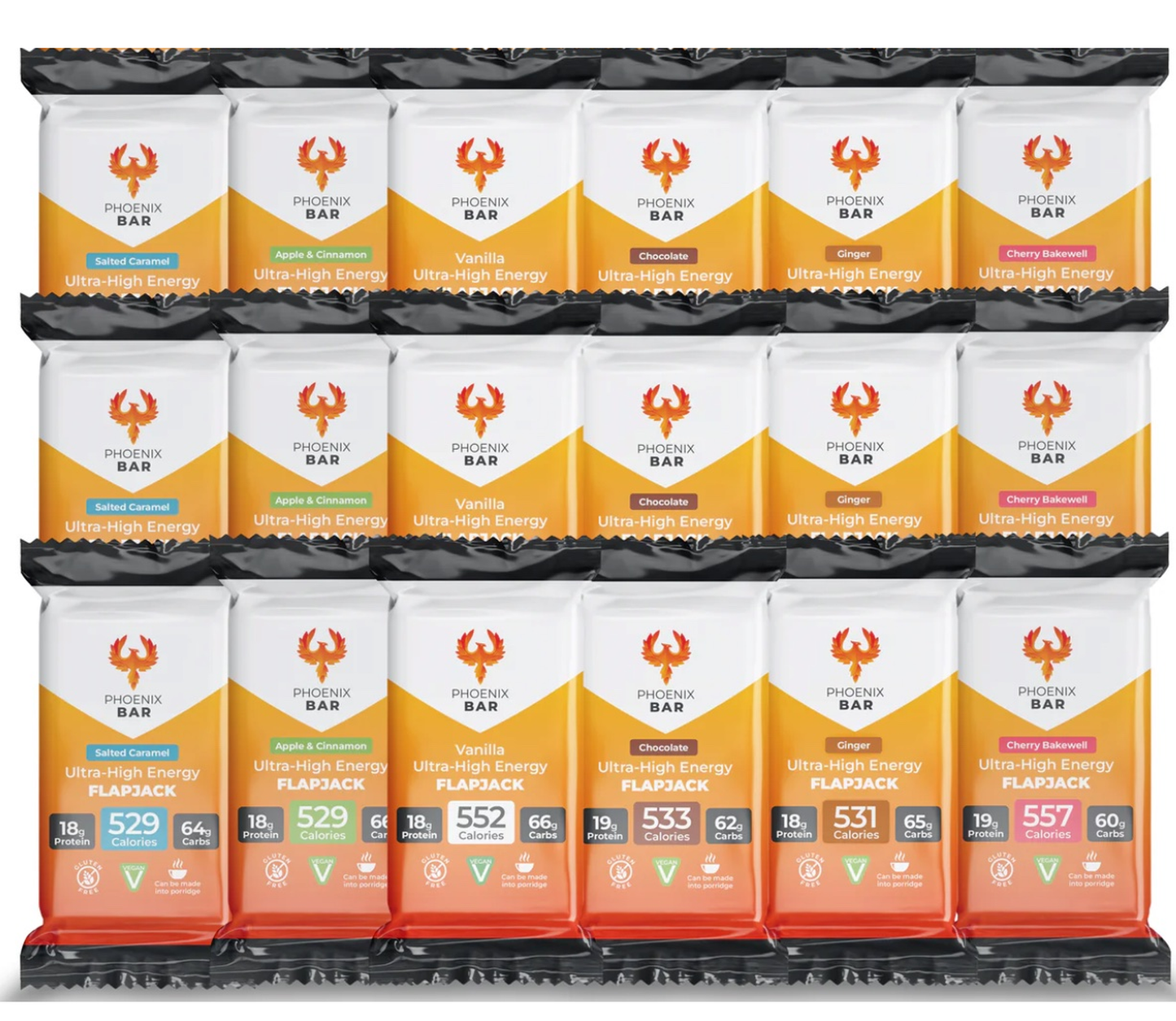
Phoenix Bars: Up to 557 Calories Per Bar
Highly compact, low-volume, calorie-dense bars. Soft, easy to eat whole or as a warm porridge. Vegan, gluten-free and contain up to 66g of carbohydrates, 19g of protein & 8 vitamins & minerals.
Weeks 13 to 16 (sharpen and taper). Week 13: Tuesday 55; Wednesday 55 with 20 minutes tempo; Thursday 50; Saturday 2 hours 30 with three 20-minute blocks at race effort; Sunday 60. About 6 hours, 58 km (36 miles). Week 14: Tuesday 50; Wednesday 45 with six two-minute hills; Thursday 45; Saturday 1 hour 45; Sunday 45. About 4 hours 30, 44 km (27 miles). Week 15: Tuesday 40; Wednesday 40 with strides; Thursday 30; Saturday 60 minutes; Sunday 30. About 3 hours, 30 km (19 miles). Week 16: Tuesday 30 easy; Wednesday 25 with four strides; Thursday 20-minute shakeout; Friday rest; Saturday or Sunday race.
Peak volume is around 75 km (47 miles) and 7 hours 45 minutes. If your 50K has more than 1,500 m of climb, add 300 to 500 m of ascent to the Saturday runs from week 5 and make the Wednesday hill sessions longer rather than adding distance.
The 20-week 50-mile and 100K training plan
This plan adds a sixth day and the back-to-back weekend. Sessions are Tuesday, Wednesday, Thursday, Saturday and Sunday, plus an optional easy 30 to 40 minutes on Monday from week 5. Peak volume is 95 to 100 km (60 miles) and roughly 10 hours in week 15.
Weeks 1 to 4 (base, 50 to 60 km a week). Midweek runs of 45 to 60 minutes with one hill session (eight to ten efforts of two to three minutes). Saturday long runs of 2 hours, 2 hours 30 and 3 hours, then 2 hours in the easy week 4. Sundays are 60 to 75 minutes easy.
Weeks 5 to 8 (build one, 60 to 75 km). Midweek runs of 50 to 65 minutes, one hill session and one tempo session of 20 to 30 minutes. This block introduces the back-to-back: Saturday 3 hours with Sunday 90 minutes (week 5), Saturday 3 hours 30 with Sunday 1 hour 45 (week 6), Saturday 3 hours 45 with Sunday 2 hours (week 7), then Saturday 2 hours 30 and Sunday 60 minutes in easy week 8. Eat 60 g of carbohydrate an hour on every run over two hours from here on.
Weeks 9 to 12 (build two, 75 to 90 km). Midweek runs of 55 to 70 minutes with hills every week and one tempo session. Saturday 4 hours with Sunday 2 hours (week 9), Saturday 4 hours 15 with Sunday 2 hours 15 (week 10), Saturday 4 hours 30 (around 40 km or 25 miles, your longest run) with Sunday 2 hours 30 (week 11), then easy week 12 with Saturday 2 hours 30 and Sunday 75 minutes. Week 10's Saturday should be a hike-run of five hours on the hilliest terrain you can find if your race has more than 2,500 m of ascent.
Weeks 13 to 16 (race specific, 85 to 100 km). Week 13: Saturday 3 hours 30 with the last 90 minutes at race effort, Sunday 2 hours. Week 14: a night run of 2 to 3 hours on Friday or Saturday evening with your race head torch, then Sunday 2 hours 30. Week 15 (peak): Saturday 4 hours in full mandatory kit as a dress rehearsal, Sunday 2 hours 30; this is also the week to run a marathon or 50K as a supported training day if one fits. Week 16: easy week, Saturday 2 hours, Sunday 60 minutes.
Weeks 17 to 20 (taper). Week 17 is about 70 percent of peak with a 2 hour 30 Saturday and 90-minute Sunday. Week 18 is 55 percent with a 2-hour Saturday. Week 19 is 40 percent with a 75-minute Saturday, some strides midweek and no hills. Week 20: three short easy runs, the last of them a 20-minute shakeout two days before the race, then race day.
For 100 km add 15 minutes to every Saturday from week 9 and treat the week 15 dress rehearsal as five hours. If your event is the Lakeland 50 or a similar mountain race, replace the week 10 and week 15 Saturdays with six to seven-hour mountain days and hold peak weekly ascent at 1,000 to 1,500 m; for the South Downs Way 50 or North Downs Way 50, 600 to 900 m a week is enough. My guide to fuelling your first ultramarathon covers what those long days should look like on the nutrition side, and if you are eyeing the Marathon des Sables I have a dedicated MDS training guide.
The 24-week 100-mile training plan
A hundred miles is trained with hours, not distance, because the second half is walked by almost everyone. Peak volume is 12 to 15 hours (roughly 120 to 130 km or 75 to 80 miles including hikes) in weeks 15 and 19. The structure is six blocks of four weeks.
Weeks 1 to 4 (base, 8 to 9 hours). Five runs a week, one hill session, Saturday long runs of 2 hours 30 to 3 hours 30, Sunday 90 minutes easy, an easy fourth week.
Weeks 5 to 8 (build one, 9 to 11 hours). Back-to-backs every other weekend: Saturday 4 hours with Sunday 2 hours in weeks 5 and 7; in week 6 a single five to six-hour hike-run with a loaded vest on hilly ground; easy week 8 with a 2 hour 30 Saturday.
Weeks 9 to 12 (build two, 10 to 12 hours). Saturday 4 hours 30 with Sunday 2 hours 30 (week 9); a six to seven-hour mountain day (week 10); Saturday 5 hours with Sunday 3 hours (week 11), which is your first 50-plus km weekend; easy week 12.
Weeks 13 to 16 (race rehearsal, 11 to 14 hours). Week 13: a night run of 3 to 4 hours starting at 9 pm, then 2 hours on Sunday morning after a short sleep. Week 14: a 50-mile or 100 km race, or a self-supported eight-hour day with your crew practising aid stops; this is the most valuable session in the whole plan. Week 15 (peak): Saturday 6 hours (around 50 to 55 km or 32 to 34 miles) in full mandatory kit with race food, Sunday 3 hours. Week 16: easy week, Saturday 2 hours 30.
Weeks 17 to 20 (consolidate, 10 to 14 hours). Week 17: Saturday 4 hours with the last two at race effort, Sunday 2 hours 30. Week 18: seven to eight-hour hike-run on your race's hardest section if you can get there. Week 19 (second peak): Saturday 5 hours 30, Sunday 3 hours, both with full race kit. Week 20: easy week, Saturday 2 hours 30.
Weeks 21 to 24 (taper). Week 21 is 70 percent of peak with a 3-hour Saturday. Week 22 is 50 percent with a 2-hour Saturday. Week 23 is 35 percent with a 75-minute Saturday and a few strides. Week 24 is three short runs and the race.
Ascent targets for the big British hundreds: the Thames Path 100 needs almost none (about 580 m in the whole race), the South Downs Way 100 has about 3,900 m so aim for 1,200 to 1,500 m a week at peak, and the Lakeland 100 has around 6,300 m so aim for 2,000 to 2,500 m a week with the mountain days carrying most of it. Use the ultra running calorie calculator to see what a 30-hour race costs in calories (it is usually 12,000 to 16,000 kcal) and read the 100-mile ultramarathon nutrition guide before your week 14 rehearsal, not after it.
Start dates for the main UK races in 2027
Count back from race day. For the 16-week 50K plan: Hurtwood 50K (20 March 2027) starts on Monday 23 November 2026; Race to the King 50 km (19 June 2027) starts on 22 February 2027; Race to the Stones 50 km or 100 km (10 to 11 July 2027) starts on 15 March 2027. For the 20-week 50-mile plan: South Downs Way 50 (10 April 2027) starts on 16 November 2026; Ultra X Scotland 110 km (1 May 2027) starts on 7 December 2026; North Downs Way 50 (15 May 2027) starts on 21 December 2026; The Wall (12 June 2027) starts on 18 January 2027; Lakeland 50 (23 July 2027) starts on 1 March 2027. For the 24-week 100-mile plan: Thames Path 100 (1 May 2027) starts on 9 November 2026; South Downs Way 100 (12 June 2027) starts on 21 December 2026; Lakeland 100 (23 July 2027) starts on 1 February 2027. My guide to the best ultra marathons in the UK has the dates, prices and cut-offs for all of them, and if you are training for a backyard ultra use the 50-mile plan with flatter long runs and an extra emphasis on eating every hour.
Kit, fuelling and the details that decide race day
Test everything in training that you will use in the race: the vest, the shoes, the socks, the head torch, the poles and the food. My ultra marathon kit list covers the mandatory items at UK events. On the food side, the pattern I see in our customers is simple: gels and drink mix for the first three to four hours, then real food. Most people cannot face sweet things by hour six, which is why we made our bars deliberately not very sweet, dense enough that two of them cover a marathon's worth of calories, and soft enough to eat with cold hands. The energy gel alternatives page compares the options, and if you have ever hit the wall in training, this explains what bonking actually is and how to avoid it.
Recovery is part of the plan too. After the race, follow the ultramarathon recovery timeline: no runs over 20 minutes in the first week, eight to ten hours of sleep for two weeks, and a return to structured training after three to four weeks.
Frequently asked questions
What is a good training schedule for an ultramarathon? Five running days a week: two or three easy runs of 45 to 60 minutes, one hill or tempo session, one long run that grows to three and a half hours for a 50K or four and a half hours for 50 miles, and (from 50 miles upwards) a medium run the day after the long run. Add two 30-minute strength sessions and take every fourth week easy.
How long do you have to train for an ultra marathon? Sixteen weeks for a 50K from a half-marathon base, 20 weeks for 50 miles or 100 km from a marathon base, and 24 weeks for 100 miles from a 50-mile base. Threshold's plans for Race to the Stones and Race to the King are also 16 weeks, and most 100-mile plans run 18 to 26 weeks.
How long would it take to train for a 50 mile ultra? About 20 weeks if you have run a marathon in the last 18 months and are running 50 km a week. From scratch, allow five to six months of base building first, so nine to ten months in total.
Can I train for an ultra on 12 weeks? For a 50K, yes, if you already run 40 km a week and have done a recent half marathon: use weeks 5 to 16 of the 50K plan. For 50 miles or more, 12 weeks is only enough if you are already running 60 km a week with regular long runs.
How many miles a week should I run for an ultramarathon? Peak weeks are roughly 45 to 50 miles (75 km) for a 50K, 55 to 60 miles (95 km) for 50 miles, and 75 to 80 miles (120 to 130 km, including hikes) for 100 miles. Hours matter more than miles once the race is over 50 miles.
Should I do back-to-back long runs? From 50 miles upwards, yes, every other weekend in the build phase. For a 50K they are optional; a single long run plus a Sunday recovery run is enough.
Do I need to run 50 miles in training for a 50-mile race? No. The longest run in the plan is about 40 km (25 miles) or four and a half hours, with the back-to-back weekend adding up to around 60 km over two days. Racing the distance in training only adds injury risk and recovery time.
Flaming Phoenix is not affiliated with, sponsored by or endorsed by any race organiser named on this page. These plans are general guidance for healthy adults; if you have a medical condition or a history of injury, check with a doctor or physiotherapist before starting.


Flaming Phoenix



Contact Us
Widerruf erklären
Füllen Sie das folgende Formular aus, um Ihre Widerrufserklärung abzugeben.

