
The Best 100 Mile Ultramarathons in the UK
Written by James Frost, founder of Flaming Phoenix and the maker of Phoenix Bars. Updated October 2026.
A 100 miler is the distance that changes people. This guide covers only true hundreds (and the two famous 95 to 110 mile exceptions everyone counts anyway). If you want every distance from 50k upwards, start with our guide to the best ultra marathons in the UK instead.
I run Flaming Phoenix, and a huge share of our customers are people training for exactly these races. We make high calorie bars built for the one problem every race below shares: getting enough food in when your stomach stops cooperating. So alongside the usual facts, each race here gets a line on the fuelling problem it poses, because that is the bit race websites never tell you.
Entry windows and exact dates move every year, so always confirm on the organiser’s site. Months below are the usual slots.
How do you choose your first 100 mile ultramarathon?
Pick by terrain and season before prestige. A flat autumn hundred with generous cut-offs (the Autumn 100 or Robin Hood 100) gives you roughly double the margin for error of a January coastal race or a Welsh mountain course. Most first-timers who blow up do so on terrain, weather or stomach, not fitness.
The classics: the hundreds everyone talks about
Lakeland 100 (late July, Coniston, around 105 miles and 6,800m of climbing). The one UK ultrarunners most often name as the race to do. A ballot that fills almost instantly, a midnight start, and two nights on Lakeland fells. The fuelling problem: the second night. Sleep deprivation kills appetite exactly when you need calories most, so practise eating soft, dense food on tired night legs long before July.
West Highland Way Race (June, Milngavie to Fort William, 95 miles). Running since 1985, entered by ballot, finished with a crystal goblet. Crewed, which means your support can hand you real food. The fuelling problem: June heat on the Loch Lomond section wrecks stomachs early, so front-load calories in the cool first hours.
South Downs Way 100 (June, Winchester to Eastbourne, around 3,800m). The most runnable of the big trail hundreds, which tempts people into racing it and under-eating. The fuelling problem: because you can run almost everything, chewing feels harder; food you can swallow in soft chunks at 10 minute miling earns its place.
Ultra-Trail Snowdonia 100 (May, Eryri, roughly 103 miles with over 10,000m of climbing). Part of the UTMB World Series and probably the hardest hundred-ish race in Britain. The fuelling problem: hands-on scrambling terrain means long stretches where gels and wrappers are unmanageable, so pre-chopped solid food in an easy pocket matters.
The winter epics
Arc of Attrition (winter edition late January, Cornwall’s South West Coast Path, 100 miles, now part of the UTMB World Series, with a summer edition too). Mud, cliff weather and long dark hours. The fuelling problem: cold hands and frozen jaw muscles. One of our customers, Sabrina, training for the Arc, put it well in her review: “1 single bar meets the emergency calorie requirement of the essential kit list for my distance (c500kcal).” Check your event’s kit list; many winter races mandate emergency calories, and meeting the requirement in one item saves weight.
Montane Winter Spine Challenger South (January, Edale to Hardraw on the Pennine Way, about 108 miles). The 100-mile-ish gateway to the full Spine. Full winter self-sufficiency between checkpoints. The fuelling problem: anything that freezes solid is dead weight; test every food in your freezer first. Flaming Phoenix is not affiliated with, endorsed by or connected to any race organiser named on this page; these are simply the races our community runs.

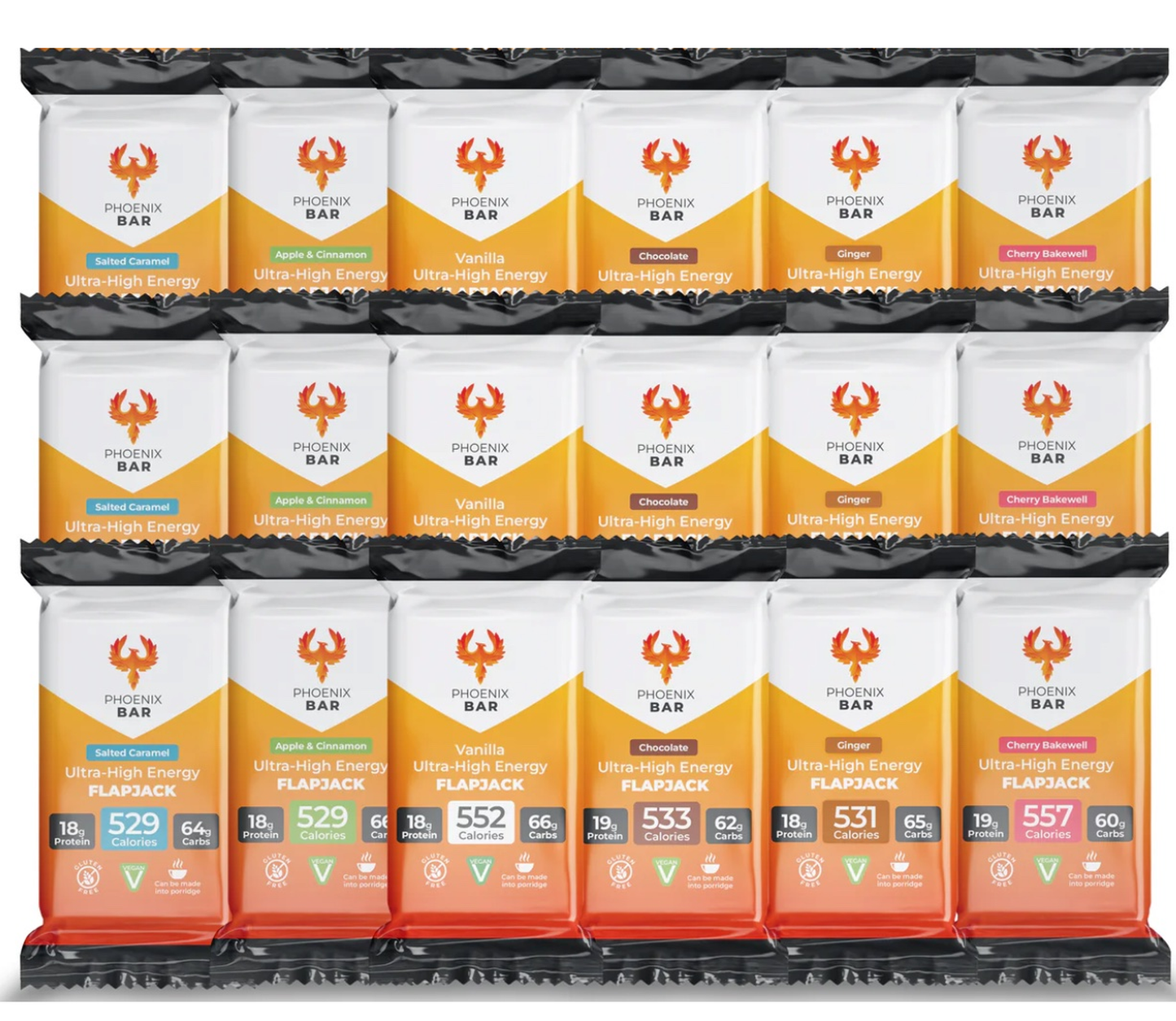
Phoenix Bars: Up to 557 Calories Per Bar
Highly compact, low-volume, calorie-dense bars. Soft, easy to eat whole or as a warm porridge. Vegan, gluten-free and contain up to 66g of carbohydrates, 19g of protein & 8 vitamins & minerals.
The mountain and moorland monsters
Hardmoors 110 (May, the Cleveland Way, around 110 miles). North York Moors coastline and heather, understated and brutal in bad weather. The fuelling problem: exposed sections where stopping to faff with food costs you heat, so eat on the move or not at all.
Snowdon Ultra 100 and Cheshire Ring Ultra 100 (GB Ultras series, various dates). Well-marked, well-supported hundreds with GPS tracking and a belt buckle culture that makes them popular first mountains-or-flat choices depending on which you pick.
The flat and fast: best first hundreds
Thames Path 100 (spring, Richmond to Oxford). The UK’s fastest hundred, with the gentlest profile. The fuelling problem: flat courses remove the walking breaks that double as eating breaks, so set an alarm and eat by the clock, around 200 to 300 calories every hour from the first hour. Our 100 mile ultramarathon nutrition guide covers the full plan.
Autumn 100 (October, Goring, four 25 mile out-and-back spurs). Pass your start point three times, which is either mentally kind or cruel. Logistically the easiest hundred in Britain: one drop bag location, four visits.
Robin Hood 100 (September, Nottinghamshire). Flat, friendly, generous cut-offs, a favourite first hundred.
North Downs Way 100 (August, Farnham to Ashford). Deceptively hilly chalk with staircase stings in the second half; August heat is the real opponent.
Cotswold Way Century (September, Chipping Campden to Bath, 102 miles). Honey-stone villages and relentless short climbs.
And if towpath suffering appeals, the Canalrace series (Grand Union Canal Race and siblings, 130 to 145 miles) sits just beyond the buckle distance: low-key, non-stop and older-school than anything else here.
What should you eat during a 100 mile ultramarathon?
Aim for 200 to 300 calories per hour from food your stomach accepts at mile 70, not mile 7. Most DNFs this distance are stomachs, not legs. Chris, one of our customers, after the Spine Sprint: “I ate 3 Phoenix Bars during the Spine Sprint and they helped fuel me to a 7th place finish. I normally struggle to eat solids during races but I found Phoenix Bars so easy to get down on the move and to digest. I would be keen to use these for the Lakeland 100.” And Mike, at the 5 Valleys Ultra: “I ate my first bar at around 26 miles... I spent the last 10 miles overtaking pretty much everyone I saw.”
One 120g Phoenix Bar carries up to 557 calories, breaks into soft chunks, and can be mixed with water into a porridge when chewing stops being an option. That is why they have become a drop bag staple: see the best energy bars for ultra running, plan your checkpoints with the drop bags and aid stations guide, and build your buildup around the ultramarathon training plan.
FAQ
How long does a 100 mile ultramarathon take? Most mid-pack finishers take 24 to 34 hours on trail hundreds; winners run 14 to 18 hours on fast courses. Cut-offs range from about 24 hours (racing-oriented events) to 38 or more (winter and mountain races). Check the cut-off before the course profile; it decides how much walking you can afford.
Do I need to qualify for UK 100 milers? Many do ask for evidence: Centurion events require a previous long-ultra finish, Lakeland and the West Highland Way use ballots with experience criteria, and UTS requires UTMB index stones. Flat hundreds like Robin Hood are typically open entry.
How many calories do you burn in a 100 miler? Roughly 10,000 to 16,000 calories depending on body weight and climbing, which is why you cannot out-store it with breakfast; our customers managing weight through heavy training blocks often lean on high calorie bars for weight gain to keep intake up between long runs.
What is the hardest 100 mile race in the UK? By climbing and terrain, Ultra-Trail Snowdonia’s 100; by conditions, the winter Arc of Attrition and the Spine Challenger. “Hardest” is really a question of which weakness a course finds first.
Rated 4.9 out of 5 from nearly 400 reviews, Phoenix Bars are made in the UK and hand-packed by James with every order. If a hundred is on your 2027 list, sort the stomach before the shoes.


Flaming Phoenix



Contact Us
Widerruf erklären
Füllen Sie das folgende Formular aus, um Ihre Widerrufserklärung abzugeben.

