

Best Foods for Ultra Running: What to Eat, Hour by Hour
The best foods for ultra running, mapped to race stages: what works early, what survives the mid-race gut, and what saves the late hours.
In diesem Leitfaden

Quick answer: The best food for ultra running changes with the hour: sports drink, gels and bananas early, salty real food such as potatoes, sandwiches and crisps in the middle, then soup, noodles and flat cola late. Together they should add up to 150 to 400 calories an hour, the race target in the International Society of Sports Nutrition's ultra-marathon position stand.
There is no single best food, because the food that works at hour two is often the food you cannot look at by hour ten. So this list runs in race order, with calories, carbohydrate and salt for each food and a ranking of the best snacks to carry by calories per gram. Strategy, timings and hydration live in the full ultra running nutrition guide; this page is the what. For bars specifically, the ranking of the best energy bars for ultra running compares them on calories and carbohydrate, and if your race is a backyard, the backyard ultra nutrition guide has a lap-by-lap plan.
How many calories and carbs should you eat per hour in an ultra?
Aim for 150 to 400 calories an hour, with 30 to 50g of carbohydrate and 5 to 10g of protein, as recommended for racing by the ISSN ultra-marathon position stand, led by researchers at Sheffield Hallam and Anglia Ruskin universities.
That is a floor to build from, not a ceiling. In one 100-mile study the ISSN reviewed, finishers averaged about 66g of carbohydrate an hour against about 42g for runners who dropped out, and elite ultra runners have been measured at around 71g. General sports advice allows up to about 90g an hour for events over two hours using glucose and fructose mixes, but the ISSN warns that rate may be unrealistic beyond six hours, because it means 360 calories of almost pure carbohydrate every hour just as your appetite turns towards fat and salt. Start at 40 to 50g, and only go higher after weeks of practice on long runs.
Every food below, from aid-station staples to high calorie bars, is here because it helps you hit those numbers when appetite, weather and your stomach start voting against you. Values are typical serves from Table 4 of the ISSN paper unless stated, so check the labels on what you actually buy.
Hours zero to four: the fast carb window
In the first four hours, eat simple carbohydrate little and often from the start, not from the first dip: your gut is co-operative and sugar goes straight in.
What works: energy gels and chews for precision (a 40g gel is about 91 calories and 23g of carbohydrate), sports drink doing double duty with fluid, bananas (135 calories and 30g in a 150g banana), dates (89 calories and 20g in 30g), jelly sweets, white bread with jam or honey (a jam sandwich is about 218 calories and 46g), rice cakes and fruit purée pouches. One gel plus 500ml of drink made with half a 50g serve of powder gives about 184 calories and 46g of carbohydrate, which covers an hour on its own.
The classic first-timer error is building the entire plan here, all gels, all sugar, because it works beautifully in hour two and then mutinies in hour seven. If gels already turn your stomach in training, the energy gel alternatives guide is the fix; either way, cap the sugar-only phase deliberately and move to real food earlier than feels necessary.
Hours four to ten: the real food shift
From about hour four, solid, savoury, familiar food starts to outperform sports products, because gut and palate fatigue arrive and salt losses build.
This is where ultras are actually fuelled. Good choices: salted boiled potatoes (about 173 calories and 26g of carbohydrate per 100g in the ISSN table, with almost no salt until you add it), small sandwiches (a peanut butter one is about 342 calories, 38g of carbohydrate and 568mg of sodium), malt loaf (two slices, 129 calories), salted crisps (a 28g bag is 150 calories and 150mg of sodium), plain wraps, oat bars and flapjacks, pretzels and plain salted rice. Mild cheese helps too: 42g of cheese bites is about 140 calories, 10g of protein and 320mg of sodium. If you would rather make your own, the high-calorie flapjack recipe travels well in a vest.
The eating technique matters as much as the menu: solids go down on the walking climbs, in small bites, chewed properly, never on the runnable descents. The ultra high carb solid foods guide ranks this whole category. This is also the stage Phoenix Bars, which we make, were designed for: up to 557 calories and 66g of carbohydrate in a small, soft 120g bar that can be broken into pieces and eaten across several hours. Philip, who uses them on long fell runs, wrote that they "have now become the standard food for my long fell runs (15+ miles)."
Hour ten and beyond: soft, salty, drinkable
After about ten hours, the best foods are soft, salty and drinkable, because sweetness becomes repulsive and chewing becomes work. The ISSN position stand notes that runners increasingly prefer savoury, fattier, saltier food as races get longer.
The food that rescues races barely counts as food: salty noodle soup, plain broth, tomato soup, rice pudding, custard pots, mashed potato, flat cola, warm sweet tea and milky drinks where a crew can provide them. A 330ml can of Coca-Cola Original Taste is 139 calories and 35g of carbohydrate, according to the manufacturer's product sheet, but no salt, so pair it with something salty. Liquid and semi-liquid calories slide past a gut that solid food can no longer negotiate with, and the salt is doing as much work as the carbohydrate. Two palate tricks worth trying: brushing your teeth or chewing mint gum at a night checkpoint, and alternating salty with sweet so that both last longer.
Best snacks for ultra running, ranked by calories per gram
The best snacks to carry are the ones with the most calories per gram that you can still eat on the move, because every gram in your vest is carried for the whole race. Here is the arithmetic for common choices (calories divided by serve weight, from the ISSN table and our own label):
- Macadamia nut butter, 28g sachet: 215 kcal, about 7.7 kcal per gram (mostly fat, so slower to digest).
- Salted cashews, 50g: 296 kcal, about 5.9 kcal per gram.
- Salted crisps, 28g: 150 kcal, about 5.4 kcal per gram, plus 150mg of sodium.
- Phoenix Bar, 120g: 529 to 557 kcal, about 4.4 to 4.6 kcal per gram, with up to 66g of carbohydrate.
- Trail mix, 50g: 224 kcal, about 4.5 kcal per gram.
- Beef jerky, 25g: 103 kcal, about 4.1 kcal per gram, plus 8g of protein and 520mg of sodium.
- Homemade oat bar with syrup, 90g: 340 kcal, about 3.8 kcal per gram.
- Sports energy bar, 55g: 180 kcal, about 3.3 kcal per gram.
- Dates, 30g: 89 kcal, about 3.0 kcal per gram.
- Energy gel, 40g: 91 kcal, about 2.3 kcal per gram.
- Banana, 150g: 135 kcal, about 0.9 kcal per gram.
Pack weight is where this pays off. Say a 50-mile race takes you 12 hours at 250 calories an hour, so 3,000 calories, and the aid stations supply half. Carrying the other 1,500 calories as gels means about 16 gels and 660g (1,500 / 91 = 16.5 gels x 40g). As Phoenix Bars it is under three bars and about 325 to 340g (1,500 divided by 4.4 to 4.6 calories per gram). As bananas it would be over 1.6kg. Ian F, who uses our bars on multi-day ultras, put it plainly: "They are the most calorie per weight I could find, so they helped to reduce the weight of my running pack."
Calories per gram is not the only test. Fat-heavy foods such as nut butter and cashews are dense but slow to digest and low in carbohydrate, and gels deliver fast sugar that dense solids cannot. The best vest mixes both: gels or drink for quick carbohydrate, and one or two dense solids for the bulk of the calories.
When everything stops working
When nothing will go down, do not stop eating; shrink the units to a sip or a single bite every few minutes and keep walking. In a survey of 500 runners from the Western States and Vermont 100-mile races, nausea or vomiting was the main reason for dropping out for 23% of non-finishers.
One crisp, one sip of flat cola, a fingernail of bar, walking while you take it, until the system settles. Fix the smallest deficit you can act on first: a few hundred millilitres of fluid, a salty bite, then a little sugar. The guide to nausea and appetite loss during endurance events covers this in more detail, and gut training for ultras is how you make it less likely in the first place.
Foods that fail
High-fibre anything early, heavy fat in the first half, dry proteins such as jerky and chicken that demand saliva you no longer have, spicy food unless deeply trained, fizzy drinks before they have gone flat, and above all, anything you have never eaten on a training run. The ISSN advises a familiar, easily digested race-day breakfast that avoids high-fat and high-fibre food for the same reason. The race is the exam, not the experiment. Shorter trail races make ideal rehearsals, and the guide to trail running food covers fuelling for those.
What should you carry, and what should you take from aid stations?
Carry your hourly carbohydrate in formats you have trained with plus one dense solid and any emergency food your race requires, and use aid stations for variety, hot food and morale.
Plan the two lists separately. Your vest carries precision and insurance; if your race's mandatory kit includes emergency food, a single, compact 120g bar covers it in one item, as the ultra marathon kit list explains. Aid stations provide variety, hot options and morale, and the discipline there is take-away, not picnic: grab what works, fill a pocket, eat on the move. For races with drop bags, the guide to ultramarathon drop bags and aid stations covers what to leave where. If you are building towards a 100-miler, the best 100-mile ultramarathons guide lists the races worth the training.
Frequently asked questions
Are gels enough for an ultra marathon? For most people, no. Gels excel early, but at about 91 calories each you would need four or more an hour to reach the top of the ISSN range, and gut and palate fatigue usually turn a gels-only plan into a liability in the middle hours. Most finishers move to real, savoury food and finish on soft and liquid calories.
What do ultra runners eat at aid stations? The staples are salted potatoes, crisps, sandwiches, sweets, fruit, cola and, at longer races, soup and noodles. Treat them as a supplement to a carried plan, not the plan itself, because you cannot rely on a particular food being there or on your stomach accepting it.
Why do ultra runners drink Coke? Full-sugar cola is fast, familiar carbohydrate that goes down when solid food will not: a 330ml can is 139 calories and 35g of carbohydrate. Runners let it go flat to avoid gas and often save it for the later hours, when its caffeine helps too. It contains no salt, so pair it with crisps or broth.
Is cheese good for ultra running? In small amounts, yes, especially after the first few hours: 42g of cheese bites gives about 140 calories, 10g of protein and 320mg of sodium. It is low in carbohydrate and slower to digest, so eat it alongside bread, crackers or potatoes, not in place of your carbohydrate.
What should I eat on race morning before an ultra? A familiar, easily digested breakfast based on carbohydrate, low in fat and fibre, eaten early enough to settle, which is the ISSN's race-day advice. Porridge, toast with jam or a bagel are common choices. In the 48 hours before, the ISSN suggests about 10g of carbohydrate per kg of body weight a day.
Sources: hourly targets, food values, carbohydrate intakes and race-day advice from the International Society of Sports Nutrition position stand on ultra-marathon nutrition (Tiller and colleagues, 2019); drop-out reasons from Hoffman and Fogard (2011); cola values from the Coca-Cola Original Taste product sheet; Phoenix Bar values from our own labels.
Written by James Frost, founder of Flaming Phoenix, which makes Phoenix Bars. I pack every order myself in London and answer every email. Updated October 2026.
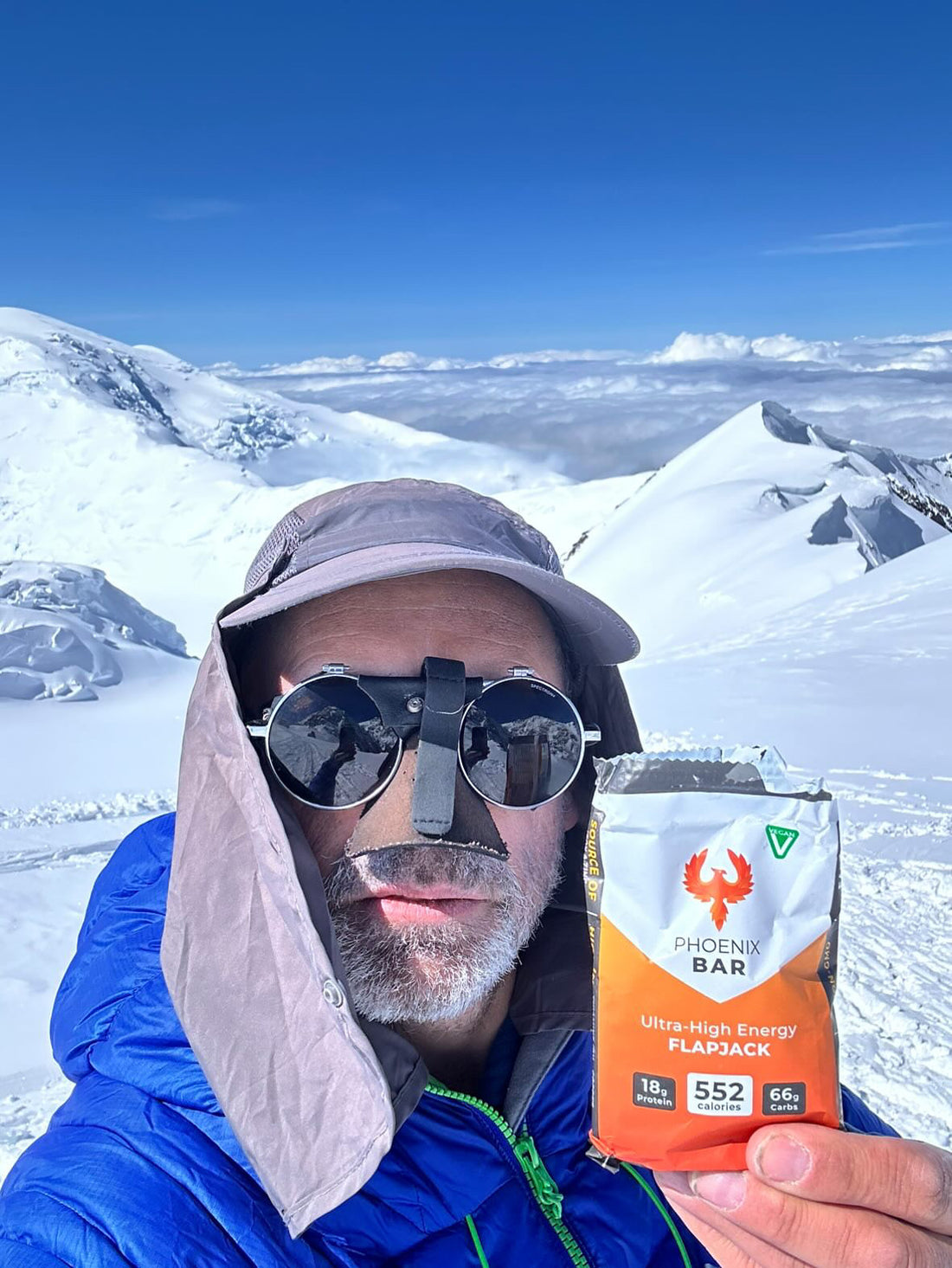
Viele Kalorien. Kleiner Riegel.
Bis zu 557 Kalorien in einem kompakten, leichten Riegel von nur 120 g, mit bis zu 66 g Kohlenhydraten und 19 g Protein. Im Ganzen essen, über ein paar Stunden in Stücken essen oder mit heißem Wasser oder warmer Milch zu Porridge verrühren.
Leicht zu essen, leicht verdaulich und nicht zu süß. Kunden haben sie bei -45 °C und in der Hitze des Marathon des Sables gegessen, und sie sind bis zu zwei Jahre haltbar: für die Berge, die Nachtschicht oder zu Hause, an Tagen, an denen genug zu essen schwerfällt.
- 557 Kalorien in nur 120 g (529 bis 557 je nach Sorte)
- 4,6 Kalorien pro Gramm
- 66g Kohlenhydrate pro Riegel (bis zu)
- 19g Protein pro Riegel (bis zu)
Widerruf erklären
Füllen Sie das folgende Formular aus, um Ihre Widerrufserklärung abzugeben.

