
How to gain weight fast (without just gaining fat)
In diesem Leitfaden

Quick answer: The fastest useful way to gain weight is a surplus of about 500 to 700 calories a day above maintenance, mostly from calorie-dense food and drinks, with plenty of protein and heavy lifting, which adds roughly 0.5kg a week. Pushing much harder mostly adds fat, because muscle can only grow so fast.
 Written by James Frost, founder of Flaming Phoenix and the maker of Phoenix Bars. Updated November 2026.
The first week or two often looks faster than that, because more food and carbohydrate pulls water into your muscles and adds weight in your gut. That early jump is real on the scale but it is not tissue, so judge your rate from week three onwards.
I'm James. I make high-calorie bars, and getting a lot of calories into people quickly is the whole thing I work on. So this page is about doing "fast" properly. The internet is full of advice to just eat everything in sight, and it does put weight on, but mostly the wrong kind. If you want to gain fast and actually keep something worth having, there is a right way to be aggressive. For the underlying fundamentals of gaining weight at any pace, start with our main guide on how to gain weight; this page is the fast-track version.
How fast can you realistically gain weight?
Faster than most people manage, but with an important split between weight and muscle. Total bodyweight can climb quickly, and at the aggressive end you can add around 0.5kg a week, with the first week or two often looking even faster because a higher food and carbohydrate intake pulls in water and fills your glycogen stores. Muscle specifically is slower: for most beginners the realistic ceiling is somewhere around 0.5 to 1kg of actual muscle a month, often less, and it slows down the more trained you are. Complete beginners and people who are underweight can gain faster on both counts because their body is primed to respond. Any gain beyond that muscle ceiling is fat, so "as fast as possible" and "as fast as useful" are not the same number. Aim for the second.
How much weight does a calorie surplus add?
A common rule of thumb is that about 7,700 calories of surplus adds roughly 1kg of bodyweight. Here is what that means at different daily surpluses.
| Daily surplus | Extra calories a week | Approx. gain a week | Approx. gain in 4 weeks |
|---|---|---|---|
| 300 calories | 2,100 | 0.27kg | 1.1kg |
| 500 calories | 3,500 | 0.45kg | 1.8kg |
| 700 calories | 4,900 | 0.64kg | 2.5kg |
| 1,000 calories | 7,000 | 0.9kg | 3.6kg |
These are approximate. Real gains usually come in a little lower, because your body burns some of the extra through more movement and heat, and the first week includes water and food weight on top. The useful band for most people is the 500 to 700 row. At 1,000 calories a day the scale moves faster, but well past what muscle can use.
How much weight can you gain in a month?
Around 2kg in a month is realistic on a steady 500 to 700 calorie daily surplus, roughly 1.8 to 2.5kg by the rule of thumb above. For a beginner who is lifting, perhaps 0.5 to 1kg of that can be muscle, and the rest is fat, water and glycogen. Gaining 5kg in a month would take a surplus of about 1,300 calories every day, and most of that extra would be fat.
What is the fastest way to gain weight?
Six levers, in order of how much they speed things up.
The biggest is a large but controlled surplus. For fast gains, push toward the higher end, around 500 to 700 calories a day over maintenance, accepting that a little more fat comes with the speed. Track it, because guessing is how a "big" intake turns out to be maintenance. Work out your maintenance number first with our calories to gain weight guide.
The second, and the one that makes the first possible, is calorie density. You cannot gain fast if you fill up before you hit your surplus, so lean on food that packs a lot of calories into little volume. A tablespoon of olive oil is about 120 calories, two tablespoons of peanut butter about 190, and a big weight gain bar 500 or more. The calorie-dense foods list ranks the rest; for between meals, try the high-calorie snacks.
Third, drink your calories. Liquids slip past fullness in a way solid food does not. A weight-gainer shake of milk, oats, a banana and peanut butter carries about 640 calories and goes down in a few minutes.
Fourth, eat frequently, four to six times a day, so the total is spread across sittings you can actually finish. Fifth, keep protein high, around 1.6 to 2.2 grams per kilogram of bodyweight, so the fast gain is muscle rather than only fat. And sixth, lift heavy with progressive overload on compound movements, because without a training stimulus a fast surplus has nowhere to go but fat. A sample aggressive day, around 4,000 calories, is laid out in our 4,000 calorie meal plan.
How do you add 650 calories without a bigger plate?
Small add-ons to meals you already eat are the quickest way to reach a fast-gain surplus. The first four on this list come to about 650 calories, using typical UK values.
| Add-on | Amount | Approx. calories |
|---|---|---|
| Olive oil stirred into pasta, rice or soup | 1 tablespoon | 120 |
| Peanut butter on toast you already eat | 2 tablespoons (32g) | 190 |
| Whole milk instead of water or squash | 250ml glass | 160 |
| Mixed nuts between meals | 30g handful | 180 |
| Grated cheddar on a meal | 30g | 125 |
The figures are approximate and vary by brand. None of these needs a new meal or much more room in your stomach, which is why they work when your appetite is the limit.
Is it bad to gain weight too fast?
Beyond the muscle ceiling, yes. Gaining faster than your body can build muscle means the surplus lands as fat, which brings a longer, harder cut later and tends to nudge your energy, blood lipids and how you feel in the wrong direction. There is also no speed benefit past a point, because you cannot force muscle to grow faster than it will by eating even more. So aim for a surplus big enough to gain quickly and small enough that most of the gain is worth keeping, which is the 500 to 700 calories above.
How can you gain weight fast if you have no appetite?
This is the real bottleneck for most people trying to gain fast, and the answer is to stop relying on volume. Use the densest, smallest foods so each mouthful carries more, drink calories rather than chewing them, add a fat like oil or nut butter into meals you are already eating so the calories climb without the plate growing, and eat to a schedule rather than waiting for hunger that never quite arrives. If you fill up fast in general, our guide for hardgainers goes deeper on exactly this problem.
Where Phoenix Bars fit
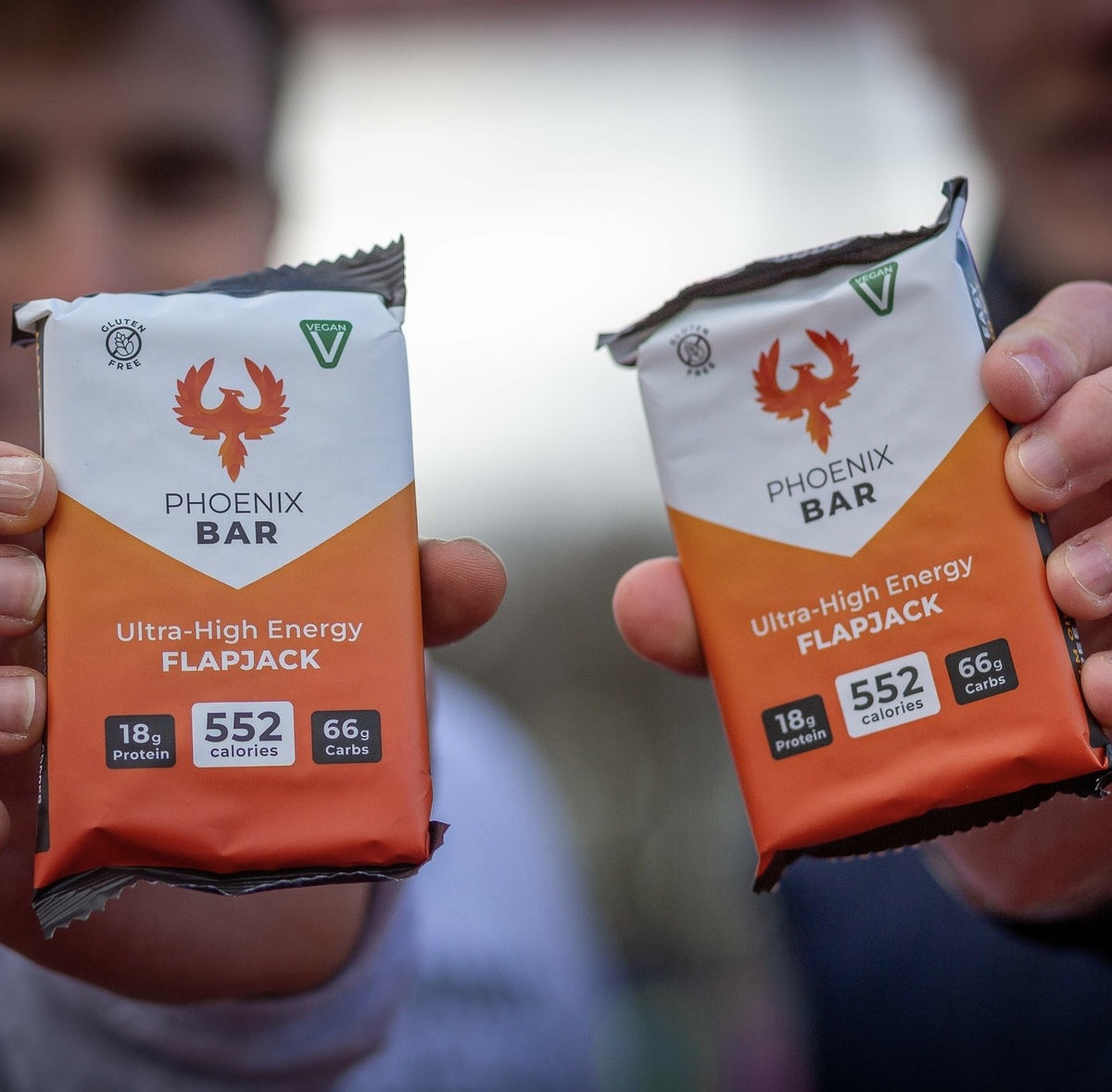
Fast weight gain lives or dies on whether you can actually get the calories in, and that is the problem I make Phoenix Bars for. Each one has up to 557 calories in a compact, 120g bar, so a single bar covers most or all of a fast-gain surplus without the volume of another meal, which is usually what stops fast gains in their tracks. No prep means it covers the busy day when cooking is not happening, and you can mix one with water or milk to make a porridge you eat with a spoon. See how to use Phoenix Bars for the different ways to take them. To compare them with other brands, see the best energy bars for weight gain.
Frequently asked questions
How fast can you gain weight?
At the aggressive end, around 0.5kg of bodyweight a week from a 500 to 700 calorie daily surplus, faster in the first week or two from water and food weight. Actual muscle is much slower, roughly 0.5 to 1kg a month for a beginner, so most gain beyond that is fat.
How can I gain weight in a week?
Expect the scale to move fastest in week one, partly from real gain and partly from extra food and water weight as you raise your intake. Run a 500 to 700 calorie surplus with dense foods and liquid calories, and do not read too much into that first jump.
Is gaining weight fast bad for you?
Gaining faster than you can build muscle just adds fat, which means a harder cut later and worse health markers, with no extra muscle to show for it. Aggressive but controlled beats all-out.
What is the fastest way to gain weight?
A large controlled surplus of calorie-dense food, liquid calories to bypass fullness, frequent meals, high protein, and heavy lifting so the gain is muscle. Drinking calories is usually the single fastest lever.
How many calories do I need to gain weight fast?
Around 500 to 700 above your maintenance level, tracked rather than guessed. Work out your maintenance first, then add the surplus and adjust based on the scale each week.
Can you gain weight fast without lifting weights?
Yes, the scale will move on a calorie surplus alone. Without resistance training, though, very little of the gain is muscle, so most of it is fat. Two or three full-body sessions a week are enough to change that.
Why am I not gaining weight even on a surplus?
Usually because the surplus is smaller than you think. Weekend dips, skipped snacks and more movement when you eat more all eat into it. If your weekly average has not moved for two weeks, add another 200 to 300 calories a day and check again.
Related guides
Go deeper from here: how to gain weight for the full fundamentals, why you can't gain weight and how to gain weight with a fast metabolism if the scale is stuck, calorie-dense foods, weight-gainer shakes and high-calorie snacks for what to eat, and calories to gain weight for your target number.
About this guide: Written by James Frost, founder of Flaming Phoenix and the maker of Phoenix Bars, drawing on more than 150 conversations with people who find it hard to eat enough. The bars are rated 4.9 out of 5 from more than 390 customer reviews. This guide combines that experience with established nutrition principles. It is general information, not medical advice. If you have lost weight without trying, see your GP before you set out to gain it back fast. Last reviewed November 2026.
Sources: McCance and Widdowson's CoFID 2021; Morton RW and others, British Journal of Sports Medicine, 2018; Phoenix Bar values from our own pack labels.

Viele Kalorien. Kleiner Riegel.
Bis zu 557 Kalorien in einem kompakten, leichten Riegel von nur 120 g, mit bis zu 66 g Kohlenhydraten und 19 g Protein. Im Ganzen essen, über ein paar Stunden in Stücken essen oder mit Wasser oder Milch zu Porridge verrühren.
Leicht zu essen, leicht verdaulich und nicht zu süß. Kunden haben sie bei -45 °C und in der Hitze des Marathon des Sables gegessen, und sie sind bis zu zwei Jahre haltbar: für die Berge, die Nachtschicht oder zu Hause, an Tagen, an denen genug zu essen schwerfällt.
- 557 Kalorien in nur 120 g (529 bis 557 je nach Sorte)
- 4,6 Kalorien pro Gramm
- 66g Kohlenhydrate pro Riegel (bis zu)
- 19g Protein pro Riegel (bis zu)
Widerruf erklären
Füllen Sie das folgende Formular aus, um Ihre Widerrufserklärung abzugeben.

