
Dirty Bulking: Does It Work, and How to Bulk Smart
Quick answer: Dirty bulking means eating a large, unrestricted calorie surplus to gain size fast, with little regard for food quality. It does reliably add weight, but past a modest surplus the extra calories mostly become fat, not muscle, so you end up with more to cut later for no more muscle. The one thing it gets right is that calorie-dense, low-fullness food makes hitting a surplus easy, which is the real problem for most people trying to grow. You can get that same benefit from calorie-dense real food without the junk-food penalty, and that is what this guide shows you how to do.
I'm James, I built Phoenix Bars after 150 conversations with people who struggle to eat enough, from ultra-runners to hardgainers, and I ate a frankly stupid number of my own test calories getting the recipe right. So I have a lot of sympathy for the dirty bulk. When every meal is only 400 calories and the scale will not move, "just eat whatever, as much as you can" feels like the obvious fix. It sort of is, and sort of is not, and the difference is worth ten minutes. If you want the full strategy for running a bulk rather than the dirty-bulk question specifically, that lives on our main bulking guide; this page is about whether going dirty is a good idea and how to get its upside without its cost.
What is dirty bulking?
Dirty bulking is a period of aggressive, rule-free eating to support muscle and strength gains. If it has calories, it is fair game. It comes from the old gym adage "if you want to get big, you have to eat big," and it was made famous by old-school powerlifters who ate fast food by the bagful and got both very strong and very heavy. The opposite approach is a clean bulk, a controlled surplus built mostly from whole foods with protein and fibre tracked, which trades speed for a leaner result. Most people are choosing between those two poles, but the honest answer, as usual, is that the best option sits in the middle.
Does dirty bulking actually work?
Yes and no, and the "no" is the important part. A big surplus will absolutely make you gain weight, fast. What it will not do is build more muscle than a moderate surplus. Muscle growth is capped by your training stimulus, your protein intake, your recovery and, if you are drug-free, simple biological limits on how fast you can add tissue. It is not capped by how far past your needs you eat. Once you have supplied enough energy and protein to support the muscle you can actually build, every calorie beyond that has nowhere to go but fat storage. So the mental model of "more food equals more muscle, so maximum food equals maximum muscle" is wrong. Past a point, more food just equals more fat. The measure that matters here is your ratio of muscle to fat gained, and a smaller, controlled surplus with hard training gives you a much better ratio than an all-out dirty bulk.
Why dirty bulking feels like it works
Here is the part worth stealing. The genuine advantage of dirty bulking is not the junk itself, it is that junk food is less filling per calorie. Processed, high-fat, high-sugar food has low satiety, so you can eat a thousand calories of it and still have room, whereas a thousand calories of chicken, rice and vegetables leaves you stuffed for hours. For a hardgainer whose bulk keeps stalling, that low-fullness quality is the thing that finally gets them into a surplus. That is the real mechanism, and notice what it actually is: it is a calorie-density and fullness problem, not a food-quality argument. Which means the benefit is separable from the cost. You can chase low-fullness, calorie-dense food without it being garbage.
The downsides you are signing up for
The bill for a dirty bulk comes later, and it is bigger than people expect. First, the cut. All that extra fat has to come off, which means a longer, harder, more miserable dieting phase down the line, and often watching some of your hard-won size go with it. Second, how you feel. Rapid fat gain tends to drag your energy, your blood lipids and your insulin sensitivity in the wrong direction, and it can leave you sluggish and puffy rather than strong. Sports scientists who coach this for a living point out that gaining too fast even hurts your training directly, because the bloat and the fatigue blunt your cardio and your work capacity, so you actually lift worse. You bulk to train harder, and past a point the dirty bulk makes you train worse. That is a bad trade.

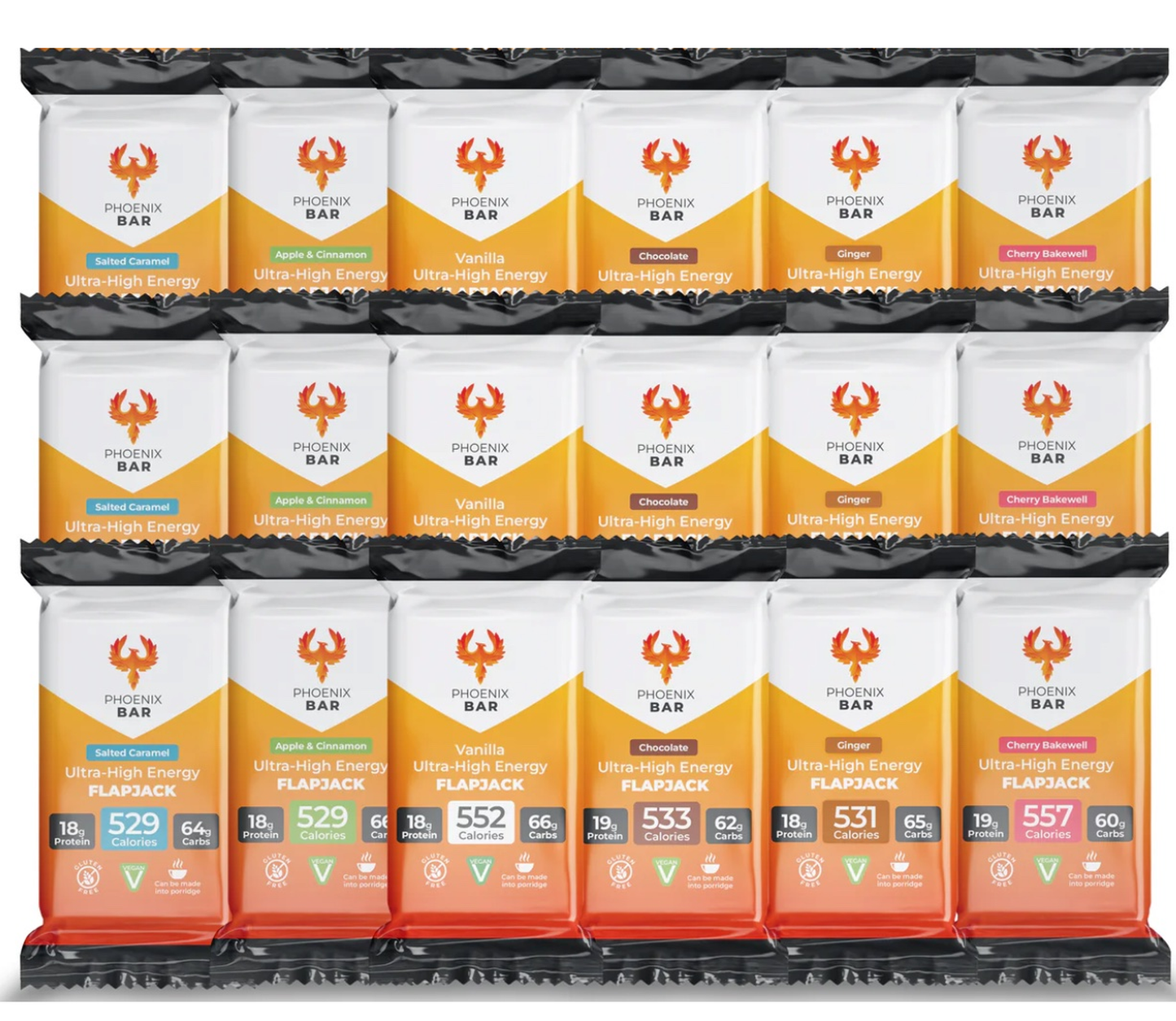
Phoenix Bars: Up to 557 Calories Per Bar
Highly compact, low-volume, calorie-dense bars. Soft, easy to eat whole or as a warm porridge. Vegan, gluten-free and contain up to 66g of carbohydrates, 19g of protein & 8 vitamins & minerals.
How big a surplus do you actually need?
Smaller than dirty-bulk culture implies. For most people, a surplus of roughly 250 to 500 calories a day over maintenance is enough to build muscle at close to your maximum rate while keeping fat gain in check. In terms of the scale, aiming for something like 0.25 to 0.5 percent of your bodyweight gained per week is a sensible lean-gain pace; complete beginners can push a little faster. Underneath the calories, get your protein right, around 1.6 to 2.2 grams per kilogram of bodyweight per day, because that is what turns the surplus into muscle rather than just weight. To put real numbers on your own target, our guide on how many calories you need to gain weight does the maths, and if you have been eating big for weeks with nothing to show for it, why you can't gain weight walks through the usual culprits.
The smart middle: dirty-bulk ease without the junk
This is the approach I would actually recommend, and it is the whole reason Phoenix exists. Keep the one good idea from dirty bulking, calorie-dense and low-fullness so the surplus is easy to hit, and drop the bad one, that it has to be junk. Real food does dense and low-fullness perfectly well. The most efficient options are oils and nut butters, nuts, full-fat dairy, granola and oats, dried fruit, fattier proteins like salmon and thigh meat, and calorie-dense bars, all of which our best high-calorie foods for bulking guide ranks in full, with the whole spectrum in calorie-dense foods. The practical trick is to add calories invisibly, stirring a fat into food that is already going down easily rather than adding another plate you have to force down. A loaded bowl of overnight oats or a homemade weight-gainer shake can carry 600 to 1,000 calories in a form you barely notice, and our bulking meals page has twelve full meals with the calories and protein counted so you clear both numbers at once. Between meals, dense grazing does the quiet work, which is what high-calorie snacks is for. None of this requires eating badly. It just requires eating dense.
Where Phoenix Bars fit
The honest reason our bars help a bulk is the fullness problem, not any magic. Most stalled bulks are not a knowledge problem, they are a "I physically cannot face a fourth meal" problem, and that is exactly the gap a dense, no-prep option fills. Each of our high-calorie bars is up to 557 calories in a 120g bar, with protein built in, and it needs nothing from you: eat it as a bar on a busy day, or stir it into hot milk as a porridge, or blend it into a shake, whichever is the least effort that day. It is real food, vegan and gluten-free, which makes it a cleaner way to add a dense few hundred calories than the usual dirty-bulk fillers. It is the thing to reach for when a shake is one step too many and a meal is two. If you want the different ways to use them, see how to use Phoenix Bars, and the six-bar bundle is the low-commitment way to test them on your own bulk before committing.
Common mistakes
The dirty bulk goes wrong in predictable ways. Going too big is the main one, treating "surplus" as "as much as possible" when a few hundred calories over maintenance is all your muscle can use, so the rest is just fat you will pay for later. Neglecting protein is the next, because calories without enough protein build the wrong kind of weight. Bulking without a hard training stimulus is pointless, since the surplus needs somewhere to go and only serious lifting sends it to muscle. Starting with no cut plan and no end date turns a "bulk" into simply getting heavier for months. And using "I'm dirty bulking" as a blanket permission slip for a genuinely bad diet catches up with your energy and your health long before it catches up with your physique. Almost all of these come back to the same fix: a controlled surplus of dense, mostly good food, trained hard, with a plan to stop.
Frequently asked questions
Is dirty bulking bad for you?
It is not inherently dangerous in a short off-season block, but done aggressively or for a long time it tends to worsen your blood lipids, insulin sensitivity and energy, and it leaves a lot of fat to cut later. A controlled surplus is the safer and usually more effective choice.
Does dirty bulking build more muscle than clean bulking?
No. Muscle gain is limited by training, protein and recovery, not by how far you exceed your calorie needs. Past a modest surplus the extra calories become fat, so a dirty bulk mostly adds fat, not more muscle, than a controlled bulk.
How many calories do you need for a bulk?
For most people a surplus of about 250 to 500 calories a day over maintenance, with protein around 1.6 to 2.2 grams per kilogram of bodyweight, supports near-maximal muscle gain with limited fat. Work out your own number in our calories to gain weight guide.
Clean bulk or dirty bulk, which is better?
For almost everyone, a controlled or lean bulk wins, because it builds the same muscle with far less fat and a much easier cut. The one edge dirty bulking has is that low-fullness food makes the surplus easier to hit, and you can get that from dense real food instead.
Can you dirty bulk without junk food?
Yes, and it is the best version. Use calorie-dense, low-fullness real foods like oils, nut butters, dairy, oats, dried fruit and dense bars to hit the surplus easily, without the health and body-fat cost of living on fast food.
How long should a bulk last?
Long enough to make meaningful gains, commonly a few months, then a planned cut. Endless bulking just becomes getting fatter, and a defined start and end keeps the fat gain worth the muscle.
Related guides
Build the rest of your plan from here: the main bulking guide for overall strategy, bulking meals and best high-calorie foods for bulking for what to eat, calorie-dense foods and high-calorie snacks for the raw materials, and how many calories you need to gain weight for your target. If your appetite, not your knowledge, is the block, why you can't gain weight is the place to start.
About this guide: I'm James, founder of Flaming Phoenix and Phoenix Bars, which I developed from more than 150 conversations with ultra-runners, expedition leaders and people who find it genuinely hard to eat enough. The bars are rated 5.0 out of 5 across more than 370 verified reviews. This guide reflects that experience alongside established sports-nutrition principles. It is general information, not medical advice, and individual needs vary, so check with a qualified professional if you have specific health considerations.


Flaming Phoenix



Contact Us
Widerruf erklären
Füllen Sie das folgende Formular aus, um Ihre Widerrufserklärung abzugeben.

