
DIY 24-hour ration pack (UK): what to pack and how many calories
In diesem Leitfaden

A DIY 24-hour ration pack is one person's food for a whole day, sealed in a single waterproof bag: a breakfast, two main meals, a pudding, snacks and drinks, in the same shape as a British Army ration pack. For a home emergency or grab bag, aim for about 2,000 to 2,500 calories of food that needs no cooking, in around 500g; for a hard, active day outdoors, aim for about 4,000 calories, the figure the Army's own 24-hour pack is built around. Below are three ready-made builds from UK supermarket food and Phoenix Bars, with the calories and weight of every item.
 Written by James Frost, founder of Flaming Phoenix and the maker of Phoenix Bars. Updated 2 November 2026.
The government's Be Ready campaign, launched on 22 October 2026, asks every household to be ready for 3 days, with non-perishable food that does not need a fridge or cooking and 3 litres of drinking water per person per day. A homemade ration pack is one of the tidiest ways to cover the food: one bag, one person, one day, with the calories already counted. For the full household shopping list, see our 3-day emergency food supply list.
Why I wrote this guide. Phoenix Bars began as my university project: a nourishing, very high-calorie bar designed to do the job of a food ration better. Fitting a day of food into the smallest, toughest package possible is the problem I have worked on ever since, and building your own ration pack is that problem in miniature. Phoenix Bars appear in each build below because I make them and they suit the job; everything else is ordinary supermarket food, and you can swap any of it.
This page is the build-it-yourself guide. If you want to know what is inside the real thing, our guide to British Army ration packs lists all 10 menus. If you would rather buy than build, our guide to emergency rations compares ration bars, biscuits and packs, and our MRE guide covers the American single-meal ration.
What goes in a 24-hour ration pack?
The British Army's 24-hour pack makes a sensible template. Each box holds a breakfast, two main meals and a pudding, plus a snack layer of biscuits, a bar, nuts and a spread, drink powders, a brew kit, and a few small items such as a spork, wipes, tissues, matches and water purification tablets. The main meals are already cooked, so they can be eaten cold or heated in boiling water. A whole box carries around 4,000 calories and weighs roughly 1.5 to 2kg, largely because the wet main meals are heavy for what they give.
A DIY pack copies that shape, with food you choose:
- Breakfast: something you can eat cold or make with water, such as a bar mixed into porridge.
- Two main meals: usually a cold lunch you can eat on the move, and a hot dinner if you will have a stove.
- Pudding: a small sweet thing to look forward to. Morale matters when you are cold, wet or worried.
- Snacks: calorie-dense food to eat through the day, such as bars, nuts and chocolate.
- Drinks: tea, coffee, hot chocolate and, on hot or hard days, electrolyte tablets.
- Extras: a spork, wet wipes, tissues, a lighter if you carry a stove, purification tablets and a spare bag for rubbish.
How many calories should a 24-hour ration pack have?
It depends on the day you are packing for:
- A normal day at home, or a grab bag: about 2,000 to 2,500 calories, in line with the NHS guide that an average woman needs about 2,000 calories a day and an average man about 2,500.
- A hard, active day outdoors: up to about 4,000 calories. That is what the British Army sizes its 24-hour pack at, for soldiers carrying kit and working all day, and a long day walking with a heavy rucksack can come close.
- Survival only: lifeboat-style rations are sized at around 800 to 1,200 calories a day, enough to keep going until rescue but well below what you need to feel normal.
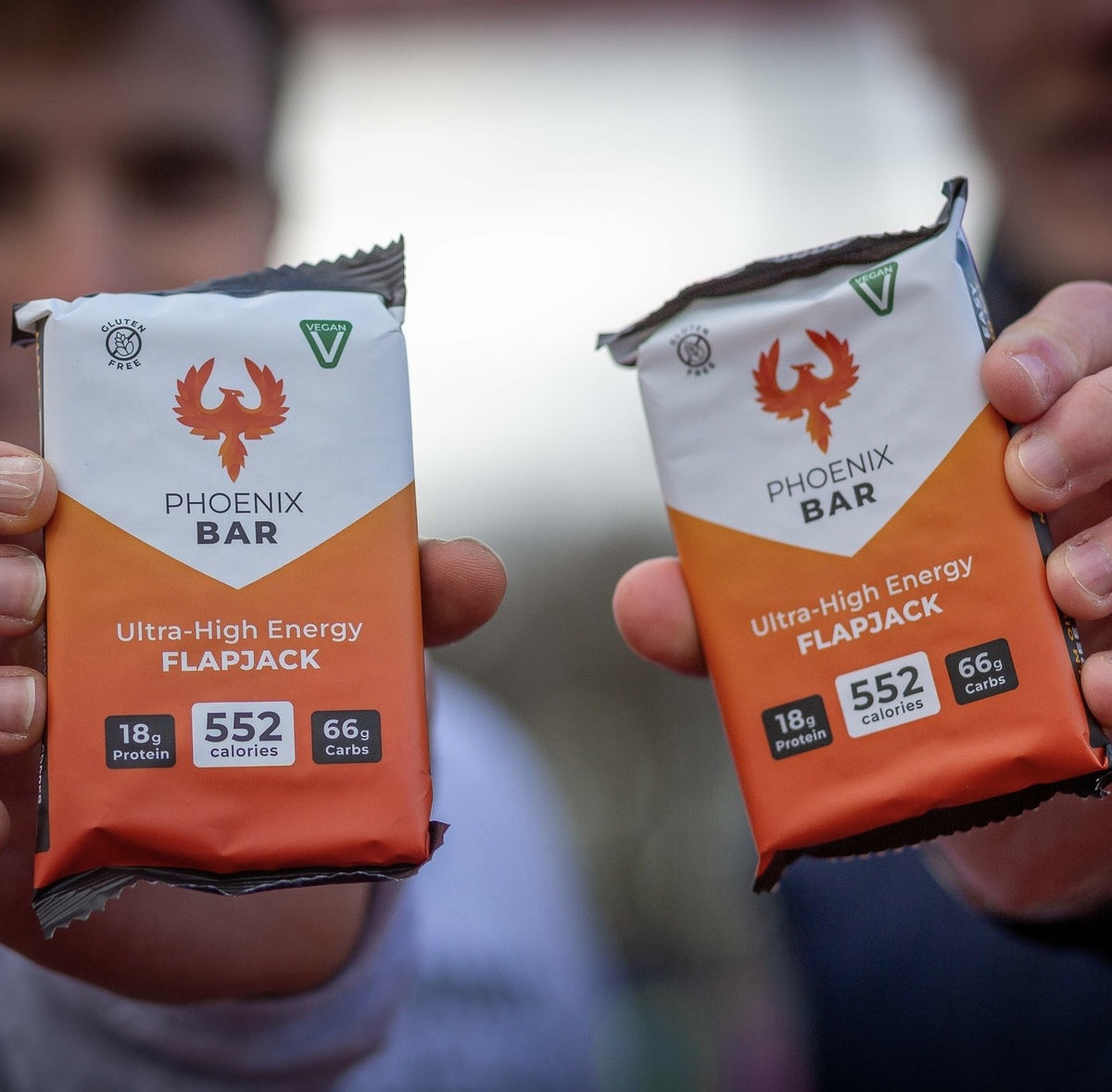
The other number that matters is calories per gram. Food with more than about 4 calories per gram, such as nuts, chocolate, nut butter and dense bars, keeps a day of food to around 500g. Wet food, such as tins, pots and ready meals, is mostly water, which makes it heavy for its calories. A Phoenix Bar carries up to 557 calories in only 120g, about 4.6 calories per gram, so two of them cover around half a day of food in one pocket.
Three ready-made 24-hour ration pack builds
Each build is one adult's food for 24 hours, grouped by meal the way a ration pack is. The calories come from the manufacturers' labels on UK supermarket products, checked in November 2026, and are rounded. Phoenix Bars are shown at up to 557 calories; depending on the flavour, a bar carries 529 to 557 calories, 60 to 66g of carbohydrate and up to 19g of protein. Recipes and pack sizes change, so always check the label on what you buy, and swap any item for one you prefer.
Build 1: home emergency or grab bag day (about 2,400 calories, no cooking)
For a Be Ready home supply, a grab bag or the car. Nothing needs cooking, heating or a tin opener, and none of the food needs water to prepare.
Breakfast
- 1 Phoenix Bar: up to 557 calories, 120g. Eat it as it is or break it into pieces.
Lunch
- Nairn's Rough Oatcakes, 6 oatcakes: about 275 calories, 62g.
- Pip & Nut peanut butter squeeze pack: about 180 calories, 30g.
- Peperami Original stick: about 110 calories, 22.5g. It does not need a fridge.
Dinner
- 1 Phoenix Bar: up to 557 calories, 120g.
- Soreen Malt Lunchbox Loaf: about 90 calories, 30g.
Snacks
- KP Original Salted Peanuts, 65g bag: about 400 calories, 65g.
- Cadbury Dairy Milk, 45g bar: about 240 calories, 45g.
Total: about 2,400 calories in just under 500g of food, nearly 5 calories per gram. That fits a grab bag without weighing it down, in line with the day of food in our emergency grab bag list. At home, with milk or water to spare, you can mix the breakfast bar into porridge instead.
Build 2: army-style active day (about 4,000 calories)
For cadets, a DofE practice expedition, a long day on the hill or a weekend camp with a stove. It follows the British Army pattern of a breakfast, two main meals, a pudding, a snack layer and a brew kit, with one hot meal at the end of the day.
Breakfast
- 1 Phoenix Bar mixed with water into porridge: up to 557 calories, 120g. It does not need hot water.
- Cadbury Instant Hot Chocolate sachet: about 110 calories, 28g.
Lunch (main meal 1, cold)
- 2 Mission Original Wraps: about 380 calories, 122g.
- John West No Drain Tuna Steak, 60g can: about 120 calories, 60g.
- Pip & Nut peanut butter squeeze pack, for the second wrap: about 180 calories, 30g.
Dinner (main meal 2, hot)
- Ainsley Harriott Moroccan Medley Cous Cous, 100g sachet: about 365 calories, 100g. Add 160ml of boiling water, cover and leave for 3 to 5 minutes.
- 2 Peperami Original sticks, sliced in: about 225 calories, 45g.
- 1 tablespoon of olive oil, stirred in: about 125 calories, 14g.
Pudding
- Ambrosia Rice Pudding pot: about 145 calories, 150g. Eat it cold, straight from the pot.
- 2 Soreen Malt Lunchbox Loaves: about 180 calories, 60g.
Snacks
- 1 Phoenix Bar: up to 557 calories, 120g.
- KP Original Salted Peanuts, 65g bag: about 400 calories, 65g.
- Cadbury Dairy Milk, 110g bar: about 590 calories, 110g.
Brew kit
- A second hot chocolate sachet for the evening: about 110 calories, 28g.
- Tea bags, instant coffee and sugar to taste, plus electrolyte tablets if it is hot.
Total: about 4,000 calories in about 1.05kg of food, before packaging. A military-style 24-hour pack weighs roughly 1.5 to 2kg, so this build comes in lighter while keeping the same shape of day. The tuna and rice pudding are the heaviest items for their calories; if weight matters, leave them out and add another Phoenix Bar or more nuts. On a DofE expedition, keep the hot dinner: the Award asks every team to cook and eat a substantial hot meal each day.
Build 3: lightweight hiking or expedition day (nearly 4,000 calories in about 770g)
For multi-day walks, wild camps and expeditions, where you carry every gram. No tins, pots or wet food: just calorie-dense, dry food from a UK supermarket, plus Phoenix Bars.
Breakfast
- 1 Phoenix Bar mixed with cold water into porridge: up to 557 calories, 120g. No stove needed.
On the move
- 1 Phoenix Bar: up to 557 calories, 120g.
- KP Original Salted Peanuts, 100g decanted from a larger bag: about 615 calories, 100g.
- Cadbury Dairy Milk, 110g bar: about 590 calories, 110g.
Lunch
- Nairn's Rough Oatcakes, 8 oatcakes: about 370 calories, 82g.
- 2 Pip & Nut peanut butter squeeze packs: about 360 calories, 60g.
Dinner
- Batchelors Super Noodles, 90g pack: about 450 calories, 90g. Simmer in 300ml of water for 4 minutes.
- 1 tablespoon of olive oil, stirred in: about 125 calories, 14g.
- 2 Peperami Original sticks, sliced in: about 225 calories, 45g.
Hot drink
- Cadbury Instant Hot Chocolate sachet: about 110 calories, 28g.
Total: nearly 4,000 calories in about 770g of food, over 5 calories per gram, and about 280g lighter than the army-style build for almost the same calories. If you would rather pour and wait than simmer, swap the noodles for the couscous from Build 2: you save fuel but carry a little more weight per calorie. Going without a stove? Our guide to no-cook backpacking meals has ideas, and our ranking of the lightest high calorie food for backpacking shows which foods carry the most calories per gram.
How to pack a DIY ration pack
- Lay out each day and check the total. Put everything for one day on the table, add up the calories from the labels, and weigh it on kitchen scales if weight matters.
- Bag each meal separately. Use one small zip-lock bag each for breakfast, lunch, dinner and pudding, one for snacks and one for the brew kit. You open one meal at a time instead of rummaging, and you can see what is left at a glance.
- Put the day in one waterproof outer bag. A heavy-duty freezer bag, a roll-top dry bag or a vacuum-sealed bag all work. Squeeze the air out so it packs flat.
- Strip bulky cardboard, but keep food sealed. Leave every item in its own sealed wrapper. Food you decant into loose bags goes stale sooner, so decant only for trips, not for a pack you will store.
- Keep the labels. If you remove outer packaging, cut out the panel with the ingredients, allergens and best before date and slip it into the bag.
- Label the outside. With a permanent marker, write the date you packed it, the earliest best before date of anything inside, the total calories, any allergens and, for a group, whose it is.
- Protect the crushable things. Oatcakes and wraps break or fold easily, so pack them flat against the side of the bag with soft items around them.
- Add the extras. A spork, wet wipes, tissues, a lighter or matches if you carry a stove, water purification tablets and an empty bag for rubbish, so everything goes home with you.
How long does a homemade ration pack last?
A DIY ration pack keeps for as long as its shortest-dated item, which is why the earliest best before date goes on the label. Phoenix Bars keep for up to two years (12 months for Cherry Bakewell). Supermarket items vary a lot, and bread products such as wraps and malt loaf usually carry the shortest dates.
- For a pack you will store, such as a grab bag or home supply, pick the longest-dated food, keep oatcakes in an unopened pack, and swap wraps and malt loaf for extra nuts or long-life high calorie bars.
- Store it somewhere cool, dry and dark. Heat shortens shelf life, so a hot loft or a car boot in summer is a poor home for most food.
- Check it every six months. Be Ready suggests setting a reminder every six months to check expiry dates and swap out anything that needs replacing.
- Rotate rather than waste. Eat anything close to its date on a walk, a long day or a camping trip, then repack. A ration pack you actually eat stays fresher than one you forget about.
- Know your dates. Best before is about quality and use by is about safety. Food with a use by date usually needs a fridge, so leave it out of a ration pack.
Water: the part a ration pack cannot carry for you
Food is only half the job. Be Ready asks for 3 litres of drinking water per person per day, with extra on top for cooking and cleaning.
- Build 1 needs no water to prepare, so all of your water is for drinking.
- Build 2 needs about 160ml for the couscous, plus water for the porridge and two hot chocolates.
- Build 3 needs about 300ml for the noodles, plus water for the porridge and a hot chocolate.
- Salty food such as peanuts, Peperami and noodles makes you thirstier, so drink little and often.
Out walking, carry what you can, plan where you will refill, and treat water from streams with purification tablets or a filter. At home, water is the bulkiest part of a 3-day supply; our guide to emergency water storage covers how much to keep and how to store it.
How to make a 3-day ration pack
A 3-day ration pack is three 24-hour packs, but a few things change when you multiply up:
- Pack each day separately and label the bags Day 1, Day 2 and Day 3, so you eat in date order and can see what is left.
- Vary the menu. The same food three days running gets dull, and food you are bored of is easy to leave uneaten. Swap the noodles for couscous or the peanuts for mixed nuts, and rotate Phoenix Bar flavours across the days.
- Check the weight. Three days of Build 1 weighs about 1.5kg, Build 3 about 2.3kg and Build 2 about 3.2kg, before water.
- Multiply the water too. Three days at Be Ready's 3 litres a day is 9 litres of drinking water per person, which is why most households store water at home rather than carry it.
- Carry enough fuel for three hot dinners if you are using Build 2 or 3, and a bag big enough for three days of rubbish.
For a home emergency you do not need three grab bags. Be Ready asks for 3 days of supplies at home plus a few essentials in a bag you can take with you, so a sensible set-up is one Build 1 per person in the grab bag and the other two days from cupboard food, as our emergency food preparedness guide shows. Our grab bag checklist covers everything else that goes in the bag.
Allergens, children and older relatives
Read every label, because the builds above contain several of the main allergens: peanuts (in the salted peanuts and peanut butter), milk (in the chocolate, hot chocolate and rice pudding), cereals containing gluten (in the oatcakes, wraps, malt loaf, couscous and noodles) and fish (in the tuna). Swap any item for one that suits your household, and recheck the calories when you do.
Phoenix Bars are vegan and gluten-free, and they contain soy. The Cherry Bakewell flavour contains almonds, some flavours contain sulphites, and the bars may contain milk, egg, nuts, peanuts and sesame.
- Children need fewer calories than adults, so a child's pack can be smaller. Pack the snacks they already eat, and try any new food at home first.
- Whole nuts are a choking risk for children under 5, as the NHS warns, so leave the peanuts out of a small child's pack and use a smooth spread instead.
- Older relatives, or anyone with a small appetite, often find soft food eaten a little at a time easier than big meals. A Phoenix Bar can be broken into small pieces or mixed with water or milk into a soft porridge, and a rice pudding pot is easy going too. Our guide to high-calorie foods for older adults has more ideas.
Build your own or buy a ration pack?
Both have a place. Building your own means food you like, allergens you control, less weight, and a pack you can eat on an everyday walk and replace. Buying means someone else has done the planning:
- Army or army-style 24-hour packs give you proper ready-cooked meals in one box, and opening one is good fun. Our guide to army ration packs covers the menus and what to check before you buy.
- Emergency ration bars and biscuits keep for 5 to 20 years, for a store you want to forget about. Our emergency rations guide compares them.
- MREs are single meals rather than a whole day, each with a built-in heater.
Plenty of people mix the two: a bought pack for the novelty night, and homemade packs built around food they will actually eat for the rest.
Common questions about 24-hour ration packs
What is a 24-hour ration pack?
A 24-hour ration pack is one person's food for a full day in a single sealed pack, usually a breakfast, two main meals, a pudding, snacks and drinks. The best known is the British Army's 24-hour Operational Ration Pack, at around 4,000 calories, but you can build your own from supermarket food, as above.
What is in a British Army 24-hour ration pack?
A breakfast, two ready-cooked main meals and a pudding, plus biscuits, a bar, nuts, a spread, drink powders, a brew kit, a spork, wipes, matches and water purification tablets. There are 10 standard menus, and our guide to British Army 24-hour ration packs lists them all.
How many calories are in a 24-hour ration pack?
A British Army 24-hour pack holds around 4,000 calories. For a homemade pack, aim for about 2,000 to 2,500 calories for a day at home or in a grab bag, and up to about 4,000 for a hard day outdoors.
How do you make your own ration pack?
Decide how many calories the day needs, choose a breakfast, two main meals, a pudding, snacks and drinks, and add up the calories from the labels. Bag each meal separately, put the day in one waterproof bag, and label it with the date packed, the earliest best before date and the total calories. The three builds above are ready-made starting points.
Can you make a ration pack that needs no cooking or water?
Yes. Build 1 gives about 2,400 calories of food that needs no cooking, heating or water to prepare, in just under 500g. You still need drinking water: Be Ready suggests 3 litres per person per day.
How long does a homemade ration pack last?
As long as its shortest-dated item. Write the earliest best before date on the bag, store it somewhere cool and dry, and check it every six months. Phoenix Bars keep for up to two years (12 months for Cherry Bakewell).
How heavy is a 24-hour ration pack?
A military-style 24-hour pack weighs roughly 1.5 to 2kg. A homemade pack can be much lighter: the builds above run from just under 500g for a no-cook home day to about 1.05kg for an army-style 4,000-calorie day, and the lightweight build carries nearly 4,000 calories in about 770g.
Can I use a DIY ration pack on a DofE expedition?
Yes, with one rule to plan around: the Duke of Edinburgh's Award asks teams to cook and eat a substantial hot meal each day, which is optional on the final day. Builds 2 and 3 include a hot dinner; Build 1 does not, so add one if you use it, and check your menu with your DofE leader.
Can I make my own MRE?
Yes, in the same way. An MRE is a single meal in a bag rather than a whole day, so build one meal at a time: a main, a side, a snack and a drink. Our MRE guide explains what goes in the American version.
Can you buy British Army ration packs?
Yes. MOD-issue packs reach civilians through military surplus dealers, prepper shops and online marketplaces, and civilian-made army-style packs are sold new. Check the pack date before you buy, so you know how much shelf life is left.
What is the best food for a DIY ration pack?
Food that is calorie-dense, keeps for months, needs little or no cooking, and that you will happily eat when you are tired. My pick, as the maker, is Phoenix Bars: high calorie bars with up to 557 calories in a compact, 120g bar and nothing to cook. Nuts, nut butter, chocolate and oatcakes round out the day well.
Flaming Phoenix is not affiliated with or endorsed by the Ministry of Defence. The builds on this page borrow the general format of a British Army 24-hour ration pack; they are not copies of any official ration.
Sources: manufacturer and retailer labels for Nairn's, Pip & Nut, Peperami, Soreen, KP, Cadbury, Mission, John West, Ainsley Harriott, Batchelors, Ambrosia and Tesco olive oil, checked November 2026; GOV.UK Be Ready; DofE expedition requirements (September 2025); NHS, understanding calories; NHS, foods to avoid giving babies and young children; MOD FOI response on ration pack types and menus (April 2022); Forces News, We try a British Army ration pack (May 2025).

Viele Kalorien. Kleiner Riegel.
Bis zu 557 Kalorien in einem kompakten, leichten Riegel von nur 120 g, mit bis zu 66 g Kohlenhydraten und 19 g Protein. Im Ganzen essen, über ein paar Stunden in Stücken essen oder mit Wasser oder Milch zu Porridge verrühren.
Leicht zu essen, leicht verdaulich und nicht zu süß. Kunden haben sie bei -45 °C und in der Hitze des Marathon des Sables gegessen, und sie sind bis zu zwei Jahre haltbar: für die Berge, die Nachtschicht oder zu Hause, an Tagen, an denen genug zu essen schwerfällt.
- 557 Kalorien in nur 120 g (529 bis 557 je nach Sorte)
- 4,6 Kalorien pro Gramm
- 66g Kohlenhydrate pro Riegel (bis zu)
- 19g Protein pro Riegel (bis zu)
