
Emergency rations UK: ration bars, biscuits and packs compared
In diesem Leitfaden

 Written by James Frost, founder of Flaming Phoenix and the maker of Phoenix Bars. Updated 25 October 2026.
Emergency rations are compact, long-life foods made to be eaten straight from the pack when normal food is not available. In the UK the main types are compressed biscuit rations such as Seven Oceans and NRG-5 (about 2,300 to 2,500 calories per 500g pack, with 5 to 20 year shelf lives), emergency ration bars such as Datrex and SOS (2,400 to 3,600 calories per pack, around 5 years), military-style ration packs (about 4,000 calories a day, around 2 to 3 years) and dense bars you would eat anyway, such as Phoenix Bars (up to 557 calories in only 120g, up to 2 years).
The government's Be Ready campaign, launched on 22 October 2026, asks every household to be ready for 3 days of disruption, and a few emergency rations are one of the simplest ways to cover the food side of a grab bag or car kit. For the full household shopping list, see our 3-day emergency food supply list.
Why I wrote this guide. Phoenix Bars began as my university project to design a nourishing, very high-calorie bar that could do the job of an emergency ration better. Since then I have spent years talking to people who rely on compact food far from a kitchen, from desert ultramarathons to a South Pole expedition. This guide compares the main emergency rations on their published specifications, including where our own bars fit.
What are emergency rations?
Emergency rations are foods designed to sit untouched for years and then feed someone with no cooking, no fridge and often no water to spare. The best known are lifeboat rations: compressed wheat biscuits made to the SOLAS and ISO 18813 standards for life rafts, vacuum-packed in foil and sized at roughly 2,500 calories per 500g.
They are built for survival rather than comfort. A pack sold as 72 hours of food typically supplies around 800 to 1,200 calories a day, enough to keep going until rescue but well below the 2,000 to 2,500 calories an adult normally eats. For a home supply where you want to feel normal for three days, plan on more.
How to choose an emergency ration
Judge every ration on six things:
- Calories per pack and per gram. Compressed rations sit around 4.6 to 5 calories per gram, about as dense as food gets.
- Shelf life. From 2 years for everyday dense bars to 20 years for the longest-life biscuits. Longer is only better if you will genuinely never rotate it.
- Water needed. Bars and biscuits need none to eat; freeze-dried meals need hot water for every serving.
- Temperature tolerance. This matters for car boots, sheds and boats. Some ration bars are tested from -30 to 65°C, while most lifeboat biscuits should be stored below 30°C.
- Allergens and diet. Most lifeboat rations are wheat-based, so check for gluten, soya and milk traces if anyone in your household needs to.
- Whether you will eat it. Food that people dread gets left, especially by children or anyone whose appetite drops under stress. Taste one before you rely on a stack of them.
Emergency rations compared
The figures below come from manufacturer and retailer listings checked in October 2026. Always check the label on the pack you buy, because specifications can change between batches and sellers.
Seven Oceans emergency food ration
- 500g pack of 9 bars (18 tablets), about 2,500 calories, roughly 270 per bar.
- Shelf life of 5 years from production.
- SOLAS approved for lifeboats and life rafts, made in Norway.
- Wheat flour, palm fat, sugar and added vitamins; may contain traces of milk and soya. Store below 30°C.
The standard ration for boats and the most common pack in UK prepper shops. Its plain, shortbread-style biscuits are made to keep for years, so they suit a grab bag you hope never to open.
NRG-5 emergency food ration
- 500g pack of 9 bars, about 2,300 calories (460 per 100g).
- Shelf life of up to 20 years, the longest of the compressed rations.
- Made in Germany for relief operations, emergency preparedness and outdoor use; contains gluten and soya.
- A gluten-free version, NRG-5 Zero, is also sold.
The pick if you want food that can genuinely be forgotten about for a decade or more. It can be eaten as it is or crushed into water as a porridge.
Datrex 2400 emergency food ration
- 12 individually wrapped 200-calorie bars, 2,400 calories in about 480g.
- Shelf life of 5 years from manufacture.
- Coconut flavoured, made in the USA and approved by the US Coast Guard; wheat-based and free of peanut products.
- Formulated not to provoke thirst.
The small, individually wrapped bars make it easy to spread through the day or split between people.
SOS 3600 emergency food bar
- 9 individually wrapped 400-calorie bars, 3,600 calories in total.
- Shelf life of 5 years from manufacture.
- Tested from -30°C to 65°C, which suits car boots and outbuildings; approved by the US Coast Guard.
- Coconut cookie flavour; contains wheat, coconut and soya.
The manufacturer suggests 3 bars per person per day, so one pack is pitched as a 3-day survival ration at about 1,200 calories a day.
Military-style 24-hour ration packs
- A British Army style 24-hour pack holds around 4,000 calories of ready-to-eat meals, snacks and drinks.
- Heavy, at around 1.5 to 2kg per day.
- The MOD requires at least 24 months of shelf life to remain when packs enter its supply chain; civilian packs usually carry around 2 to 3 years.
The closest thing to proper meals in a box. Our guide to army ration packs lists the menus and what is inside.
Ready-to-eat meal pouches
- Pre-cooked wet meals such as Wayfayrer, 300g per pouch, eaten hot or cold.
- Shelf life of 3 years from manufacture.
- Around 330 to 460 calories per pouch, so you need several a day.
They feel like dinner rather than a ration, which helps morale, though they weigh more for the calories they carry.
Freeze-dried meals
Sold with shelf lives of up to 25 years and light to carry, but every serving needs hot water, which a power cut or evacuation may take away. Our guide to freeze-dried meals compares the brands.
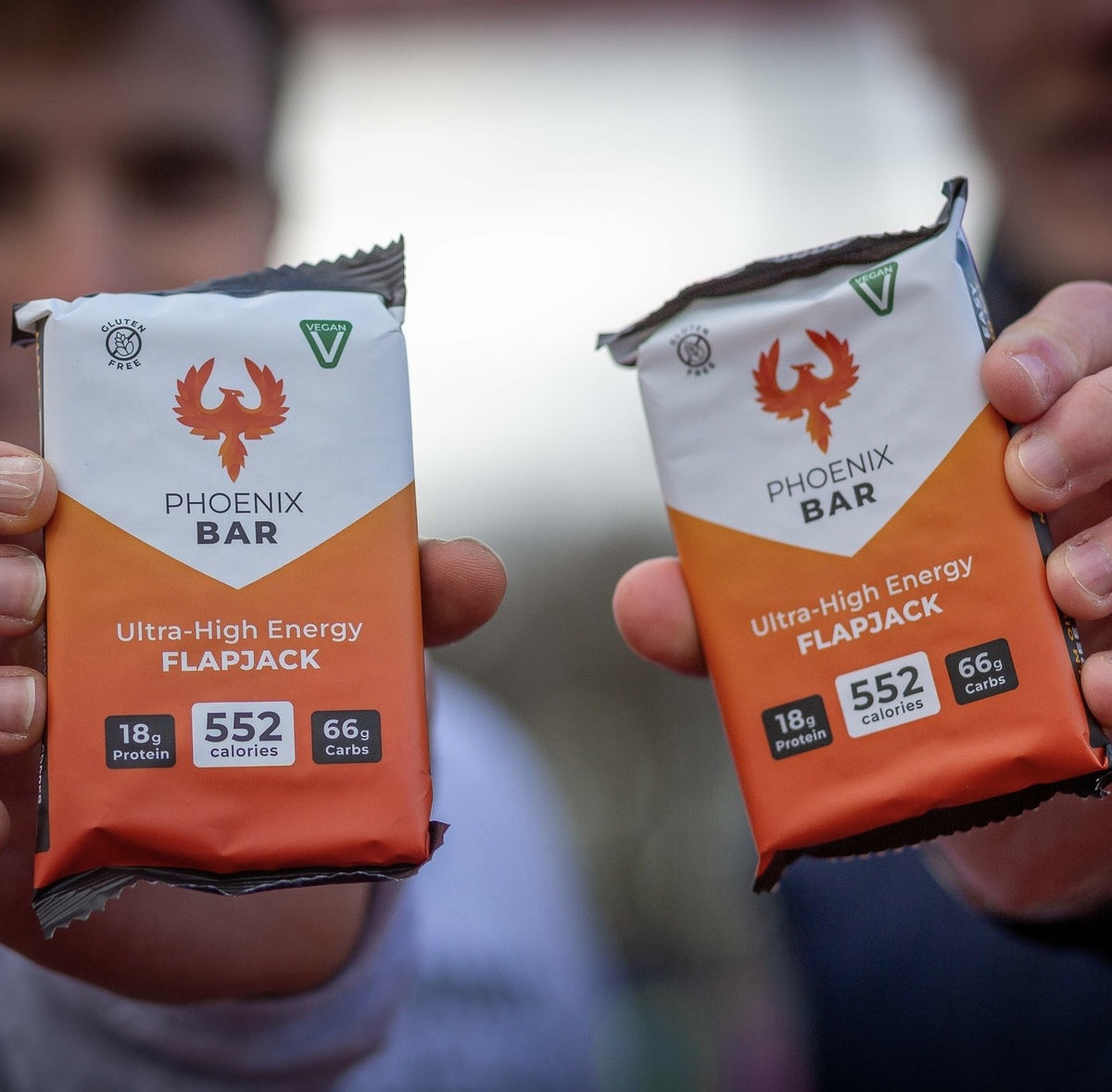
Phoenix Bars
- Up to 557 calories in only 120g per bar, about 4.6 calories per gram, level with compressed rations on density.
- Shelf life of up to 2 years (12 months for Cherry Bakewell).
- No cooking or water needed: eat it as it is, break it into pieces, or mix it with water into a porridge.
- Will not freeze or melt, so it suits a car boot or grab bag.
- Vegan and gluten-free, made in the UK, in six flavours.
Phoenix Bars are high calorie bars made for the layer of your supply that you check and rotate: bars you can take on a long walk or a night shift and replace, so the stock stays fresh and is always something people will happily eat. Customers have carried them across the Atlantic in a rowing boat and to the South Pole.
Which emergency ration is best?
It depends on where the food will live and how often you will look at it:
- For storage you will not touch for a decade: NRG-5, at up to 20 years.
- For boats and life rafts: a SOLAS-approved ration such as Seven Oceans.
- For a car boot: something that copes with heat and cold, such as SOS bars (tested from -30 to 65°C) or Phoenix Bars, which will not freeze or melt.
- For a grab bag you check and rotate: Phoenix Bars, or a mix of bars and a compressed ration pack.
- For food that feels like a meal: army-style ration packs or ready-to-eat pouches, if weight is not a problem.
- For gluten-free households: NRG-5 Zero or Phoenix Bars, since most lifeboat rations are wheat-based.
How many emergency rations do you need for 3 days?
It depends whether you are planning to survive or to feel normal. Lifeboat-style packs are sized for survival: one 500g pack sold as 72 hours of food gives about 800 calories a day. For a home supply, plan on about 2,000 to 2,500 calories per adult per day, or 6,000 to 7,500 for three days.
- Compressed biscuit rations (about 2,300 to 2,500 calories per 500g): about three packs per adult for three normal days, or one pack at survival level.
- SOS 3600 bars: about two packs per adult for three normal days.
- Phoenix Bars (up to 557 calories each): about 12 to 13 bars per adult for three normal days, weighing about 1.5kg.
Most households mix and match: a few rations or bars in the grab bag and the car, and the rest of the three days from tins and cupboard food. Add 3 litres of drinking water per person per day.
How to store emergency rations
- Keep them somewhere cool, dry and dark, away from big temperature swings; many lifeboat rations specify storage below 30°C.
- Leave them sealed until you need them. The vacuum-packed foil is what gives the long shelf life.
- Store water with them, because food without water is only half a kit.
- Write the best before dates on the outside of your box and set a reminder to check them; Be Ready suggests every six months.
- Rotate the shorter-life layer into everyday use, on walks, commutes and long days, and replace it.
Emergency rations for older relatives and anyone with a small appetite
Dry, compressed biscuits can be hard going for someone who struggles to eat much or finds chewing difficult. For older relatives, or anyone whose appetite drops under stress, choose rations that are easy to eat in small amounts and can be softened with water or milk. NRG-5 and Phoenix Bars can both be mixed with water into a porridge. Our guides to high-calorie foods for older adults and what to eat when your appetite is low cover everyday options too.
Common questions about emergency rations
What is the difference between emergency rations and ration packs?
Emergency rations usually means compressed biscuits or bars designed to keep for 5 to 20 years and be eaten without preparation. Ration packs are boxes of ready-to-eat meals, snacks and drinks, like the army 24-hour pack, which feel more like normal food but are heavier and keep for around 2 to 3 years.
Do emergency rations make you thirsty?
Many lifeboat-style rations are formulated not to provoke thirst, because fresh water is scarce in a life raft. You still need water: the government's Be Ready checklist asks for 3 litres per person per day for drinking.
Are emergency rations vegan or gluten-free?
Most are wheat-based, so they contain gluten, and several carry traces of milk or soya. NRG-5 Zero is sold as gluten-free, and Phoenix Bars are vegan and gluten-free. Always check the label of the exact pack you buy.
How long do emergency rations last?
From about 2 years for dense everyday bars to 3 years for ready-to-eat pouches, 5 years for most lifeboat biscuits and ration bars, up to 20 years for NRG-5 and up to 25 years for freeze-dried tins, according to manufacturer listings. Heat shortens shelf life, so store them somewhere cool.
Can I just use supermarket food instead?
For a home supply, yes, and it is often the best option. Tins, oatcakes, nut butter and nuts cover three days well, as our 3-day emergency food supply list shows. Emergency rations earn their place where weight, space and shelf life matter: the grab bag, the car and the boat.
Where can I buy emergency rations in the UK?
Outdoor and prepper shops, marine chandleries (for SOLAS-approved lifeboat rations) and large online marketplaces all stock them. Check the production date as well as the best before date, so you know how much of the shelf life is left.
For a wider look at freeze-dried buckets, ration packs and pantry staples on cost, weight and water, see our guide to survival food in the UK, or compare dense bars in our highest calorie bars UK guide.
Sources: manufacturer and retailer listings for Seven Oceans, NRG-5, Datrex, SOS and Wayfayrer, checked October 2026; GOV.UK Be Ready.

Viele Kalorien. Kleiner Riegel.
Bis zu 557 Kalorien in einem kompakten, leichten Riegel von nur 120 g, mit bis zu 66 g Kohlenhydraten und 19 g Protein. Im Ganzen essen, über ein paar Stunden in Stücken essen oder mit Wasser oder Milch zu Porridge verrühren.
Leicht zu essen, leicht verdaulich und nicht zu süß. Kunden haben sie bei -45 °C und in der Hitze des Marathon des Sables gegessen, und sie sind bis zu zwei Jahre haltbar: für die Berge, die Nachtschicht oder zu Hause, an Tagen, an denen genug zu essen schwerfällt.
- 557 Kalorien in nur 120 g (529 bis 557 je nach Sorte)
- 4,6 Kalorien pro Gramm
- 66g Kohlenhydrate pro Riegel (bis zu)
- 19g Protein pro Riegel (bis zu)
