
Wild Camping Food - What to Pack for a UK Wild Camp
Wild camping means carrying everything you need on your back — and food is usually the heaviest part of your kit after your shelter and sleep system. Getting it right means balancing three things: enough calories to sustain you, low enough weight to carry comfortably, and food you will actually want to eat after a long day on the hill.
This guide covers how to plan food for a wild camping trip in the UK, from overnight bivvies to multi-day routes. It focuses on practical choices — what to take, how much, and how to get the most energy from the least weight.
How Many Calories Do You Need When Wild Camping?
The standard adult guideline of 2,000–2,500 calories per day assumes a relatively sedentary lifestyle. When you are walking for six to ten hours with a loaded pack over rough terrain, your actual calorie expenditure is significantly higher — typically between 3,000 and 4,500 calories per day, depending on your body weight, the weight of your pack, the terrain, and conditions.
You do not necessarily need to replace every calorie you burn. Most people carry enough stored energy to tolerate a moderate deficit over a few days without problems. But if you consistently eat too little, you will notice it — reduced energy, poor decision-making, feeling cold more easily, and a growing sense that everything is harder than it should be.
A practical target for most wild camping trips in the UK is somewhere between 2,500 and 3,500 calories per day. If you are doing high-mileage days in mountain terrain with a heavy pack, aim toward the higher end. For a gentle overnight camp with a short approach, less is fine.
The important thing is not to hit an exact number — it is to take enough food that you can eat consistently throughout the day and still have a proper meal in the evening.
Calorie Density — The Most Important Number in Your Food Bag
When you are carrying everything on your back, the question is not just how many calories a food contains — it is how many calories it provides per gram of weight.
This is calorie density, and it is the single most useful metric for planning wild camping food. The higher the calorie density, the more energy you get for every gram you carry.
Here is a rough guide to how common wild camping foods compare:
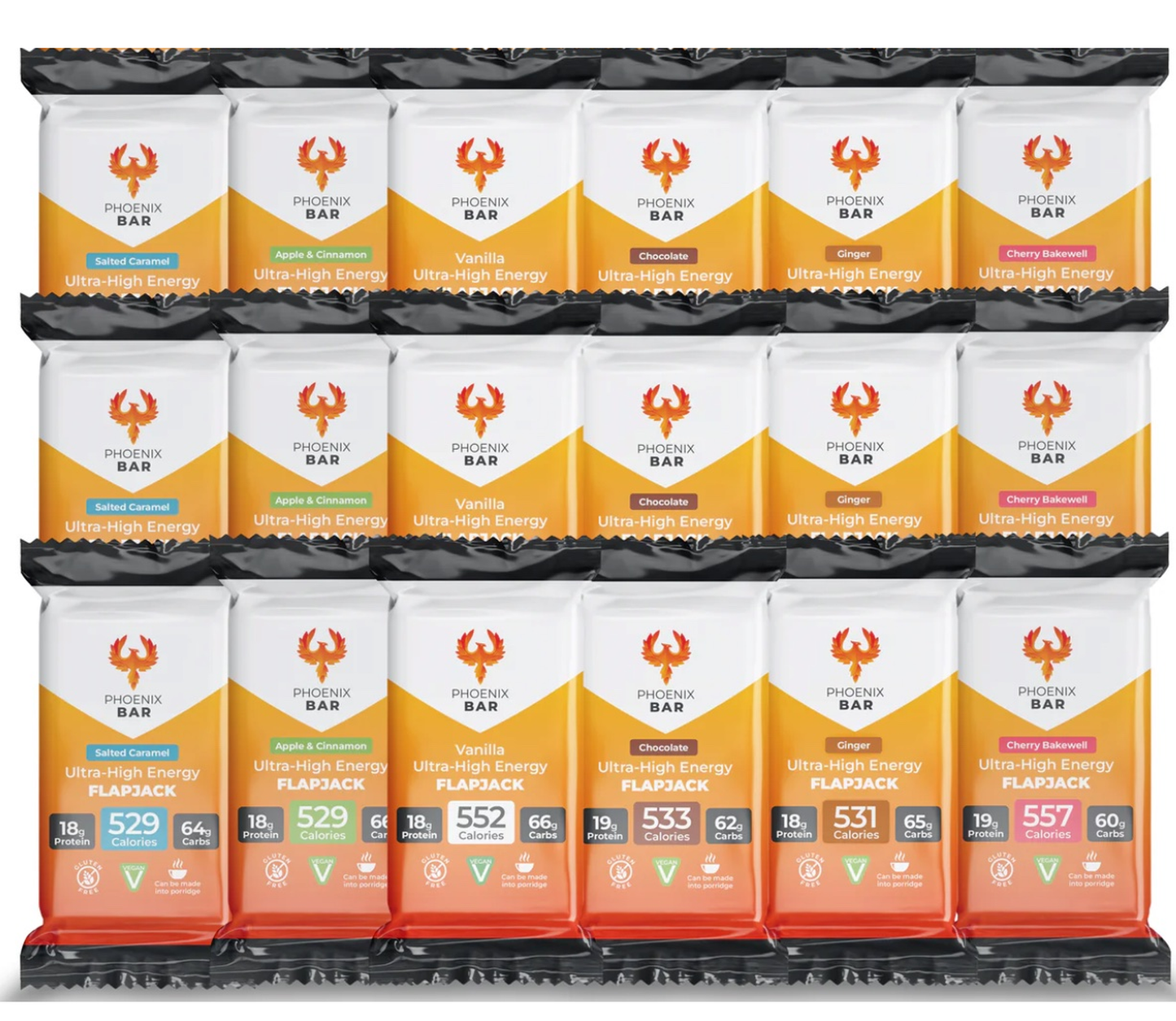
Fresh fruit sits at around 0.5–0.9 calories per gram. Bread is roughly 2.5 calories per gram. Cooked pasta and rice come in at about 1.3–1.7 calories per gram. Oats are approximately 3.7 calories per gram. Cheese ranges from 3.0 to 4.0 calories per gram. Nuts and nut butters are typically 5.5–6.5 calories per gram. Dark chocolate is around 5.0–5.5 calories per gram. Freeze-dried meals are usually 3.5–4.5 calories per gram. Phoenix Bars provide approximately 4.5 calories per gram — delivering up to 557 calories in a single compact bar.
The practical implication is straightforward. If you pack foods at the lower end of the calorie density scale — tinned goods, fresh fruit, bread — your food bag becomes heavy quickly and you run out of calories before you run out of days. If you prioritise foods at the higher end — nuts, nut butters, cheese, chocolate, energy-dense bars, and freeze-dried meals — you can carry enough fuel for a multi-day trip without your pack becoming unmanageable.
For a detailed explanation of calorie density and how it applies to different situations, see our guide to calorie-dense foods.
Categories of Wild Camping Food
Most wild camping food falls into one of four categories, and the best food bags include a mix of all four.
Main meals are the meals you sit down for — typically breakfast and dinner. These provide the largest single portion of your daily calories and are usually the most satisfying part of the day. Freeze-dried and dehydrated meals are the most popular choice for wild camping because they are lightweight, compact, and only require boiling water. Brands such as Firepot, Expedition Foods, Real Turmat, and Summit to Eat all make meals specifically designed for this purpose. Alternatively, you can build meals from supermarket ingredients — couscous with a sachet of sauce, instant noodles with a tin of tuna, porridge with peanut butter and dried fruit. These are cheaper but require more preparation and washing up.
Snacks and trail food are the foods you eat between meals — on the move, at rest stops, or in the tent before bed. This is where calorie density matters most, because snacks need to be compact enough to fit in a jacket pocket and light enough that you barely notice them. Good options include nuts, trail mix, flapjacks, cheese, chocolate, dried fruit, nut butter sachets, and energy-dense bars. Snacks often account for 30–40% of total daily calories on a wild camping trip, so they are not an afterthought — they are a core part of your nutrition plan.
Drinks are easy to overlook but matter more than most people realise. Hot drinks provide warmth and comfort as well as calories. Instant coffee, tea, hot chocolate sachets, and powdered soup all weigh almost nothing and take up negligible space. On cold, wet days in the UK mountains, a hot drink at a rest stop can make a genuine difference to morale and decision-making.
Emergency and backup food is food you carry but hope not to need — something calorie-dense and compact that sits at the bottom of your pack in case you are out longer than planned, the weather closes in, or you simply underestimate how much you need. A good emergency food option should be shelf-stable, require no preparation, and deliver a meaningful number of calories in a small package.

Phoenix Bars: Up to 557 Calories per Bar
Highly compact, lightweight and nutritionally dense camping food. Ready to eat on the move or can be mixed with water to make a nutritious porridge.
A Practical Wild Camping Food Plan
For a two-day, one-night wild camp — the most common format in the UK — a food plan might look something like this:
Day 1 — travelling in and setting up camp. Eat a proper meal before you leave. Carry trail snacks for the walk in — nuts, flapjacks, cheese, chocolate, or an energy bar. Eat steadily throughout the approach rather than saving everything for camp. Once pitched, cook your evening meal — a freeze-dried meal or a simple stove-cooked option. Have a hot drink and a final snack before sleep.
Day 2 — breaking camp and travelling out. Breakfast can be porridge (instant oats with dried fruit, nuts, and a spoonful of peanut butter is hard to beat for calorie density and speed), or a simpler option like a breakfast bar with a hot drink if you want to pack up quickly. Carry enough snacks for the walk out, plus a small reserve in case the day is longer or harder than expected.
For longer trips — three, four, or five days — the principles are the same but the calorie density of your food becomes increasingly important. Every gram you save on food weight compounds over multiple days. On a five-day trip, the difference between carrying food at 2.0 calories per gram versus 4.5 calories per gram is roughly a kilogram and a half of pack weight. That is a meaningful difference over long mountain days.
Food That Works When You Do Not Feel Like Eating
One of the less-discussed realities of wild camping is that appetite often drops when you need calories most. After a long day in bad weather, when you are cold, tired, and mildly dehydrated, the idea of eating can feel unappealing — even though your body urgently needs fuel.
This is where food characteristics matter as much as food content. Soft, neutral-flavoured, calorie-dense foods that require no preparation tend to be the easiest to eat when appetite is low. Something you can break into pieces and eat gradually — rather than a full meal that demands to be consumed in one sitting — can be the difference between getting calories in and going to sleep underfed.
If this is something you experience regularly, our guide on what to eat when you have no appetite covers the underlying reasons and practical strategies in more detail.
Weight, Bulk, and Packaging
A few practical considerations that affect what you choose to carry:
Packaging waste. Wild camping follows Leave No Trace principles — everything you carry in, you carry out. Choose foods with minimal packaging, or repackage into reusable zip-lock bags before you leave. Remove cardboard outers and decant anything you can. This saves weight, reduces bulk, and means less rubbish to carry.
Water requirements. Freeze-dried meals need water to rehydrate. If you are camping near a water source — a stream, loch, or river — this is not a problem, but if your camp is dry, you need to carry the water too. Factor this into your planning, particularly in summer when smaller streams can run dry.
Temperature. Some foods behave differently in cold conditions. Cheese becomes harder to eat. Chocolate can freeze solid. Nut butter becomes stiff. Conversely, some foods cope well — Phoenix Bars, for instance, were originally designed for extreme cold environments and remain soft and edible in sub-zero temperatures. Consider what conditions you are likely to encounter and choose accordingly.
Shelf life. Multi-day trips and trips where food is pre-positioned in drop bags require food that does not spoil. Freeze-dried meals, nuts, dried fruit, energy bars, and similar shelf-stable foods are all suitable. Fresh food — sandwiches, cooked meats, dairy — should generally be consumed on day one.
Where Phoenix Bars Fit
Phoenix Bars were originally developed for ultra-endurance events and extreme expeditions, but the same qualities that make them effective in those contexts — compact size, high calorie content, soft texture, no preparation needed, long shelf life, climate-resistant packaging — also make them practical for wild camping.
Each bar delivers up to 557 calories, weighs 125g, and requires nothing except opening the wrapper. They can be eaten whole as a meal replacement in situations where cooking is impractical, broken into pieces and eaten gradually throughout the day as a high-calorie snack, or crumbled into a mug with hot water or milk to make a warm porridge — useful on cold mornings when a quick, high-calorie breakfast is more appealing than a full cooking session.
Phoenix Bars are vegan, gluten-free, and available in six flavours. They have up to a two-year shelf life, making them suitable for trips planned well in advance or for keeping in your pack as a reliable backup option.
For guidance on different ways to use Phoenix Bars during outdoor activities, see How to Use Phoenix Bars. For the full product range, see Phoenix Bars.
A Wild Camping Food Checklist
Before you set off, check you have covered the following:
Enough total calories for every day plus a reserve. A mix of main meals, snacks, and hot drinks. At least one no-cook, calorie-dense food option for emergencies or when cooking is impractical. Food repackaged to remove unnecessary weight and bulk. Enough water or access to water for rehydrating freeze-dried meals. A stove, fuel, lighter, and eating utensils if you are cooking. A zip-lock bag or similar for carrying out all food waste and packaging.
Frequently Asked Questions
What is the best food for wild camping in the UK? The best wild camping food balances calorie density, weight, ease of preparation, and taste. Freeze-dried meals work well for main meals. Nuts, cheese, flapjacks, chocolate, and compact energy bars are effective for snacks. The right combination depends on the length and difficulty of your trip.
How much food should I take wild camping? As a practical guideline, aim for roughly 2,500–3,500 calories per day, depending on how far you are walking and how heavy your pack is. For a single overnight trip, this might mean one main evening meal, breakfast, and a generous supply of snacks. For longer trips, plan each day individually and add a reserve.
Can I wild camp without a stove? Yes. Many wild campers choose to go stoveless to save weight and simplify their kit. This means relying entirely on no-cook foods — sandwiches, wraps, cheese, nuts, dried fruit, energy bars, and other ready-to-eat options. It is entirely viable for shorter trips and in warmer conditions, though most people find that hot food and drink significantly improve morale, particularly in poor weather.
What is the lightest food to take wild camping? The lightest foods in terms of calories per gram are fats and oils (around 9 calories per gram), followed by nuts and nut butters (5.5–6.5), chocolate (5.0–5.5), and compact energy-dense bars like Phoenix Bars (approximately 4.5). Freeze-dried meals are also lightweight because the water has been removed — you add water from your environment rather than carrying it.
How do I keep food safe from animals when wild camping in the UK? The UK does not have bears, but foxes, mice, and birds can be attracted to food left unattended. Keep food in sealed containers or bags, inside your rucksack or hung from a tree branch if you are leaving camp. Never leave food wrappers or scraps — follow Leave No Trace principles and carry everything out with you.
This guide is part of our series on nutrition for outdoor activities. For related reading, see our guides to hiking and trekking nutrition, ultra-endurance and expedition nutrition, and calorie-dense foods.
"I used Phoenix Bars as part of my expedition to Kang Yatse 2, a 6,000m peak in India. They kept me going during the tough slogs at high altitude and will be buying more for my wild camping trips."
"I'm terrible at making sure I'm properly fuelled on long-distance hikes, so finding these — especially as they're vegan — was a revelation. Tasted great, stayed in one piece in the bottom of my backpack until I needed a bite on the move."


Flaming Phoenix
High-Calorie Protein Bars for Endurance, Expeditions and Weight Gain




Why I built Phoenix Bars
Hi, I'm James.
I started Phoenix Bars at 23 after 150 conversations with ultra endurance athletes, extreme adventurers and people who struggle to eat enough calories.
Every design choice came directly from one of those conversations.
I pack every order from my home in Surrey, and I reply to every email myself, usually the same day.
Made in the UK. Hand-packed by James in Surrey. Used at Marathon des Sables, the South Pole, and in everyday situations where food feels hard.


