
Hitting the Wall: What Bonking Actually Is, and How to Push It Back
By James Frost, founder of Flaming Phoenix. I make dense, real-food fuel for endurance athletes, and a large part of my job is helping people understand the difference between running out of fuel and running out of fitness. I am not a coach or a dietitian, and a plan built for your body and event will beat any general guide, but this is the practical version. Last reviewed June 2026.
Hitting the wall, also called bonking, the knock, or a hunger flat, is the sudden, brutal fatigue that arrives when your body runs low on its stored carbohydrate. It is not weakness and it is not bad luck. It is arithmetic. You carry only a limited tank of glycogen, around 2,000 calories in a trained athlete, enough for roughly 90 minutes of hard effort or 18 to 20 miles of running, and when that tank empties faster than you refill it, your performance falls off a cliff. The good news is that because the wall is predictable, it is largely preventable. You have three levers: start with a full tank, empty it more slowly, and top it up as you go. This guide explains what is actually happening when you hit the wall, the three ways to push it back, how to tell a true bonk from dehydration or a turned stomach, and what to do if it catches you anyway.
What hitting the wall actually is
Your body runs hard efforts mainly on carbohydrate, stored as glycogen in your muscles (around 300 to 400 grams) and your liver (around 75 to 100 grams). Carbohydrate is the fuel that runs out first, well before you exhaust fat or protein, and a trained athlete holds only about 2,000 calories of it, which covers roughly 90 minutes of hard running or 18 to 20 miles before the tank runs low. That is why marathon runners so reliably blow up between miles 18 and 22: it is the point where the maths catches up with them.
It helps to know that two related things are happening, because they feel slightly different. As your muscle glycogen drains, your legs turn to lead and you cannot hold pace. That is the wall in the literal sense. Separately, as your liver glycogen falls, your blood sugar drops, and because your brain runs on glucose, you get the mental side: dizziness, fogginess, irritability, nausea, and the dark, catastrophic thoughts that make you certain you cannot go on. That blood-sugar crash is the bonk proper. Usually they arrive together. Once glycogen is gone, your body is forced to rely on fat, which burns far less efficiently and simply cannot support a fast pace, which is what turns the closing miles of an under-fuelled race into a shuffle. Performance is already impaired once you drop below about half your stores and badly compromised by the time you are down to a quarter, so the goal is never to get close to empty in the first place.
The three ways to push the wall back
There are exactly three levers, and it is worth pulling all of them.
The first is to start with a full tank. In the days before a long effort, eat plenty of carbohydrate so your glycogen stores are topped right up, and have a carbohydrate-rich meal on the morning itself, which is what the high-calorie breakfast guide is for. Starting full simply buys you more miles before the tank runs low, and carb loading and training can raise your reserves substantially.
The second is to empty the tank more slowly, and the biggest free lever here is pacing. Going out too hard burns glycogen disproportionately fast and drags the wall forward, so an even, controlled effort is one of the most effective things you can do to delay it. Training matters too: a strong aerobic base, and some thoughtfully placed easier sessions, can nudge your body toward burning more fat and sparing glycogen. That approach is debated, is best done carefully rather than on your hard sessions, and is never a reason to under-eat overall, since chronic under-fuelling causes far more problems than it solves.
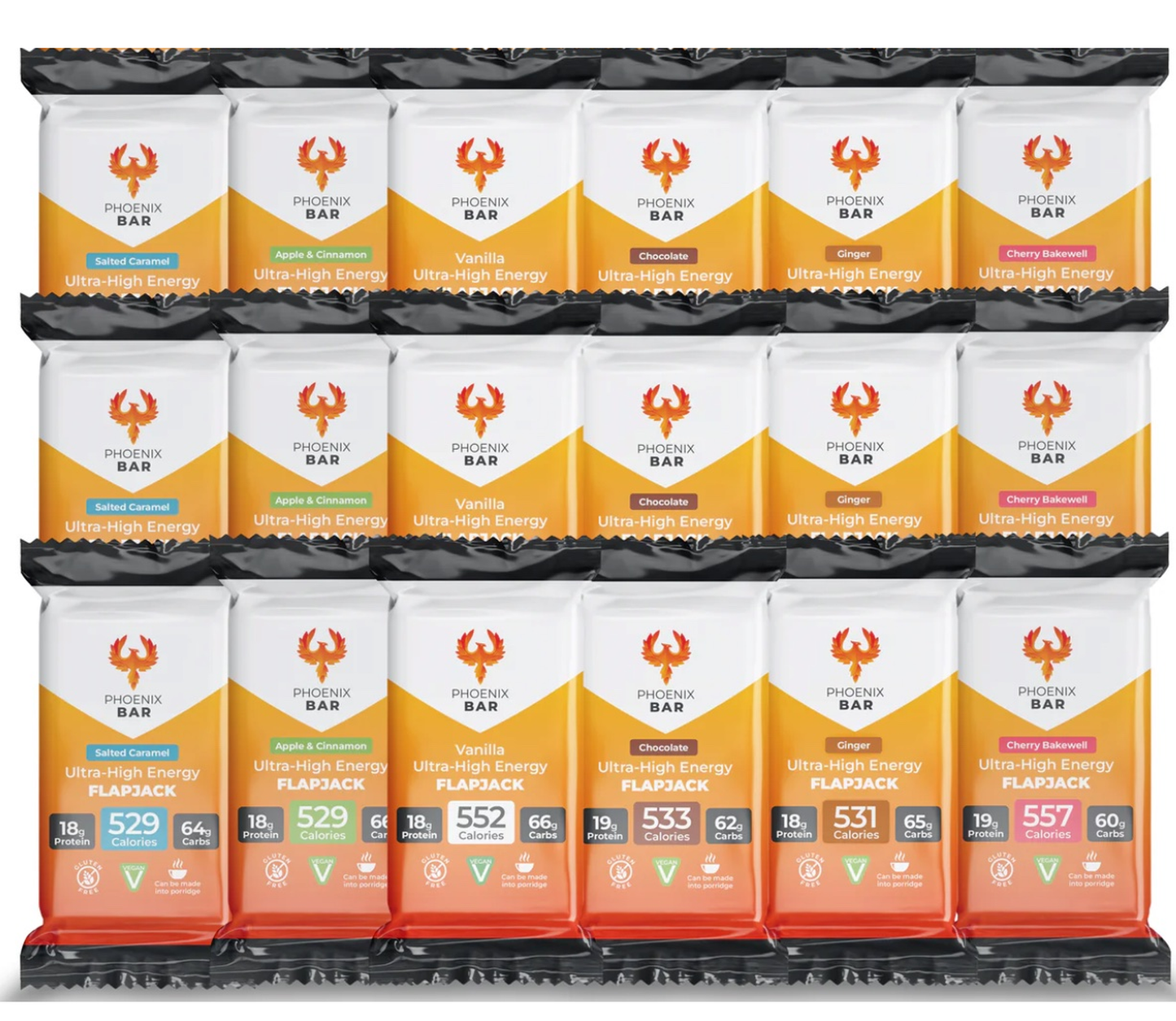
The third is to top the tank up as you go, and the cardinal rule is to start before you feel low, because once you are deep in a hole it is very hard to climb out. Aim for roughly 30 to 60 grams of carbohydrate an hour for efforts of one to two and a half hours, rising toward 90 grams an hour for longer ones, taken in small regular amounts rather than occasional large hits. For short, high-intensity efforts, simple fast-absorbing carbohydrate reaches the muscle quickest. Over longer, steadier efforts, real food provides more durable energy and spares your gut the relentless sugar hit that causes its own problems, a case made in full on the energy gel alternatives guide and the ultra-high-carb solid foods guide. This is where a Phoenix Bar fits: each 120g bar is up to 557 calories of dense real food, a substantial and steady contribution to your hourly target that sits well over long efforts and comes in six flavours so it does not become the thing you dread, eaten cold on the move or stirred into a warm porridge. Being honest about it, for the very fastest top-up at threshold a simple sugar acts quicker, so a bar earns its place on longer, lower-intensity efforts and as part of your pre-effort loading rather than as a last-second rescue. The wider principle of getting a lot of energy into a small package is on the calorie-dense foods guide.

Phoenix Bars: Up to 557 Calories Per Bar
Soft, easy to eat whole or as a warm porridge. Low volume, two-year shelf life.
The wall is also in your head
The reason a bonk feels like a crisis is that low blood sugar hits the brain directly, so it arrives wrapped in despair, irritability, and the absolute conviction that you should stop. Knowing this is chemical rather than truthful is a genuine tool, because the feeling usually lifts within minutes of getting carbohydrate in. Expect the dark patch on any long effort, have a simple plan and a phrase to hold onto, and treat getting one more mouthful in as the win that turns it around. Plenty of strong races have been rescued by a runner who recognised the thoughts for what they were and kept feeding the machine.
Is it really the wall, or something else?
It is worth a quick mental check, because the wrong fix wastes time. A true bonk is a fuel problem: heavy legs, a foggy or low mood, and noticeable improvement once sugar goes in. Dehydration is a fluid problem: thirst, a thumping headache, dark urine, and cramping, and no amount of sugar fixes it. A turned stomach is a gut problem: nausea and the inability to take fuel in at all, which is its own subject on the mid-race nausea and appetite loss guide, and forcing food only makes it worse. Cramp is usually fatigue and electrolytes rather than fuel. Reading the signal right tells you whether to reach for sugar, fluid and salt, or to slow down and settle your stomach.
What to do once you have hit it
Prevention beats cure here, and it is only fair to say that once you are deep in a bonk you will probably have to slow down a lot, because there is no instant refill. That said, you can salvage it. Get fast carbohydrate in immediately, a gel, a sweet drink, flat cola, anything simple, then ease right off the pace to cut your body's glucose demand and let what you have eaten catch up, and give it ten to fifteen minutes to take effect. Keep small amounts coming after that rather than waiting for one big recovery. You may not get back to your target pace, but you can usually rescue the effort and avoid the full death march. The lesson, every time, is that it is far easier to stay ahead of the wall than to climb back over it, which is the same theme that runs through fuelling a 100-mile race and the wider ultra-endurance guide.
Common questions
What is the difference between hitting the wall and bonking? They are mostly used to mean the same thing. Strictly, hitting the wall describes muscle glycogen running out, when your legs go heavy and you cannot hold pace, while bonking describes the blood sugar crash that starves your brain and brings dizziness and fog. In practice they usually happen together.
Why do marathon runners hit the wall around mile 20? Because a trained athlete stores only about 2,000 calories of glycogen, enough for roughly 18 to 20 miles. If you have not topped the tank up along the way, that is where it runs dry and your pace collapses.
How do I avoid hitting the wall? Pull all three levers: start with full glycogen by carb loading and eating a good carbohydrate breakfast, pace evenly so you do not burn through fuel early, and take in 30 to 90 grams of carbohydrate an hour from the start rather than waiting until you feel low.
Can you recover from a bonk mid-race? Partly. Get fast carbohydrate in straight away, slow right down to reduce demand, and give it ten to fifteen minutes. You will likely lose some time, but you can usually salvage the effort. It is much easier to prevent than to reverse.
How is bonking different from dehydration or a turned stomach? Bonking is a fuel problem fixed by carbohydrate. Dehydration is a fluid and salt problem that sugar will not touch. A turned stomach is a gut problem where you cannot take fuel in at all. Each needs a different response, so it pays to read the symptoms before reaching for a fix.
Are Phoenix Bars good for preventing the wall? Yes, as steady fuel over longer, lower-intensity efforts and as part of your pre-effort loading, where their dense real-food calories sit well and avoid the gut fatigue of constant sugar. For the fastest possible top-up during short, high-intensity efforts, pair them with a simple fast carbohydrate.
The single idea to take away is that the wall is arithmetic, not fate. You know the size of your tank and roughly how fast you empty it, so you can plan around it: start full, burn it evenly, and keep topping it up before you feel the need. Do that and the wall stops being the thing that ends your races and becomes a problem you have already solved. If you want to go further, the energy gel alternatives guide and the mid-race nausea guide are the natural next reads, and a mixed-flavour Starter bundle is a simple way to build dense fuel into your long efforts.


Flaming Phoenix



Contact Us
Declare withdrawal
Please fill out the following form to declare your withdrawal from the contract.

