

Hiking Calorie Calculator: How Many Calories Do You Burn Hiking?
In this guide

A 70 kg adult hiking rolling countryside with a day pack burns about 420 kcal an hour (6.0 METs × 70 kg), so a three-hour hike comes to about 1,260 kcal and a five-hour hill day about 2,100. Flat, unladen walking is nearer 270 an hour. The hiking calorie calculator further down this page works out yours.
How many calories does hiking burn per hour?
Between about 270 and 630 kcal an hour for a 70 kg hiker, set mainly by the gradient and what is on your back. The calculator's settings, per hour at 70 kg:
- Flat and easy, no pack: about 265 kcal (3.8 METs)
- Flat and easy, day pack: about 315 kcal (4.5 METs)
- Rolling trails, no pack: about 370 kcal (5.3 METs)
- Rolling trails, day pack: about 420 kcal (6.0 METs)
- Hilly, day pack: about 505 kcal (7.2 METs)
- Steep and mountainous, day pack: about 575 kcal (8.2 METs)
- Steep and mountainous, full multi-day pack: about 630 kcal (9.0 METs)
Body weight scales every line: at 85 kg rolling trails with a day pack come to about 510 kcal an hour, at 60 kg about 360. Going from a canal towpath to a proper hill day roughly doubles what an hour costs.
How many calories does a 3, 4 or 5 hour hike burn?
A three-hour hike on rolling trails with a day pack burns about 1,260 kcal for a 70 kg hiker, four hours about 1,680 and five hours about 2,100. Longer days at the same pace:
- 1 hour: about 420 kcal
- 2 hours: about 840 kcal
- 3 hours: about 1,260 kcal
- 4 hours: about 1,680 kcal
- 5 hours: about 2,100 kcal
- 6 hours: about 2,520 kcal
- 8 hours: about 3,360 kcal
Count moving time only. A seven-hour day out with an hour of lunch, photos and map stops is six hours of hiking.
How many calories does a 5 or 10 mile hike burn?
A 10-mile hike with 500 m of climbing burns about 1,700 kcal for a 70 kg hiker with a day pack, roughly 170 kcal a mile. Miles alone cannot give a calorie figure, so turn the route into hours first. Naismith's rule, devised by the Victorian mountaineer William Naismith in 1892, allows 1 hour for every 5 km plus 10 minutes for every 100 m of ascent.
Worked example: 10 miles is 16.1 km. 16.1 ÷ 5 = 3.2 hours, plus 500 m of ascent at 10 minutes per 100 m = 50 minutes, so about 4 hours 3 minutes. On rolling trails with a day pack: 6.0 × 70 × 4.05 = about 1,700 kcal. A 5-mile walk with 250 m of climbing works out the same way at about 2 hours and 850 kcal. On flat ground with nothing on your back the cost drops to about 86 kcal a mile, the same as an ordinary walk. Eric Langmuir's revision in Mountaincraft and Leadership slows the base pace to 4 km/h, which adds hours and therefore calories.
Worked example: Scafell Pike from Wasdale Head
TheLakeDistrict.org gives the Wasdale route up Scafell Pike (977 m) as about 6 miles and 5 to 6 hours there and back. Take 5 hours of moving time for a 70 kg walker with a day pack. On the Steep and mountainous setting that is 8.2 × 70 × 5 = 2,870 kcal; on Hilly it is 7.2 × 70 × 5 = 2,520 kcal.
The real figure sits between the two. A good share of the moving time is spent coming down, and the Compendium rates walking downhill at 3.3 METs against 7.0 or more for a sustained climb, so a single steep value for the whole day overstates it. Call it 2,500 to 2,900 kcal, which is more than the NHS guide figure of 2,000 kcal for an average woman's whole day, spent before you are back at the car.
How the hiking calorie calculator works
The calculator adds a terrain value and a pack value, then multiplies by your weight and moving hours: calories = (terrain METs + pack METs) × kg × hours. One MET is about 1 kcal per kilogram per hour. Calculated using the 2024 Adult Compendium of Physical Activities walking and hiking values: Flat (3.8) and Rolling (5.3) match its entries for hiking slowly and at a normal pace through fields and hillsides. Hilly (6.5) and Steep (7.5) are whole-day averages for up-and-down ground, below the Compendium's 7.0 to 8.8 for continuous 6 to 20% climbs and well above its 3.3 for walking downhill.
The pack additions, 0.7 METs for a 5 to 10 kg day pack and 1.5 for a full multi-day pack, are our own allowance rather than Compendium values: its loaded and unloaded hill entries were measured at different paces and grades, so they cannot be subtracted cleanly. For comparison, the Compendium rates backpacking at 7.0 METs and hiking with a day pack at 7.8. The result is gross calories, including what your body burns at rest; subtract your weight × hours for the net cost.
How many calories do you need on a hiking day?
Add the net cost of the hike to a normal day. The NHS guide figure is 2,000 kcal a day for an average woman and 2,500 for an average man. Five hours on rolling trails with a day pack adds about 1,750 kcal net for a 70 kg hiker ((6.0 minus 1) × 70 × 5), so that day needs somewhere around 3,750 to 4,250 kcal. On a multi-day trip that gap repeats every day, and most people cannot eat it all back.
How to refuel on the hill
Eat as you go rather than trying to replace 2,000 kcal at dinner. Something small every hour of walking, in the region of 100 to 200 kcal at a time, covers up to 1,000 kcal of a five-hour day before you sit down to eat, so you are not arriving back at the car running on empty. Pick food that is dense, robust in a pack and easy to eat with cold hands: the best food for hiking list covers what works, and the calorie-dense foods guide ranks options by calories per gram.
Calories per gram is why our high calorie bars exist. Phoenix Bars carry up to 557 calories in a compact, lightweight 120g bar, about an hour of hilly walking with a day pack for a 70 kg hiker, and they break into pieces you can eat between stiles. Kate Allen put it simply: "They worked really well broken off into little chunks." For bigger trips, see hiking and trekking nutrition, the lightest high-calorie food for backpacking, our pick of the best energy bars for hiking and the food planning in the multi-day kit list.
Frequently asked questions
Does hiking burn more calories than walking? Yes, usually 40 to 60% more per hour. The Compendium rates hiking at a normal pace through fields and hillsides at 5.3 METs against 3.8 for walking on the flat at about 5 km/h, and a day pack takes it to about 6.0. Hikes also last longer: a five-hour hill day with a day pack (about 2,100 kcal) costs roughly eight times an hour on the flat (about 266).
Does a heavy pack really burn more? Yes. The calculator adds 1.5 METs for a full multi-day pack, about 105 kcal an hour at 70 kg, and 0.7 METs, about 50 kcal, for a day pack. The Compendium puts backpacking at 7.0 METs against 5.3 for unladen hiking. For weighted vests and heavy loads on purpose, use the rucking calorie calculator.
Do you burn calories hiking downhill? Yes, but far fewer than climbing. The Compendium rates walking downhill at about 2.5 mph at 3.3 METs, a little more than the 3.0 for the same pace on the flat, because your legs are braking your body weight on every step. That braking is why long descents leave legs sorer than the climb did.
How many calories does hiking uphill burn in an hour? About 490 kcal for a 70 kg hiker on a steady 6 to 10% climb with no pack (7.0 METs), and about 615 kcal on an 11 to 20% gradient (8.8 METs). Carrying 10 to 18 kg up a 3 to 10% grade rates 7.5 METs, about 525 kcal an hour.
Do you burn more calories hiking in hot weather? This calculator, like every MET-based one, does not adjust for heat. In practice heat slows most people down, so plan for more hours on the route and more water rather than a different hourly figure, and start early on hot days.
Other calculators: walking calorie calculator for steps and flat walks, running calorie calculator, cycling calorie calculator and swimming calorie calculator.
Sources: 2024 Adult Compendium of Physical Activities, walking and hiking (Herrmann and colleagues, Journal of Sport and Health Science, 2024); NHS, Understanding calories; UKHillwalking, Naismith's rule; TheLakeDistrict.org, Scafell Pike.
Written by James Frost, founder of Flaming Phoenix. Phoenix Bars are sold in 21 countries, and this calculator exists because "how far is it in flapjacks" is a genuinely useful question. Updated October 2026.
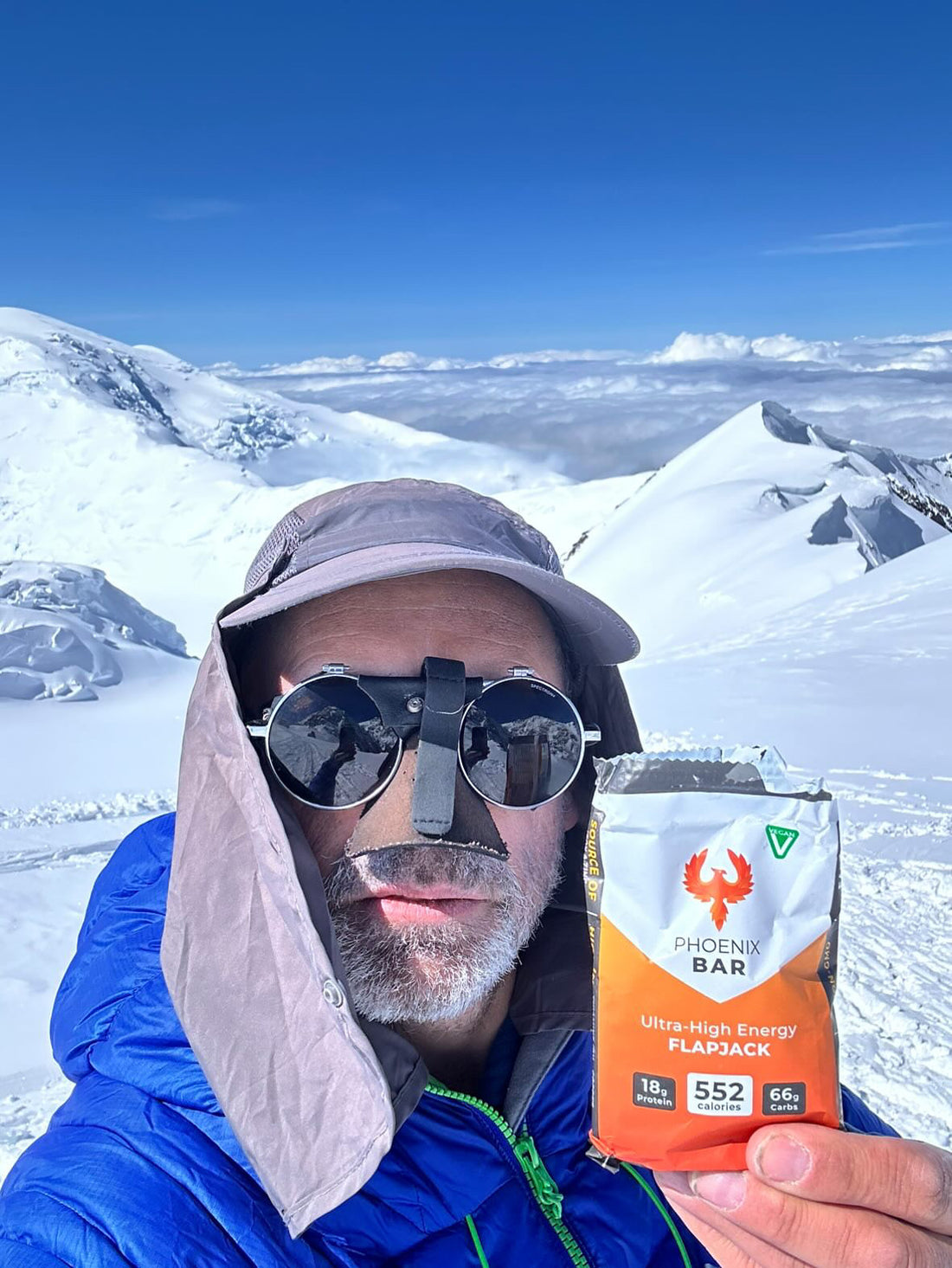
Big calories. Small bar.
Up to 557 calories in a compact, lightweight bar of only 120g, with up to 66g of carbs and 19g of protein. Eat it whole, break it into pieces over a few hours, or mix it with water or milk for porridge.
Easy to eat, easy to digest and not sickly sweet. Customers have eaten them at -45°C and through the heat of the Marathon des Sables, and they keep for up to 2 years, so they work on a mountain, on a night shift, or at home on days when eating enough feels hard.
- 557 calories in only 120g (529 to 557 by flavour)
- 4.6 calories per gram
- 66g carbs per bar (up to)
- 19g protein per bar (up to)
Hiking Calorie Calculator
Declare withdrawal
Please fill out the following form to declare your withdrawal from the contract.

