Best High-Calorie Foods for Bulking and How to Eat Them
The best high-calorie foods for bulking are the ones that pack the most energy into the least volume, so you can hit a calorie surplus without feeling permanently stuffed. That means oils and nut butters, nuts, full-fat dairy, granola and oats, dried fruit, fattier cuts of meat, and calorie-dense bars. Aim for a modest surplus of roughly 250 to 500 calories a day above maintenance, get enough protein, and lean on calorie-dense snacks between meals, because the real bottleneck in bulking is almost never willpower. It is appetite.
If your goal is general weight gain rather than building muscle in the gym, start with our broader guide on how to gain weight. This page is for people training to add size.
What does bulking actually require?
Bulking comes down to three things, in order of importance. First, a consistent calorie surplus, eating more than you burn, day after day. Second, enough protein to turn those extra calories into muscle rather than just fat. Third, progressive resistance training to give your body a reason to build. Get all three and you grow. Miss the surplus and nothing else matters, because you cannot build tissue out of calories that are not there.
There is a choice between a lean bulk, a slow controlled gain that minimises fat, and a dirty bulk, eating big with less regard for what the calories come from. For most people a lean bulk is the better long-term play, because it means less fat to cut later. Either way, the daily surplus is the engine.
Why high-calorie foods matter for bulking
Here is the part the generic food lists miss. For most hard gainers, the problem is not knowing what to eat. It is physically getting it all down. A surplus of a few hundred calories sounds small until you are already full from three big meals and still short of your target. The stomach has a volume limit, and low-calorie "healthy" foods like chicken breast, rice, and vegetables fill that limit fast without delivering many calories.
This is exactly why calorie density is the most useful concept in bulking. A food with high calorie density gives you more energy per gram, so you reach your surplus before you reach the point of feeling sick. Our calorie-dense foods guide ranks more than forty options by how many calories they deliver per bite, and it is the single best reference for building a bulking diet around foods that work with your appetite instead of against it.
How big a calorie surplus do you need?
For a lean, muscle-focused bulk, a surplus of around 250 to 500 calories per day above maintenance is the sweet spot for most people. That supports a gain of roughly a quarter to half a percent of bodyweight per week, which is enough to build muscle steadily without piling on excess fat. Bigger surpluses do not build muscle faster past a point. They just add fat that you will have to diet off later.
The practical test is the scale and the mirror over a few weeks, not a single day. If you are not gaining at all, add 200 to 300 calories. If you are gaining fat quickly, pull it back. Treat the number as a starting estimate to adjust, not a fixed rule.
How much protein do you need for bulking?
Protein is what directs your surplus into muscle. A well-supported target is roughly 1.6 to 2.2 grams of protein per kilogram of bodyweight per day, spread across the day rather than crammed into one meal. Most people do not need to go higher than that, and the extra calories are usually better spent on carbohydrate and fat to power training and hit the surplus. Carbohydrate fuels your sessions and fills out your muscles, and fat is the most calorie-dense macronutrient, which makes it your most efficient tool for hitting a surplus without volume.
The best high-calorie foods for bulking
Build your diet around foods that combine high calorie density with easy eating. The standouts, by category, are these.
Oils and fats are the most efficient calories there are, at around nine calories per gram. A tablespoon of olive oil over pasta, or a knob of butter melted into rice or potato, adds a hundred or more calories with no real change to how full you feel. Nut butters and nuts are next, dense, portable, and easy to add to almost anything: peanut and almond butter stirred into porridge or spread thick on toast, and a handful of nuts as a between-meal hit.
Full-fat dairy is a hard gainer's best friend. Switching from skimmed to whole milk, full-fat yoghurt, and real cheese adds hundreds of calories a day with no extra eating effort, and milk in particular is easy to drink in volume. Granola and oats are the most calorie-dense breakfast base you can build on, especially with whole milk, honey, and nut butter added. Our high-calorie breakfast guide covers how to start the day at four to six hundred calories before you have really tried.
Dried fruit like dates, raisins, and figs gives you dense, soft carbohydrate that is easy to graze on. Fattier proteins do double duty by delivering protein and calories together: salmon, chicken thigh with the skin, fattier cuts of red meat, and eggs cooked with butter and cheese. And calorie-dense bars give you a ready-to-eat surplus you can carry, which matters when the gap between meals is where most hard gainers fall short. For grazing options specifically, see our high-calorie snacks guide.

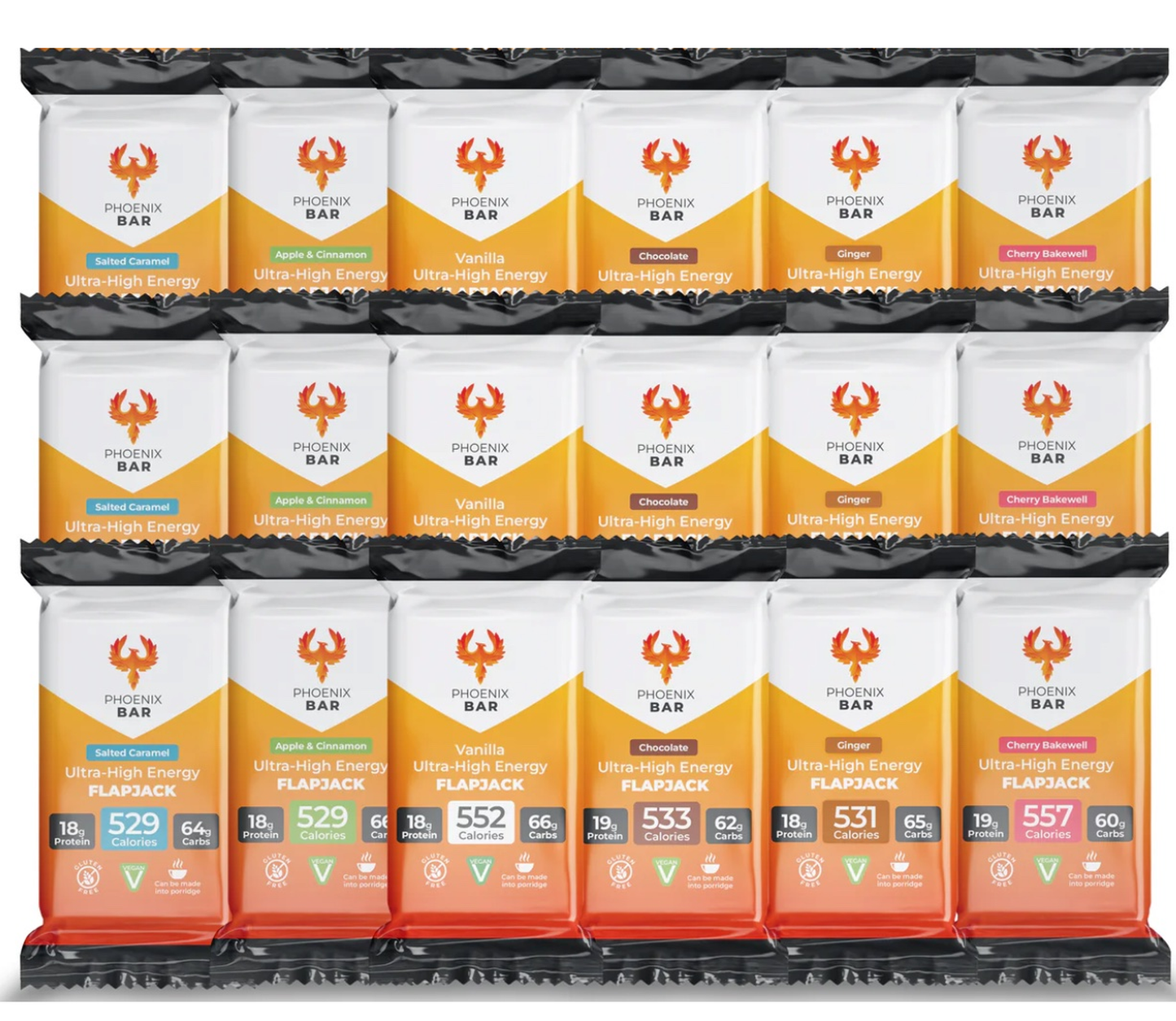
Phoenix Bars: Up to 557 Calories Per Bar
Soft, easy to eat whole or as a warm porridge. Low volume, two-year shelf life. Rated 5.0/5 from 344 reviews. £4.99 per bar.
How to hit a surplus without feeling stuffed
This is the skill that separates people who grow from people who give up. A few tactics do most of the work.
Increase calorie density before you increase portion size. Add oil, butter, cream, cheese, and nut butter to meals you already eat, rather than trying to eat more of them. Drink some of your calories, because liquid is far easier to consume in volume than solid food: a smoothie made with whole milk, banana, peanut butter, oats, and honey can clear five or six hundred calories and goes down easily even when you are not hungry. Our high-calorie drinks and smoothies guidehas the formulas.
Eat little and often instead of forcing three enormous meals, so each one is manageable. Use the gaps between meals and the hour before bed, when most people simply forget to eat, as your easiest opportunities to top up. And keep something calorie-dense within arm's reach at all times, because a surplus is built from the calories you actually eat, not the ones you planned to.
A sample high-calorie bulking day
A day that hits a strong surplus without misery looks something like this. A large bowl of granola or oats with whole milk, nut butter, and honey to start. A mid-morning handful of nuts and dried fruit, or a dense bar. A lunch built on a carbohydrate base with a fatty protein and added oil or cheese. An afternoon smoothie or snack in the gap before training. A full dinner with generous fats. And a final top-up before bed, ideally something that goes down easily when you are tired. If you want a fully mapped version, our 3,000 calorie meal plan and 5,000 calorie meal plan lay out the numbers for different targets.
Bulking on a budget
You do not need expensive supplements to bulk. The cheapest effective bulking foods are oats, whole milk, eggs, peanut butter, rice, and bananas, and a hard gainer can get a long way on those alone. The honest trade-off is convenience and variety: cooking volume every day takes time, and eating the same few foods gets old, which is when people stop hitting their surplus. Calorie-dense bars and ready-to-eat options earn their place not because they beat rice and peanut butter on price, but because they cover the moments when cooking is not happening and the easy calories would otherwise be missed.
Where Phoenix Bars fit
When I started Phoenix Bars, I had 150 conversations with people who struggled to eat enough, and a good number of them were hard gainers saying the same thing: I know what to eat, I just cannot physically get enough of it down to grow. That is the exact problem these bars were built for.
Each one packs up to 557 calories into a soft 120 gram bar, so it is an easy few hundred calories of surplus between meals or in the hour before bed, without the volume of a full meal. They are soft and easy to eat when your appetite is already tested, you can blend one into a smoothie with whole milk for a six-hundred-plus calorie drink, and they keep for two years so a box lives in your bag or kitchen for whenever you are falling short. They are vegan and gluten-free, which also makes them a rare dense option if you bulk on a plant-based diet.
If you want to try them as a bulking snack before committing, the six-bar Short-Term Bundle is the low-commitment way in. Try Phoenix Bars for your bulk, or see the different ways to eat them in our guide on how to use Phoenix Bars.
Related guides
For general weight gain beyond muscle building, see how to gain weight. For the full ranking of energy-dense foods, see calorie-dense foods. For grazing ideas, see high-calorie snacks. And for liquid calories that go down easily, see high-calorie drinks and smoothies.
Frequently asked questions
What are the best high-calorie foods for bulking? The most efficient are oils and nut butters, nuts, full-fat dairy, granola and oats, dried fruit, fattier proteins like salmon and chicken thigh, and calorie-dense bars. These deliver the most calories for the least volume.
How many calories should I eat to bulk? Most people grow best on a surplus of around 250 to 500 calories per day above maintenance, supporting a gain of roughly a quarter to half a percent of bodyweight per week. Adjust based on results over a few weeks.
How much protein do I need to build muscle? Around 1.6 to 2.2 grams of protein per kilogram of bodyweight per day, spread across your meals, is the well-supported range for muscle gain.
How do I eat enough to bulk without feeling sick? Increase calorie density rather than portion size, drink some of your calories, eat smaller amounts more often, use the hour before bed, and keep calorie-dense snacks within reach.
Can I bulk on a budget? Yes. Oats, whole milk, eggs, peanut butter, rice, and bananas are cheap and effective. Ready-to-eat options add convenience for the moments when cooking is not practical.
Written by James Frost, founder of Flaming Phoenix. I pack every order myself from Surrey and reply to every email, usually the same day. Last reviewed May 2026.


Flaming Phoenix