Long-Course Triathlon Nutrition: How to Fuel a Full-Distance Race (From Six Real Athletes)
Written by James Frost, Founder of Flaming Phoenix. Last reviewed: April 2026.
A full-distance triathlon (3.8km swim, 180km bike, 42.2km run) takes most athletes between 9 and 17 hours and burns 7,000 to 11,000 calories. Most athletes can absorb 60 to 90 grams of carbohydrate per hour during the bike leg, but only 30 to 60 grams per hour on the run, when GI tolerance drops sharply. The hardest nutrition problem in long-course triathlon is not the maths. It is what to eat in the late bike and the run when gels stop being tolerable, the stomach turns on sugar, and aid stations don't have what you trained on.
This guide covers full-distance and half-distance triathlon nutrition, stage by stage. It draws on the experience of six Phoenix Bars customers who have raced long-course triathlon, including a coach with eight full-distance finishes. It includes calorie targets per discipline, what to eat when gels fail, where Phoenix Bars fit in a triathlon nutrition plan, and the most common mistakes triathletes make.
How long-course triathlon nutrition actually works
The science of fuelling endurance racing is well-established. The hard part is applying it under race conditions, when stress, heat, and heart rate change what your gut can absorb.
Three numbers matter most:
- Carbohydrate per hour: 60g/h is the well-trained baseline. Elite athletes practise up to 90g/h or 120g/h using multiple transportable carbs (typically a 2:1 ratio of glucose to fructose), but only after months of gut training.
- Fluid per hour: 500ml to 750ml depending on body size, heat, and humidity. More than 1L/h almost always overwhelms gastric emptying.
- Sodium per litre of fluid: 300 to 1,000mg/L depending on individual sweat sodium concentration. The brand-agnostic guideline is to roughly match what you lose.
Carbohydrate tolerance changes by discipline. Most athletes can take in 90g/h on the bike, where mechanical jostling is low and core temperature is regulated by airflow. The same intake on the run causes vomiting in many athletes because of impact, heat, and reduced gut blood flow. The athletes who finish strong are the ones who bank carbs on the bike and don't try to chase the same number on the run.
Energy balance matters too. A long-course triathlete burns 600 to 1,000 calories per hour. Even at 90g of carbs per hour (360 calories), you are running a deficit of several hundred calories every hour you race. The point of nutrition is not to close that deficit, which is impossible. The point is to slow it enough that performance does not collapse.
Race-morning breakfast: 2 to 4 hours before the start
The goal of pre-race breakfast is to top up liver glycogen after an overnight fast and to start the race fully hydrated, without sitting heavy in the stomach. The standard target is 1 to 4g of carbohydrate per kilogram of body weight, eaten 2 to 4 hours before the start. For a 70kg athlete that's 70g to 280g of carbs.
Most triathletes find that simple, familiar, low-fibre, low-fat carbohydrate works best. Porridge with honey, white toast with jam, a banana, and a sports drink is a classic combination. The mistake most athletes make is either eating too late (within 90 minutes of the start, which can cause GI distress in the swim) or eating too little (because nerves kill appetite). For more options if appetite is a problem on race morning, see the high-calorie breakfast guide.
A Phoenix Bar mixed with hot water makes a calorie-dense porridge that delivers around 557 calories with 66g of carbohydrate from one 120g bar. Several customers use them this way on race morning specifically because the volume is lower than a full bowl of oats and the calories are higher.
"I use Phoenix Bars for long-distance triathlons (usually as pre-race breakfast) and have found them to be a nice easy source of getting carbs and calories in early-morning." Zac Berrill, long-distance triathlete
For more on the porridge method and other ways to use the bar, see the How to Use Phoenix Bars guide.
The 30-minute pre-swim window
A small pre-race carbohydrate top-up 15 to 30 minutes before the swim start can lift perceived energy in the first hour without causing GI issues. A gel, a banana, or 200ml of sports drink is typical. This is not the time to experiment.
A small piece of a Phoenix Bar (a quarter or half) works for athletes who tolerate solids better than gels at this point. The risk with anything liquid this close to the swim is feeling sloshy in the water.
On the bike: where the race is fuelled
The bike leg is where 60% to 70% of your race-day calories will come in. It is also the only leg where you can carry meaningful amounts of food, can eat at low intensity for sections, and have your stomach not punished by impact.
The target on the bike is the upper end of your trained carb tolerance: 60g/h for most age-group athletes, 80g to 90g/h for trained pros and well-prepared athletes. Practical breakdown for 90g/h:
- 1 standard sports drink bottle (60g carb/750ml) per hour, plus
- 30g of solid or semi-solid food per hour (one gel, half a bar, or a few chews)
The mistake on the bike is going too liquid. After 4 to 5 hours of nothing but gels and sports drinks, most athletes' stomachs start to refuse anything sweet. This is when real food, especially something savoury or neutral-flavoured, becomes essential. The principle of eating calorie-dense foods to maximise energy per bite is what separates athletes who finish strong from those who blow up in the last hour of the bike.
"I used these as fuel for my [full-distance triathlon] and they were perfect, allowing me to hit my calorie and carb targets whilst being super lightweight and tasty." Anthony Stanley, full-distance triathlete
A Phoenix Bar broken into small pieces and stored in a top tube bag or jersey pocket gives you 557 calories of solid food you can eat in chunks across an hour. The neutral oat-based base is significantly less sweet than a typical energy bar, which matters once palate fatigue sets in. For the broader cycling-specific fuelling case (audax, ultra-distance, bikepacking), see the Cycling and Bikepacking Nutrition guide.
T2: the bike-to-run transition (the most overlooked moment)
The 90 to 120 seconds you spend in T2 is the most underrated nutritional opportunity in long-course triathlon. Your stomach will never be more settled in the back half of the race than it is right now, before the run impact starts. Most age-groupers walk through T2 ignoring this. Pros eat.
Practical T2 protocol:
- Take a half-gel or 30g to 50g of solid carbohydrate immediately on dismount
- Top up sodium (a salt stick, an electrolyte chew, or a strong-mix sports drink)
- Drink 200ml of water
- Spend 30 seconds longer in T2 than feels heroic
A small piece of a Phoenix Bar (broken off pre-race and pre-positioned in your run kit) takes 60 seconds to chew but lands meaningfully in the stomach before the first mile of the run.
On the run: when gels stop working
This is where the race is won or lost from a nutrition standpoint. By the time you start the marathon you will have been racing for 4 to 8 hours. Heart rate is high. Core temperature is high. Cortisol is high. Blood is shunted away from the gut. Most athletes who hit "the wall" in a long-course triathlon aren't out of glycogen. They have a stomach that's stopped accepting fuel.
Two things help most:
- Drop the carb target. If you were taking 90g/h on the bike, drop to 60g/h on the run. Trying to maintain bike-leg carb intake is the single most common cause of run-leg vomiting.
- Switch the fuel format. Many athletes who were tolerant of gels in training cannot stomach them on the run. The solution is real food: small bites of something with a different flavour profile.
Phoenix Bars solve a specific problem here: they are solid, neutral, oat-based, and not sickly sweet. They can be eaten in tiny pieces, walked through aid stations, washed down with water or coke. The bar can also be made into a portable porridge with hot water at a special-needs station, which most aid stations will provide on request.
"Have been using these bars for the last year in trail running and [long-course triathlon] races and they've changed the game for me. Only a limited time that I can stomach gels for and these come on clutch in the later stages of races. All the carbs, vitamins and protein keep me going." Oliver Hughes, long-course triathlete and trail runner (vegan)
If your appetite drops sharply on the run and you're struggling to take in any food, the techniques in the soft high calorie foods guide translate directly to race-day situations. The same principles that help when appetite is the problem also apply when gut tolerance breaks down under heat and effort.

Phoenix Bars: Up to 66g of Carbohydrates Per Bar
Soft, easy to eat whole or as a warm porridge. Low volume, two-year shelf life. Rated 5.0/5 from 344 reviews. £4.99 per bar.
Where Phoenix Bars fit in a long-course triathlon nutrition plan
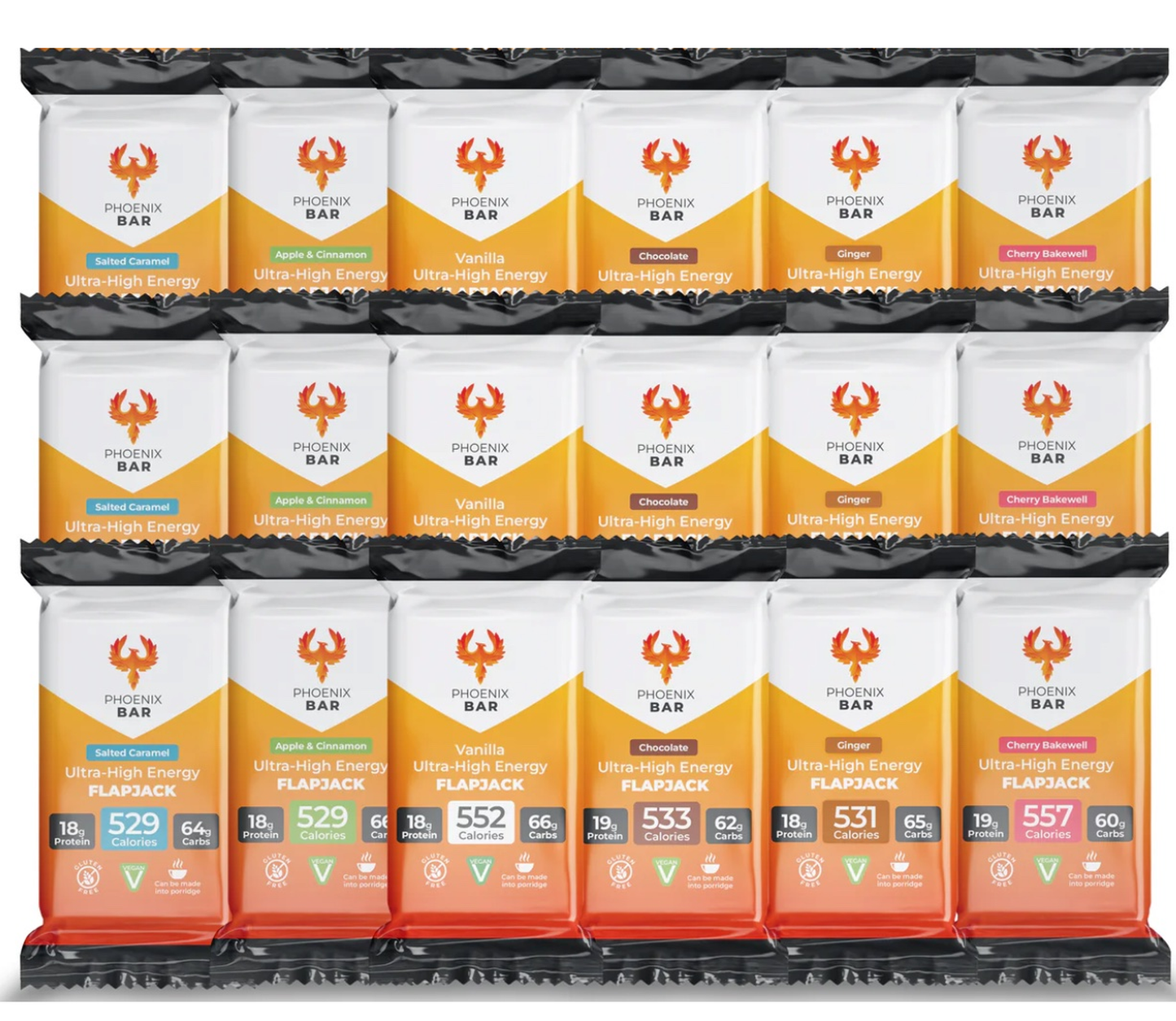
A Phoenix Bar is a 557-calorie, 120g, vegan, gluten-free oat-based bar designed specifically for situations where calorie density per gram matters and standard energy products are too sweet, too small, or too gel-like to do the job. Calorie density is 4.6 calories per gram, which is at the top end of any commercially available portable food. A typical flapjack delivers around 4.2 calories per gram, a typical energy bar around 3.7, and a standard energy gel around 2.9.
Practical placements across a full-distance triathlon. At T-3 to T-4 hours, one bar made into porridge with hot water for race-morning breakfast. At T-30 minutes pre-swim, one quarter to one half of a bar as an optional top-up. On the bike, half to one bar across 4 to 6 hours, eaten in chunks alongside drinks and gels. In T2, a small piece pre-positioned in your run kit. On the run, a small piece every 30 to 45 minutes when gels stop working, alternated with water or coke. Post-finish, one bar within 30 minutes of crossing the line for recovery.
For half-distance triathlon, the same template applies in compressed form: one bar pre-race breakfast, half a bar across the 90 to 180 minute bike, with the rest available on the run if gels start failing.
The same calorie-density logic applies to other compact nutrition needs. See the high calorie snacks guide for more on which foods deliver the most energy per gram, and how to get more calories without eating more food for techniques that work in training as well as racing.
What 30+ marathons and 8 full-distance finishes taught one coach
Some advice carries more weight when it comes from someone with the receipts.
"As an endurance athlete I have always struggled to find nutrition that provides enough calories, tastes good and is practicable. I came across Phoenix Bars and was intrigued by the amount of calories in such a small bar. Having completed over 30+ marathons / ultra marathons up to 100 miles, [8 full-distance triathlons], I can honestly say I wouldn't go anywhere else for nutrition. When running for 30+ hours carrying your own food and equipment, knowing I can carry a handful of Phoenix bars and still get my required calories in is a win. Being an experienced endurance coach I always recommend Phoenix bars to any athletes I coach." J., endurance coach with 8 full-distance triathlon finishes
The coach's point about "carrying a handful and still getting calories in" is the central case for Phoenix Bars in long-course triathlon: kit minimalism without calorie compromise. Three Phoenix Bars weigh 360g and provide approximately 1,670 calories. To get the same calories from gels, you would need to carry around 17 of them, weighing 595g.
The 7 most common nutrition mistakes triathletes make
Drawn from common patterns in our customer feedback and well-established sports nutrition literature.
- Trying race-day fuel for the first time on race day. "Nothing new on race day" is the most quoted rule in triathlon for a reason. Train your gut on what you'll race with, including the brand, flavour, concentration, and timing.
- Skipping breakfast or eating too little. Race-morning nerves kill appetite. Discipline yourself to hit the carb target. A Phoenix Bar porridge is one solution if a full bowl of oats won't go down.
- Going too liquid on the bike. Four to five hours of gels and sports drinks alone is a stomach problem waiting to happen. Plan for at least 30g/h of solid food after hour 3.
- Holding bike-leg carb intake on the run. Drop from 90g/h to 60g/h on the run. Trying to maintain bike-leg targets causes most run-leg vomiting.
- Ignoring T2 as a nutritional opportunity. Spend an extra 30 seconds, take 30g to 50g of carbs, and start the run with a settled stomach.
- Underestimating sodium loss in heat. A 70kg athlete can lose 1,000mg of sodium per litre of sweat in hot conditions, and produce 1.5L/h. Salt loss compounds across 10 hours.
- Picking up "free" fuel at aid stations because it's there. If you didn't train with it, the chance of GI distress goes up. Use special-needs bags to carry your own race-day fuel.
Half-distance versus full-distance: how nutrition differs
A half-distance triathlon (1.9km swim, 90km bike, 21.1km run) takes most athletes 4 to 7 hours and burns 3,500 to 5,500 calories. Two practical differences from full-distance racing. First, carb density matters more than total carb load. You don't have time for a full re-fuelling cycle, so you front-load the bike with concentrated nutrition. Second, pre-race breakfast does more of the work. A solid breakfast covers a higher proportion of total race calories than in a full-distance race, so getting it right is disproportionately important.
A typical half-distance nutrition plan: one Phoenix Bar porridge for breakfast (557 cal), one sports drink bottle plus half a Phoenix Bar broken into pieces across the bike (around 600 cal), 1 to 2 gels and water on the run (200 cal). Total intake around 1,300 to 1,500 calories, against a 3,500 to 5,500 burn.
The same fuelling principles apply across other long-distance running disciplines. If you train across multiple endurance formats, the ultra-endurance and expedition nutrition guide covers the broader principles, and trail running nutrition covers the run-specific considerations in more detail.
Frequently asked questions
How many calories should I eat during a full-distance triathlon?
Most age-group long-course athletes aim for 250 to 400 calories per hour during the race, with the higher end on the bike and the lower end on the run. Total intake across a 12-hour race is typically 3,000 to 4,500 calories, against a burn of 7,000 to 11,000 calories. Closing the full deficit is impossible. The goal is to eat enough to slow the deficit.
How many carbs per hour should I eat during a triathlon?
60g/h is the established baseline for trained athletes. Well-prepared athletes can take 80 to 90g/h on the bike, dropping to 60g/h on the run. Going above 90g/h requires months of gut training and a 2:1 glucose-to-fructose ratio.
What should I eat for breakfast before a long-course triathlon?
A high-carbohydrate, low-fibre, low-fat breakfast 2 to 4 hours before the start. Target 1 to 4g of carb per kg of body weight (70 to 280g of carbs for a 70kg athlete). Common options: porridge with honey, white toast with jam, banana, sports drink. A Phoenix Bar mixed with hot water makes a 557-calorie porridge in two minutes.
Can you eat solid food during a triathlon?
Yes, especially on the bike. Solid food becomes more important as the race progresses because gels and sports drinks become harder to tolerate after several hours. Most age-group athletes eat solid food on the bike and switch to gels, chews, and sports drink on the run when stomach tolerance drops.
What do you do when gels stop working in a long-course triathlon?
Switch to a different format and a different flavour profile. Many athletes who tolerate gels in training cannot stomach them on the late bike or the run because of GI shutdown under heat and effort. Solid neutral-flavoured food (oat-based bars, real food at aid stations, coke, or salty foods) often works when sweet liquids do not.
How is half-distance triathlon nutrition different from full-distance?
Half-distance is shorter (4 to 7 hours vs 9 to 17 hours), so total calorie burn is lower (3,500 to 5,500 vs 7,000 to 11,000). Carbs per hour can usually run at the high end (90g/h) for the full bike leg without GI consequences. Pre-race breakfast carries proportionally more of the day's calorie load.
What's the best food for the bike leg of a long-course triathlon?
A combination of liquid and solid carbohydrate. Most athletes target 60 to 90g/h, split between a sports drink (30 to 60g/h) and solid food (30g/h). Calorie-dense bars work better than gels in the bike leg because they keep the stomach engaged with real food rather than an unbroken stream of sugar.
Are Phoenix Bars suitable for triathlon racing?
Yes. Phoenix Bars are 557 calories per 120g bar, vegan, gluten-free, and oat-based. They can be eaten whole, broken into pieces, or mixed with hot water to make porridge. Triathletes use them as race-morning breakfast (porridge), in bike jersey pockets (broken into chunks), and on the run when gels stop working (small pieces with water or coke).
How to start
Phoenix Bars come in six flavours and are available in three bundle sizes. For a single full-distance race build, most triathletes order the 12-bar Starter Bundle, which covers race-day plus a few key training sessions for gut training. For a full season including a half-distance plus a full-distance race, the 18-bar Essential Bundle gives you enough to train and race properly.
If you want to discuss a custom plan for a specific race, get in touch via the contact page.
Phoenix Bars is an independent UK nutrition brand. We are not affiliated with, endorsed by, or sponsored by World Triathlon, The Ironman Group, or any specific triathlon race operator. Information in this guide is general nutrition guidance and is not a substitute for personalised advice from a qualified sports dietitian.


Flaming Phoenix